Sports Law Roundup – 12/16/2016

aslr

I used to write the sports technology roundup at TechGraphs, an internet website that died, and now I am writing the sports law roundup at ALDLAND, an internet website.

Here are the top sports-related legal stories from the past week:

  • NBA CBA: Like baseball, the NBA has a new collective-bargaining agreement. Full details are not yet public, but it appears there will be salary cap and luxury tax changes, as well as an increase– from thirteen to fourteen– in the number of guaranteed roster spots for each team. The league also has agreed to shorten the preseason and expand the calendar length of the regular season without increasing the number of regular season games. One aspect that will not change is the manner in which the players and owners divide basketball-related income. The players conceded roughly seven percent (approximately from 57% to 50%) during the last lockout in 2011.
  • NFL concussion settlement: Earlier this year, the NFL settled a class-action lawsuit brought by former players seeking compensation for ongoing problems related to head injuries suffered during their professional football careers by agreeing to provide a fund to compensate former players for the next sixty-five years. The U.S. Court of Appeals for the Third Circuit affirmed the settlement, but a small subset of the class members– approximately thirty of 22,000– were dissatisfied with the settlement, believing it was underinclusive because it did not provide relief for former players who develop CTE, the disease found in people who suffer from repeated brain trauma that, at this time, is not detectable while the player is alive. Seeking further review of the settlement, these plaintiffs petitioned the Supreme Court. On Monday, the Court declined to grant their petition, leaving in place the Third Circuit’s ruling. It is unclear whether these objecting plaintiffs have any further recourse, though they likely are watching the new lawsuit highlighted in this space last month that specifically addresses CTE.
  • Student-athlete classification: As discussed here last week, the United States Court of Appeals for the Seventh Circuit rejected claims by a group of former Penn student-athletes that they are employees entitled to minimum-wage compensation under the Fair Labor Standards Act. Now, those students plan to request en banc review, meaning that they will ask the full panel of Seventh Circuit judges to reconsider the decision. (Federal circuit courts typically hear cases in three-judge panels, even though more than three judges make up each of the federal circuit courts. Aside from an appeal to the Supreme Court, which may not even be accepted, the only way to reverse a circuit court ruling is to ask the full court to do so.) The plaintiffs contend that the amateur aspect of collegiate athletics the ruling noted is not pertinent to an FLSA analysis, and that the Seventh Circuit’s decision “conflicts with decisions in this and other circuits on employee status.”
  • Raiders stadium: In an apparent attempt to keep the Raiders from moving to Los Angeles or Las Vegas, the Alameda County Board of Supervisors voted to support the building of a new football stadium in Oakland that– unlike the new basketball arena being built for the NBA’s Warriors that will relocate them from Oakland to San Francisco–  would be funded, in significant part, with public money. The Board’s vote does not guarantee that the Raiders will stay in Oakland.
  • Rams fans: St. Louis-area holders of Rams personal seat licenses suing the team after its move to Los Angeles now have requested class-action status. The plaintiffs are seeking a variety of forms of relief, including reimbursement for tickets and concessions. A judge already has ruled that some of the plaintiffs who want the team to continue to honor the licenses by allowing the St. Louis fans to purchase season tickets at the team’s new home in L.A. are entitled to do so.
  • NFL broadcasting: The plaintiffs in an antitrust lawsuit targeting NFL Sunday Ticket, the product of the exclusive agreement between the NFL and DirecTV for the television broadcasting of out-of-market NFL games, won an apparently significant victory when Fox and CBS agreed to produce documents evidencing their own Sunday-Ticket-related agreements with the league and DirecTV in connection with a judge’s discovery order. The NFL contends that the plaintiffs have failed to allege an antitrust violation because the NFL can decide how to broadcast its games, and the Sunday Ticket package represents an addition to viewers’ existing options (i.e., the one or two games available each Sunday afternoon on Fox and CBS, plus the national Thursday/Sunday night/Monday night broadcasts) rather than a restriction.
  • Secondary ticket market: The President has signed the BOTS Act, a bill that expands the authority of the Federal Trade Commission to regulate the online secondary market for event tickets. The new law seeks to prohibit “ticket bots and other online tools that deliberately circumvent security protocols limiting or restricting online ticket purchases.” Here’s hoping this law will provide a more meaningful benefit to sports fans than the NFL’s practically meaningless agreement to end its league-wide imposition of a price floor on game tickets sold on the secondary market.
  • Formula One acquisition: Liberty Media, the company that owns the Atlanta Braves, will acquire auto-racing series Formula One for $4.4 billion. According to a reputable source, F1 cars are the fastest in the world among road-course racing cars.
  • MLB CBA: I wrote about the new CBA in this space after the league and players union reached their agreement on November 30. Now we have more information about the particularities of the agreement, and this analysis provides a helpful overview. We also learned that the Tampa Bay Rays were the only team to vote against approving the agreement. In a public statement, the Rays’ general managing partner made reference to an “opportunity [that] was missed” to “address the extraordinary and widening competitive gap that exists on-field between higher and lower revenue clubs.”

Sports court is in recess.

2016 Oregon is the Oregon Everyone Thought They Were Watching for the Last Decade

There is a myth that exists in college football that some really good teams are great offenses with bad defenses. These teams win games by scores like 62-51 or 45-38, and, so the theory goes, they are just good enough on offense to outscore any opponent.

In reality, all great teams are fairly complete, meaning that they are good in all phases of the game. You can’t really be a great team if you have a bad defense. What apparently fools everybody is the fact that football is a game with no set pacing. A baseball game is nine innings, or twenty-seven outs if you prefer. Golf is eighteen holes. A set in tennis is six games. Games like football and basketball are different. A football game can range, at the extremes, from something like seven possessions (this year, Navy v. Notre Dame) to as many as seventeen or eighteen. The typical range is more like 9-10 for a low-possession game, and perhaps fifteen for a high-possession game. But, as with basketball, certain teams tend to play high-possession games, and certain teams tend to play low-possession games. Teams that play high-possession games generally feature hurry-up offenses, or pass-happy offenses, or defenses that prefer to gamble for stops rather than playing “bend but don’t break”. Teams that play-low possession games will be teams that run the ball a lot, or play conservative defense that seeks to avoid giving up big plays at the expense of allowing lots of first downs. As should be somewhat obvious, teams that play high-possession games tend to score more points, and they allow more points, all else being equal. For some reason, we collectively seem to appreciate this in basketball, and we don’t necessarily consider low scoring teams to be “bad” on offense. We look to efficiency rankings instead.

Football analysis is catching up, but nobody seems to be taking notice. The stats I will be quoting are from Football Outsiders (very good site if you’ve never seen it).  This site ranks offenses and defenses as units, based on some advanced per-possession stats that attempt to adjust for quality of opponent. This is obviously an imperfect process, but in my opinion it provides much better information than simply saying that, because a team averages 35.6 points per game, they are “good” on offense.

Oregon has long had a reputation as a high-flying offense and a poor defense. I think it is time to challenge that assumption. Offensively, they’ve been good, no question. Since 2007, their offensive ranks have been 7th, 13th, 11th, 11th, 5th, 2nd, 6th, 1st, 13th, and 18th. This year, their 18th rank is their worst on offense in a decade. That’s pretty good. But what about defense? Since 2007, they have been 19th, 42nd, 22nd, 5th, 9th, 4th, 29th, 28th, 84th, and 126th. Raise your hand if you are surprised, particularly about the stretch for 2010 to 2012 (5th, 9th, and 4th). The 2010 national title game was billed as two great offenses against two bad defenses (Auburn and Oregon), yet somehow, those two defenses held the great offenses to some of their lowest point totals all season (22 to 19). Turns out, when analyzed properly, both were great defenses as well (that just so happened to be playing with extreme, hurry up offenses, so they played many high scoring games).

I still consider the absence of a playoff in 2012 to be a travesty. 2012 Oregon vs. 2012 Alabama would have been a great game, and we needed to see it. If only somebody could have beaten Notre Dame during the regular season…  Oh well.

In any event, Oregon’s national-title-contender status from 2010 to 2014 was based upon great offense AND great defense. Last year they still managed to be 9-4, a pretty good year, with the 84th defense. But this year, with a truly terrible defense, they are 4-8, despite still having a great offense.

And that is normal. Many teams follow that formula. For example, 2013 Indiana (8th offense, 105th defense, 5-7 record), 2012 Baylor (5th offense, 94th defense 8-5 record), 2010 Michigan (8th offense, 107th defense, 7-6), 2009 Stanford (4th offense, 104th defense, 8-5 record). Another prominent team that had this reputation was West Virginia under Rich Rodriguez. As a 2007 national title contender that lost in an upset to Pitt to drop out of the title game, then routed Oklahoma in the Fiesta Bowl, they were 3rd on offense and 9th on defense. Not quite what most people thought.

The bottom line is that you won’t be a great team without being at least good on defense. There may be an exception or two (I haven’t researched every team from all time), but the general rule is pretty clear: if you are an elite offense and a below-average defense, you will be .500 or maybe a little better. 8-5 or 9-4 is about the best you can possibly do, and most do worse. Anybody winning 11 or 12 games has a good defense. Don’t be confused if a team like that sometimes gives up a lot of points. Maybe they are playing against a great offense, and/or defending more possessions than most other teams. If they are 12-2, its virtually guaranteed they’ve got a strong defense. Don’t believe the myth.

Sports Law Roundup – 12/9/2016

aslr

I used to write the sports technology roundup at TechGraphs, an internet website that died, and now I am writing the sports law roundup at ALDLAND, an internet website.

Here are the top sports-related legal stories from the past week:

  • College football defamation: On Thursday, former Baylor head football coach Art Briles sued three Baylor regents and the university’s senior vice president and CEO claiming that they defamed him by stating that he had knowledge of sex crimes reportedly committed by his players and failed to provide that information to proper authorities. In addition, Briles alleges that the officials sought to prevent him from securing another coaching position elsewhere. He also included a claim for intentional infliction of emotional distress, and, in total, seeks unspecified damages in excess of $1,000,000. Here is a picture of Briles’ longtime attorney, Ernest H. Cannon, riding a horse at a rodeo.
  • Football player suspension challenges: In related stories covered in this space last week, two NFL players represented by the same Ohio law firm launched collateral attacks on the NFL/NFLPA collective bargaining agreement targeting alleged procedural deficiencies in the suspension-appeal process after both were suspended for drug violations. The NFL and NFLPA now have taken action in one of those cases by appointing a third arbitrator to hear a rescheduled appeal by Green Bay Packer Mike Pennel. The absence of a third arbitrator is central to the claims Pennel raised in the lawsuit he filed in Ohio federal court. In connection with that suit, Pennel also sought a temporary restraining order, which the responsive actions by the league and union were designed to moot. On Tuesday, Pennel agreed to drop his lawsuit in exchange for a reduction– from ten games to four– in his suspension, which will allow him to play in the postseason should his Packers secure a playoff berth. (Pennel’s attorneys also represent Philadelphia Eagle Lane Johnson, who filed similar complaints with the National Labor Relations Board and U.S. Department of Labor around the same time Pennel filed his lawsuit.)
  • Student-athlete classification: The United States Court of Appeals for the Seventh Circuit rejected claims by a group of former Penn student-athletes that they are employees entitled to minimum-wage compensation under the Fair Labor Standards Act. The trial court granted a motion to dismiss the defendants– the NCAA, Penn, and more than 120 other NCAA member schools– filed, and the appellate court affirmed. The court agreed that dismissal as to the non-Penn defendants was appropriate because of a lack of standing; the plaintiffs had attended only Penn and had no basis to recover wages from any school they didn’t attend. The court also agreed that dismissal was appropriate as to Penn, because the plaintiffs had failed to state a claim for relief from Penn. Noting the “revered tradition of amateurism in college sports” and the weight of judicial and regulatory precedent holding that student-athletes are not employees, the court concluded that the FLSA does not apply to student-athletes. While many disagree with this outcome, it is consistent with the original meaning and purpose behind the “student-athlete” designation. (In a concurring opinion, Judge Hamilton cautioned against broad application of the court’s decision, noting that the plaintiffs participated in a non-revenue sport– track and field– for a school that does not offer athletic scholarships, and suggested that he might have voted differently had the plaintiffs been student-athletes on athletic scholarship in a revenue sport.)
  • Hockey head injuries: A group of former NHL players suing the league for its alleged failure to warn them of known risks of head trauma now have requested class certification in that case for two classes of former players based on the different measures of relief sought: damages for those already diagnosed with neurological injuries and medical monitoring for others. Attorneys from a number of large law firms, including Skadden Arps Slate Meagher & Flom, are representing the NHL in this case. Skadden is the anchor tenant in a new commercial real estate development in Manhattan that also will be home to the NHL’s offices when it opens in 2019.
  • Minor League Baseball lobbying: MiLB has created a political action committee in order to boost lobbying efforts. The impetus for this move likely is the class-action lawsuit minor-league players filed alleging that their compensation violates federal wage and hour laws and the leagues’ attempt to snuff out that suit by way of congressional action. The proposed Save America’s Pastime Act would create a carve-out in the Fair Labor Standards Act exempting minor-league players from minimum-wage and overtime protections. There has been essentially no action on the bill since Rep. Brett Guthrie of Kentucky introduced it in June, leaving plenty of time for MLB to say dumb things about it.
  • Soccer ban: The Court of Arbitration for Sport denied former FIFA president Sepp Blatter’s request to overturn his six-year ban from all national and international soccer-related activity and fine of 50,000 Swiss francs for his involvement with bribes and kickbacks during his leadership of FIFA.
  • Canadian Super Bowl commercials: There is a thing in Congress called the House Northern Border Caucus, and four of its members, representing districts in North Dakota, New York, and Washington, sent a letter asking the Canadian government to reverse its decision to block Canadian advertisers from running commercials on the Canadian broadcast of the Super Bowl. Canadian broadcasters used to have an agreement with the NFL that allowed Canadian commercials on the Canadian broadcast of the game, but, in 2015, Canadian regulators changed course in response to viewer demands to see the popular American commercials that run during the game. Canadian broadcasters and advertisers and the NFL, which is losing out on Canadian advertising revenue as a result, all oppose that change. The company that holds the Canadian broadcast rights to the Super Bowl, Bell Media, also has sued the regulatory body in an attempt to reverse the policy.
  • Hockey logo: Things are off to a rough start for Las Vegas’ first major professional sports team after the U.S. Patent and Trademark Office denied the Golden Knights’ registration application, citing a “confusing[] similar[ity]” to a mark registered by the College of Saint Rose. Arguable visual similarities aside, I didn’t even know there was a Saint Rose, much less a College of Saint Rose, and I certainly didn’t know the school’s mascot is the Golden Knights, and neither did you, which means that, however similar these marks might be, the likelihood of confusion here is very low. This likely is little more than another instance of the USPTO seeking a moment in the sports sun.
  • Gambling: The nation of Antigua and Barbuda has issued a threat to the United States if the U.S. does not meet a year-end deadline to comply with a 2003 World Trade Organization order ruling that American online sports betting and gambling laws violate international law. If the U.S. does not comply with the WTO order, which also carries an annual noncompliance penalty of $21 million and has accrued to over $250 million, Antigua and Barbuda intends to suspend intellectual property protections for Americans, effectively permitting Antiguans to establish websites hosting royalty-free downloads of American IP (e.g., books, music, movies, television programming, etc.).
  • Baseball ambassador: Bobby Valentine, former MLB player and manager of the Mets and Red Sox, reportedly is under consideration by president-elect Donald Trump for the position of ambassador to Japan. Valentine, who currently serves as athletic director at Sacred Heart University, is popular among Japanese baseball fans thanks to two successful stints as manager of a professional baseball team there.

Sports court is in recess.

The Funeral Jam in the Court of the Crimson King is the Jam That Never Ends

When I first really found my footing in popular music listening, it was in the vast soundscape of 1970s progressive rock. I didn’t really understand what exactly I was hearing when I listened to Yes or Emerson, Lake & Palmer (or, later, when venturing into darker waters with King Crimson), but it truly captured my imagination. On Wednesday, one of the pillars of that genre, Greg Lake, lost his battle with cancer. With Robert Fripp, a childhood friend, Lake founded King Crimson, the ur-band of progressive rock. Lake then took his considerable vocal talents, along with his bass guitar, and joined on with (the recently late) keyboardist Keith Emerson and later drummer Carl Palmer in ELP, “progressive rock’s first supergroup.” The band’s two-CD live compilation, King Biscuit Flower Hour: Greatest Hits Live, was in heavy rotation in my car stereo and, once I expanded my radio-format horizons at WHCL, on the airwaves. The second disc contains only one song, and I used a portion of it for the intro to every show. The full version, recorded at a live concert performance in Anaheim in 1974, constitutes today’s Jam:

The Red Wings have lost their championship identity

redwings-yzerman-sl-fea

Since the Detroit Red Wings returned to championship prominence in the 1990s following the hiring of head coach Scotty Bowman, the team has been known for its smothering style of play. In this modern golden age, the Wings won four Stanley Cups– 1997, 1998, 2002, and 2008– with legendary rosters, sure, but also by executing a theoretically simple and highly effective strategy focused on puck possession. Two decades before the concept would even begin to emerge in public hockey analysis, Bowman knew that puck possession led to wins.

In recent years, statisticians have made strides in tracking possession, something I’ve written about here a few times before:

A quick refresher on hockey’s new statistics: puck possession correlates more strongly with winning than do things like goals or shots; measuring possession in a fluid game like hockey is difficult; as a practical solution, Corsi and its less-inclusive sibling, Fenwick, are statistics that track certain, more easily measured events (all shots, including on-goal shots and missed shots, and, in Corsi’s case, blocked shots), thereby serving as proxies for possession and, therefore, indicators of team success. Once you get past the names (as the NHL is in the process of doing), the concept is simple.

The earliest season for which Corsi is available is the 2007-08 season. Fortunately for purposes of this post, that’s the last year Detroit, under the guidance of the Bowman Administration’s successor, Mike Babcock, won the Stanley Cup. Anecdotally, Babcock followed in Bowman’s possession-oriented footsteps, and the statistics agree: the Wings led the league by a wide margin.

cf-2008

Today, though, things are different. Sure, Detroit hasn’t missed the playoffs since 1990, but it’s going to be another uphill climb to keep their historic streak alive, with current projections giving them just a 22.5% chance of earning a postseason berth. (Only three teams have worse odds right now.) It isn’t looking good.

Unsurprisingly (as a factual matter, anyway), puck possession has fallen off steeply this year, as compared with that last championship season. Here’s the same chart shown above for 2016:

cf-2016

Under Jeff Blashill, Babcock’s successor, these really aren’t the same Red Wings. Here’s a broad visual of how well the team has controlled the puck during all seasons for which Hockey-Reference has Corsi data:

cf-2007-16

The season isn’t yet half over, thankfully, but there is a lot of catching up to do if the team wants to leave its hallowed home on a positive note before making the move to the Hot-n-Ready Center next season.

________________________________________________________

Related
Taking a pass on new hockey statistics
Bouncing puck: Passing, not shooting, is the key to scoring on the ice and the hardcourt
More on passing data and the shot quality debateHockey Prospectus
There’s no such thing as advanced sports statistics

Sports Law Roundup – 12/2/2016

aslr

I used to write the sports technology roundup at TechGraphs, an internet website that died, and now I am writing the sports law roundup at ALDLAND, an internet website.

Here are the top sports-related legal stories from the past week:

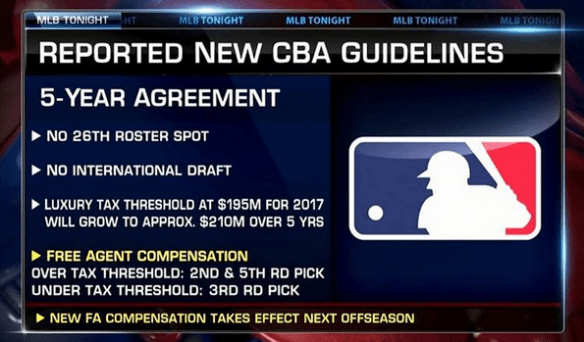
  • MLB CBA: Shortly before the December 1 deadline, MLB and the MLBPA reached agreement on a new collective bargaining agreement that will govern the sport for the next five years.
    2016-mlb-cba
    Details still are emerging, but early analyses are labeling this round of negotiations another win for ownership. (Others see it as a mere “setup for war in 2021.”) One of the most visible changes fans will notice is that the All Star Game no longer will determine home-field advantage in the World Series; instead, that perk will go to the team with the better regular-season record. Another aesthetic change: no more chewing tobacco (although current players are free to chaw down; the ban only applies to new players as they enter the league). Following in the NFL’s footsteps, MLB has indicated plans to play a regular-season game in a foreign country, possibly England or Mexico, as soon as 2018.
  • Football player suspension challenges: Lane Johnson, a fourth-year offensive tackle for the Philadelphia Eagles who is serving a ten-game suspension following a second failed test for performance-enhancing drugs, has challenged his suspension by filing complaints against the NFL and NFLPA with the National Labor Relations Board and U.S. Department of Labor, alleging that the suspension procedure violated his rights under his employment contract and federal labor law. While the filings currently are not public, Johnson’s challenge appears, based on a statement from his lawyer, to be a collateral attack on the collective bargaining agreement itself: “During Lane’s appeal, it became apparent that the written words in the collectively bargained Performance-Enhancing Substances (‘PES’) Policy, under which Lane was disciplined, are meaningless. The NFL and NFLPA have undermined these protections leaving the players — including Lane — with a hollowed-out process devoid of any protections.”
    Faced with a similar situation, Mike Pennel, a third-year defender for the Green Bay Packers, is challenging the adequacy of the suspension-appeal procedures by filing an action in federal court. Pennel’s allegation is that the use of only two arbitrators, rather than three, for his appeal hearing violated the league’s substance-abuse policy.
    Both Pennel and Johnson are represented by the same law firm, Ohio-based Zashin & Rich.
  • NBA arena: A court’s denial of two citizens’ organizations’ petitions will allow construction to proceed in San Francisco on a new, privately financed, $1 billion arena for the Golden State Warriors. The groups had sought to block the project because, in their view, the city’s environmental analysis was insufficient, specifically including an allegation that increased traffic would interfere with the operation of the nearby UCSF hospital. The Warriors will leave their current home in Oakland to begin play in the new San Francisco arena in 2019.
  • Sharper sentencing: A judge sentenced longtime NFL safety and serial rapist Darren Sharper, previously most famous for playing fourteen seasons for the Packers, Vikings, and Saints, and for his supporting “role” in this viral video, to twenty years in prison as part of a plea bargain in which Sharper admitted to drugging and raping women in four states. Sharper, whose victims number more than a dozen, previously pleaded guilty in a federal trial for drugging three women so he could rape them and is appealing the eighteen-year sentence he received in connection with that plea.
  • Inmate phone calls: Former Florida Gator and New England Patriot Aaron Hernandez, who is incarcerated in Massachusetts following his conviction for murdering one person and being charged with multiple additional murders, has sued Securus Technologies, one of the largest providers of inmate telephone services. Based on media reports of a Securus data breach, Hernandez’s suit alleges that the company failed to protect privileged and confidential information, such as telephone calls between Hernandez and his lawyers.
  • Whistleblowing coach: A judge awarded former Penn State football coach Mike McQueary an additional $5 million Wednesday after determining that the school terminated his employment as a result of his testimony against other PSU officials who failed to act in response to McQueary’s report on child sexual abuse by another football coach. McQueary previously won $7.3 million in a jury trial on claims related to the university’s investigation of the assault and its related defamation of McQueary. (Yes, the PSU community really did attack McQueary for reporting a football coach’s child sexual abuse. Four years later, that community appears to be as delusional as ever.)
  • Football painkillers: In an update to a story previously highlighted in this space, a judge has ordered Dallas Cowboys owner Jerry Jones to sit for a deposition in a lawsuit by former NFL players alleging that teams irresponsibly dispensed painkillers to their players in order to keep them on the field, granting a discovery victory to the players. The victory was a partial one, however, because the judge denied the plaintiffs’ request to depose Jim Irsay, the owner of the Indianapolis Colts, famous guitars, and a personal history of painkiller abuse.
  • Super Bowl hotel rooms: Marriott has emerged victorious in a contract dispute with a sports travel agency after a judge ruled that the hotel chain was not bound by its obligations to the agency to provide 300 rooms for the Super Bowl in Houston, because the agency, in selling 240 of the rooms to another broker, violated a no-transfer provision of the agreement with Marriott. When Marriott cancelled the contract, the agency sued, accusing Marriott of violating their contract in order to pursue a more lucrative opportunity with the NFL and alleging that Marriott knew of the agency’s practice of reselling rooms. Even if that was true, the judge explained, the no-transfer clause was clear, and the agency could not enforce a contract it had breached.

Sports court is in recess.

Baseball Notes: The WAR on Robbie Ray

baseball notes

There are a few things we know with reasonable certainty about Robbie Ray. He was born on October 1, 1991 just south of Nashville in Brentwood, Tennessee. In 2010, the Washington Nationals drafted him in the twelfth round of the amateur draft. The Nationals traded him, along with two other players, to the Detroit Tigers in 2013 in exchange for Doug Fister. A year later, the Tigers traded him to the Arizona Diamondbacks as part of a three-team trade that netted the Tigers Shane Green and the New York Yankees Didi Gregorius. So far, Ray has seen major-league action as a starting pitcher with the Tigers and Diamondbacks. He showed promise in his first three appearances (two starts and an inning of relief), for Detroit. He showed less promise in his remaining six appearances– four starts and two relief innings– for that team. Things have ticked back up for Ray since his arrival in the desert, however.

__________________________________

Most baseball fans likely have some familiarity with the player-valuation concept of wins above replacement player, usually labeled WAR. What many fans may not realize, however, is that there actually are three different versions of the WAR statistic. The goal of each version is the same: to determine a comprehensive valuation of an individual baseball player. Each takes slightly different paths to reach that comprehensive valuation, but they typically reach similar conclusions about a given player, such that it’s common to see or hear a player’s WAR cited without specific reference to the particular version utilized.

For example, the three versions– Baseball-Reference’s WAR (“rWAR”), FanGraphs’ WAR (“fWAR”), and Baseball Prospectus’ WARP (“WARP”)– all agree that Mike Trout had a great 2016. He finished the season with 10.6 rWAR, 9.4 fWAR, and 8.7 WARP, good for first, first, and second by each metric, respectively. For another example, they also agree about Trout’s former MVP nemesis, Miguel Cabrera: 4.9 rWAR, 4.9 fWAR, 3.9 WARP. (In my anecdotal experience, WARP tends to run a little lower than rWAR and fWAR for all players.)

__________________________________

While the WAR varietals typically and generally concur, that isn’t always the case. Pitchers can be particularly susceptible to this variance, because the measurement of pitching performance is one of the areas in which the three metrics are most different. Continue reading

Sports Law Roundup – 11/25/2016

aslr

I used to write the sports technology roundup at TechGraphs, an internet website that died, and now I am writing the sports law roundup at ALDLAND, an internet website.

Here are the top sports-related legal stories from a short holiday week:

  • NFL head injuries: A new lawsuit, filed Monday by thirty-eight former NFL players against the league and its teams, seeks an amendment to the NFL-NFLPA collective bargaining agreement to provide for workers’ compensation benefits for CTE, the disease found in people who suffer from repeated brain trauma, for living patients, as well as loss-of-consortium compensation for their spouses. The plaintiffs, including Detroit Lions All-1990s lineman Tracy Scroggins, allege that they have symptoms of CTE. While doctors typically cannot diagnose CTE until the patient has died, allowing for a more thorough brain examination, this lawsuit shifts the focus to those demonstrating CTE symptoms while they are alive. Advances in brain-imaging technology and a newly developed blood test may provide medical support for legal claims based on “living CTE.”
  • Professional athlete Ponzi scheme: On Monday, a banker pleaded guilty to conspiracy, wire fraud, and money laundering in connection with a Ponzi scheme she ran with former NFL player Will Allen designed to defraud investors with a plan to make loans to professional athletes seeking offseason financing when they weren’t receiving payments from their team salaries. The athletes’ identities are not public information, but, according to the banker, they include “the second-best player on a National Football League team, two other pro football players, two pro baseball players and a hockey player.” Allen, who already entered a guilty plea, spent more than a decade in the NFL as a defensive back for the Giants and Dolphins.

Sports court is in recess.

Analyzing college football coaches’ favorite musical artists

bruce-springsteen-slide-super-bowl-halftime-show

ESPN conducted a survey of all 128 Division I college football coaches, asking them to name their favorite musical artist. The full list of responses is here. My cursory analysis is here:   Continue reading

Sports Law Roundup – 11/18/2016

aslr

I used to write the sports technology roundup at TechGraphs, an internet website that died, and now I am writing the sports law roundup at ALDLAND, an internet website.

Here are the top sports-related legal stories from the past week:

  • Baseball stadium netting: On Wednesday, the trial court dismissed a lawsuit seeking increased fan-safety measures in baseball stadiums, including expanded safety netting behind dugouts and along the foul lines, based on a lack of standing. I previously wrote about this case over at TechGraphs (see here, here, and here), generally discussing the ways in which it– despite the legal weaknesses in the plaintiffs’ position– already was effecting change. Although those legal weaknesses proved to be the downfall of this suit, the court’s ruling was not without its admonitions to Major League Baseball. For example, an early footnote contains this observation: “Why Major League Baseball, knowing of the risk [foul balls pose] to children in particular, does little to highlight this risk to parents remains a mystery.” The order also expressly suggests the possibility that future litigation along these lines may be more availing in other states, where the “Baseball Rule,” which makes it very difficult for fans to recover against baseball teams and leagues, has fallen under attack: “Thus, it is conceivable that, under the right set of circumstances, a plaintiff could obtain the type of relief that plaintiffs seek here. Given the changing nature of both the baseball game experience and the injuries at issue, which are far different from those in 1914, what is a ‘reasonable expectation’ on an ‘ordinary occasion’ is not a static concept.
  • Football painkillers: Attorneys for retired NFL players in a lawsuit against the league alleging that team doctors dispensed painkillers “‘as if they were candy’ regardless of long-term effects” are seeking permission to depose team owners Jerry Jones and Jim Irsay. Outside of football, Irsay, who inherited ownership of the Indianapolis Colts from his father, is known for collecting famous guitars– including Jerry Garcia’s Tiger, Les Paul’s Black Beauty, and Prince’s Yellow Cloud— and having a history of abusing painkillers. The plaintiffs also have amended their complaint to add a RICO claim, which, among other things, introduces the potential for tripling their financial recovery in the lawsuit.
  • NCAA transfer rules: Johnnie Vassar, a former Northwestern basketball player, filed a putative class-action lawsuit against the NCAA, alleging that the rule forcing transferring students to sit out of their sport for their first year at their new school violates antitrust laws. Vassar claims that he attempted to transfer from Northwestern but was unable to do so, because all of his target schools only would accept him if he could play immediately. In recent years, Northwestern has emerged as a cradle of anti-NCAA legal activity.
  • Triathlon death: A wrongful death claim brought in connection with the drowning death of a competitor in the 2010 Philadelphia Triathlon cannot proceed, a Pennsylvania appellate court ruled, concluding that the triathlete knowingly and voluntarily assumed the risk of participating in the event when, in the course of registering for it, he executed a detailed liability waiver.
  • Cuban baseball-player smuggling: In a federal criminal case against a sports agent accused of conspiracy to smuggle Cuban baseball players into the United States, the government has listed numerous professional players, including Yoenis Cespedes and Jose Abreu, as trial witnesses. For more on this general subject, ESPN The Magazine’s feature on Yasiel Puig is a must-read.
  • Boxing fraud: The defendants– Floyd Mayweather, Manny Pacquiao, HBO, Top Rank, and others– in twenty-six lawsuits alleging that they improperly concealed Pacquiao’s shoulder injury leading up to the fighters’ 2015 bout in order to boost pay-per-view sales admitted that the plaintiffs– fans and bars– had standing to pursue their claims, even as the defendants denied that those claims had any merit.
  • Gambling: West Virginia, Arizona, Louisiana, Mississippi and Wisconsin are asking the United States Supreme Court to review a Third Circuit decision rejecting New Jersey’s attempt to open up sports gambling in its state. The five states, together, filed an amicus brief in support of New Jersey’s cert petition (formal request that the Supreme Court allow them to appeal the Third Circuit’s ruling), arguing that the manner in which Congress has regulated sports gambling is unconstitutional and threatens the balance of power between the federal and state governments. In an unrelated story, daily fantasy leaders FanDuel and DraftKings announced a merger agreement this morning.
  • Secondary football ticket market: Under pressure from state regulators, the NFL agreed to end its league-wide imposition of a price floor on game tickets sold on the secondary market that had prevented the resale of tickets at prices below face value. The agreement does not apply to tickets for the Super Bowl and Pro Bowl, nor does it prevent teams from acting “unilaterally” to enforce price floors, meaning that the practice could continue.
  • Campus police records: The Indiana Supreme Court affirmed a trial court’s dismissal  of ESPN’s lawsuit seeking the University of Notre Dame Police Department’s incident reports involving student athletes, deciding that the ND Police Department is not a “public agency” and thus cannot be compelled to produce the requested materials under the state’s open records law.

Sports court is in recess.