Erin Andrews says the NFL enforces an in-game press embargo

Erin Andrews, an NFL sideline reporter for Fox, told Stephen Colbert last night (4:37 mark of the above video) that she is not allowed to report actual comments she hears from players or coaches.

“I hear the craziest things you could ever imagine,” Andrews said, explaining that she wished she could report them, but “the NFL doesn’t allow that.” Instead, she said, she is required to “paraphrase” what she hears in very general terms. Andrews wouldn’t elaborate on potential consequences of such reporting, saying only that “it’s just a rule, as a sideline reporter, I cannot repeat verbatim what I hear on the sideline.”

No sports entity is more interested in image control than the NFL (although execution sometimes is a different question), so it’s not shocking that Roger Goodell would have a gag order in place to keep what he undoubtedly sees as his reporters from relating to the public the actual comments of what he undoubtedly sees as his players.

This really shouldn’t come as a surprise if you recall the story that broke over the summer, when the league dictated to NBC which announcers the network was required to use on its Thursday and Sunday night broadcasts.

In the professional football world, the NFL Network is state-run media, obviously, but little leaks like the NBC Al Michaels/Mike Tirico story and Andrews’ revelation last night serve as gentle reminders that, for the NFL, there is no such thing as an independent press.

Detroit Lions 2016 Wild Card preview

stafford-finger-before-after

Head coach Jim Caldwell has the Detroit Lions back in the playoffs for the second time in his three-year tenure. After ending the season with three consecutive losses, the Lions (9-7) will play the Seahawks tonight in Seattle in the first NFC wild card game, which kicks off at 8:15 Eastern on NBC.

Detroit’s playoff history in the Super Bowl era isn’t pretty. In the fifty seasons since the 1966 merger, the Lions have appeared in the postseason in just twelve of those seasons, winning just one game.

That one win, a 38-6 dismantling of the Dallas Cowboys on January 5, 1992, also was the last NFL playoff game hosted in Detroit, and one of only two ever in the Super Bowl era (not counting games, like Super Bowl XL, in which the Lions, obviously, did not participate).

The national press picked up on an interesting narrative following that win, which featured Barry Sanders, of course, and also Erik Kramer, whom they highlighted as “a strikebreaker,” or, in the words of Cowboys defenders Jack Del Rio (now the head coach of the Oakland Raiders, who have an AFC wildcard meeting with the Houston Texans this afternoon) and Tony Casillas, “a scab.” Kramer had played for Atlanta as a replacement player during the 1987 NFL strike, something that upset apparent union tough guys Del Rio and Casillas and, the New York Times postulated, Kramer’s ostensible supporters in the center of the UAW universe (“this grizzled, battered town, this blue-collar, lunch-bucket town”). The on-field performances by Kramer, who had claimed the starting job after starting the season as the team’s third quarterback, and Sanders that day erased any internal concerns that might have troubled the Honolulu blue and silver faithful, however. They also silenced Del Rio:

Del Rio kept up the verbal barrage during the game, or part of it, anyway.

“I didn’t hear him make any more remarks after the first quarter, said Kramer.”

Detroit only led 7-3 at the end of that first quarter, but Dallas already had amassed half of the points it would score all day. Kramer threw three touchdown passes, Sanders finished the day with a forty-seven-yard TD run, and the Lions defense even got in on the scoring action, when Mel Jenkins intercepted starting Dallas QB Steve Beuerlein and ran it back for six. By at least this one measure– Super-Bowl era playoff wins– then, Kramer might be considered the Lions best-ever playcaller.

img_20170107_1201186

This time around, the Lions quarterback again is the lead story. Matthew Stafford has struggled somewhat since injuring the middle finger on his throwing hand (pictured above, both pre- and post-injury). He claims he doesn’t rely much on that finger for gripping the ball, but the injury can’t help. Nor do recent injuries to other key contributors like DeAndre Levy, Marvin Jones, Ezekiel Ansah, Travis Swanson, and Riley Reiff, all of whom are likely to be game-time decisions. It also is not clear whether the team has a running back, although the emergence of Zach Zenner has caught the eye of at least one Seahawk defensive lineman.

While Detroit’s nine wins came on the back of a weak schedule, the Seahawks (10-5-1) also had some bad losses this year, dropping games to the Rams and Saints and going 0-1-1 against the disappointing Cardinals. They are coming off a win in Week 17, but they barely scraped by two-win San Francisco. This has not quite been the dominant Seahawks squad of recent seasons. Still, they best the Lions in all of the usual statistical categories and are 7-1 at home, where the game will be played tonight. (The Lions were 3-5 on the road this season.)

Any pieces of good news at this point are going to be small, but a notable one is the absence of Earl Thomas, one of Seattle’s best defenders, who will not play due to a leg injury. Seattle’s aggressive defensive tendencies also may help twist this piece of seemingly bad news into good news:

https://twitter.com/DetroitMoments/status/817350040314384384

Lions fans are upset because Brad Allen, who calls a lot of penalties and officiated two Detroit losses and no wins, will be refereeing this game. Caldwell isn’t worried about the NFL assigning Allen to this game, though, and neither am I, because I think, in general, playoff games are officiated differently; Allen will have a completely different crew under his supervision; and, despite Seattle’s 2-1 record in Allen games, Seattle’s defensive strategy shouldn’t mesh well with a referee who throws a lot of flags. Their “efficient-breach” approach allows them to be aggressive, because they know that, even if their defenders commit pass interference or defensive holding on most every play, the officials won’t flag it every time. It therefore might not be a bad thing if Allen and his crew called more penalties in this game, so long as they do so fairly.

Another matchup to watch will be the Detroit defensive line against the Seattle offensive line, the latter being the only real Seahawk weakness. In a disappointing year from Ansah, the Lions haven’t made waves in the pass-rush department, but a breakout day from the fourth-year defensive end could be a difference-maker today.

It’s going to be a long and loud afternoon in Seattle, where a wintry mix has been in and out of the forecast. It will be tough sledding for these battered Lions. Here’s hoping they find a new gear and, once again, give their fans a reason to celebrate in January.
Sports Law Roundup – 12/30/2016

aslr

I used to write the sports technology roundup at TechGraphs, an internet website that died, and now I am writing the sports law roundup at ALDLAND, an internet website.

After a week off for Christmas, we’re back with the top sports-related legal stories from the past week:

  • Soccer CBA: The collective-bargaining agreement between the U.S. Women’s National Team Players’ Association and the U.S. Soccer Federation is set to expire this weekend, and reports, centered around the union’s termination of its executive director on Wednesday, indicate that the two sides are unlikely to reach a new agreement in time. Compensation appears to be a central issue of contention for the players, who already have a pending wage-discrimination complaint with the Equal Employment Opportunity Commission. Absent a new agreement before the deadline, the existing CBA would remain in place (though either side then would have the right to terminate the agreement on sixty-days’ notice).
  • NFL head injuries: The lawsuit filed last month by thirty-eight former NFL players against the league and its teams seeking an amendment to the NFL-NFLPA CBA to provide for workers’ compensation benefits for CTE for living patients and loss-of-consortium compensation for their spouses is over. In an apparent attempt to avoid having the case lumped in with already-pending NFL concussion litigation, which is in the settlement phase, the plaintiffs voluntarily dismissed this suit and intend to re-file individually in various state courts.
  • Soccer witchcraft ban: This isn’t really a legal update, but it has been a slow few weeks in the sports law world, so there’s room for a note on the national governing body of soccer in Rwanda’s new ban on witchcraft during games. The restriction only applies to coaches, and the penalty is a four-match suspension and a fine. It appears that sorcery, however, remains legal in Rwandan soccer.

Sports court is in recess.

Sports Law Roundup – 12/16/2016

aslr

I used to write the sports technology roundup at TechGraphs, an internet website that died, and now I am writing the sports law roundup at ALDLAND, an internet website.

Here are the top sports-related legal stories from the past week:

  • NBA CBA: Like baseball, the NBA has a new collective-bargaining agreement. Full details are not yet public, but it appears there will be salary cap and luxury tax changes, as well as an increase– from thirteen to fourteen– in the number of guaranteed roster spots for each team. The league also has agreed to shorten the preseason and expand the calendar length of the regular season without increasing the number of regular season games. One aspect that will not change is the manner in which the players and owners divide basketball-related income. The players conceded roughly seven percent (approximately from 57% to 50%) during the last lockout in 2011.
  • NFL concussion settlement: Earlier this year, the NFL settled a class-action lawsuit brought by former players seeking compensation for ongoing problems related to head injuries suffered during their professional football careers by agreeing to provide a fund to compensate former players for the next sixty-five years. The U.S. Court of Appeals for the Third Circuit affirmed the settlement, but a small subset of the class members– approximately thirty of 22,000– were dissatisfied with the settlement, believing it was underinclusive because it did not provide relief for former players who develop CTE, the disease found in people who suffer from repeated brain trauma that, at this time, is not detectable while the player is alive. Seeking further review of the settlement, these plaintiffs petitioned the Supreme Court. On Monday, the Court declined to grant their petition, leaving in place the Third Circuit’s ruling. It is unclear whether these objecting plaintiffs have any further recourse, though they likely are watching the new lawsuit highlighted in this space last month that specifically addresses CTE.
  • Student-athlete classification: As discussed here last week, the United States Court of Appeals for the Seventh Circuit rejected claims by a group of former Penn student-athletes that they are employees entitled to minimum-wage compensation under the Fair Labor Standards Act. Now, those students plan to request en banc review, meaning that they will ask the full panel of Seventh Circuit judges to reconsider the decision. (Federal circuit courts typically hear cases in three-judge panels, even though more than three judges make up each of the federal circuit courts. Aside from an appeal to the Supreme Court, which may not even be accepted, the only way to reverse a circuit court ruling is to ask the full court to do so.) The plaintiffs contend that the amateur aspect of collegiate athletics the ruling noted is not pertinent to an FLSA analysis, and that the Seventh Circuit’s decision “conflicts with decisions in this and other circuits on employee status.”
  • Raiders stadium: In an apparent attempt to keep the Raiders from moving to Los Angeles or Las Vegas, the Alameda County Board of Supervisors voted to support the building of a new football stadium in Oakland that– unlike the new basketball arena being built for the NBA’s Warriors that will relocate them from Oakland to San Francisco–  would be funded, in significant part, with public money. The Board’s vote does not guarantee that the Raiders will stay in Oakland.
  • Rams fans: St. Louis-area holders of Rams personal seat licenses suing the team after its move to Los Angeles now have requested class-action status. The plaintiffs are seeking a variety of forms of relief, including reimbursement for tickets and concessions. A judge already has ruled that some of the plaintiffs who want the team to continue to honor the licenses by allowing the St. Louis fans to purchase season tickets at the team’s new home in L.A. are entitled to do so.
  • NFL broadcasting: The plaintiffs in an antitrust lawsuit targeting NFL Sunday Ticket, the product of the exclusive agreement between the NFL and DirecTV for the television broadcasting of out-of-market NFL games, won an apparently significant victory when Fox and CBS agreed to produce documents evidencing their own Sunday-Ticket-related agreements with the league and DirecTV in connection with a judge’s discovery order. The NFL contends that the plaintiffs have failed to allege an antitrust violation because the NFL can decide how to broadcast its games, and the Sunday Ticket package represents an addition to viewers’ existing options (i.e., the one or two games available each Sunday afternoon on Fox and CBS, plus the national Thursday/Sunday night/Monday night broadcasts) rather than a restriction.
  • Secondary ticket market: The President has signed the BOTS Act, a bill that expands the authority of the Federal Trade Commission to regulate the online secondary market for event tickets. The new law seeks to prohibit “ticket bots and other online tools that deliberately circumvent security protocols limiting or restricting online ticket purchases.” Here’s hoping this law will provide a more meaningful benefit to sports fans than the NFL’s practically meaningless agreement to end its league-wide imposition of a price floor on game tickets sold on the secondary market.
  • Formula One acquisition: Liberty Media, the company that owns the Atlanta Braves, will acquire auto-racing series Formula One for $4.4 billion. According to a reputable source, F1 cars are the fastest in the world among road-course racing cars.
  • MLB CBA: I wrote about the new CBA in this space after the league and players union reached their agreement on November 30. Now we have more information about the particularities of the agreement, and this analysis provides a helpful overview. We also learned that the Tampa Bay Rays were the only team to vote against approving the agreement. In a public statement, the Rays’ general managing partner made reference to an “opportunity [that] was missed” to “address the extraordinary and widening competitive gap that exists on-field between higher and lower revenue clubs.”

Sports court is in recess.

Sports Law Roundup – 12/9/2016

aslr

I used to write the sports technology roundup at TechGraphs, an internet website that died, and now I am writing the sports law roundup at ALDLAND, an internet website.

Here are the top sports-related legal stories from the past week:

  • College football defamation: On Thursday, former Baylor head football coach Art Briles sued three Baylor regents and the university’s senior vice president and CEO claiming that they defamed him by stating that he had knowledge of sex crimes reportedly committed by his players and failed to provide that information to proper authorities. In addition, Briles alleges that the officials sought to prevent him from securing another coaching position elsewhere. He also included a claim for intentional infliction of emotional distress, and, in total, seeks unspecified damages in excess of $1,000,000. Here is a picture of Briles’ longtime attorney, Ernest H. Cannon, riding a horse at a rodeo.
  • Football player suspension challenges: In related stories covered in this space last week, two NFL players represented by the same Ohio law firm launched collateral attacks on the NFL/NFLPA collective bargaining agreement targeting alleged procedural deficiencies in the suspension-appeal process after both were suspended for drug violations. The NFL and NFLPA now have taken action in one of those cases by appointing a third arbitrator to hear a rescheduled appeal by Green Bay Packer Mike Pennel. The absence of a third arbitrator is central to the claims Pennel raised in the lawsuit he filed in Ohio federal court. In connection with that suit, Pennel also sought a temporary restraining order, which the responsive actions by the league and union were designed to moot. On Tuesday, Pennel agreed to drop his lawsuit in exchange for a reduction– from ten games to four– in his suspension, which will allow him to play in the postseason should his Packers secure a playoff berth. (Pennel’s attorneys also represent Philadelphia Eagle Lane Johnson, who filed similar complaints with the National Labor Relations Board and U.S. Department of Labor around the same time Pennel filed his lawsuit.)
  • Student-athlete classification: The United States Court of Appeals for the Seventh Circuit rejected claims by a group of former Penn student-athletes that they are employees entitled to minimum-wage compensation under the Fair Labor Standards Act. The trial court granted a motion to dismiss the defendants– the NCAA, Penn, and more than 120 other NCAA member schools– filed, and the appellate court affirmed. The court agreed that dismissal as to the non-Penn defendants was appropriate because of a lack of standing; the plaintiffs had attended only Penn and had no basis to recover wages from any school they didn’t attend. The court also agreed that dismissal was appropriate as to Penn, because the plaintiffs had failed to state a claim for relief from Penn. Noting the “revered tradition of amateurism in college sports” and the weight of judicial and regulatory precedent holding that student-athletes are not employees, the court concluded that the FLSA does not apply to student-athletes. While many disagree with this outcome, it is consistent with the original meaning and purpose behind the “student-athlete” designation. (In a concurring opinion, Judge Hamilton cautioned against broad application of the court’s decision, noting that the plaintiffs participated in a non-revenue sport– track and field– for a school that does not offer athletic scholarships, and suggested that he might have voted differently had the plaintiffs been student-athletes on athletic scholarship in a revenue sport.)
  • Hockey head injuries: A group of former NHL players suing the league for its alleged failure to warn them of known risks of head trauma now have requested class certification in that case for two classes of former players based on the different measures of relief sought: damages for those already diagnosed with neurological injuries and medical monitoring for others. Attorneys from a number of large law firms, including Skadden Arps Slate Meagher & Flom, are representing the NHL in this case. Skadden is the anchor tenant in a new commercial real estate development in Manhattan that also will be home to the NHL’s offices when it opens in 2019.
  • Minor League Baseball lobbying: MiLB has created a political action committee in order to boost lobbying efforts. The impetus for this move likely is the class-action lawsuit minor-league players filed alleging that their compensation violates federal wage and hour laws and the leagues’ attempt to snuff out that suit by way of congressional action. The proposed Save America’s Pastime Act would create a carve-out in the Fair Labor Standards Act exempting minor-league players from minimum-wage and overtime protections. There has been essentially no action on the bill since Rep. Brett Guthrie of Kentucky introduced it in June, leaving plenty of time for MLB to say dumb things about it.
  • Soccer ban: The Court of Arbitration for Sport denied former FIFA president Sepp Blatter’s request to overturn his six-year ban from all national and international soccer-related activity and fine of 50,000 Swiss francs for his involvement with bribes and kickbacks during his leadership of FIFA.
  • Canadian Super Bowl commercials: There is a thing in Congress called the House Northern Border Caucus, and four of its members, representing districts in North Dakota, New York, and Washington, sent a letter asking the Canadian government to reverse its decision to block Canadian advertisers from running commercials on the Canadian broadcast of the Super Bowl. Canadian broadcasters used to have an agreement with the NFL that allowed Canadian commercials on the Canadian broadcast of the game, but, in 2015, Canadian regulators changed course in response to viewer demands to see the popular American commercials that run during the game. Canadian broadcasters and advertisers and the NFL, which is losing out on Canadian advertising revenue as a result, all oppose that change. The company that holds the Canadian broadcast rights to the Super Bowl, Bell Media, also has sued the regulatory body in an attempt to reverse the policy.
  • Hockey logo: Things are off to a rough start for Las Vegas’ first major professional sports team after the U.S. Patent and Trademark Office denied the Golden Knights’ registration application, citing a “confusing[] similar[ity]” to a mark registered by the College of Saint Rose. Arguable visual similarities aside, I didn’t even know there was a Saint Rose, much less a College of Saint Rose, and I certainly didn’t know the school’s mascot is the Golden Knights, and neither did you, which means that, however similar these marks might be, the likelihood of confusion here is very low. This likely is little more than another instance of the USPTO seeking a moment in the sports sun.
  • Gambling: The nation of Antigua and Barbuda has issued a threat to the United States if the U.S. does not meet a year-end deadline to comply with a 2003 World Trade Organization order ruling that American online sports betting and gambling laws violate international law. If the U.S. does not comply with the WTO order, which also carries an annual noncompliance penalty of $21 million and has accrued to over $250 million, Antigua and Barbuda intends to suspend intellectual property protections for Americans, effectively permitting Antiguans to establish websites hosting royalty-free downloads of American IP (e.g., books, music, movies, television programming, etc.).
  • Baseball ambassador: Bobby Valentine, former MLB player and manager of the Mets and Red Sox, reportedly is under consideration by president-elect Donald Trump for the position of ambassador to Japan. Valentine, who currently serves as athletic director at Sacred Heart University, is popular among Japanese baseball fans thanks to two successful stints as manager of a professional baseball team there.

Sports court is in recess.

Sports Law Roundup – 12/2/2016

aslr

I used to write the sports technology roundup at TechGraphs, an internet website that died, and now I am writing the sports law roundup at ALDLAND, an internet website.

Here are the top sports-related legal stories from the past week:

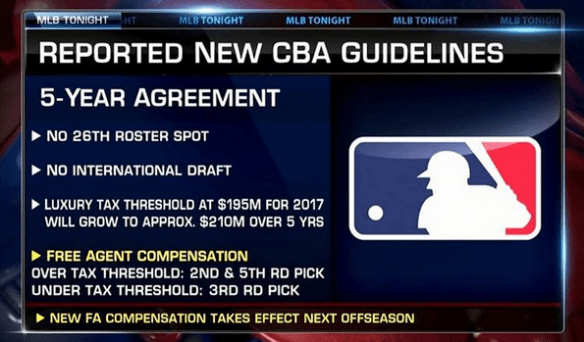
  • MLB CBA: Shortly before the December 1 deadline, MLB and the MLBPA reached agreement on a new collective bargaining agreement that will govern the sport for the next five years.
    2016-mlb-cba
    Details still are emerging, but early analyses are labeling this round of negotiations another win for ownership. (Others see it as a mere “setup for war in 2021.”) One of the most visible changes fans will notice is that the All Star Game no longer will determine home-field advantage in the World Series; instead, that perk will go to the team with the better regular-season record. Another aesthetic change: no more chewing tobacco (although current players are free to chaw down; the ban only applies to new players as they enter the league). Following in the NFL’s footsteps, MLB has indicated plans to play a regular-season game in a foreign country, possibly England or Mexico, as soon as 2018.
  • Football player suspension challenges: Lane Johnson, a fourth-year offensive tackle for the Philadelphia Eagles who is serving a ten-game suspension following a second failed test for performance-enhancing drugs, has challenged his suspension by filing complaints against the NFL and NFLPA with the National Labor Relations Board and U.S. Department of Labor, alleging that the suspension procedure violated his rights under his employment contract and federal labor law. While the filings currently are not public, Johnson’s challenge appears, based on a statement from his lawyer, to be a collateral attack on the collective bargaining agreement itself: “During Lane’s appeal, it became apparent that the written words in the collectively bargained Performance-Enhancing Substances (‘PES’) Policy, under which Lane was disciplined, are meaningless. The NFL and NFLPA have undermined these protections leaving the players — including Lane — with a hollowed-out process devoid of any protections.”
    Faced with a similar situation, Mike Pennel, a third-year defender for the Green Bay Packers, is challenging the adequacy of the suspension-appeal procedures by filing an action in federal court. Pennel’s allegation is that the use of only two arbitrators, rather than three, for his appeal hearing violated the league’s substance-abuse policy.
    Both Pennel and Johnson are represented by the same law firm, Ohio-based Zashin & Rich.
  • NBA arena: A court’s denial of two citizens’ organizations’ petitions will allow construction to proceed in San Francisco on a new, privately financed, $1 billion arena for the Golden State Warriors. The groups had sought to block the project because, in their view, the city’s environmental analysis was insufficient, specifically including an allegation that increased traffic would interfere with the operation of the nearby UCSF hospital. The Warriors will leave their current home in Oakland to begin play in the new San Francisco arena in 2019.
  • Sharper sentencing: A judge sentenced longtime NFL safety and serial rapist Darren Sharper, previously most famous for playing fourteen seasons for the Packers, Vikings, and Saints, and for his supporting “role” in this viral video, to twenty years in prison as part of a plea bargain in which Sharper admitted to drugging and raping women in four states. Sharper, whose victims number more than a dozen, previously pleaded guilty in a federal trial for drugging three women so he could rape them and is appealing the eighteen-year sentence he received in connection with that plea.
  • Inmate phone calls: Former Florida Gator and New England Patriot Aaron Hernandez, who is incarcerated in Massachusetts following his conviction for murdering one person and being charged with multiple additional murders, has sued Securus Technologies, one of the largest providers of inmate telephone services. Based on media reports of a Securus data breach, Hernandez’s suit alleges that the company failed to protect privileged and confidential information, such as telephone calls between Hernandez and his lawyers.
  • Whistleblowing coach: A judge awarded former Penn State football coach Mike McQueary an additional $5 million Wednesday after determining that the school terminated his employment as a result of his testimony against other PSU officials who failed to act in response to McQueary’s report on child sexual abuse by another football coach. McQueary previously won $7.3 million in a jury trial on claims related to the university’s investigation of the assault and its related defamation of McQueary. (Yes, the PSU community really did attack McQueary for reporting a football coach’s child sexual abuse. Four years later, that community appears to be as delusional as ever.)
  • Football painkillers: In an update to a story previously highlighted in this space, a judge has ordered Dallas Cowboys owner Jerry Jones to sit for a deposition in a lawsuit by former NFL players alleging that teams irresponsibly dispensed painkillers to their players in order to keep them on the field, granting a discovery victory to the players. The victory was a partial one, however, because the judge denied the plaintiffs’ request to depose Jim Irsay, the owner of the Indianapolis Colts, famous guitars, and a personal history of painkiller abuse.
  • Super Bowl hotel rooms: Marriott has emerged victorious in a contract dispute with a sports travel agency after a judge ruled that the hotel chain was not bound by its obligations to the agency to provide 300 rooms for the Super Bowl in Houston, because the agency, in selling 240 of the rooms to another broker, violated a no-transfer provision of the agreement with Marriott. When Marriott cancelled the contract, the agency sued, accusing Marriott of violating their contract in order to pursue a more lucrative opportunity with the NFL and alleging that Marriott knew of the agency’s practice of reselling rooms. Even if that was true, the judge explained, the no-transfer clause was clear, and the agency could not enforce a contract it had breached.

Sports court is in recess.

Sports Law Roundup – 11/25/2016

aslr

I used to write the sports technology roundup at TechGraphs, an internet website that died, and now I am writing the sports law roundup at ALDLAND, an internet website.

Here are the top sports-related legal stories from a short holiday week:

  • NFL head injuries: A new lawsuit, filed Monday by thirty-eight former NFL players against the league and its teams, seeks an amendment to the NFL-NFLPA collective bargaining agreement to provide for workers’ compensation benefits for CTE, the disease found in people who suffer from repeated brain trauma, for living patients, as well as loss-of-consortium compensation for their spouses. The plaintiffs, including Detroit Lions All-1990s lineman Tracy Scroggins, allege that they have symptoms of CTE. While doctors typically cannot diagnose CTE until the patient has died, allowing for a more thorough brain examination, this lawsuit shifts the focus to those demonstrating CTE symptoms while they are alive. Advances in brain-imaging technology and a newly developed blood test may provide medical support for legal claims based on “living CTE.”
  • Professional athlete Ponzi scheme: On Monday, a banker pleaded guilty to conspiracy, wire fraud, and money laundering in connection with a Ponzi scheme she ran with former NFL player Will Allen designed to defraud investors with a plan to make loans to professional athletes seeking offseason financing when they weren’t receiving payments from their team salaries. The athletes’ identities are not public information, but, according to the banker, they include “the second-best player on a National Football League team, two other pro football players, two pro baseball players and a hockey player.” Allen, who already entered a guilty plea, spent more than a decade in the NFL as a defensive back for the Giants and Dolphins.

Sports court is in recess.

Sports Law Roundup – 11/18/2016

aslr

I used to write the sports technology roundup at TechGraphs, an internet website that died, and now I am writing the sports law roundup at ALDLAND, an internet website.

Here are the top sports-related legal stories from the past week:

  • Baseball stadium netting: On Wednesday, the trial court dismissed a lawsuit seeking increased fan-safety measures in baseball stadiums, including expanded safety netting behind dugouts and along the foul lines, based on a lack of standing. I previously wrote about this case over at TechGraphs (see here, here, and here), generally discussing the ways in which it– despite the legal weaknesses in the plaintiffs’ position– already was effecting change. Although those legal weaknesses proved to be the downfall of this suit, the court’s ruling was not without its admonitions to Major League Baseball. For example, an early footnote contains this observation: “Why Major League Baseball, knowing of the risk [foul balls pose] to children in particular, does little to highlight this risk to parents remains a mystery.” The order also expressly suggests the possibility that future litigation along these lines may be more availing in other states, where the “Baseball Rule,” which makes it very difficult for fans to recover against baseball teams and leagues, has fallen under attack: “Thus, it is conceivable that, under the right set of circumstances, a plaintiff could obtain the type of relief that plaintiffs seek here. Given the changing nature of both the baseball game experience and the injuries at issue, which are far different from those in 1914, what is a ‘reasonable expectation’ on an ‘ordinary occasion’ is not a static concept.
  • Football painkillers: Attorneys for retired NFL players in a lawsuit against the league alleging that team doctors dispensed painkillers “‘as if they were candy’ regardless of long-term effects” are seeking permission to depose team owners Jerry Jones and Jim Irsay. Outside of football, Irsay, who inherited ownership of the Indianapolis Colts from his father, is known for collecting famous guitars– including Jerry Garcia’s Tiger, Les Paul’s Black Beauty, and Prince’s Yellow Cloud— and having a history of abusing painkillers. The plaintiffs also have amended their complaint to add a RICO claim, which, among other things, introduces the potential for tripling their financial recovery in the lawsuit.
  • NCAA transfer rules: Johnnie Vassar, a former Northwestern basketball player, filed a putative class-action lawsuit against the NCAA, alleging that the rule forcing transferring students to sit out of their sport for their first year at their new school violates antitrust laws. Vassar claims that he attempted to transfer from Northwestern but was unable to do so, because all of his target schools only would accept him if he could play immediately. In recent years, Northwestern has emerged as a cradle of anti-NCAA legal activity.
  • Triathlon death: A wrongful death claim brought in connection with the drowning death of a competitor in the 2010 Philadelphia Triathlon cannot proceed, a Pennsylvania appellate court ruled, concluding that the triathlete knowingly and voluntarily assumed the risk of participating in the event when, in the course of registering for it, he executed a detailed liability waiver.
  • Cuban baseball-player smuggling: In a federal criminal case against a sports agent accused of conspiracy to smuggle Cuban baseball players into the United States, the government has listed numerous professional players, including Yoenis Cespedes and Jose Abreu, as trial witnesses. For more on this general subject, ESPN The Magazine’s feature on Yasiel Puig is a must-read.
  • Boxing fraud: The defendants– Floyd Mayweather, Manny Pacquiao, HBO, Top Rank, and others– in twenty-six lawsuits alleging that they improperly concealed Pacquiao’s shoulder injury leading up to the fighters’ 2015 bout in order to boost pay-per-view sales admitted that the plaintiffs– fans and bars– had standing to pursue their claims, even as the defendants denied that those claims had any merit.
  • Gambling: West Virginia, Arizona, Louisiana, Mississippi and Wisconsin are asking the United States Supreme Court to review a Third Circuit decision rejecting New Jersey’s attempt to open up sports gambling in its state. The five states, together, filed an amicus brief in support of New Jersey’s cert petition (formal request that the Supreme Court allow them to appeal the Third Circuit’s ruling), arguing that the manner in which Congress has regulated sports gambling is unconstitutional and threatens the balance of power between the federal and state governments. In an unrelated story, daily fantasy leaders FanDuel and DraftKings announced a merger agreement this morning.
  • Secondary football ticket market: Under pressure from state regulators, the NFL agreed to end its league-wide imposition of a price floor on game tickets sold on the secondary market that had prevented the resale of tickets at prices below face value. The agreement does not apply to tickets for the Super Bowl and Pro Bowl, nor does it prevent teams from acting “unilaterally” to enforce price floors, meaning that the practice could continue.
  • Campus police records: The Indiana Supreme Court affirmed a trial court’s dismissal  of ESPN’s lawsuit seeking the University of Notre Dame Police Department’s incident reports involving student athletes, deciding that the ND Police Department is not a “public agency” and thus cannot be compelled to produce the requested materials under the state’s open records law.

Sports court is in recess.

ESPN Films’ 30 for 30 series finally peaks following Simmons’ departure

At some point in the last fifteen years, ESPN, as a brand, became uncool. I described this transition at length here, pegging 2003 as the beginning of the end of the Worldwide Leader’s cool cache. The ongoing creep (some would say, “dash”) toward faceless, nameless on-air talent and lowest-common-denominator content has not infected every corner of the four-letter network’s offerings, and the conventional wisdom was and remains that the weaker a program’s ties to Bristol, Connecticut, the higher its quality. That physical remoteness from the corporate jackboot seemingly allowed things like Bill Simmons’ Los-Angeles-based Grantland and the itinerant College GameDay to flourish.

Simmons also took a leading role in ESPN Films’ 30 for 30 series, a universally praised series of sports documentaries. After Simmons and ESPN parted ways in the spring of 2015, Grantland died, but 30 for 30 lived on. While I’ve enjoyed every 30 for 30 film I’ve caught flipping around on the television, none ever has been appointment viewing.

Until now.

Nearly two years after Simmons got himself kicked out of ESPN, the network will air what undoubtedly will be received as the best 30 for 30 entry ever: “This Was the XFL.” From the press release:

A bold challenge, a fearless experiment and ultimately, a spectacular failure. In 2001, sports entertainment titans Ebersol and McMahon launched the XFL. It was hardly the first time a league had tried to compete with the NFL, but the brash audacity of the bid, combined with the personalities and charisma of Ebersol and McMahon and the marketing behemoths of their respective companies — NBC and WWE — captured headlines and a sense of undeniable anticipation about what was to come.

Bringing together a cast of characters ranging from the boardrooms of General Electric to the practice fields of Las Vegas, “This Was the XFL” is the tale of — yes — all that went wrong, but also, how the XFL ended up influencing the way professional team sports are broadcast today. And at the center of it all – a decades long friendship between one of the most significant television executives in media history and the one-of-a-kind WWE impresario. This film will explore how Ebersol and McMahon brought the XFL to life, and why they had to let it go.

Both of these films (plus exclusive bonus features) will be available for streaming on WatchESPN immediately following their premieres.

I’m not much for fantasy football, but I played fantasy XFL, still love the ideas behind this league, and remain on vigilant watch for the emergence of subsequent examples of its ilk. The XFL improved the NFL, which now is in need of another shakeup. Here’s hoping that the release of this movie, slated for three days prior to the next Super Bowl, will rattle the NFL’s cage.

_____________________________________________________

Related
Pre/Postmodern football fans rejoice: The SPFL cometh

Evidence that Chip Kelly definitely reads ALDLAND?

Last week, physguy highlighted a situation that can occur toward the end of each half of a football game: if the offense is driving and runs a pass play with time winding down, the defense’s best response often is to commit aggressive pass interference in order to eat the dwindling clock and avoid a touchdown. While he imposed a rule change to counter this defensive incentive, Roger Goodell and co. had not implemented it in time for this week’s games, and San Francisco head coach Chip Kelly, almost certainly having read our site last week, took advantage against the Saints on Sunday:

It can’t be more clear than that. As physguy wrote to me after seeing this play, “This Saints example . . . clearly shows that it needs to be addressed. My rule change makes it so that the defense can only force a FG by beating the offense fair and square.”

___________________________________________________

Previously
Disincentivizing Defensive Penalties in College Football: Ten-Second Runon

Related
Catching Fire: Is Brad Ausmus Evolving? Or, Evidence that Brad Ausmus Definitely Reads ALDLAND