 Even if it doesn’t pack as much action as baseball, or even tennis, there’s no denying that football is America’s de facto national pastime. Many point to the game’s amenability to television as the main reason for its ascension to this position, while some look to the work of labor leaders like Gene Upshaw, who led the charge for free agency, ultimately introducing a new era of NFL riches.
Those two factors undoubtedly contributed to the NFL’s rise in popularity, but I don’t think they explain why the NFL is as extremely popular as it is today, when every sport receives tailored television treatment, and the power balance between players and ownership across all major sports is far more even than it probably ever has been. If you step back far enough, football’s not much different than any of the other major sports. How does this otherwise undifferentiated product stay on top?
More than ever before, we’re living in an attention economy. Availability no longer determines value, because, as a result of the proliferation of communication technology, everything is equally available. When sports (and other broadcasted entertainment) are equally available and are available in such a volume that they cannot all be consumed, people must make decisions about which sports components they will follow and which ones the will not. Economics is about the allocation of limited resources, and in the market for sports entertainment, the only limited resource is our attention.
Why does the NFL grab more of the attention of more people than any other sport? Scarcity. Between the NFL, MLB, NBA, and NHL, no professional sports league plays fewer games than the NFL. Moreover, those games are scheduled such that, with minimal deviation, they all are played on the same day. Intentional scarcity makes NFL games both manageably consumable in the attention economy and appointment viewing. Scarcity flips the cost script: having a small number of games and coordinating them on a once-weekly basis means the cost of paying attention to them is low, and because missing one Sunday’s slate of games means missing a significant proportion of the season, not to mention being out of the conversational loop for a full week, the cost of not paying attention is high.
Intentional scarcity might seem like a counterintuitive strategy for boosting a product’s popularity, and the supplier’s revenues, but in a flooded market of generally undifferentiated products, it can be a very successful strategy for generating consumer demand.
Whether the NFL is consciously employing an intentional scarcity strategy is an open question– Roger Goodell’s ongoing push for an expanded season of eighteen games would seem to be contrary to that approach– but there is at least one market in which some manufacturers are openly pursuing an intentional scarcity strategy: the market for bourbon.
The bourbon market has all the essential elements of the sports entertainment market that make it susceptible to the successful pursuit of the intentional scarcity strategy: generally speaking, it is contained of undifferentiated products– competing in the bourbon market is similar to competing in NASCAR– that are present in such great volume that it is practically impossible to consume all of them, at least on a regular basis. The most famous exemplar of the scarcity approach is the Old Rip Van Winkle Distillery, but it certainly is not the only one.
Intentional scarcity can be a viable strategy for competing in a flooded market of generally undifferentiated products. Regardless of whether the NFL is intentionally engaging in this strategy, the approach is an important contributor to the league’s station atop the sporting world.
 In college football, polls abound. There’s the Associated Press poll. The coaches’ assistants’ poll. Robots have polls. ALDLAND has one too. Wisconsin edged Ole Miss in last week’s poll, and this week’s poll has two new options. Cast your vote below.
 Since “
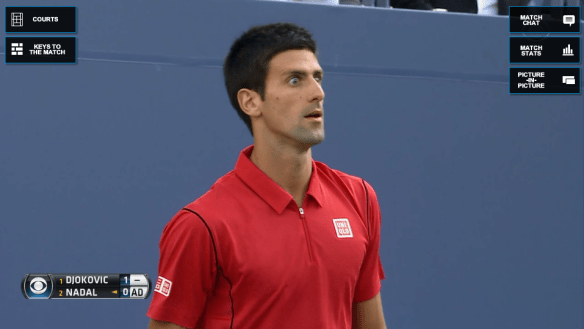 Rafa Nadal currently has a 2-1 lead over Novak Djokovic in the first set of the men’s final of the U.S. Open. You can watch live
  The New York Times has been flirting with Nashville for years, joining the charge of northern and coastal publications eager to tag Music City as America’s newly discovered “It City” with multiple travel-section features and other glowing profiles. They even utilized
  Maybe he just
  ALDLAND