Do the 2023 Detroit Tigers have the worst MLB players?

It is early in the 2023 MLB season. Very early. Less-than-two-weeks-in early. Not-even-ten-games-played early. Additionally, I take no pleasure in writing what you’re reading, because it is not good news, and because it now is nearly almost-astonishingly early in the 2023 MLB season.

On the other hand, if the thing I was writing was good news, I might not qualify it or hesitate to write about it or share it with the many manys of readers of this website. If the 2023 Detroit Tigers were so extremely separating themselves from the MLB pack in such a singular– but also good– fashion, you would be reading about it here, and you would want to be reading about it here. This is that, but the bad version.

By way of substantive introduction, Detroit does not have the worst record in baseball. They’re very close to having the worst record, and the reason they don’t have the worst record is at least partially circumstantial. The Tigers are tied with the Oakland A’s for the fewest wins (two apiece), but the A’s have played– and lost– one more game than has Detroit. Oakland seems to have better players than Detroit, though, at least if you grant any credence to FanGraphs wins above replacement as a reasonable general indicator of player performance. According to that metric, Kyle Muller, Ryan Noda, and Zach Jackson each have contributed more to the A’s than any player has contributed to the Tigers.

Considering the fact that, by fWAR, the Tigers’ best player so far in 2023 has been Matt Vierling, and further considering that Vierling is by that same measure the 258th-best player in baseball this season, it isn’t that surprising that another team might have multiple players who have been better than the Tigers’ best player. Nor probably is it surprising that more teams than just Oakland would, so far, have multiple players better than the Tigers’ best player. Maybe it’s mildly surprising that every other team in baseball has multiple players who rank higher than the Tigers’ best player on the fWAR leaderboard, but you probably figured that’s where this was going to end up.

Vierling, in case you never heard of him before two weeks ago, was a fifth-round pick out of Notre Dame by the Philadelphia Phillies, for which he debuted in 2021. In thirty-four games that season, he hit .346/.364/.479 and played first base and outfield. In 117 games in 2022, he hit .297/.351/.648 and played all over the field. On January 7, 2023, the Phillies sent him to Detroit along with Nick Maton and Donny Sands in exchange for Gregory Soto and Kody Clemens. Vierling played especially well in the Tigers’ two wins this season, both of which came on the road against the defending-champion Houston Astros. In those two games, he had six hits, including a home run and a double, a walk, and three RBI. In the rest of the games, he has a total of two hits (both singles) and one walk.

The Tigers are back on the road tonight in Toronto and Vierling is back in the starting lineup, hitting third. The A’s are in Baltimore with Muller scheduled as the starting pitcher and Noda hitting second.
Reining in the Moneyball Revolution’s Chief Excess, Twenty Years Later

What was the point of Moneyball? Nerds said on-base percentage is better than batting average and were technically correct on that narrow point? The real answer, of course, is that cheap owners‘ teams still can win by excelling at identifying and exploiting budget-friendly market inefficiencies. But when Brad Pitt says “on-base percentage is all we’re looking at now,” people tend to focus on that part and forget the rest.

Reaching base, however a player does it, is good, and counting only some ways players reach base necessarily misses relevant data points. By including walks and hits-by-pitch (“hit-by-pitches”?), on-base percentage (“OBP”) does paint a more complete picture of a baseball player’s offensive production than does batting average (“BA”), which only counts hits. The responsive inclination to look first to OBP rather than the traditional go-to, BA, thus is understandable.

Those comfortable with taking this new step, especially the early OBP adopters, often did so zealously and callously, even as they cloaked themselves in the mantle of measured reason. And when they did so, they very often took a second step: banishment of BA. Elevation of OBP was not enough; BA, the very embodiment of the old and impure way of thinking, must be cast out.

For the SABR revolutionaries, like not a few revolutionaries before them and to mix corporeal metaphors, that second step proved to be something of an overreach. As it turns out, the ancients were in fact onto something with BA, and there was something in that something that deserved to be conserved and carried forward through the revolutionary wave. BA, Eli Ben-Porat writes, not only deserves its place in baseball’s basic offensive statistic trinity– the Triple Slash Line of BA/OBP/SLG– but is the only component that actually belongs there.

As Ben-Porat explained over the weekend: “Dismissing batting average, in this author’s view, is just plain wrong. It is statistically significant in terms of predicting team runs, and on a per point basis, the most impactful component of” the building blocks of the triple slash line. After all, BA is a big part of both OBP and slugging percentage (“SLG”). And because of the way OBP weighs walks relative to hits, it can obscure the value of the offensive production it presents; in other words, not all OBPs are created equal. To Billy Beane’s point, it is important to account for a batter’s walks, but a hit– even a single– is better than a walk. Two players thus could post identical OBPs but have gotten there in much different fashion. Dumping BA would mask the real significance of a light-hitting, ball-taking batter’s empty OBP that matched the same mark of a more balanced player who hit more than he walked. Ben-Porat shows both that BA still matters and that presenting OBP without BA really makes the former less useful.

Whether Ben-Porat’s proposed adoption of an even more elemental triple slash line that omits the BA components of OBP and SLG and leaves the remainders (i.e., BA/BB%/ISO) catches on is another question. For now, rest with the satisfaction that you aren’t wrong to not get irritated when you see a player’s BA displayed during an upcoming MLB telecast.

__________________________________________________

Related
Why I’m not going to see Moneyball
Baseball Notes: Offensive Discrimination
Window Shopping: Ian Kinsler’s Walking, Not Running
Trout vs. Cabrera, and Aging with DRC+

Today in ALDLAND History: Two football coaches reveal the sports industry’s inner workings; the NFL media probes regional stereotypes; and a blockbuster MLB free-agent signing

Now that ALDLAND has been up and running for more than a decade, we’ve amassed a meaty body of sports stories, data, and observations we can mine for memories and reengagement.

And speaking of meaty bodies, eleven years ago today, we brought you the stories of Steve Spurrier, then coaching at South Carolina, who volunteered that he did not want to hire “fat, sloppy guys” as assistant coaches, among other preferences, and Todd Haley, who believed the Kansas City Chiefs still were tapping his cell phone a month after he’d been fired from the head coaching job there. Read more in The sports profession: Where not everybody’s working for the weekend.

Spurrier spent four more seasons in Columbia before resigning in the middle of the 2015 season. His next head-coaching job came in 2019 with the Alliance of American Football’s Orlando Apollos.

Haley next worked as an offensive coordinator for the Pittsburgh Steelers, Cleveland Browns, and Riverview (Sarasota) High School before returning as a head coach for the USFL’s Tampa Bay Bandits and Memphis Showboats.

Continuing the football time traveling, ten years ago today, we already knew the matchups for the NFL playoff conference championships, and the coverage of the NFC’s pairing of Atlanta and San Francisco was anything but imaginative. Read more in Stereotyping the NFC Championship Game.

The Falcons would fall to the 49ers, helping set up the Harbowl.

From postseason to offseason, eight years ago today we brought you the breaking story of Max Scherzer’s departure from the Detroit Tigers and signing with the Washington Nationals for $210 million over seven years. Read more in Mr. Scherzer goes to Washington.

During those seven seasons in Washington, Scherzer was a six-time All-Star, a two-time Cy-Young winner, and a World-Series champion. I, on the other hand, did not win any awards during those seven years for my conclusion at the time of Scherzer’s Nationals deal that “it wouldn’t be prudent to commit the amount of money he’s due to another long-term contract for another player on the old side of thirty.”

Thanks for re-reading.

2022 Detroit Tigers Midseason Pitching Report

It’s ugly out there. This was supposed to be the arrival year for the next great Detroit Tigers pitching staff. Instead, Tucker Barnhart, Kody Clemens, and Harold Castro each have pitched more innings than Spencer Turnbull, who still is recovering from Tommy John surgery, and, combined, those three position players have pitched nearly as many innings (7.0) as has Matt Manning (8.0), who hasn’t pitched since mid-April due to various injuries. Casey Mize also couldn’t make it out of April, throwing just ten innings before injuries knocked him out and eventually required him to take the Tommy John medicine. Alex Faedo survived all the way to July before discovering he’d inherited one of Matt Kemp‘s hips. Elvin Rodriguez, who came to the Tigers organization as the player to be named later in the Justin Upton trade, has made five scattered starts, because why not? (His rotation-worst 13.19 ERA is why not.) The two veteran workhorses signed in the offseason, Eduardo Rodriguez and Michael Pineda, have not been good in the rare moments they’ve been on the field, and while Pineda recently returned (to serve live batting practice), the team literally doesn’t know where Rodriquez is and apparently hasn’t for some time. Tarik Skubal stood amidst the carnage and looked ready to thrive, but he fell apart sometime in mid-June and has not yet commenced the reassembly process. (Skubal’s pitching as I write, so maybe this will serve as a reverse jinx.)

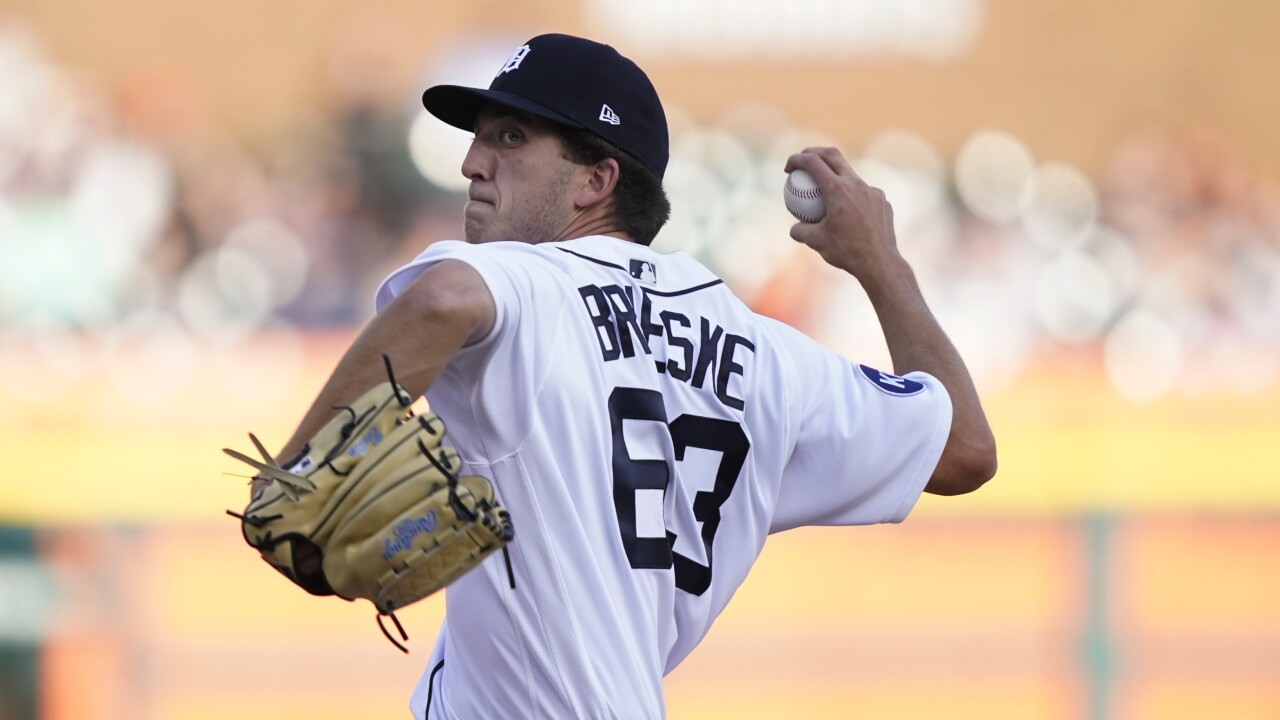
This leaves Beau Brieske as the first-half star of the Detroit rotation, just as everyone predicted. He shouldered more innings than every Tigers starter other than Skubal and, since June 1, he leads those starters in ERA (3.35), FIP (3.64), and fWAR (0.8). All of this of course made today’s injury announcement even more predictable. The twenty-seventh-round draft pick out of CSU-Pueblo will be out until at least August with a sore throwing arm. Considering the 91.2 innings he’s pitched for Detroit and Toledo in about three months nearly match the 106.2 innings he threw in a full season of minor-league ball in 2021 (and far exceed the 20.1 professional innings tossed in 2019), he probably was due for some soreness.

On the other side, Tigers fans have been fawning over the bullpen’s first-half performance. Only the Astros’ and Yankees’ bullpens posted lower ERAs in the first half. That’s neat, especially for a Detroit franchise with a recent history of notable struggles in that department. Maybe don’t look much further than that, though, because there’s good reason to expect the relief corps to collapse down the stretch as well. As a consequence of the severe rotation problems, the Detroit bullpen was highly taxed, and that fatigue, which very possibly will be further exacerbated in the next two weeks by trade departures, should start to manifest itself in terms of in-game results. Independent of that, an expected return to ordinary home-run/fly-ball fluctuations– the gap between the bullpen’s 3.31 FIP and 4.06 xFIP suggests a good deal of good luck in this regard– also would bring this group back to Earth.

Manager A.J. Hinch has the unenviable task of patching together enough functioning arms to cover the roughly 630 innings remaining in this season. His navigation of that obstacle course alone may make this second half worth watching.

MLB.TV.PSA

Readers of this website know that this author is among the last people on Earth who would go out of his way to promote an MLBAM business decision, but here you are, reading a post by me notifying you that MLB.tv is on sale today for a loosely speaking fair-ish price.

Of course, this occasion mostly serves as a reminder of MLB’s callous media-distribution practices. Six years ago, the league settled an antitrust lawsuit attacking things like its telecast blackout policy and centralized MLB.tv product by agreeing to make pricing and offering concessions to fans. Specifically, the seasonal price of the full MLB.tv package at that time would drop from $129.99 to $109.99, and the league would create a new, single-team package at a seasonal price of $84.99. These prices were to remain fixed for five years (i.e., through the 2020 season), subject to annual increases only up to the higher of three percent or the rate of inflation.

Now, that settlement agreement has expired, and MLB is seizing the opportunity to undo its effects. Most obviously, across-the-board pricing is up, doubly insulting as the league simultaneously excludes games from the full MLB.tv package for the benefit of its new partnerships with NBC and Apple.

Perhaps even more underhanded, however, is the soft killing of the single-team MLB.tv package. When first offered, the single-team option was priced at seventy-seven-percent of the full package price, then a twenty-five-dollar difference. MLB now has aggressively closed that gap. At today’s sale pricing, for example, the cost of the single-team option has jumped to eighty-six-percent of the full package price, just a ten-dollar difference. Stated otherwise, someone considering a single-team package can receive a thirty-fold increase in programming for just ten additional dollars. “Even you dummies know that’s a good deal,” fans hear Rob Manfred saying in their heads, even as they wonder why it doesn’t quite feel like a deal. The move to neutralize the single-team package feels like a purely spiteful move designed to achieve the functional undoing of one of the settlement agreement’s most visible achievements without any meaningful cost savings to MLB.

As I have been writing here for years, the message should be a simple one: “Rather than changing the game he wants people to watch . . . Manfred ought to change the way people can watch the game, obviously by making it easier for them to do so.” For how much longer can Manfred continue to squeeze baseball’s fans– including, as a recent example, Padres fans required to purchase yet another streaming service to watch this morning’s Peacock-exclusive game against the Atlanta Braves beginning at 8:35 am San Diego time– remains to be seen.

Miguel Cabrera’s 3,000th Hit Put Him in Exclusive Company (via FanGraphs)

Miguel Cabrera had to wait a couple of extra days to make history, thanks to a hitless afternoon capped by a controversial managerial decision and then a rainout. Nonetheless, on Saturday afternoon he collected his 3,000th career hit with a single off the Rockies’ Antonio Senzatela. In doing so, he joined some elite company as not only the 33rd player to reach 3,000 hits, but also the seventh to do so as a member of the 500-homer club and the third to reach both of those round numbers with a career batting average of .300 or better. The other two? Hank Aaron and Willie Mays. You may have heard of them, and even if you don’t put much stock in batting average, you have to admit that’s about as cool as company gets.

What’s more, Cabrera actually owns the highest batting average and on-base percentage of the seven players who have both milestones, with a wRC+ that trails only Mays and Aaron[.]

For all of his struggles over the past half-decade, Cabrera would still have to go 0-for-352 to drop his batting average to .299. Even with those struggles and his lack of defensive value (he’s 102 runs below average in terms of Defensive Runs Saved, including 11 below in just 847.1 innings at first base since 2018), he ranks 11th in JAWS among first basemen (68.8/44.8/56.8), in no danger of slipping below Palmeiro (13th at 71.9/38.9/55.4) or Murray (16th at 68.7/39.2/53.9). And while he may be the last to reach 3,000 hits for some time given the dearth of candidates (Dan Szymborski put Jose Altuve, who has 1,783 hits, at 34% and Freddie Freeman, who has 1,723 hits, at 28% last September), he’s hardly the least.

Cabrera joined Ty Cobb and Al Kaline as the other players to reach 3,000 hits as Tigers. As ESPN’s Marly Rivera pointed out, he’s the first Venezuelan to reach 3,000 hits and the seventh Latino, after Roberto Clemente, Rod Carew, Palmeiro, Rodriguez, Adrián Beltré, and Pujols. … Read More

(via FanGraphs)

[UPDATED] Braves not Truist to their word on new tax handouts (via AJC)

The fact that the Atlanta Braves got a ton of cash from taxpayers to build their new ballpark is largely forgotten in the wake of the team’s World Series victory.

But there was an understanding when the Braves got $300 million-plus from Cobb County to construct its park: It was that the team, on its own nickel, would build all the affiliated restaurants, apartments and office towers ― AKA The Battery.

Mike Plant, the team’s development chief, promised this back in 2015 when he said, “We do not ask, nor do we intend to ask, for any incentives for the mixed-use part.”

Well, that was then.

Last week, the Bravos were up at the plate again looking for a second helping of taxpayer love. The team and their friends at Truist, the mega-bank with a silly name, approached the Cobb Development Authority with the latest scheme: a 10-year property tax break to help build a $200 million, 250,000-square-foot office tower overlooking Truist Park. … Read More

(via AJC)

UPDATE: “The Atlanta Braves and Truist Financial this past week withdrew their application for property tax breaks on a $200 million office tower at The Battery, Cobb County development officials confirmed to The Atlanta Journal-Constitution.”

_____________________________________________________________

Previously
“Atlanta” Braves seek millions more from Cobb County
Ted Turner on the Atlanta Braves’ move to Cobb County
2017 Atlanta Braves Season Preview
Braves finally strike a positive note in move to new stadium
The political costs of a new baseball stadium
Previewing the 2016 Atlanta Braves
The Braves are failing on their own terms
New Braves stadium project continues to falter
Georgia Supreme Court Upholds Cobb’s Braves Stadium Bond Deal
Braves Break Ground on Baseball Boondoggle
The yard sale at Upton Abbey continues
From Barves to Burbs: What’s happening to baseball in Atlanta?

No Joy in Mudville, No CBA Deal in Jupiter, and No Opening Day on March 31 (via FanGraphs)

So much for commissioner Rob Manfred’s stated desire to avoid a “disastrous outcome,” and so much for the urgency of the owners’ “defensive” lockout, which was supposed to jumpstart negotiations towards a new collective bargaining agreement — albeit in a most curious manner, with 43 days of radio silence and just one formal proposal to the players over a 71-day span. On Tuesday evening, the commissioner canceled the first two series of the regular season — a total of 91 games, constituting five to seven for each team — after the players union and the owners failed to meet his artificially-imposed deadline for a new CBA in time to preserve the season’s scheduled opening on March 31.

“I had hoped against hope I wouldn’t have to have this press conference where I am going to cancel some regular season games,” said Manfred on Tuesday. Citing the two sides meeting in Jupiter, Florida for nine straight days, he added, “I want to assure our fans that our failure to reach an agreement was not due to a lack of effort by either party.”

If indeed those games are lost, they would be the first regular season games missed due to a work stoppage since the 1994-95 players’ strike, and the first due to a lockout by the owners….

It’s worth reiterating that any attempt to reduce the number of games below 162 and thus salaries, service time (including eligibility for free agency), and bonuses would be subject to collective bargaining as well, opening a can of worms that could affect both sides’ positions on other issues….Read More

(via FanGraphs)

The Bonds of Enshrinement: Assessing the Cooperstown Case for David Ortiz in 2022

https://img.bleacherreport.net/img/images/photos/001/750/956/72350937_crop_exact.jpg?w=1200&h=1200&q=75

Earlier this year,* the Baseball of Fame passed an important threshold when Barry Bonds, Roger Clemens, Curt Schilling, and Sammy Sosa each failed to secure enough votes for induction on their final year of eligibility (though various mop-up committees conceivably could change that in the future). In other news, David Ortiz was the only player selected for enshrinement this year.

In the last decade or so, the online baseball social media community quickly and unequivocally came to the unwavering position that Bonds, allegations of wrongdoing cast far aside, belongs in the Hall.** Thus, any voter supporting Bonds’ candidacy is cheered as righteous, upstanding, intelligent, and correct, while any failing to do so is an unreconstructed hypocrite. These are the only choices.

As ever with these types of social movements, it isn’t enough to be “right.” One also must be right for the right reason. Naturally, herein also enters the discussion of identifying the right reason why the wrong are wrong, perhaps so as to convert them– upon receipt of the crowd’s wise and agreed critique– to being right. Among collective critics, few devices are more seductive than the critique of hypocrisy, and boy are people who think Barry Bonds should be in the baseball hall of fame enjoying lobbing that one over the barricade right now. As enunciated by ESPN baseball “insider” and live Pinocchio puppet Jeff Passan, the latest version goes like this:

The campaign against Bonds has spanned decades, involving malfunctions of fairness and logic across multiple cohorts.

It starts with Major League Baseball and the blind eye that Selig, his office and the game’s stewards turned toward PEDs. From there came the duplicity of riding the steroid wave to new stadiums and bigger TV deals and exponential revenue growth while villainaizing the very people who fueled it.

Perhaps ironically (irony being another too-seductive critique of people expressing themselves on the internet), Passan’s thesis contains some infirmities of its own. Omission of serial commas aside, this seems to ignore the fact that the Hall is a separate entity outside the control of MLB or its commissioner or club owners. Everyone associated with baseball profited from the game’s pharmacologically driven power boom in the second half of the 1990s, and MLB still recognizes all of the statistics posted and records broken during that era. Among “the game’s stewards,” only the Hall and its electors have tried to deny laudatory acknowledgement of this period of history. The facts do not support this particular smear of Bud Selig and the owners. (Readers of this site know there are plenty of other, valid reasons to engage in that exercise.)

Nor does logic support the levying of this charge. If player-driven, sport-wide profits should buoy the Hall-of-Fame credentials of the players whose playing pushed those profits, then, the theory would hold, more support is due to, for example, the non-serving players who kept the game going during World War II (vis-a-vis the likes of Hank Greenberg and Ted Williams) or the white players, simply by virtue of their skin color, during MLB racial segregation. As concerns this sort of parsing, the far-better and generally accepted view is, of course, the opposite. Passan’s contention is too reductive to be useful.

And none of this explains Ortiz’s first-ballot election. Let’s start with the case for Ortiz. He spent most of a twenty-season career with a very successful, popular, and visible Boston Red Sox team for which he was one of the most visible faces. He was a key part of three World Series championships, adding World Series and ALCS MVP honors to ten regular-season All-Star nods. Ortiz didn’t experience much of a decline as he aged, and, as a forty-year-old, he led all of baseball in slugging (.620), OPS (1.021), and doubles (48) in 2016, his final season. He finished with 2,472 hits and 541 home runs.

I don’t lose much sleep over first-ballot (or unanimous first-ballot) status; you’re either in or you’re out. That said, here, in reverse-chronological order, is the full list of players selected for enshrinement on their respective first ballot:

Continue reading

You Took the Words Right Out of My Jam

Nobody hit that grand rock production sweet spot like Meat Loaf, who died yesterday at the age of seventy-four, and who, this now being the end of time for which no one prayed, Satan better hope is not coming his way. My first memory of Meat Loaf was an appearance at an MLB all-star game. (Google suggests it might be this one, but I’m not so sure.) When I later heard the original music he created with Jim Steinman, Prof. Roy Bittan, the Mighty Max Weinberg, and Todd Rundgren, with assists from Edgar Winter and Phil Rizzuto, it was almost impossible to believe it was real, and seeing that music presented in the context of the Rocky Horror Picture Show didn’t make it any easier to believe. Bat out of Hell, Meat Loaf’s 1977 debut, is punch in the face after punch in the face, and the title track and “Paradise by the Dashboard Light” are knockouts. A decade and a half later, 1993’s Bat out of Hell II proved Loaf & Co. still had it, opening with comeback epic singalong “I’d Do Anything for Love (But I Won’t Do that).” (Full disclosure: this post is not sponsored by Dr Pepper.)

Meat Loaf’s memory can bear two selections, and these two heavy hitters will serve as this week’s Jam: