The Bonds of Enshrinement: Assessing the Cooperstown Case for David Ortiz in 2022

https://img.bleacherreport.net/img/images/photos/001/750/956/72350937_crop_exact.jpg?w=1200&h=1200&q=75

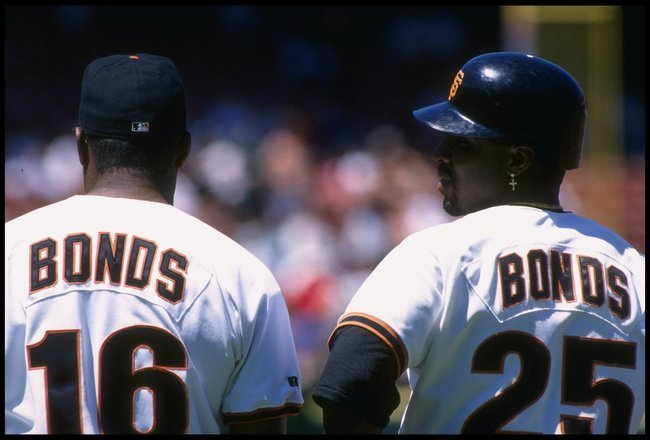
Earlier this year,* the Baseball of Fame passed an important threshold when Barry Bonds, Roger Clemens, Curt Schilling, and Sammy Sosa each failed to secure enough votes for induction on their final year of eligibility (though various mop-up committees conceivably could change that in the future). In other news, David Ortiz was the only player selected for enshrinement this year.

In the last decade or so, the online baseball social media community quickly and unequivocally came to the unwavering position that Bonds, allegations of wrongdoing cast far aside, belongs in the Hall.** Thus, any voter supporting Bonds’ candidacy is cheered as righteous, upstanding, intelligent, and correct, while any failing to do so is an unreconstructed hypocrite. These are the only choices.

As ever with these types of social movements, it isn’t enough to be “right.” One also must be right for the right reason. Naturally, herein also enters the discussion of identifying the right reason why the wrong are wrong, perhaps so as to convert them– upon receipt of the crowd’s wise and agreed critique– to being right. Among collective critics, few devices are more seductive than the critique of hypocrisy, and boy are people who think Barry Bonds should be in the baseball hall of fame enjoying lobbing that one over the barricade right now. As enunciated by ESPN baseball “insider” and live Pinocchio puppet Jeff Passan, the latest version goes like this:

The campaign against Bonds has spanned decades, involving malfunctions of fairness and logic across multiple cohorts.

It starts with Major League Baseball and the blind eye that Selig, his office and the game’s stewards turned toward PEDs. From there came the duplicity of riding the steroid wave to new stadiums and bigger TV deals and exponential revenue growth while villainaizing the very people who fueled it.

Perhaps ironically (irony being another too-seductive critique of people expressing themselves on the internet), Passan’s thesis contains some infirmities of its own. Omission of serial commas aside, this seems to ignore the fact that the Hall is a separate entity outside the control of MLB or its commissioner or club owners. Everyone associated with baseball profited from the game’s pharmacologically driven power boom in the second half of the 1990s, and MLB still recognizes all of the statistics posted and records broken during that era. Among “the game’s stewards,” only the Hall and its electors have tried to deny laudatory acknowledgement of this period of history. The facts do not support this particular smear of Bud Selig and the owners. (Readers of this site know there are plenty of other, valid reasons to engage in that exercise.)

Nor does logic support the levying of this charge. If player-driven, sport-wide profits should buoy the Hall-of-Fame credentials of the players whose playing pushed those profits, then, the theory would hold, more support is due to, for example, the non-serving players who kept the game going during World War II (vis-a-vis the likes of Hank Greenberg and Ted Williams) or the white players, simply by virtue of their skin color, during MLB racial segregation. As concerns this sort of parsing, the far-better and generally accepted view is, of course, the opposite. Passan’s contention is too reductive to be useful.

And none of this explains Ortiz’s first-ballot election. Let’s start with the case for Ortiz. He spent most of a twenty-season career with a very successful, popular, and visible Boston Red Sox team for which he was one of the most visible faces. He was a key part of three World Series championships, adding World Series and ALCS MVP honors to ten regular-season All-Star nods. Ortiz didn’t experience much of a decline as he aged, and, as a forty-year-old, he led all of baseball in slugging (.620), OPS (1.021), and doubles (48) in 2016, his final season. He finished with 2,472 hits and 541 home runs.

I don’t lose much sleep over first-ballot (or unanimous first-ballot) status; you’re either in or you’re out. That said, here, in reverse-chronological order, is the full list of players selected for enshrinement on their respective first ballot:

Continue reading
You Took the Words Right Out of My Jam

Nobody hit that grand rock production sweet spot like Meat Loaf, who died yesterday at the age of seventy-four, and who, this now being the end of time for which no one prayed, Satan better hope is not coming his way. My first memory of Meat Loaf was an appearance at an MLB all-star game. (Google suggests it might be this one, but I’m not so sure.) When I later heard the original music he created with Jim Steinman, Prof. Roy Bittan, the Mighty Max Weinberg, and Todd Rundgren, with assists from Edgar Winter and Phil Rizzuto, it was almost impossible to believe it was real, and seeing that music presented in the context of the Rocky Horror Picture Show didn’t make it any easier to believe. Bat out of Hell, Meat Loaf’s 1977 debut, is punch in the face after punch in the face, and the title track and “Paradise by the Dashboard Light” are knockouts. A decade and a half later, 1993’s Bat out of Hell II proved Loaf & Co. still had it, opening with comeback epic singalong “I’d Do Anything for Love (But I Won’t Do that).” (Full disclosure: this post is not sponsored by Dr Pepper.)

Meat Loaf’s memory can bear two selections, and these two heavy hitters will serve as this week’s Jam:

Miguel Cabrera stays positive in 2021, and the Detroit Tigers outperform expectations

Before the 2021 season began, we, along with everyone else, predicted that it would be a historic season for Miguel Cabrera. The team’s veteran anchor had within range two of baseball’s all-time career benchmarks: 500 home runs and 3,000 hits. On August 22, Cabrera knocked his 500th career homer over the right-center fence in Toronto, becoming just the twenty-eighth player in MLB history to accomplish that feat. And, even in the face of declining batting average and power production, Cabrera came within a baker’s dozen of 3,000 hits. He finished the year with a career total of 2,987, teeing up another exciting celebration for early in the 2022 season.

Also significant: according to WARP, Cabrera was a positive-value contributor to the Tigers in 2021. While not remotely glamorous, his 0.7 WARP represented his best seasonal performance by that metric since 2016. It also marks his nineteenth-consecutive year as a positive WARP contributor, keeping alive the possibility he finishes his career among the elite, selective group of players who played at least twenty-one seasons without tallying a negative in the wins-above-replacement column. Among active players, only Yadier Molina (eighteen seasons of positive WARP); Robinson Cano (sixteen seasons of non-negative WARP); and Joey Votto (fifteen seasons of non-negative WARP) even are candidates to join this group in the next six years, and the best bet probably is that none of them will make it. As much as anything, Cabrera’s contract, under which he’s signed through his twenty-first season (with extremely unlikely to vest options for more beyond that), makes this achievement a possibility.

As for the rest of the team, there were some other things to like in 2021 too. Other outlets have covered player and prospect development more comprehensively, so I’ll just add a note that the team as a whole outperformed the major projection systems’ preseason expectations (PECOTA: sixty-six wins; FanGraphs: seventy-one wins) by notching a lofty seventy-seven wins. There were some nice winning stretches this season, including a hot start to the second half, which afforded them, with five games to go, mathematical possibilities of finishing with a .500 record and second place in the division (alas, neither of those things occurred).

Finally, on the subject of projections and expectations, had 2021 played out the way PECOTA saw it before the season started, we would have seen some special oddities:

Cabrera didn’t hit a triple, and Buck Farmer did not earn his first career save, the latter a big miss for our readers, especially since the Tigers released Farmer in mid-August after just 35.1 innings pitched. Jeimer Candelario was not caught stealing all year, though, and Matthew Boyd at last notched a sub-4.00 ERA season. Not bad!

As nice as those small accomplishments appear, their respective contexts provide additional color. For Candelario, it was a nothing-ventured-nothing-lost situation. While he wasn’t caught stealing for the first time since 2017, nor did he successfully steal a base, something that also last occurred in 2017. Candelario, it appears, was not part of A.J. Hinch’s base-stealing revolution in Detroit. For Boyd, his 3.89 ERA made for a career-best mark, but it wasn’t a career-best season for him, as the Opening Day starter appeared in just fifteen games and pitched fewer than eighty innings, missing all of July and nearly all of August and September due to soreness in his throwing elbow. Boyd, who may be headed to free agency, likely would’ve traded a slightly worse ERA for a full season of healthy starts in 2021. A difficult reminder that PECOTA may be able to tell us the what (at least fifty percent of the time, anyway), but not the how or why.

Now it’s onto the postseason (the AL wild card round begins tonight) and, hopefully, an exciting and active offseason for the Tigers, who appear ripe to move aggressively back into contention for the division in 2022.

Five Hundred Home Runs Dies In Darkness?

The ever-astute and hip Washington Post decided to celebrate Miguel Cabrera’s historic home run achievement by opining that Cabrera and Albert Pujols may be the last major leaguers to reach five hundred home runs and three thousand hits because apparently they tallied a lot of their numbers while opposing pitching was relatively bad and batters (but we’re not saying who!) artificially extended their careers with prohibited performance-enhancing drugs, and pitching is good now and PEDs are gone.

Rather than engage that cheerful take, let’s join the throngs of the genuinely happy and have yet another look at the rarity of Cabrera’s accomplishment from two big-picture perspectives.

Cabrera famously hit his first career MLB home run in his first career MLB game, a walk-off shot in the bottom of the eleventh inning. That day, June 20, 2003, Cabrera, then twenty years old, became the 18,306th person to play Major League Baseball. (A list of all 2003 debutants is available here.) As of this writing, 22,538 people have done so, meaning that Cabrera, the twenty-eighth player to five hundred homers, joined a group that represents barely a tenth of a percent of all MLB players ever. Whether we eventually will look back at this benchmark as– perhaps like Rickey Henderson’s 1,406 career stolen bases or maybe Denny McClain’s 31 wins in 1968– an irreplicable vestige of eras past is, for this moment, a matter for dour D.C. dilettantes to debate. We can celebrate and appreciate the extreme rarity and therefore special nature of Cabrera’s feat right now.

Also noteworthy in the present moment is the rarity of the observation of the achievement for current fans. The six seasons between Cabrera’s five-hundredth blast and David Ortiz’s was the longest such gap between such career landmark hits since the nine-year period between Mike Schmidt’s (1987) and Eddie Murray’s (1996).

That the combination of talent, consistency, and longevity required to hit five hundred major-league home runs always has been rare and appears likely to remain so does not in any way diminish the significance of the accomplishment. And although the Washington Post isn’t projected to produce any journalism on the level of Woodward and Bernstein’s Watergate work in the foreseeable future and hasn’t since, neither has Cabrera taken time to comment on the Post’s weaker competition during the zenith of institutional print media. (Selections from today’s online front page for modern reference.)

Thus, a humble suggestion that the Washington Post aim its performative social criticism elsewhere. Cabrera, with his excellent resume and obvious love of the game, can handle it, but it doesn’t become them. Perhaps the editors just are embarrassed that their own team can’t hang onto this type of historic player and so responds by lashing out at other greats. Regardless, I look forward to not reading a Washington Post sportswriter’s forthcoming book on Stephen Strasburg’s career entitled The Final Days.

Miguel Cabrera’s Monster Milestone (via FanGraphs)

On Sunday afternoon against the Blue Jays, Miguel Cabrera became the newest member of an elite baseball club by hitting his 500th regular-season home run, making him just the 28th player to reach that mark in MLB history; he joins Albert Pujols as the only active players on the list. (He’s also the first-ever Tiger and first ever Venezuelan-born player to get there). Cabrera is also chasing entry into the equally exclusive 3,000 hits club, but he would need roughly a hit per game for the rest of the season to do that, making 2022 more likely, so let’s focus on 500 and his road there. … Read More

(via FanGraphs)

________________________________________________________

Related
Miguel Cabrera in the bWAR era
Miguel Cabrera continues to shine in the DRC era
Miguel Cabrera further bolstered by sabermetric update
Trout vs. Cabrera, and Aging with DRC+ (via Baseball Prospectus)
Man vs. Machine
Real talk: The media is completely blowing it on the Miguel Cabrera triple crown story

Cherry picking the 2021 Detroit Tigers All-Stars

The annual National Cherry Festival resumes this weekend in Traverse City and runs until the start of the 2021 MLB All-Star break begins after the following weekend. Let’s use that time to look at how the Detroit Tigers have been performing over an intraseason period selected solely to make them appear better than they have been if you do something foolish like take then entire season into account.

On May 7, the Tigers lost to the Minnesota Twins 7-3, dropping their record to 9-24, and leaving them as the only MLB team without a double-digit win total. Miguel Cabrera was running a career-worst .127/.225/.238 line, and the team had just one above-average hitter in Jeimer Candelario (115 wRC+, with his BABIP still hovering around .400).

On May 8, though, the Tigers reversed the scoreboard and beat the Twins 7-3. That started a 25-21 run, a .543 winning percentage that– holding all else constant– would bump Detroit up to third place in the AL Central (or first place in the NL East).* Sure they actually remain locked in a virtual tie for last place in the division, but let’s stick with this May 8 thing a little while longer.

Since May 8, Detroit quadrupled its tally of above-average hitters. Robbie Grossman and Eric Haase (both 107 wRC+) have come on strong and clutch. And Jonathan Schoop and breakout star Akil Baddoo are on fire. Their respective 167 wRC+ and 159 wRC+ marks would make each of them top-ten hitters if extended over the full season to date. (On the other hand, Candelario dropped 100 points of BABIP and flipped his wRC+ from 115 to 85.)

As he so often does, Miguel Cabrera deserves special mention. He’s pulled up his offensive rate numbers a good deal and continues to accumulate historic-level career achievements. He continues to close in on 3,000 hits (2,915), and at 493 homers, he now is tied with Lou Gehrig and Fred McGriff on the all-time list.

Continue reading

The ongoing saga of Charlie Blackmon’s 1979 Pontiac Trans Am gets COVID

Thanks in significant part to the historic woes of the Arizona Diamondbacks, owners of an active road losing streak twenty-three games in length, the Colorado Rockies have risen out of last place in the National League West, though their 30-43 record wouldn’t place them in any better position in any other MLB division. Star outfielder Charlie Blackmon has significantly improved his personal situation, however. What in early May looked like the worst season of his career (e.g., 58 OPS+/56 wRC+) now shapes up as merely league average. Maybe DRC+ (then the outlier at 108, now roughly steady at 112) knows something after all, and the fact that Blackmon maintained an on-base streak almost as long as Arizona’s losing streak certainly helped.

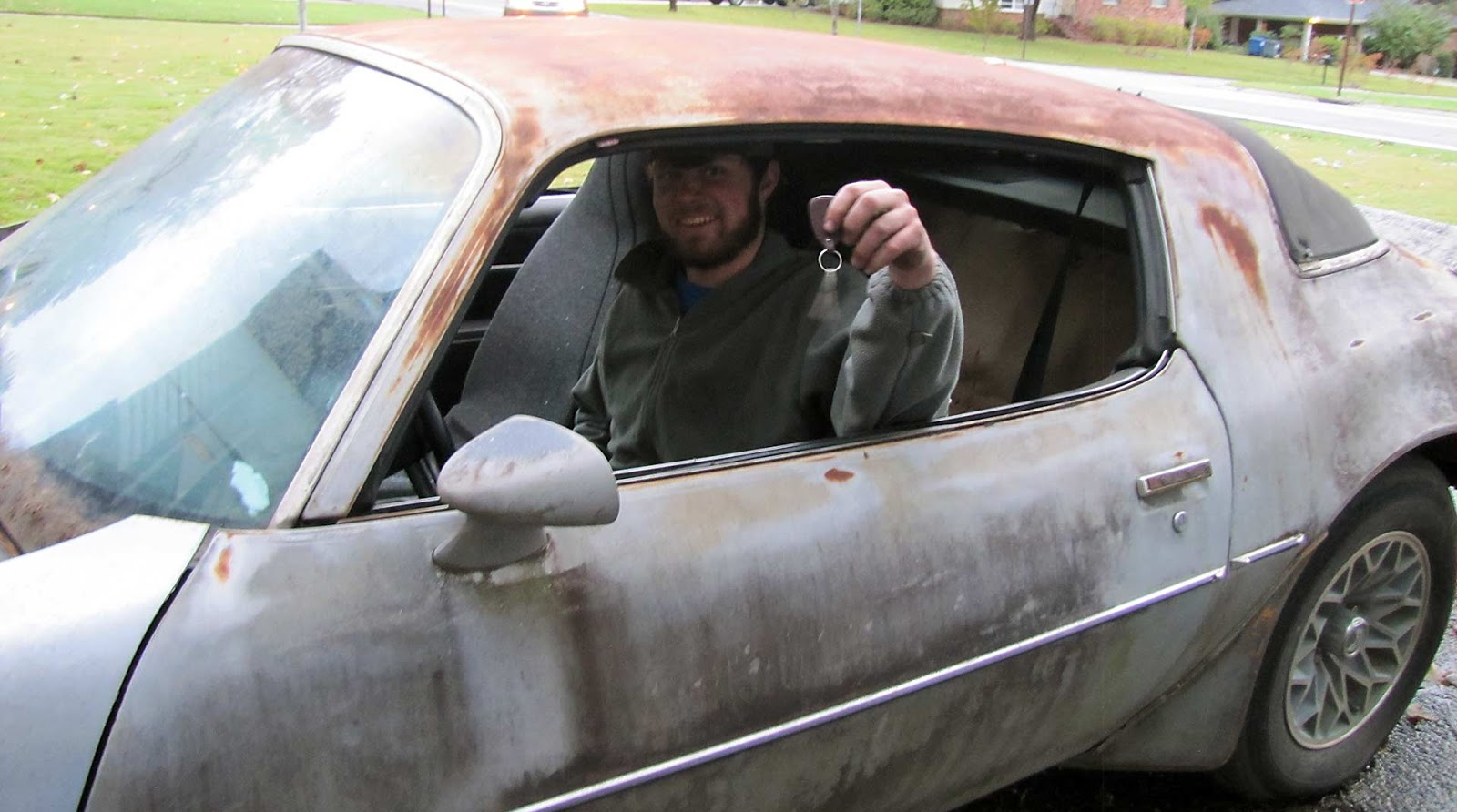
The Rockies don’t face the Atlanta Braves until September, by which time Blackmon likely hopes his Georgia-based legal troubles will have been resolved. ALDLAND remains–weirdly– your exclusive source for coverage of the legal saga of Blackmon’s 1979 Pontiac Trans Am. After Blackmon sued a Georgia man and his company in January, alleging that they refused to either complete work on or return his vintage vehicle, it looked like the case was steering toward a fast resolution when the defendants fumbled their opportunities to respond to the lawsuit. As predicted in these very digital pages, Blackmon then asked the Superior Court of Cherokee County, Georgia, to grant him a default judgment against both the individual defendant, Michael Ramsey, and the corporate defendant, Ramsey Performance. My assessment of the case at that point:

Judge [David] Cannon certainly has plenty of latitude to grant a default judgment in Blackmon’s favor here. The easiest part to resolve should be a ruling on the question of a default judgment against Ramsey’s company, which, in Georgia, must be represented by a lawyer. Apparently open questions about the precise nature of the remedy or remedies Blackmon seeks (e.g., Does he just want his car back? Does he want money from Ramsey, and, if so, exactly how much?) may complicate the situation for Blackmon, however, and complications and uncertainties usually are not helpful to a party seeking entry of a default judgment.

Now, in his first edict in this case on the subject of the defendants’ default, Judge Cannon indeed seized upon that easiest portion of the issue before him, but not quite in the manner Blackmon probably wished. Acknowledging that Georgia law requires Ramsey Performance to be represented by an attorney in litigation in that state, the court’s notice nevertheless states that, in consideration of general guidance from the Supreme Court of Georgia favoring generosity in granting extensions of time during pandemic conditions, it will permit Ramsey Performance nearly another month to find a lawyer.

While this is a significant reprieve for Ramsey Performance, the relief may be short-lived. The mere participation of an attorney on the company’s behalf alone will not cure the company’s problems in this case, and that attorney still will be in the difficult position of having to convince Judge Cannon that he should excuse Ramsey Performance’s failures to respond to Blackmon’s complaint and motion for default judgment. To the extent settlement remains on the table, this may push Ramsey, who has repeatedly expressed his displeasure with the notion of having to pay for a lawyer, closer to a deal.

So pump the brakes for now, attentive public, and navigate your browser back here in a few weeks for our continuing exclusive coverage of arguably the summer’s biggest sports law story.

_________________________________________________________

Previously
A predictable turn in the ongoing saga of Charlie Blackmon’s 1979 Pontiac Trans Am
A reminder that it’s spring training for automotive shop workers too: The ongoing saga of Charlie Blackmon’s 1979 Pontiac Trans Am
The ongoing saga of Charlie Blackmon’s 1979 Pontiac Trans Am

No Spin Mizer: If the glove doesn’t stick, we must acquit; or, Spin Doctors: Tracking possible reactions to MLB’s announced crackdown on pitchers using foreign substances

On June 2, 2021, MLB’s rumored crackdown on pitcher use of foreign substances took a significant step toward reality. That morning, USA Today published a story describing the enforcement of the policy as “imminent.” The same day, four minor-league pitchers who had been ejected from games during the preceding weekend for using foreign substances received ten-game suspensions.

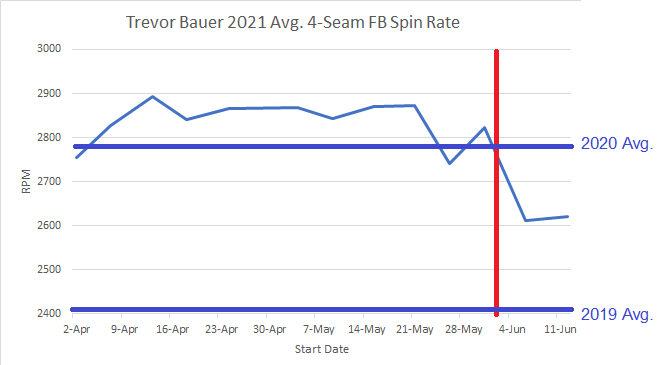
MLB pitchers, it seemed, took note. To many, Gerrit Cole, now the top starter in the New York Yankees rotation, has become the face of elite spin rates, and he was continuing to earn that reputation in 2021. In his first start after June 2, however, his spin rate plunged.

Trevor Bauer, the defending NL Cy Young winner now pitching for the Los Angeles Dodgers, forced his way into the group of spin-rate leaders last season following years of public comments criticizing pitchers who used foreign substances to increase their spin rates. Like Cole, Bauer saw his spin rate plummet after June 2.

Another leader in this category in recent seasons is Yu Darvish, now a starter for the San Diego Padres. Unlike Cole and Bauer, Darvish appeared unfazed by the June 2 announcement, at least judging by the relative consistency in his spin rates this season.

Since the June 2 announcement and enforcement of minor-league suspensions, MLB yesterday announced that it would apply the ten-game-suspension policy to major leaguers as well, with a progressive-discipline scheme for repeat offenders.

While a variety of factors can affect measured spin rates, it’s difficult to interpret the spin-rate dips from Cole and Bauer in their post-June-2 starts as anything other than an acknowledgement of the use of substances that go beyond providing the sort of control-improving grip that even batters appreciate from a safety standpoint and facilitate extreme spin rates (Spider Tack has become the brand name associated with that latter variety of substance). Cole and Bauer don’t come to this point by the same route, however. Bauer’s well-documented history of criticizing Cole and his former teammates in Houston for what Bauer strongly implied– and later seemed to demonstrate in a live-action experiment– were artificially high spin rates arguably places him in a different category than others in this conversation. On the other hand, perhaps he’s just more media-savvy. Should it make a difference if Bauer publicly changed his game to capitalize on and make a point of highlighting MLB’s underenforcement of foreign-substance rules, while Cole did, well, whatever this is?

Nor can we draw any firm conclusions from Darvish’s spin-rate graph. Not only did Darvish’s RPMs not drop after June 2, but they continued to climb. Was he undaunted by the “imminent” threat of enforcement, and, if so, why?

All of this brings us to Casey Mize’s start last night, immediately following MLB’s declaration that it would begin enforcement of its zero-tolerance policy against major-league pitchers. In his short professional career, Mize has not been a high spin guy, nor has he been publicly associated with what he calls the “sticky.” Which is why he was so upset when an umpire forced him to change gloves during the game:

Mize was walking off the mound following the first inning of his start on Tuesday in Kansas City against the Royals, when John Tumpane stopped him for what looked like a friendly conversation.

According to Mize, Tumpane said Mize’s glove was too light-colored.

Mize said the glove, which he’s worn for every one of his big-league starts, was originally charcoal-colored, but may have faded a bit in the sun.

“He said the gray color was too light,” Mize said.

Color judgement aside, Mize was most angry because Tumpane’s order came on the same day that Major League Baseball announced a widespread crackdown on the use of sticky substances that some pitchers have used to help them grip the baseball and increase the spin rate on their pitches.

“I assume everyone thinks that I was using sticky stuff now, which I was not,” Mize said. “So I just thought the timing of it was pretty (expletive), honestly. The umpires need to get on the same page, because I’ve made 12 starts (in 2021) and everybody was fine with (the glove). Or John Tumpane just needs to have some feel and just let me pitch with the glove that the other team did not complain about. (Tumpane) brought it up himself. John’s a good umpire and a very nice guy. But I mean, just have some feel for the situation because I hate that I’m in a position now where I assume everyone thinks I was using sticky when in reality, that was not the situation at all.”

First, for visual illustration, some relevant images of Mize’s mitt:

Without more information, this seems like a questionable decision by the umpire, and, whatever his motivation, the decision did drag Mize into the broader conversation about foreign substances. So what do the spin measurements say about Mize’s pitches? Most obviously, he operates in a much lower band of RPMs than the likes of Cole, Bauer, and Darvish. That alone may be more than enough for many to exonerate him. And while Mize’s average spin rates did decline between his May 28 start and his June 3 start, the magnitude of the change was negligible relative to those Cole and Bauer exhibited. If his data suggest anything, it’s that Mize is telling the truth.

However irked Mize was after being forced into a mid-game glove change, it did not appear to alter his performance. He completed 6.2 innings, threw a season-high 103 pitches, and allowed three runs on the way to a 4-3 Tigers win in Kansas City.

To this point in the season, Mize has been the best of Detroit’s young pitchers, and he trails only Spencer Turnbull in WARP. He’s following up an interesting if inconsistent debut in 2020 with across-the-board improvements in major statistical categories. While veterans attempting to be crafty and the commissioner’s office duke it out over Spider Tack, here’s hoping Mize can avoid that fray and continue to find his footing as a leading member of Detroit’s rotation.

A predictable turn in the ongoing saga of Charlie Blackmon’s 1979 Pontiac Trans Am

The end of the first month of the 2021 MLB season finds the Colorado Rockies stuck in last place in the National League’s Western Division. By OPS+, they’re the worst hitting team in the NL and the second-worst overall, their 85 OPS+ just edging the Detroit Tigers at 81 OPS+. Even though the Rockies were in the playoffs as recently as 2018, their slow start this year already has cost Jeff Bridich his general manager post. Perhaps unsurprisingly in light of the foregoing, Charlie Blackmon, the team’s ostensible star, so far is having the worst season of his career. His .169/.299/.292 line shakes out to 58 OPS+/56 wRC+/108 DRC+.*

Meanwhile, the winding road that conveys the legal saga of Blackmon’s 1979 Pontiac Trans Am– a story that remains too hot for any other website to cover– may be approaching its terminus. We picked up the tale as it hit the courthouse steps in January, when Blackmon filed suit against Michael Ramsey and his company, Ramsey Performance, alleging that the two entities took his money and his car and, after failing to complete agreed-upon restoration work on the latter, refused to return either. When Ramsey declined to hire a lawyer and instead made a “Good Job/Good Effort” attempt to respond to Blackmon’s complaint by filing only a copy of the complaint bearing Ramsey’s handwritten comments on the allegations, I predicted that Blackmon’s legal team would wait a few weeks and then file a motion for default judgment or judgment on the pleadings.

That’s exactly what happened. Referring to Ramsey’s unusual filing as “a something,” Blackmon’s motion asked the Superior Court of Cherokee County, Georgia to take a shortcut to the end of the lawsuit. Ramsey’s response either was so deficient that it didn’t amount to an answer at all, the essence of the argument goes, or it was an answer that didn’t deny any of the material allegations in the complaint. Either way, Blackmon contended that the court can rule for him on the question of the defendants’ liability right now. The question of damages– basically, the amount of money the court would order paid to Blackmon– could throw a wrench into Blackmon’s gears, however. Because he hasn’t been able to inspect the vehicle, the motion proposes the appointment of a special master– an investigator who works at the judge’s direction– to provide an assessment of the Pontiac’s condition for the purpose of determining a precise monetary award.

If Ramsey’s response to this motion is better than his response to the complaint, it is so only because he typed it as a partially separate document rather than handwriting his comments on Blackmon’s filing. This response otherwise is worse than the last one. Continuing to represent himself, Ramsey complains that Blackmon refused an out-of-court resolution of the dispute on terms Ramsey dictated. Ramsey also provided in-line responses to some of the arguments in Blackmon’s default motion, though these generally do not help his position, being either admissions of matters pertinent to the question of default (e.g., acknowledgement that he was served with the complaint) or immaterial. He also attached correspondence that again reveals Blackmon’s personal email address (although Blackmon’s own lawyer already let that cat out of the bag) and is neither relevant nor, to the extent it constitutes settlement communications, admissible as evidence.

Next up will be the trial judge’s ruling on the default motion. Judge Cannon certainly has plenty of latitude to grant a default judgment in Blackmon’s favor here. The easiest part to resolve should be a ruling on the question of a default judgment against Ramsey’s company, which, in Georgia, must be represented by a lawyer. Apparently open questions about the precise nature of the remedy or remedies Blackmon seeks (e.g., Does he just want his car back? Does he want money from Ramsey, and, if so, exactly how much?) may complicate the situation for Blackmon, however, and complications and uncertainties usually are not helpful to a party seeking entry of a default judgment.

Those, of course, are matters for Blackmon’s legal team to sweat. Their client likely is more concerned about his sub-.200 batting average and his team’s NL-worst record.

As always, keep your browser dialed to ALDLAND.com, where we remain your (actually; I somehow am not kidding) exclusive source for hot rod baseball litigation.

* All statistics current as of the time I typed them.

_________________________________________________________

Previously
A reminder that it’s spring training for automotive shop workers too: The ongoing saga of Charlie Blackmon’s 1979 Pontiac Trans Am
The ongoing saga of Charlie Blackmon’s 1979 Pontiac Trans Am

MLB’s Instant Replay Review is Neither Instant nor Review: Discuss

OT - Coffee Talk

It was another bad weekend for MLB officials, whose joint obsessions with speaking publicly about an alleged need to shorten the length of games and threatening their existing fans with rule changes they hate (while forcing official telecast commentators to praise the ill-conceived reforms) came to a sudden and startling head in Atlanta last night.

This catastrophe was not entirely without advance warning, thanks to a Thursday-afternoon prelude in Queens, where replay review affirmed a plainly incorrect, game-ending call at home plate. There, with game tied and the bases loaded in the bottom of the ninth inning, officials awarded the Mets a walk-off victory when their batter, Michael Conforto, leaned into strike three from Miami Marlins pitcher Anthony Bass (good fish name), taking the ball off his elbow and forcing in the game-winning run. Replay review showed that Conforto not only failed to make any effort to avoid being hit but actually extended his elbow out toward the pitched ball. Even the home telecast crew on SNY acknowledged the rules violation. MLB officials did not, however, asserting that the scope of their review was limited to the simple question of whether the pitch hit Conforto, and the Mets had a win in their home opener.

Three days later, things became unimaginably worse and even less defensible for MLB. In the primetime Sunday night game, the Philadelphia Phillies and Atlanta Braves had dueled to a six-all tie through eight innings. The Braves sent reliever Will Smith out to start the ninth. Smith allowed a leadoff double to Alec Bohm, who advanced to third on Jean Segura‘s groundout. Smith then induced Didi Gregorius to fly out to Marcell Ozuna in left field. Bohm tagged up and headed home. Ozuna’s throw to catcher Travis d’Arnaud looked good enough to end the inning, but the home-plate umpire called Bohm safe.

Instant replay showed anyone with eyes that Bohm was not safe, however. While there may be room for debate as to whether Ozuna’s throw beat Bohm to the plate, the fact that Bohm never actually touched home plate should have negated any other question on the call. Video replay clearly and unequivocally showed that Bohm missed the plate entirely. A lengthy video replay review shockingly resulted in a decision upholding the safe call, however, and angry Braves fans began littering the field with debris, causing further delay.

Continue reading