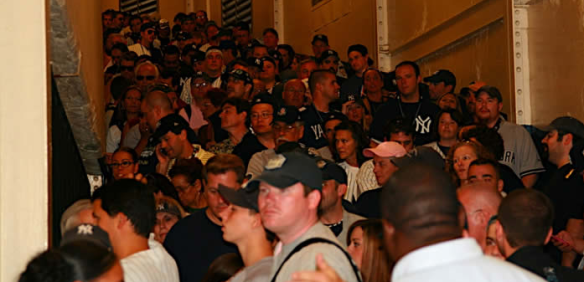
When do baseball teams score runs?

baseballline

One of the marks of a smart baseball writer is the ability to sense a trend, research its existence and nature, place her findings in context, and present her conclusions in a way that meaningfully educates readers. Inherent in this ability is the wherewithal to know when to stop researching a trend or pressing on a concept, realizing that the fruits of the work have been or soon will be exhausted. Sometimes a person who is not a “smart baseball writer” by the foregoing definition will noodle about on an idea for so long, he’ll end up with a small pile of research that no longer has any bearing on any meaningful conclusions.

Two years ago, I decided to investigate a hunch that the Detroit Tigers were having trouble scoring runs late in games. My initial research mostly seemed to support my hypothesis, and a follow-up look appeared to confirm it more strongly. More than merely interesting (and fleetingly self-satisfying), it also was informatively concerning, because it placed the team’s well-known bullpen problems in a more nuanced light: relief-pitching woes alone weren’t the problem, because the lack of late-game scoring was compounding the problem of surrendering leads during the final frames. As strange as it seemed, the Tigers had interrelated shortcomings on both sides of the plate.

One comment I received in the course of sharing those findings stuck with me: I needed to place this information in context. After all, there are plausible reasons to believe that all teams might, perhaps to varying extents, experience decreased run production in the late innings.

And so it was that, two years later, I finally discovered Retrosheet, a site that compiles inning-by-inning scoring data to a more useful degree than the resources I’d utilized back in 2013. What follows are two graphs of the inning-by-inning scoring of sixteen teams for the 2014 season. Continue reading

On the Road Again: A study of NHL rink variation

One of the important background dimensions to comparative baseball statistics is known as “park adjustments,” a set of corrective factors applied to account for the physical differences (e.g., outfield wall depth) between each park. Among American sports today, only Major League Baseball and NASCAR (and golf, I suppose) permit such structural variation between the competitive arenas themselves.

Professional hockey used to be in that group too. More than merely adjusting, adding, and subtracting lines on the ice to affect the flow of play, as the NHL continues to do (cf. the NBA three-point line), the rinks themselves used to be different sizes. League rules mandate a uniform rink size, but so-called “small rinks” persisted in the NHL as late as the 1980s and 1990s in Boston, Chicago, and Buffalo.

While hockey does not face the structural differences present in baseball, there still is a need to apply rink-by-rink statistical adjustments. That’s because the compiling of basic hockey statistics (e.g., shots, hits, turnovers) requires statisticians to make judgment calls to a more significant degree than in a discrete-event sport like baseball.

By way of limited background, the NHL collects basic gameplay statistics through a computer system known as the Real Time Scoring System (RTSS). A benefit of RTSS is that it aggregates and organizes data for analysis by teams, players, and fans. A vulnerability of RTSS is the subjectivity alluded to above that comes when human scorers track a fluid, dynamic sport like hockey.

While others have noted certain biases among the RTSS scorers at different rinks, a paper by Michael Schuckers and Brian Macdonald published earlier this month analyzes those discrepancies across a spread of core statistics and proposes a “Rink Effects” model that aims to do for subjective rink-to-rink differences in hockey scoring what park adjustments do for structural differences between baseball parks.    Continue reading

Hockeytown, Hockey home

joelouisoustideOn Saturday, January 18, 2014, the Detroit Red Wings beat the visiting Los Angeles Kings 3-2 in a shootout. It was the best hockey game I’ve ever seen. I’ve watched innumerable Red Wings games over the years, including playoff wins over rivals and Stanley Cup wins. I’ve seen them in person before too, watching them lose to their rivals in Denver, Nashville, and Chicago. (I even saw an intra-squad scrimmage.) This was my favorite game.

It was my first trip to Joe Louis Arena, the historic home of hockey in Detroit for only a little while longer, and everything went perfectly. We stayed in Greektown, where we enjoyed an authentic Greek lunch prior to the game. When we were ready to head to the arena, we took the accurately named People Mover and were there before we knew it.

Once inside, we had time to enjoy the statues of great Red Wings past on a full lap around before finding our great seats, where we watched the team warm up and tried to read all of the banners hanging from the rafters. The experience was extremely satisfying and fulfilling, as was the Little Caesar’s pizza, which is better there than it is anywhere else in the world.

IMG-20140118-00061

IMG-20140118-00060

Hockey games are subject to all kinds of random variation, so it was especially wonderful when the game itself matched and then elevated the tenor of the evening. After a scoreless first period, the Red Wings could not kill off successive minor penalties, and the Kings’ power-play goal gave them a 1-0 lead. Less than a minute later, however, Detroit’s Henrik Zetterberg tied the game with an even-strength goal. That sequence essentially repeated itself in the third period, when the Kings scored a power-play goal with just 2:15 to go in the game. Detroit’s Niklas Kronwall tied the score at two with just twenty-seven seconds to go in the game, sending it to overtime.    Continue reading

ALDLAND Podcast

There hasn’t been much going on in sports lately but that does not mean that ALDLAND doesn’t have things to talk about. We talk peeing on graves, we talk invading countries to take their sports stars, as well as more normal sports topics like soccer and baseball. It’s all here in the ALDLAND podcast.

_______________________________

Download the ALDLAND podcast at our Podcasts Page or stream it right here:

ALDLAND Podcast

Even the ALDLAND Podcast is not immune from Lebron discussion, and so we start off the episode with that very topic. Where will he go? Why will he go there? All these questions and more are discussed. But don’t worry, Carmelo Anthony, Chris Bosh and Dwyane Wade, we haven’t forgot about you and also predict your landing destinations. Not to be left out, soccer makes its presence felt in this edition of the ALDLAND Podcast as the World Cup final gets a healthy preview.

_______________________________

Download the ALDLAND podcast at our Podcasts Page or stream it right here:

Families that play together (periodically) win together: NBA champions edition

Following the San Antonio Spurs’ dominant win over the Miami Heat in the NBA finals, FiveThirtyEight decided to examine whether the popular narrative about the winners and losers– that the Spurs played a more complete, team-oriented style of basketball the Heat, increasingly reliant on their solitary superstar, could not combat– was borne out in the numbers. They did this by comparing the relative usage rates (USG%) of the teams’ lineups. Plotting the difference in USG% between each team’s “top” player, the one who “used” the most possessions to either shoot, be fouled, or commit a turnover, and each successive player, should show how well the team spread the ball around. A team that did a good job of sharing the ball should plot a flatter line than a team that did not. FiveThirtyEight’s chart supported the popular narrative: San Antonio’s line was flatter than Miami’s, and the league average, while Miami’s line topped both.

As FiveThirtyEight pointed out, this isn’t how NBA championships are supposed to be won. As much as the Heat’s assemblage of its “big three” was seen as groundbreaking, it fit the narrative that grew out of Michael Jordan’s Bulls and Kobe Bryant’s Lakers (and certainly existed before Phil Jackson coached both of those teams to multiple championships) that the NBA was a star-driven league, and the way to win championships was to have a superstar. The Heat simply presented as an extreme version of that reality, with little in the way of supporting cast members.

FiveThirtyEight only compared this year’s teams, but the article made me wonder how the last NBA champions who deviated from the star-heavy model– the Detroit Pistons team that won it all exactly ten years ago amidst a solid run– compared statistically to this year’s Spurs.

I tallied the numbers using Basketball-Reference‘s team playoff data, sorted by USG%. Before doing so, though, I made an executive decision to omit data from players who appeared in fewer than ten playoff games that year, which swept out Austin Daye (one game for the 2014 Spurs) and Darko Milicic (eight games for the 2004 Pistons). The resulting plot lines for each team are essentially equally flat:

nbachampusagechartFor perspective, keep in mind where the Spurs’ line– red on my chart, black on the one above– is situated relative to the rest of the (2014) league. It seems these Spurs and those Pistons were on the same page when it came to playing team-oriented basketball. Meanwhile, Miami is discussing adding Carmelo Anthony for next season. Anthony has been in the top ten in the league for USG% in nine of the past ten years.

ALDLAND Podcast

ALDLAND is in finals mode . . . NBA and NHL finals that is! Your favorite hosts are here to break down, or at least pay lip service to the championship rounds in both hockey and basketball. And that’s not all. Stay around after finals talk for a quick discussion on the upcoming Vanderbilt-Stanford series in the NCAA baseball tournament. It’s really the most fun you can have listening to a podcast.

_______________________________

Download the ALDLAND podcast at our Podcasts Page or stream it right here:

Hockey parlor games

Found this from FiveThirtyEight:

With the Stanley Cup finals set to start tonight, I thought this would be a fun game to play, especially for hockey fans whose teams are done for the season.

For me, the picking went pretty easy, probably because there are lots of good combinations here. I went with Ken Dryden ($2); Lidstrom, my favorite player, potentially overvalued but always undervalued while he played ($5); Chelios ($1); Mr. Hockey ($5); Super Mario ($4); and John Bucyk, never of whom I have heard ($1). (I originally had Shanahan at LW before realizing I needed two defensemen, hence Cheli and Mr. Bucyk.)

FiveThirtyEight offers a team “formed from an advanced stats point of view.” In this case, that mostly means referencing Goals Versus Threshold (“GVT”), a WAR-like statistic that seeks to present “the value of a player, in goals, above what a replacement player would have contributed.” Their picks:

  • Hasek ($4) – “A steal”
  • Orr ($5) – “the difference between his production at his peak … and that of the next-best defenseman is truly massive”
  • Larry Robinson ($2) – “a higher five-year peak [in terms of GVT] than . . . Lidstrom despite” costing less than half as much as Nick
  • Gretzky ($5) – his “production was such a radical outlier that he’ll be worth the price”
  • Jarri Kurri ($1) and Bucyk ($1) – “both Hall of Famers” and “building a top-heavy team with a few stars and a bunch of lesser players is not such a bad thing.

Post your team in the comments below, and cast your predictive vote for the outcome of this year’s Stanley Cup finals right here:

Kershaw in Context

ESPN Los Angeles:

The Los Angeles Dodgers and Clayton Kershaw have agreed on a seven-year, $215 million deal, sources with knowledge of the situation said.

Kershaw has an out clause after five years.

It is the richest deal for a pitcher in Major League Baseball history, eclipsing the seven-year, $180 million contract Detroit gave Justin Verlander last winter, and his average annual salary of $30.7 million is the highest ever for any baseball player.

The 25-year-old Kershaw has won two of the last three National League Cy Young Awards, as well as a Roberto Clemente award for his charitable work.

One of the things I’ve noticed is most eye-opening to casual sports fans is the size of athletes’ contracts, especially when presented in a more understandable context than “$D over Y years.” In continuing service to this site’s prime audience, the casual sports fan, here are two graphics that place Kershaw’s record-setting contract in context:

Now imagine being the person writing the checks for Kershaw and his teammates.

This is probably the end of probably the best weekly NFL column of the past two years

yrNo, I’m not talking about any of the various aborted (but sure to return!) attempts at weekly football columns on this site. I’m talking about Alex Pappademas’ “I Suck at Football” column, which ran on Grantland’s sports blog, The Triangle, on a weekly basis during the 2012 and 2013 NFL seasons.

I still remember reading Pappademas’ first column in the then-unnamed series. On September 24, 2012, he published the first post, entitled “Nuclear Physics, Bloody Marys, and Bengals: A First Trip to a Sports Bar.” On Monday of this week, he posted what’s likely– though unconfirmed– to be the final entry: “I Suck at Football, Week 18: The Barrel-of-Fun Room.”

The column’s basic tenets emerge in the inaugural article:

On Sunday my friend Richard Feynman took me out to drink and watch football at 10 in the morning. My friend Richard Feynman’s name isn’t really Richard Feynman, but I’ve decided to give every real person in my I Suck At Liking Football journal the name of a famous theoretical physicist, because this sport is still basically quantum mechanics to me. So on Sunday Richard Feynman’s wife took their son to choir practice and (metaphors!) Richard Feynman and I went to football-church, in a sports bar on Vermont Avenue.

Not only did Pappademas not have a favorite football team, he hardly understood the sport itself, or even how to be a fan of it (as evidenced by the originally named “I Suck At Liking Football journal”). By the end of the opening offering, he has picked a favorite team– the Cincinnati Bengals– and begun to deal with the unfamiliar challenges of existing in a sports bar, Ye Rustic, at 10:00 am on a Sunday.

“I Suck at Football” is a crude name for an elegant collection of writing. Every week offered an unpredictable mix of unanticipated portions of life and football. For you, the beauty of this is that, if you’re hearing about this column for the first time, you haven’t missed out: these articles aren’t game really recaps, and you probably didn’t watch the Bengals that week anyway.

Somewhere along the line, I can’t find where now, Pappademas appeared to suggest that this journal would be a two-season affair, and this week’s post has an air of finality to it:

I sat awake by the fire and realized my emotions didn’t really exist. They were just something my brain happened to be doing at that moment. Brain-weather. I was the one deciding to let them consume me. And I should have known that, because watching bad Bengals football taught me that lesson over and over. I felt frustration, anger, disappointment — and then I could stop feeling it, because it was just a TV show, and whether Dalton threw three interceptions or 300 changed nothing about my life outside Ye Rustic.

Thanks to the website redesign Grantland undertook sometime in the past twenty-four hours, there isn’t an easy way to view this series in one place. For now, your best bet may be to cycle through Pappademas’ full-site author archive, which contains a bunch of other stuff too. It’s worth the effort.