Can Jaguars Swim?

british jaguars

The NFL has not disguised its efforts to develop its brand abroad, and it appears to be moving toward establishing a team in another country. With expansion, which probably would reduce current owners’ revenues, unlikely, the only ready option is to relocate an existing team across the boarder.

The obvious choice is Canada. The Buffalo Bills already have some sort of timeshare arrangement with Toronto, but so long as Roger Goodell remains NFL commissioner, that move will not happen. (Goodell:Bills::Selig:Brewers, sort of.) Mexico doesn’t quite seem to be happening for the NFL either.

Instead, the league has set its eyes on Europe, and London in particular. Even though it abandoned NFL Europe, the league is pressing its product there more than ever, and it’s doing so in a targeted way. The team to go? The Jacksonville Jaguars.

I watched last night’s crime against football on Sky Sports, a British broadcasting operation. During breaks, they were airing commercials for some UK version of fantasy football that featured three Jags cheerleaders and chances to win gear from “your favorite team,” spoken over the image of a Maurice Jones-Drew jersey. (You can view the commercial here.) Jacksonville is playing Atlanta in the NFL’s now-annual game in London, but the commercial doesn’t include any Falcons imagery. It’s all about establishing a long-term connection between European fans and the Jaguars.

The newish Jags owner is on board with that long-term connection– Shad Khan, a native of Pakistan who moved to America at age sixteen and became a billionaire through the automotive-parts industry, called the Jaguars “the home team for London.” Khan also bought a London-based soccer team, Fulham Football this summer, and in Khan’s eyes, that’s no coincidence: “Obviously, there would be some practices, some synergies we’d like to take advantage of [between the Jaguars and Fulham],” he said. Khan also pointed out that the Jaguars will be playing one home game in London at least for the next four seasons.

U.S.-based fans may just now be hearing about the prospect that a team, possibly the Jaguars, could be making a more permanent connection to London, but from the looks of things like the commercial I saw last night and Kahn’s actions, the NFL may have already made a decision.

Bay of Cigs: Heeeeeere’s Jhonny?

jhoLast month, Jhonny Peralta, the starting shortstop for the Detroit Tigers, agreed to accept a fifty-game suspension because of his connection to the Biogenesis Clinic. That suspension is nearly over, and he could return to the team on September 27, which is the date of the first game of the Tigers’ final regular season series, coincidentally taking place in Miami.

The decision whether to bring Peralta back to the team belongs to the team, and general manager Dave Dombrowski in particular. The question is whether they should allow him back.   Continue reading

ALDLAND Podcast

Marcus and I are back to discuss the games we previewed last week, as well as talk about some of the exciting games on this weekend’s slate. Coaches on the hot seat and how hot those seats might be is another topic of discussion, as is our new favorite musical artist, “Mathers.”

_______________________________

Download the ALDLAND podcast at our Podcasts Page or stream it right here:

Tuesday Afternoon Inside Linebacker

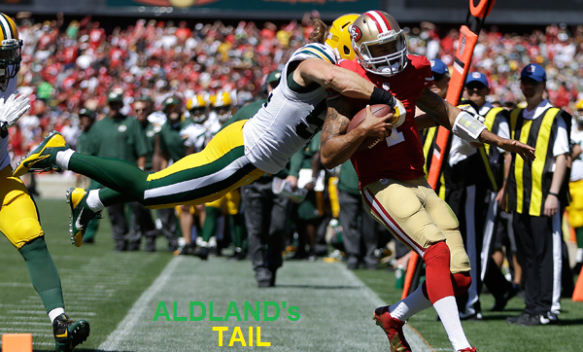
tailSince “Monday Morning Quarterback” and “Tuesday Morning Quarterback” are taken and uninspired, and because I’m preempting my own exhaustion of “Monday“-themed alliterations, ALDLAND’s regular football/weekend roundup will move to Tuesday afternoons, which also permits incorporation of the Monday night NFL game. With week two of college football and week one of the NFL in the books, here goes:

College Football

Pregame:

  • Brendan and Physguy were in Ann Arbor for ESPN College Gameday, and the only evidence is a couple cryptic tweets from Brendan.

The games — No surprises:

  • I was able to find Michigan State’s game against South Florida on television in the Southeast, which may be thanks to USF’s participation in the game, but which also felt like finding a unicorn in the wild. MSU’s defense continues to outscore their offense, and that’s with three quarterbacks! Even Sparta only ever had two kings at once. Michigan State 21, South Florida 6.
  • I also found Vanderbilt-Austin Peay on TV, which is a reminder that it’s week two for the broadcasters as well. VU had no problem with its Middle Tennessee neighbors, winning 38-3.

Like football, like bourbon: The real reason for the NFL’s popularity

pappy van sandersEven if it doesn’t pack as much action as baseball, or even tennis, there’s no denying that football is America’s de facto national pastime. Many point to the game’s amenability to television as the main reason for its ascension to this position, while some look to the work of labor leaders like Gene Upshaw, who led the charge for free agency, ultimately introducing a new era of NFL riches.

Those two factors undoubtedly contributed to the NFL’s rise in popularity, but I don’t think they explain why the NFL is as extremely popular as it is today, when every sport receives tailored television treatment, and the power balance between players and ownership across all major sports is far more even than it probably ever has been. If you step back far enough, football’s not much different than any of the other major sports. How does this otherwise undifferentiated product stay on top?

More than ever before, we’re living in an attention economy. Availability no longer determines value, because, as a result of the proliferation of communication technology, everything is equally available. When sports (and other broadcasted entertainment) are equally available and are available in such a volume that they cannot all be consumed, people must make decisions about which sports components they will follow and which ones the will not. Economics is about the allocation of limited resources, and in the market for sports entertainment, the only limited resource is our attention.

Why does the NFL grab more of the attention of more people than any other sport? Scarcity. Between the NFL, MLB, NBA, and NHL, no professional sports league plays fewer games than the NFL. Moreover, those games are scheduled such that, with minimal deviation, they all are played on the same day. Intentional scarcity makes NFL games both manageably consumable in the attention economy and appointment viewing. Scarcity flips the cost script: having a small number of games and coordinating them on a once-weekly basis means the cost of paying attention to them is low, and because missing one Sunday’s slate of games means missing a significant proportion of the season, not to mention being out of the conversational loop for a full week, the cost of not paying attention is high.

Intentional scarcity might seem like a counterintuitive strategy for boosting a product’s popularity, and the supplier’s revenues, but in a flooded market of generally undifferentiated products, it can be a very successful strategy for generating consumer demand.

Whether the NFL is consciously employing an intentional scarcity strategy is an open question– Roger Goodell’s ongoing push for an expanded season of eighteen games would seem to be contrary to that approach– but there is at least one market in which some manufacturers are openly pursuing an intentional scarcity strategy: the market for bourbon.

The bourbon market has all the essential elements of the sports entertainment market that make it susceptible to the successful pursuit of the intentional scarcity strategy: generally speaking, it is contained of undifferentiated products– competing in the bourbon market is similar to competing in NASCAR– that are present in such great volume that it is practically impossible to consume all of them, at least on a regular basis. The most famous exemplar of the scarcity approach is the Old Rip Van Winkle Distillery, but it certainly is not the only one.

Intentional scarcity can be a viable strategy for competing in a flooded market of generally undifferentiated products. Regardless of whether the NFL is intentionally engaging in this strategy, the approach is an important contributor to the league’s station atop the sporting world.

Tainted Love: The New York Times doesn’t get Vanderbilt

nyt george jonesThe New York Times has been flirting with Nashville for years, joining the charge of northern and coastal publications eager to tag Music City as America’s newly discovered “It City” with multiple travel-section features and other glowing profiles. They even utilized Vanderbilt basketball player Joe Duffy as a sports columnist during Duffy’s senior year.

All of this praise and proclamation certainly drew Nashville’s attention. A sudden object of affection rightly wants to know that its new, putative suitor’s interest is real, though, and a period of trouble or difficulty can provide a means of testing the authenticity of that interest. If the suitor’s interest is genuine, it will respond in a way that demonstrates true understanding or, at the very least, in a way that seeks to gain that understanding, so as best to further the relationship. If it responds by turning to cliches and shallow “conventional wisdom,” though, it suggests the interest was only ever skin-deep.

I’m not suggesting that the New York Times owes Nashville, or Vanderbilt University, any special degree of care or deference. That’s especially so where, as here, the issue is a rape allegation, and one that describes a single victim with multiple alleged perpetrators at that. (To say that rape is a topic beyond the scope of this website a) is true; b) is not to signal that it is a topic that people should not discuss; and c) is not to say that the integrity of a sports team as such is the more important issue here.)

I am suggesting that the New York Times owes Nashville and Vanderbilt University a duty of ordinary journalistic practices, which include researching stated assumptions instead of treating general stereotypes as established fact applicable to the matter at hand. I also am suggesting that the New York Times did not meet that standard in an article about Vanderbilt University’s football program it published today. (HT: Johnny Too Bad.)

Continue reading