Stadium Jam

The Wall Street Journal (now with questionable sports bona fides!) published today, in oral-history style, a feature on Crosby, Stills, Nash & Young’s 1974 summer stadium tour. An introductory excerpt:

On July 9, 1974, a month before President Richard Nixon resigned, with albums by Elton John and John Denver at the top of the charts, David Crosby, Stephen Stills, Graham Nash and Neil Young reunited to begin an ambitious nine-week tour of the U.S., Canada and England. Produced by Bill Graham, most of the 31 concerts were performed at stadiums and speedways with lengthy sets and clear, audible sound—firsts for an outdoor rock tour. Tickets cost about $7.50 (or $36 in today’s dollars).

Although the band hadn’t had a top-10 album since 1971, CSNY performed three-hour sets before crowds averaging 50,000 per concert, paving the way for rock stadium tours that followed.

Graham Nash: The idea for the tour was Bill Graham’s. Bill called me in my room at the Chateau Marmont in Los Angeles in early ’74. Bill said a lot of money could be made, and we knew Bill was used to putting on large events and had just produced Bob Dylan’s 40-date tour. Bill also pointed out that something on this scale had never been tried before, which sounded pretty cool to us.

For our music-sports nexus, the article also sheds a little light on Stephen Stills’ well-photographed penchant for wearing football jerseys onstage and on album covers:

[Tour photographer Joel] Bernstein: Stephen started wearing football jerseys on stage that year. The jerseys had a practical purpose—they were big and loose and perfect for a guitarist on stage. But they also were a statement. Remember, there were no NFL stores back then. All of those jerseys were originals, given to him by NFL players. I think for Stephen, they symbolized being in a stadium on a great team. There probably was a certain amount of irony there, too—he was a big football fan.

Speaking of photographs, the article includes a slideshow, which is the real gem here. High-quality audio and video from the tour are due out next month, but HD sideburn images are just a click away.   Continue reading

Before the Flood: USA men’s soccer attempts to break through

Recife, Brazil, site of today’s final group-stage match between the United States and Germany, is under water. I’ll leave the real soccer talk to Brendan and Marcus (and Chris)– here’s the latest episode of the ALDLAND Podcast— and proceed with the essential information.

If the Americans beat or tie Germany, they’re into the knockout round. If the U.S. loses, though, they’ll need one of a few different outcomes in the Ghana-Portugal match, which will be played simultaneously. This chart from FiveThirtyEight summarizes what Ghana-Portugal outcomes will allow the U.S. to advance despite a loss to Germany:

Both matches begin at noon Eastern.

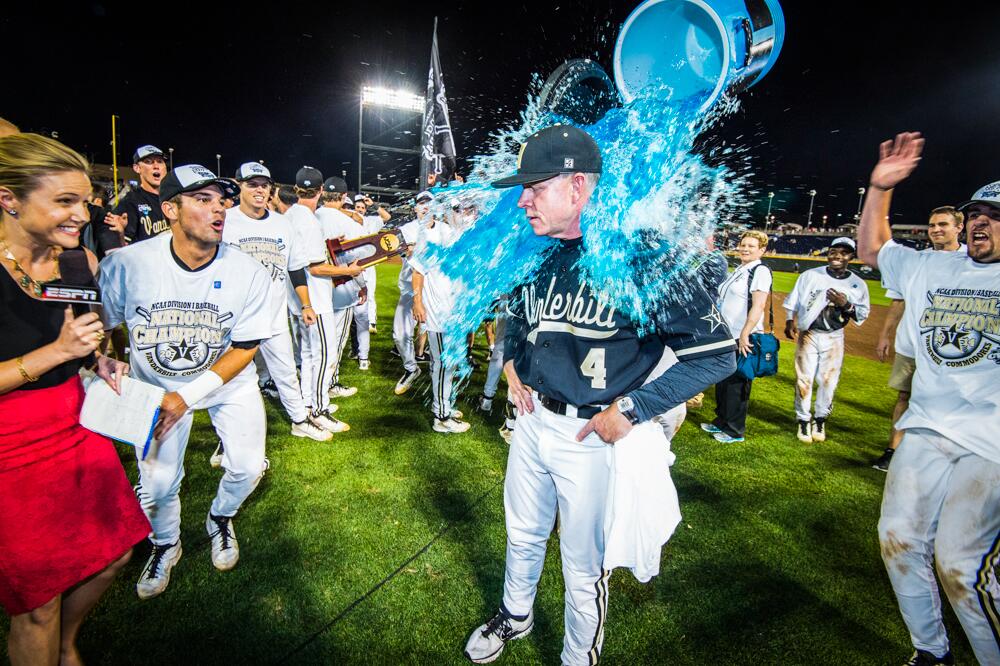
Vanderbilt wins the College World Series, claims its first-ever mens’ national championship

After struggling through the first two games of the College World Series, Vanderbilt came out looking like a team that belonged in the final pairing in a much tighter game three. The Commodores drew inspiration from energetic and emotional starting pitcher Carson Fulmer, who really limited the Virginia bats for the first time this series. Timely hitting finally arrived for Vandy as well: Although they only plated one run in an extended first inning, the only inning for UVA starting pitcher Josh Sborz, VU claimed the only home run of the series, John Norwood’s solo blast that proved to be the game winner, in the eighth. After that, Vanderbilt reliever Adam Ravenelle dealt two innings of solid relief to close the door on Virginia and secure the 3-2 victory. (Fans of the MLB team that drafted Ravenelle, the Detroit Tigers, are already asking whether he’s available to help stem the club’s bullpen woes this season.)

For Vanderbilt, a charter member (1932) of the Southeastern Conference and a university with an interscholastic athletic history dating to the 1800s, last night’s win was especially remarkable, because it was the school’s first-ever national championship for a men’s team, and just its second national championship overall. (The women’s bowling team claimed the school’s first national championship in 2007.) This win certainly feels like the culmination of the steady development of the VU baseball program by coach Tim Corbin, and with a very young roster, it shouldn’t be surprising if his Commodores are back in Omaha next year to defend their title.

______________________________________

Postscript: Like any overdue collegiate athletic victory, last night featured a post-game marriage proposal. After his team won it all, Vanderbilt pitcher Brian Miller came away with a win of his own as well. Long live college sports.

History at stake in the College World Series finale tonight

The outcome of tonight’s game between Vanderbilt and Virginia will decide the College World Series. A victory for the end of the alphabet is guaranteed, but for Vanderbilt, the stakes are higher: a win would be the school’s first national championship for a men’s team, and only its second overall. (The VU women’s bowling team won it all in 2007.)

After winning game one of the best-of-three series on Monday, the Commodores had a chance to clinch last night. They were unable to hold an early 2-1 lead, however, and ended up falling 7-2. While some are criticizing Vandy coach Tim Corbin’s decision to leave starting pitcher Tyler Beede in to pitch the seventh inning, during which Virginia’s 4-2 lead expanded to a 6-2 lead, the real problem lies with Vanderbilt’s absentee offense. There remains plenty of attention on Vanderbilt’s nine-run third inning in the first game, but UVA still owns the run differential advantage, 15-11, over the two games. Take out that wild third in the opening contest, which was as much a result of an early and unexpected pitching collapse as it was Vandy plate discipline or hitting, and that expands to a 15-2 advantage for Virginia. The truth is that VU has been unable to generate its own offense in this series, and outside of one disastrous frame, Virginia has been in control. The Commodores aren’t a power-hitting bunch, and the conditions in Omaha won’t do anything to change that, but one has to believe the Vandy bats are due to come alive. They must do so tonight if the Dores are going to claim this national championship.

While a Vanderbilt win tonight would make school history, and last night’s bid may itself have been historic as (possibly, I haven’t researched this) the school’s first actual opportunity to win a men’s national championship, the Cav-Hoos are carrying the mantle and burden of a conference into tonight’s game: The ACC has just one College World Series win, and it came in the 1950s, when Wake Forest topped the Broncos of Western Michigan.

Families that play together (periodically) win together: NBA champions edition

Following the San Antonio Spurs’ dominant win over the Miami Heat in the NBA finals, FiveThirtyEight decided to examine whether the popular narrative about the winners and losers– that the Spurs played a more complete, team-oriented style of basketball the Heat, increasingly reliant on their solitary superstar, could not combat– was borne out in the numbers. They did this by comparing the relative usage rates (USG%) of the teams’ lineups. Plotting the difference in USG% between each team’s “top” player, the one who “used” the most possessions to either shoot, be fouled, or commit a turnover, and each successive player, should show how well the team spread the ball around. A team that did a good job of sharing the ball should plot a flatter line than a team that did not. FiveThirtyEight’s chart supported the popular narrative: San Antonio’s line was flatter than Miami’s, and the league average, while Miami’s line topped both.

As FiveThirtyEight pointed out, this isn’t how NBA championships are supposed to be won. As much as the Heat’s assemblage of its “big three” was seen as groundbreaking, it fit the narrative that grew out of Michael Jordan’s Bulls and Kobe Bryant’s Lakers (and certainly existed before Phil Jackson coached both of those teams to multiple championships) that the NBA was a star-driven league, and the way to win championships was to have a superstar. The Heat simply presented as an extreme version of that reality, with little in the way of supporting cast members.

FiveThirtyEight only compared this year’s teams, but the article made me wonder how the last NBA champions who deviated from the star-heavy model– the Detroit Pistons team that won it all exactly ten years ago amidst a solid run– compared statistically to this year’s Spurs.

I tallied the numbers using Basketball-Reference‘s team playoff data, sorted by USG%. Before doing so, though, I made an executive decision to omit data from players who appeared in fewer than ten playoff games that year, which swept out Austin Daye (one game for the 2014 Spurs) and Darko Milicic (eight games for the 2004 Pistons). The resulting plot lines for each team are essentially equally flat:

nbachampusagechartFor perspective, keep in mind where the Spurs’ line– red on my chart, black on the one above– is situated relative to the rest of the (2014) league. It seems these Spurs and those Pistons were on the same page when it came to playing team-oriented basketball. Meanwhile, Miami is discussing adding Carmelo Anthony for next season. Anthony has been in the top ten in the league for USG% in nine of the past ten years.

ALDLAND Podcast

It’s World Cup time, and ALDLAND is here to bring you coverage of the big event down in Brazil (although not live coverage, because our request for travel funds was denied). We talk surprises, not surprises, the United States of America, and how the United States of America is the most awesome country in the world. We also discuss at length how you should be ashamed of yourself if you were born in the US and root for another country over your nation of birth.

_______________________________

Download the ALDLAND podcast at our Podcasts Page or stream it right here:

ALDLAND Podcast

ALDLAND is in finals mode . . . NBA and NHL finals that is! Your favorite hosts are here to break down, or at least pay lip service to the championship rounds in both hockey and basketball. And that’s not all. Stay around after finals talk for a quick discussion on the upcoming Vanderbilt-Stanford series in the NCAA baseball tournament. It’s really the most fun you can have listening to a podcast.

_______________________________

Download the ALDLAND podcast at our Podcasts Page or stream it right here:

Flying Tigers: Closing Time?

Detroit sought The Answer once before, late in his life, but he brought only questions. Now, Joe Nathan is supposed to be Detroit’s answer to the clown show that was 2013 Jose Valverde. Through one third of the season, though, Joe is looking a lot like Jose.

Before Detroit canned him for the last time, Papa Grande pitched 19.1 innings for the 2013 Tigers. To date, Nathan has pitched 20.2 innings for the 2014 Tigers. Their numbers are eerily similar:

josenathan

(Click to enlarge. Numbers from BaseballReference.)

Last year, the team cut Valverde loose in the middle of the season, handing the closer job to the very capable former eighth-inning man, Joaquin Benoit. Could something similar happen this season? Joba Chamberlain has firmly grasped the eighth-inning reins at this point, and he could shift into the closer, perhaps once Joel Hanrahan is ready for big-league action. If Brad Ausmus doesn’t at least start to experiment with his approach to the ninth inning, though, Anibal Sanchez, who has lost two gems in one week due in large part to Nathan’s mistakes, may take matters into his own hands.

[Cross-posted at Bless You Boys. -Ed.]

_____________________________________________________

Previously
Flying Tigers: Closing the Book on 2013 – 6/2
Flying Tigers: Victor Martinez, Professional Hitter
 – 5/7
Flying Tigers: Actually Mad Max
 – 4/29
Flying Tigers: Waiting for Takeoff – 4/28

Hockey parlor games

Found this from FiveThirtyEight:

With the Stanley Cup finals set to start tonight, I thought this would be a fun game to play, especially for hockey fans whose teams are done for the season.

For me, the picking went pretty easy, probably because there are lots of good combinations here. I went with Ken Dryden ($2); Lidstrom, my favorite player, potentially overvalued but always undervalued while he played ($5); Chelios ($1); Mr. Hockey ($5); Super Mario ($4); and John Bucyk, never of whom I have heard ($1). (I originally had Shanahan at LW before realizing I needed two defensemen, hence Cheli and Mr. Bucyk.)

FiveThirtyEight offers a team “formed from an advanced stats point of view.” In this case, that mostly means referencing Goals Versus Threshold (“GVT”), a WAR-like statistic that seeks to present “the value of a player, in goals, above what a replacement player would have contributed.” Their picks:

  • Hasek ($4) – “A steal”
  • Orr ($5) – “the difference between his production at his peak … and that of the next-best defenseman is truly massive”
  • Larry Robinson ($2) – “a higher five-year peak [in terms of GVT] than . . . Lidstrom despite” costing less than half as much as Nick
  • Gretzky ($5) – his “production was such a radical outlier that he’ll be worth the price”
  • Jarri Kurri ($1) and Bucyk ($1) – “both Hall of Famers” and “building a top-heavy team with a few stars and a bunch of lesser players is not such a bad thing.

Post your team in the comments below, and cast your predictive vote for the outcome of this year’s Stanley Cup finals right here:

Flying Tigers: Closing the Book on 2013

Rock and Roll never forgets, and neither does ALDLAND. Last season, I took a look at whether the Tigers struggled to score later in games, a trend that, if shown and in combination with the team’s bullpen woes, would make comeback wins less likely. While the preliminary numbers suggested I was onto something, the trend appeared even more pronounced with one-hundred games’ worth of data. The purpose of this post is to make good on the promise implicit in that last one by completing the full season’s worth of data.

First, an aside on data collection. I previously gathered and organized these inning-by-inning run totals by hand because I didn’t realize Baseball Reference actually tracks that information. In order to maintain the same error potential, and because B-R doesn’t separate the runs/inning between wins and losses, I’ve updated (a simplified version of) my chart as I did before.

r-in 2013

Continue reading