Analyzing college football coaches’ favorite musical artists

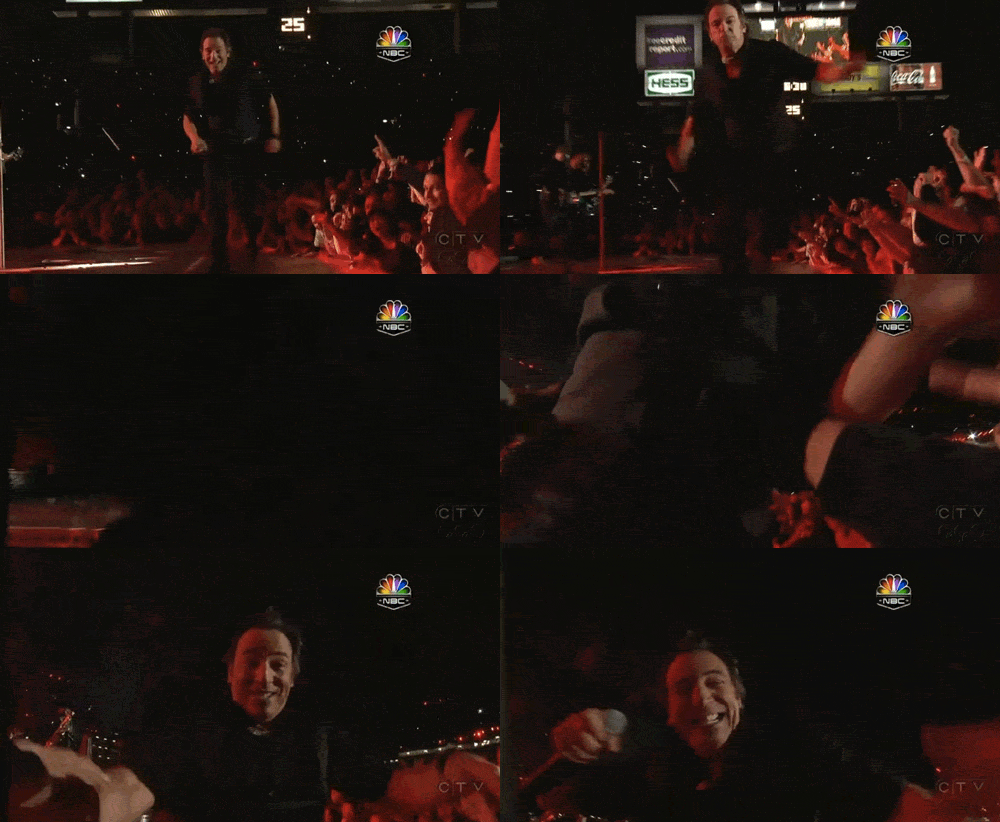
bruce-springsteen-slide-super-bowl-halftime-show

ESPN conducted a survey of all 128 Division I college football coaches, asking them to name their favorite musical artist. The full list of responses is here. My cursory analysis is here:   Continue reading

Sports Law Roundup – 11/18/2016

aslr

I used to write the sports technology roundup at TechGraphs, an internet website that died, and now I am writing the sports law roundup at ALDLAND, an internet website.

Here are the top sports-related legal stories from the past week:

  • Baseball stadium netting: On Wednesday, the trial court dismissed a lawsuit seeking increased fan-safety measures in baseball stadiums, including expanded safety netting behind dugouts and along the foul lines, based on a lack of standing. I previously wrote about this case over at TechGraphs (see here, here, and here), generally discussing the ways in which it– despite the legal weaknesses in the plaintiffs’ position– already was effecting change. Although those legal weaknesses proved to be the downfall of this suit, the court’s ruling was not without its admonitions to Major League Baseball. For example, an early footnote contains this observation: “Why Major League Baseball, knowing of the risk [foul balls pose] to children in particular, does little to highlight this risk to parents remains a mystery.” The order also expressly suggests the possibility that future litigation along these lines may be more availing in other states, where the “Baseball Rule,” which makes it very difficult for fans to recover against baseball teams and leagues, has fallen under attack: “Thus, it is conceivable that, under the right set of circumstances, a plaintiff could obtain the type of relief that plaintiffs seek here. Given the changing nature of both the baseball game experience and the injuries at issue, which are far different from those in 1914, what is a ‘reasonable expectation’ on an ‘ordinary occasion’ is not a static concept.
  • Football painkillers: Attorneys for retired NFL players in a lawsuit against the league alleging that team doctors dispensed painkillers “‘as if they were candy’ regardless of long-term effects” are seeking permission to depose team owners Jerry Jones and Jim Irsay. Outside of football, Irsay, who inherited ownership of the Indianapolis Colts from his father, is known for collecting famous guitars– including Jerry Garcia’s Tiger, Les Paul’s Black Beauty, and Prince’s Yellow Cloud— and having a history of abusing painkillers. The plaintiffs also have amended their complaint to add a RICO claim, which, among other things, introduces the potential for tripling their financial recovery in the lawsuit.
  • NCAA transfer rules: Johnnie Vassar, a former Northwestern basketball player, filed a putative class-action lawsuit against the NCAA, alleging that the rule forcing transferring students to sit out of their sport for their first year at their new school violates antitrust laws. Vassar claims that he attempted to transfer from Northwestern but was unable to do so, because all of his target schools only would accept him if he could play immediately. In recent years, Northwestern has emerged as a cradle of anti-NCAA legal activity.
  • Triathlon death: A wrongful death claim brought in connection with the drowning death of a competitor in the 2010 Philadelphia Triathlon cannot proceed, a Pennsylvania appellate court ruled, concluding that the triathlete knowingly and voluntarily assumed the risk of participating in the event when, in the course of registering for it, he executed a detailed liability waiver.
  • Cuban baseball-player smuggling: In a federal criminal case against a sports agent accused of conspiracy to smuggle Cuban baseball players into the United States, the government has listed numerous professional players, including Yoenis Cespedes and Jose Abreu, as trial witnesses. For more on this general subject, ESPN The Magazine’s feature on Yasiel Puig is a must-read.
  • Boxing fraud: The defendants– Floyd Mayweather, Manny Pacquiao, HBO, Top Rank, and others– in twenty-six lawsuits alleging that they improperly concealed Pacquiao’s shoulder injury leading up to the fighters’ 2015 bout in order to boost pay-per-view sales admitted that the plaintiffs– fans and bars– had standing to pursue their claims, even as the defendants denied that those claims had any merit.
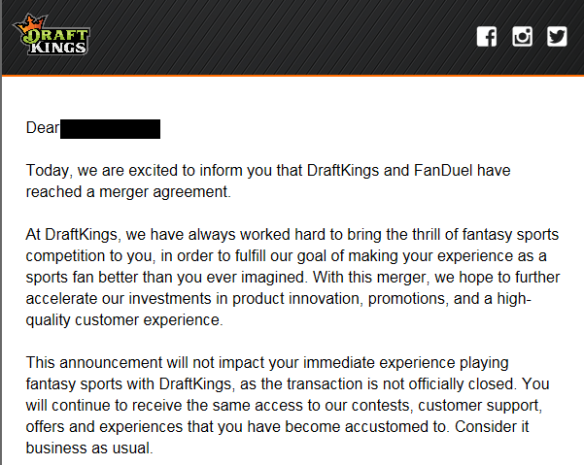
  • Gambling: West Virginia, Arizona, Louisiana, Mississippi and Wisconsin are asking the United States Supreme Court to review a Third Circuit decision rejecting New Jersey’s attempt to open up sports gambling in its state. The five states, together, filed an amicus brief in support of New Jersey’s cert petition (formal request that the Supreme Court allow them to appeal the Third Circuit’s ruling), arguing that the manner in which Congress has regulated sports gambling is unconstitutional and threatens the balance of power between the federal and state governments. In an unrelated story, daily fantasy leaders FanDuel and DraftKings announced a merger agreement this morning.
  • Secondary football ticket market: Under pressure from state regulators, the NFL agreed to end its league-wide imposition of a price floor on game tickets sold on the secondary market that had prevented the resale of tickets at prices below face value. The agreement does not apply to tickets for the Super Bowl and Pro Bowl, nor does it prevent teams from acting “unilaterally” to enforce price floors, meaning that the practice could continue.
  • Campus police records: The Indiana Supreme Court affirmed a trial court’s dismissal  of ESPN’s lawsuit seeking the University of Notre Dame Police Department’s incident reports involving student athletes, deciding that the ND Police Department is not a “public agency” and thus cannot be compelled to produce the requested materials under the state’s open records law.

Sports court is in recess.

The End of Tulsa Jam

The Tulsa Sound is defined in large part by the work of its two principal pillars, J.J. Cale and Leon Russell. Cale passed three years ago, and, on Sunday, Russell too returned to the eternal dust bowl:

Russell, known as “The Master of Space and Time,” was a master of the blues, country, rock, gospel — whatever styles of music were put in front of him and whatever he could pull from his creative mind. With dozens of albums, hundreds of songs recorded by musicians at the top of their game and thousands of contributions to recordings from The Beach Boys to J.J. Cale, Russell’s influence on music in the last 50 years has been profound.

In 1969, Russell performed in the Delaney & Bonnie and Friends band, with several members of the band coming on with Joe Cocker for the Mad Dogs and Englishmen recordings and iconic tour. That tour put a spotlight on fellow Tulsa musicians, with Jim Keltner and Blackwell on drums and Carl Radle on bass performing on the tour and on the album.

Russell launched his solo career with the release of his self-titled album in 1970, an album that included one of his best-known songs, “A Song for You.”

Russell moved back to Tulsa in the early 1970s to establish Shelter Records and build recording studios in Tulsa and near Grand Lake. A memorial to Russell grew throughout the day Sunday on the steps of his old Tulsa studio, The Church Studio on Third Street, which the city renamed Leon Russell Road in 2010.

His solo career produced multiple hit albums and songs, including “A Song for You,” “Tight Rope,” “Stranger in a Strange Land” and “Lady Blue.” His work spanned genres from the rock sounds of his self-titled 1970 album to the honky-tonk of “Hank Wilson’s Back,” incorporating blues, gospel and soul across his albums.

“He played and recorded with the heavyweights of country music — George Jones and Willie Nelson — and of course rock ‘n’ roll royalty — George Harrison and Eric Clapton,” said Jeff Moore, director of the forthcoming Oklahoma Museum of Popular Culture, to which Russell donated a large part of his work for future display.

Relix adds this note from Russell’s appearance at the 2015 Lockn’ Festival:

But when it came down to brass tacks, he was straight business—playing and singing with all his might, giving tips to the musicians, beaming with joy as Derek [Trucks] ripped a solo or Susan [Tedeschi] wailed on the mic, and even leading the troupe through some surreal improvised jams. He was fully engaged with everyone in that rehearsal room, even though it must’ve been an overwhelming experience for him (he was working with dozens of people he hadn’t seen in over 45 years). He was like the elder statesman of the experience and treated everyone with love, respect and humility, which ultimately guided that massive collective to deliver one of the finest and most memorable shows any of us had ever seen or any of the musicians had been a part of.

Enough chatter. I’ve featured the exact same take of this first jam in this space before, but its opening makes it too perfect to omit this time around:

Russell also played a featured role in Ravi Shankar and George Harrison’s Concert for Bangladesh, and this spotlight medley is a highlight of the night:

I’m not sure what’s going to happen now to the Tulsa Sound and scene without these two, and I’m hardly in a position to say, but I know that they made something special, authentic, and perfectly delivered. We don’t deserve more, and we probably don’t even deserve that.

____________________________________________________

Previously
J.J. Jam
Stranger in Town Jam

DraftKings and FanDuel finally announce inevitable merger agreement

dk-merger

According to this morning’s press release, the two DFS companies “are merging to create a stronger entity that can focus on growing the fantasy sports market by developing new products and features, delivering enhanced user experiences and creating an overall stronger fantasy sports community, all aimed at creating a more diverse, exciting and appealing experience for fantasy sports players and sports fans generally,” which, sure.

There already was some probably unethical data sharing going on between these companies, and with the bills for difficult regulatory battles coming due, it makes perfect sense that these companies would merge. DraftKings’ CEO will become the CEO of the new company, and FanDuel’s CEO will become the chairman of the board.  The two sites will continue to operate separately through the 2017 NFL season, integrating only after the merger has cleared all regulatory hurdles and is finalized.

If you’re still playing these games without the use of a zombie computer army, well, good luck.

_________________________________________________________

Related
Lose money playing DraftKings or FanDuel? File a lawsuit.
Why I don’t gamble on sports, ep. 37

Final 2016 MLB prediction report

giphy

Now that the individual awards are out, we can put a wrap on my preseason MLB predictions. I’ve already recapped the team-standing predictions and results here, and what follows is a look at how well I predicted the individual player awards announced this week:

American League

MVP: Mike Trout

Correct. Trout’s win was not the result of a unanimous vote, but it was a clear win. He was the favorite for the award at the beginning of the season, and, despite playing on a bad team (a factor that seems to matter to some), Trout is a generational player, and maybe more, who a not-small group of people believe should have won this award every year of his career. By the leading WAR metrics, this wasn’t even Trout’s best season (although it’s a close call by rWAR), but he was better than everybody else. Good call, BBWAA.

Cy Young: Chris Sale

Incorrect. Sale finished fourth, and Rick Porcello won the award. Let’s not talk any more about this one.

Rookie of the Year: A.J. Reed

Incorrect. This one was my biggest gamble of the entire predicting process. While the NL ROY choice was obvious even before the season started, the AL seemed to me to be wide open, so I chose a little-discussed player who seemed to be in a position to make a big impact for a good team that seemed ready to explode. Even last year, the Astros had a lineup stocked with young talent, and it appeared that they might be a bit ahead of schedule on their massive rebuilding plan. Preseason, their only real gap in the lineup looked like it was at first base, and Reed was a power-hitting first baseman waiting in the wings. Unfortunately for my prediction, which obviously is what matters most here, the Astros weren’t ahead of schedule, and Reed did not propel them to the postseason in a blaze of hitting glory. Instead, Houston’s pitching regressed, and Reed played just forty-five games of sub-replacement-level baseball. Next year could be a very different story, though, as Houston– which added Brian McCann and Josh Reddick yesterday– looks to be making a very strong push for 2017. Right on schedule.

The actual winner, Michael Fulmer, was a great choice. I wrote more about his win here.

National League

MVP: Paul Goldschmidt   Continue reading

Kate Upton has a point: Writers must do better with baseball awards voting (via Fox Sports)

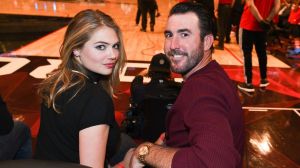
111716-mlb-tigers-verlander-upton-pi-vadapt-980-high-75Kate Upton had a point. Her math is off, her facts are off, but she had a point.
Sorry, Kate, no writer should be fired for failing to vote for your fiance, Justin Verlander, for the American League Cy Young Award.

But, with all due respect to the Baseball Writers Association of America — of which I am a proud member — the omission of Verlander from the ballot by both Tampa Bay voters is indeed an indication that we can do a better job choosing the voters for our awards.

Judging voters too harshly is a slippery slope: I vehemently oppose penalizing anyone for holding an unpopular or even mistaken opinion. At the same time, it is the obligation of every voter to develop a sound rationale for his or her choices. Different answers are acceptable; it’s the process that matters.

The Tampa Bay voters, Bill Chastain of MLB.com and Fred Goodall of the Associated Press, cannot be held solely responsible for Verlander’s second-place finish, despite what Upton said in her epic Twitter rant Wednesday night. Verlander would have needed third-place votes or better from both to overcome Porcello – and seven other writers placed him fourth or fifth.

Chastain told the New York Daily News that he submitted his ballot with about a week left in the regular season; a curious choice, to say the least, when Verlander’s Tigers were still fighting for a playoff berth. Goodall, one of several AP writers who vote for BBWAA awards, does not solely cover baseball; he reports on a variety of sports in the Tampa Bay area.

Ultimately, though, each writer needs to take responsibility; if you are not prepared to engage in or capable of the necessary analysis, then don’t accept the ballot. Chastain and Goodall did not make indefensible choices — Chastain went Porcello-Britton-Kluber-Sale-Masahiro Tanaka; Goodall went Porcello-Kluber-J.A. Happ-Britton-Aaron Sanchez. But the complete exclusion of Verlander by both makes little sense.

Votes are subjective, differences of opinion expected. But the BBWAA has a responsibility, too — a responsibility to make sure that we select the most qualified voters, the best of the best, to get the optimal result.

If we fail to do that, shame on us. … Read More

(via Fox Sports)

HT: LRAD/MSN.com

Michael Fulmer and the changing face of the Detroit Tigers

fulmer_poy_r6n5p8h1_j3r60e3n

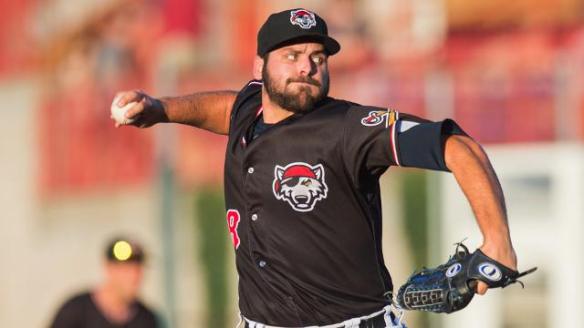
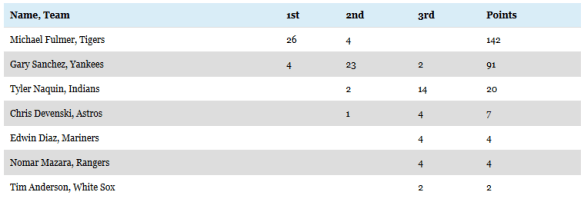
We learned Monday that Detroit Tigers starting pitcher Michael Fulmer is the 2016 American League rookie of the year. While not a unanimous selection like his National League counterpart, Corey Seager, he still claimed the award in convincing fashion:

royfulmer

Fulmer is the fifth Tiger to win the award, joining teammate Justin Verlander, Lou Whitaker, Mark Fidrych, and Harvey Kuenn. The connection between Verlander, who won his rookie of the year exactly ten years ago and is a contender for his second Cy Young award this year, and Fulmer seems to be a neat and real mentorship relationship. Here’s a snapshot statistical comparison of Verlander and Fulmer in their rookie-of-the-year seasons:

royfulmerverlander

It certainly is exciting to consider the possibility that the Tigers have found in Fulmer another Verlander, even if Fulmer’s numbers– comparatively superior to Verlander’s ROY season across the selected metrics– have some worried about his ability to repeat his rookie-year successes. (This concern boils down to the relatively large gap between Fulmer’s ERA and his FIP. It seems worth noting that Verlander had an even larger gap in 2006.) It doesn’t mean a lot, but the similarities make for a fun comparison.

Fulmer’s accolades serve as a reminder that the next generation of this Tigers team already has arrived, at least in part, and that, with business-side changes afoot, the veteran generation could be gone before we know it.   Continue reading

Kansas trick kick-return play validates Mountain West’s hazing of Boise State

One of the first stories we covered at this site occurred back in 2011, when the Mountain West Conference hazed new member Boise State by prohibiting them from wearing their blue uniforms in home conference games, claiming that the uniforms gave the Broncos “a competitive edge” in games played on their blue home turf, all while permitting charter conference member Colorado State to wear green uniforms in all of their conference games played on green turf. The MWC position was such a sham that even the NCAA could see it was a bad idea.

On Saturday night, though, the otherwise hapless Kansas Jayhawks showed that there might be something to this turf camouflage concern:

Not bad, but it won’t help KU hide from Charlie Weis, to whom the university still owes money.

Zappa plays Zappa and you can too

zpz

Frank Zappa is one of the greatest and most interesting musicians America has produced. From 1966 until he died in 1993, he released dozens of albums bending various musical genres around his acerbic wit. FZ’s M.O., as I understand it, basically was to trick people into consuming high art by dressing it up as low art. His bands were one part orchestra, one part Foley studio, and one part rock & roll outfit. Creating the appearance of radical spontaneity on stage or in the recording studio merely was a crowning achievement of what undoubtedly was a very organized process. Zappa may have held extreme political views, but he was no anarchist. In light of the complexity of the music and the number of people it took to make it, everything– even kazoo honks and beach ball bounces– had to be carefully composed, or the project wouldn’t work. Was radical spontaneity involved in the initial generation of the ideas the songs would convey? Surely, and that’s what made these songs exciting and (attractively) dangerous to fans: even though the execution of these concepts necessarily was an orderly process, it still was Frank at the helm, and the audience didn’t know how far he would push the limits or if he’d steer them entirely off the rails.

All of that is what makes it a little bit difficult to digest what Dweezil Zappa is up to. Continue reading