Sports Law Roundup – 2/3/2017

aslr

I used to write the sports technology roundup at TechGraphs, an internet website that died, and now I am writing the sports law roundup at ALDLAND, an internet website.

After a week off to attend a fancy law conference, we’re back with the top sports-related legal stories from the past week or so:

  • Baylor sexual assault: The scope of the sexual assault scandal at Baylor University continues to expand. Last week, a former Baylor student sued the university because, she alleged, she was the victim of a group rape committed by two football players in 2013 that the school ignored. The plaintiff also alleged that football players were responsible for numerous other crimes “involving violent physical assault, armed robbery, burglary, drugs, guns, and, notably, the most widespread culture of sexual violence and abuse of women ever reported in a collegiate athletic program.” She further claims that, between 2011 and 2014, thirty-one Baylor football players committed a total of fifty-two rapes, including five gang rapes. The complaint makes out claims under Title IX and common-law negligence theories. One significant hurdle for the plaintiff is that both types of claims are subject to two-year statutes of limitations. Since her alleged rape occurred in 2013, the university is likely to seek a dismissal on that basis.
  • College football defamation: In more Baylor football news, former head coach Art Briles now has dropped the defamation lawsuit he filed just two months ago against three Baylor regents and the university’s senior vice president and CEO for their statements that Briles was aware of sex crimes reportedly committed by his players and failed to provide that information to proper authorities, among other claims. As of this writing, no one has made an official comment on Briles’ behalf explaining the dismissal, but it appears to be connected to documents some of the same defendants in the Briles case filed in a new defamation case brought this week by former Baylor football director of operations Colin Shillinglaw. Those documents supposedly demonstrate Briles’ awareness of and attempts to cover up his players’ wrongdoing. If you’re the TMZ type, you can read more about the contents of the alleged Briles communications here.
  • Wrestling ban: Iran has announced that it will not allow the American wrestling team to compete in the 2017 Freestyle World Cup, which the Iranian city of Kermanshah is hosting this month. The ban comes as a form of retaliation for President Donald Trump’s January 27 executive order temporarily blocking people from entering the United States from Iran and six other majority-Muslim countries.
  • Football head injuries: A state court judge in New York denied the NFL’s motion to dismiss a wrongful-death lawsuit brought by the son of deceased player Arthur DeCarlo Sr., who, his son alleges, died as a result of CTE he contracted from head injuries sustained while playing football. This is the only CTE case against the NFL that is outside of the federal multidistrict settlement based in a Pennsylvania federal court. Addressing a statute-of-limitations issue, the New York judge likened the case to asbestos claims by describing CTE as a latent condition, the manifestation of which is not discoverable until the completion of a posthumous autopsy. Meanwhile, on Monday, a group of former college football players filed suit against helmet manufacturer Riddell seeking class-action status and alleging that Riddell made false claims about its helmet’s ability to protect against concussions. This is the fifth active concussion-related lawsuit pending against Riddell.
  • Cheerleader wages: A former San Francisco 49ers cheerleader filed a complaint against the NFL and the twenty-six NFL teams that have cheerleaders, alleging that they conspired to suppress cheerleader wages (which are between $1,000 and $1,500 per year, according to the complaint) below market value. The unnamed plaintiff is seeking to represent a class of all NFL cheerleaders employed in the past four years.
  • Child abuse: Three former Penn State University administrators will face criminal child endangerment charges stemming from the Jerry Sandusky sexual assault scandal inside the university’s football program. PSU’s former president, senior vice president, and athletic director were successful in quashing charges of failing to report child sexual abuse, but their trials on the remaining charge will go forward next month.
  • Student-athlete rights: The general counsel of the National Labor Relations Board issued an official memorandum stating that football players at Division I FBS schools “are employees under the [National Labor Relations Act], with the rights and protections of that act.” The precise legal consequences of this memorandum are unclear, at least to this writer, but the practical consequences likely will include an increase in unionization attempts and unfair labor practice filings among student-athletes at the covered schools. The memorandum already has generated critical comments from some members of Congress who believe it would have “devastating consequences for students and academic institutions[,] puts the interests of union leaders over America’s students, and . . . has the potential to create significant confusion at college campuses across the nation.”
  • Baseball hacking: As punishment for their hacking of the Houston Astros’ database, MLB fined the St. Louis Cardinals $2 million and forced them to forfeit two 2017 draft picks (the fifty-sixth and seventy-fifth overall picks) to the Astros. In addition, the league banned the currently jailed St. Louis employee who hacked the Houston system multiple times from future MLB employment. Most commentators and team officials regard the sanction as a light one.
  • Daily Fantasy Sports: The European island nation of Malta has granted daily fantasy sports website DraftKings a license to operate in that country, and that license may allow the site to operate in other European jurisdictions that recognize the Maltese license as well.
  • Live game streaming: MSG has entered into an agreement with the NHL to broadcast the four New York and New Jersey hockey teams (Sabres, Rangers, Islanders, and Devils) on the network’s live streaming service, MSG GO, which is available for free to MSG subscribers. Meanwhile, another New-York-area network, SNY, will begin streaming Mets games on its own website and the NBC Sports app. (NBC previously reached a streaming agreement with MLB Advanced Media for in-market access to Cubs, White Sox, Phillies, Athletics, and Giants games starting this year.)

Sports court is in recess.

Jim Leyland still isn’t buying media narratives

leyland-heat

If you’ve missed hearing Jim Leyland’s gravely voice churning up prefabricated media narratives like rocks in a cement mixer, then do not miss the MLB Network special on Leyland, which airs tonight at 9:00 Eastern.

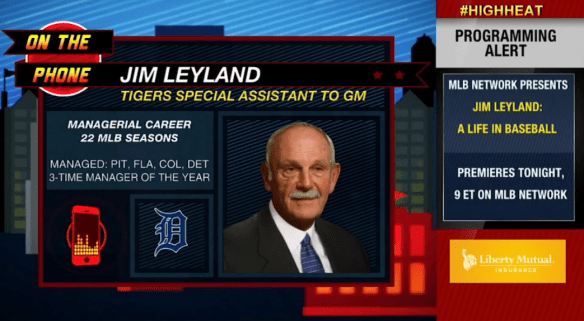
In advance of the program, Leyland appeared today on MLB Network’s High Heat, refusing to take the bait as host Christopher “Mad Dog” Russo persistently and loudly (as expected) ran Leyland through some of the tougher moments in his more than twenty years as a major-league manager.

For me, Leyland, with his lovable disdain for the media, memorable battles with umpires, smoking of Marlboro Reds, and the mutual affection between him and his players and assistant coaches, is an essential part of the recent stretch of Detroit Tigers success, and he means a lot to the Marlins and Pirates communities too. The mere mention of a Jim Leyland special probably is enough to send most baseball fans to their televisions or DVRs, but if you’re on the fence, here’s the preview video, which includes this shot:

leyland-costas

Plus this guy(!):

gene-leyland

This is going to be a good show no matter what, but I will be a little disappointed if we don’t get to see Leyland singing (or not singing) or talking about his sweet pre-game ritual or post-game dancing.

Sports Law Roundup – 1/20/2017

aslr

I used to write the sports technology roundup at TechGraphs, an internet website that died, and now I am writing the sports law roundup at ALDLAND, an internet website.

Here are the top sports-related legal stories from the past week:

  • Hockey head injuries: In a discovery dispute in a case between the NHL and over one hundred former players alleging that the league knew or should have known that concussions can lead to CTE, the NHL filed a motion seeking a court order compelling Boston University’s CTE Center to turn over research documents the former players say constitute evidence supporting their claims. Thus far, BU, which “maintains what it calls the largest brain repository in the world dedicated to the study of CTE,” had refused to provide the league with the requested information on confidentiality grounds.
  • Atlanta Braves Community Fund: A lawsuit alleges that, since at least 2010, the Atlanta Braves have failed to make adequate payments to a nonprofit entity known as the Community Fund as required under the team’s contract with the city (technically the City of Atlanta and Fulton County Recreation Authority) for Turner Field. That contract required the Braves to pay specified shares of revenue from both baseball and non-baseball events at Turner Field to the Community Fund, which now claims that the team underpaid in violation of that contract. The Braves played their final game ever at Turner Field last October.
  • Beatles’ declaration worth many pennies: Since we’re thin on sports law stories this week and sometimes cover music on this site, here included is comment on Paul McCartney’s recent lawsuit seeking a declaration that his prior exercise of certain rights under copyright law will not cause a breach of publishing agreements with Sony. McCartney is hoping to gain control of the rights to songs he wrote prior to 1978 but fears retribution from Sony, which could not provide “clear assurances he won’t face contract troubles for taking back his songs.”

Sports court is in recess.

Is the next Mike Trout already in Detroit?

mlbf_554824983_th_45

He’s only twenty-five years old, but Mike Trout is the best player in baseball today and one of the best ever. There’s only one of him, though, and he’s under contract with the Angels through 2020, which means that your team can’t have him anytime soon, and, unless your team is the Yankees or Dodgers, it probably can’t afford him once he hits free agency either. If you don’t and won’t ever have Trout himself, your only option is to make like the post-Jordan NBA and find the next Trout. Everybody wants to be like Mike.

The Detroit Tigers, for example, really could use a guy like Trout. They haven’t done much this offseason, and they’re in need of a center fielder. Of course, they had a decent center fielder in 2016 in Cameron Maybin, but the team “traded” him to the Angels as soon as the season was over and, surprise, the Angels didn’t send Trout, who also plays center, to the Tigers in return.

While the hole in the middle of the outfield currently remains unaddressed (the team’s very recent acquisition of Mikie Mahtook notwithstanding), another anticipated outfield move that Detroit has not yet made is trading right fielder J.D. Martinez, who will be a free agent after this coming season. Martinez has been very good since the Tigers acquired him from Houston, and, assuming he returns to form following his elbow injury last season, he will earn a payday next offseason beyond what the Tigers likely will want to offer.

Before Martinez inevitably departs the Motor City, it’s worth taking another look at what exactly the Tigers have in their young right fielder, and, bold as it may seem, asking whether he’s the next Trout.

On one hand, the answer obviously is no. Martinez, in his best season, was, by whichever WAR metric you prefer, about half as valuable as Trout was in his best. There also is the matter of age: while we’d expect The Next Trout to be younger than Trout, J.D. is four years older than Mike.

On the other hand, anyone who’s followed Martinez’s career knows that he was reborn as a hitter after he left Houston for Detroit, creating a bit of deception in his developmental track (I’m sure he doesn’t spend much time thinking about those first three MLB seasons), even if the aging clock ticks on.

Imagining, for purposes of this strained and fabricated narrative, that this “young” Martinez was coming up behind the more experienced Trout, we might also notice that the two outfielders have similar batting profiles.

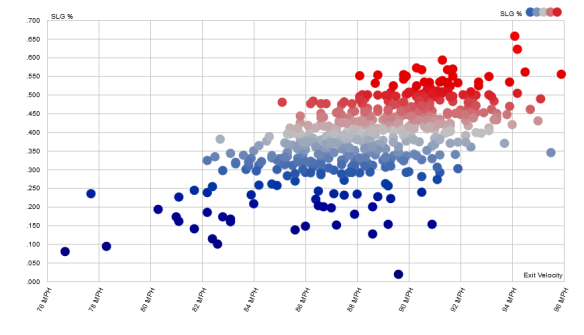
This afternoon, Baseball Savant creator Darren Wilman tweeted a link to a chart comparing hitters according to their batted ball exit velocity and slugging percentage:

scatter

Right there next to each other at the top of the curve are Trout and Martinez. (Click below to see more precise indications of their positions.)

Everyone knows Trout and Martinez are power-hitting outfielders, but I still was surprised to see how close Martinez was to Trout on this graph. Martinez’s overall value suffers because he plays an easier position than Trout, and, although his defense showed marked improvement in 2015 (before the improvements evaporated in his broken-elbow season last year), plays it less well than Trout plays his. Still, if I’m Martinez’s agent, a chart showing that my client hits– in terms of exit velocity and extra bases– just like Trout is going to be on page one of the Boras Binder I’m distributing this offseason. And if I’m Tigers GM Al Avila, I’ll make sure every potential trade partner this summer catches a glimpse of it too.

Sure, some still want Detroit to make another all-in push in 2017, but the proverbial contention window is hanging as heavy and tenuously in its frame as it ever has for this crew, and it’s tough to imagine a world in which they can retain Martinez. In five years, after seeing him mash in pinstripes or Dodger blue, Tigers fans may look back and see Martinez’s delayed, Trout-esque offensive prime as one of the largest costs of their now-overleveraged roster.

At last, unimpeachable grounds for removing a BBWAA member’s hall of fame vote

halloffameexterior

Voting now is underway for the 2017 class of Baseball Hall of Fame inductees, which means it’s the time of year when two things happen: 1) people who vote on HOF enshrinement write articles explaining their ballot choices as a way of reminding us that they (i.e., the writer-voters) are important, and 2) people say that some of those people should lose their voting rights for some reason or another. Maybe the voter voted for Roger Clemens. Maybe the voter didn’t vote for Roger Clemens. Maybe the voter hasn’t covered baseball in ten years and thinks Roger Clemens still is playing for the Blue Jays. Maybe the voter sold his vote to Deadspin. Who knows. What these would-be disenfranchisers tend to have in common is that they themselves are disenfranchised but want their voices heard on the ballot questions just as much as those actually allowed to vote. These “disputes” come down to policy preferences, and it’s tough imagine a voter’s decision to vote or not vote for a particular player providing a basis for stripping a voter of his or her vote (though Lou Whittaker and Alan Trammel’s exclusions from Cooperstown will never not baffle).

At last, though, we are presented with an actual voter who, without question whatsoever, is deserving of banishment from the collection of people entitled to vote on admission to the Baseball Hall of Fame. If ever there were grounds upon which all agree a voter should lose voting privileges, it would be a demonstrated inability to actually vote.

Bill Livingston is one of those people who falls into the first group described above, and he wrote one of those group-one articles about his ballot this year. He wanted to tell the world that he had a vote, but that he was abstaining from voting because he hasn’t decided what he thinks about steroids in baseball. Actually, more precisely, he wrote that he was abstaining because other people (the royal “baseball”) hadn’t figured out what to do about steroids in baseball. Whatever. Maybe it’s dumb or lame or a waste, or maybe you’d hope the people upon whom HOF-voter status is bestowed would undertake a little personal responsibility and make up their minds, but it ultimately is fine. He’s abstaining. So be it.

Except Livingston didn’t abstain. He cast a blank ballot. In elections run like this one, that action constitutes casting a vote against everybody, and that’s a lot different than abstaining. Deadspin explains the situation succinctly:

The thing is, if you want to abstain from voting, what you need to do is not submit a ballot at all. That way, your ballot won’t be counted in the total pool of ballots and thus won’t change the number of votes a player needs to get to cross the 75-precent threshold [required for induction]. All Livingston has done by submitting a signed, blank ballot is to make it a little bit harder for everyone in this year’s class to get into the Hall of Fame . . . .

Mr. Livingston, I presume from his publicly described action, actually does not know how to vote, and that demonstrated ignorance constitutes unimpeachable grounds for removal of his voting privileges.

_________________________________________________________

Related
The Baseball Hall of Fame, Deadspin, the Third Rail, and the Fourth Wall
No one elected to Baseball Hall of Fame
Totally disinterested person offers opinion on 2013 MLB Hall of Fame candidates
Amid the glut of Pete Rose journalism, a new, false dichotomy

Sports Law Roundup – 1/13/2017

aslr

I used to write the sports technology roundup at TechGraphs, an internet website that died, and now I am writing the sports law roundup at ALDLAND, an internet website.

Here are the top sports-related legal stories from the past week:

  • College football head injuries: A group of former Texas Tech, Oklahoma, and TCU football players has sued the NCAA and Big XII conference, alleging that those entities breached contractual obligations to warn players of and take adequate steps to prevent head injuries. The plaintiffs are seeking class action status, and their lawyer has said that he expects to file similar lawsuits on behalf of more players this year.
  • Olympic surveillance: Two years ago, the former mayor of Salt Lake City and six SLC residents filed a proposed class action against George W. Bush, Dick Cheney, David Addington, Michael Hayden, the FBI, and the NSA, alleging that the federal government improperly spied upon people attending the 2002 Winter Olympics. Now, a judge has denied the NSA’s motion to dismiss the case and will allow it to proceed.
  • Gymnast abuse: In more Olympic news, eighteen women sued USA Gymnastics, the national governing body for gymnastics in the United States; Michigan State University; and a gym in the Lansing area. Their complaint alleges that an affiliated doctor molested and sexually assaulted the plaintiffs, some of whom were as young as nine years old when the alleged attacks occurred, and that the defendants failed to act appropriately upon their knowledge of this doctor’s actions. This is the third civil action involving this doctor, and criminal complaints also have been filed. The FBI reportedly recovered child pornography from the doctor’s electronic devices and is in possession of video evidence of the doctor perpetrating sexual assaults.
  • Baseball land shark attack: The judge overseeing a dispute between the Miami Marlins and a fan who alleges she suffered a serious neck injury in 2013 when a shark mascot, following an on-field race with other mascots, leaned into the stands and pretended to bite her head has ordered the parties to participate in mediation in advance of the case’s June trial date.
  • Concert dodgers: A concert promoter sued the Los Angeles Dodgers and Guggenheim Partners, the entity that owns the team, because, the promoter alleges, they failed to pay him a share of the proceeds from concerts by Paul McCartney and AC/DC hosted at Dodger Stadium for his work in securing those performances. The promoter says he’s owed $2 million, while a leaked draft response from the defendants reportedly tells him to “forget about the check, we’ll get hell to pay.”
  • Sports gambling legalization: Legislators in South Carolina and New York separately proposed amendments to their state constitutions that would legalize sports betting. The South Carolina proposal would allow all forms of gambling, while the New York one would be limited to allowing sports gambling at racetracks and casinos.
  • Preemptive free agency: Last week, we highlighted an article suggesting that a California employment law could allow certain athletes playing for teams in that state to unilaterally opt out of long-term contracts and become free agents. High-profile baseball agent Scott Boras subsequently weighed in on the subject and counseled against the idea largely because the transactional costs of attempting the move (i.e., years of litigation) likely would outweigh– and, due to time delay, probably completely negate– any potential benefit to the player.
  • CTE: This also is not a legal news story, exactly, but this space has highlighted a number of sports-related head-injury lawsuits in the past, which makes sharing this compelling and well-told story of a young person’s struggles with CTE appropriate. If you only click through to one link in this post, make it this one.

Sports court is in recess.

Sports Law Roundup – 1/6/2017

aslr

I used to write the sports technology roundup at TechGraphs, an internet website that died, and now I am writing the sports law roundup at ALDLAND, an internet website.

Here are the top sports-related legal stories from the first week of 2017:

  • Baseball stadium funding: The Arizona Diamondbacks, seeking the right to “explor[e] other stadium options,” have sued the Maricopa County Stadium District after the District refused to authorize funding for the $185 million needed for capital repairs and improvements to Chase Field, which opened in 1998, according to an assessment completed by the District.The team has expressed willingness to cover all of the District’s expenses, but the District apparently must give its permission to proceed and thus far has declined to do so.
  • Student-athlete classification: In a case we have been monitoring in this space (here and here), the U.S. Court of Appeals for the Seventh Circuit has denied the request of a group of former Penn student-athletes for full-court (en banc) review of that court’s earlier rejection of their claim that they were employees entitled to minimum-wage compensation under the Fair Labor Standards Act. The denial of the request for further review leaves in place the court’s decision handed down last month. It is unclear whether the plaintiffs will request permission to appeal to the Supreme Court.
  • Daily Fantasy Sports: A DFS website argued that daily fantasy sports actually are illegal gambling in an attempt to avoid a $1.1 million lawsuit based on an advertising and sponsorship contract with the Minnesota Wild. I wrote more about this case here earlier this week. Meanwhile, a Maryland law authorizing the lawful, regulated conduct of DFS contests in that state, which is regarded as less restrictive than similar measures in other states, went into effect on Monday; a Florida legislator introduced a bill Wednesday that would declare DFS legal in that state; and FanDuel earned another win in a patent-infringement suit brought by two gambling technology companies in Nevada.
  • Preemptive free agency:  Nathaniel Grow has an interesting article on FanGraphs that illuminates a California employment law that could apply to allow even union employees like professional athletes to unilaterally opt out of long-term contracts after seven years of employment. This poses a potentially tantalizing, if legally unproven, opportunity for someone like Mike Trout, a generational talent not yet in his prime who likely could fetch an even more historically large contract were he to hit the open market now, at age twenty-five, rather than after the 2020 season, which is when his current contract ends.

Sports court is in recess.

Baseball’s faithless electors

My latest post for Banished to the Pen considers the Tampa Bay Rays, the faithless electors of the vote on the 2016 MLB collective bargaining agreement, and it includes this picture:

drays

The full post is available here.

Sports Law Roundup – 12/16/2016

aslr

I used to write the sports technology roundup at TechGraphs, an internet website that died, and now I am writing the sports law roundup at ALDLAND, an internet website.

Here are the top sports-related legal stories from the past week:

  • NBA CBA: Like baseball, the NBA has a new collective-bargaining agreement. Full details are not yet public, but it appears there will be salary cap and luxury tax changes, as well as an increase– from thirteen to fourteen– in the number of guaranteed roster spots for each team. The league also has agreed to shorten the preseason and expand the calendar length of the regular season without increasing the number of regular season games. One aspect that will not change is the manner in which the players and owners divide basketball-related income. The players conceded roughly seven percent (approximately from 57% to 50%) during the last lockout in 2011.
  • NFL concussion settlement: Earlier this year, the NFL settled a class-action lawsuit brought by former players seeking compensation for ongoing problems related to head injuries suffered during their professional football careers by agreeing to provide a fund to compensate former players for the next sixty-five years. The U.S. Court of Appeals for the Third Circuit affirmed the settlement, but a small subset of the class members– approximately thirty of 22,000– were dissatisfied with the settlement, believing it was underinclusive because it did not provide relief for former players who develop CTE, the disease found in people who suffer from repeated brain trauma that, at this time, is not detectable while the player is alive. Seeking further review of the settlement, these plaintiffs petitioned the Supreme Court. On Monday, the Court declined to grant their petition, leaving in place the Third Circuit’s ruling. It is unclear whether these objecting plaintiffs have any further recourse, though they likely are watching the new lawsuit highlighted in this space last month that specifically addresses CTE.
  • Student-athlete classification: As discussed here last week, the United States Court of Appeals for the Seventh Circuit rejected claims by a group of former Penn student-athletes that they are employees entitled to minimum-wage compensation under the Fair Labor Standards Act. Now, those students plan to request en banc review, meaning that they will ask the full panel of Seventh Circuit judges to reconsider the decision. (Federal circuit courts typically hear cases in three-judge panels, even though more than three judges make up each of the federal circuit courts. Aside from an appeal to the Supreme Court, which may not even be accepted, the only way to reverse a circuit court ruling is to ask the full court to do so.) The plaintiffs contend that the amateur aspect of collegiate athletics the ruling noted is not pertinent to an FLSA analysis, and that the Seventh Circuit’s decision “conflicts with decisions in this and other circuits on employee status.”
  • Raiders stadium: In an apparent attempt to keep the Raiders from moving to Los Angeles or Las Vegas, the Alameda County Board of Supervisors voted to support the building of a new football stadium in Oakland that– unlike the new basketball arena being built for the NBA’s Warriors that will relocate them from Oakland to San Francisco–  would be funded, in significant part, with public money. The Board’s vote does not guarantee that the Raiders will stay in Oakland.
  • Rams fans: St. Louis-area holders of Rams personal seat licenses suing the team after its move to Los Angeles now have requested class-action status. The plaintiffs are seeking a variety of forms of relief, including reimbursement for tickets and concessions. A judge already has ruled that some of the plaintiffs who want the team to continue to honor the licenses by allowing the St. Louis fans to purchase season tickets at the team’s new home in L.A. are entitled to do so.
  • NFL broadcasting: The plaintiffs in an antitrust lawsuit targeting NFL Sunday Ticket, the product of the exclusive agreement between the NFL and DirecTV for the television broadcasting of out-of-market NFL games, won an apparently significant victory when Fox and CBS agreed to produce documents evidencing their own Sunday-Ticket-related agreements with the league and DirecTV in connection with a judge’s discovery order. The NFL contends that the plaintiffs have failed to allege an antitrust violation because the NFL can decide how to broadcast its games, and the Sunday Ticket package represents an addition to viewers’ existing options (i.e., the one or two games available each Sunday afternoon on Fox and CBS, plus the national Thursday/Sunday night/Monday night broadcasts) rather than a restriction.
  • Secondary ticket market: The President has signed the BOTS Act, a bill that expands the authority of the Federal Trade Commission to regulate the online secondary market for event tickets. The new law seeks to prohibit “ticket bots and other online tools that deliberately circumvent security protocols limiting or restricting online ticket purchases.” Here’s hoping this law will provide a more meaningful benefit to sports fans than the NFL’s practically meaningless agreement to end its league-wide imposition of a price floor on game tickets sold on the secondary market.
  • Formula One acquisition: Liberty Media, the company that owns the Atlanta Braves, will acquire auto-racing series Formula One for $4.4 billion. According to a reputable source, F1 cars are the fastest in the world among road-course racing cars.
  • MLB CBA: I wrote about the new CBA in this space after the league and players union reached their agreement on November 30. Now we have more information about the particularities of the agreement, and this analysis provides a helpful overview. We also learned that the Tampa Bay Rays were the only team to vote against approving the agreement. In a public statement, the Rays’ general managing partner made reference to an “opportunity [that] was missed” to “address the extraordinary and widening competitive gap that exists on-field between higher and lower revenue clubs.”

Sports court is in recess.

Sports Law Roundup – 12/9/2016

aslr

I used to write the sports technology roundup at TechGraphs, an internet website that died, and now I am writing the sports law roundup at ALDLAND, an internet website.

Here are the top sports-related legal stories from the past week:

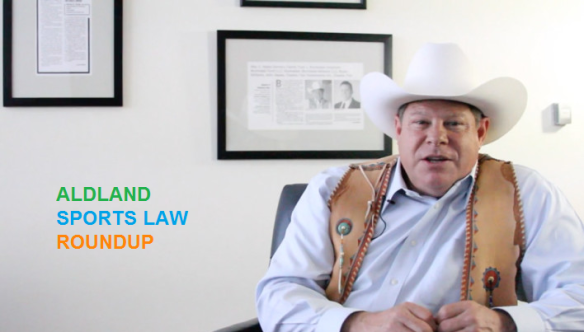
  • College football defamation: On Thursday, former Baylor head football coach Art Briles sued three Baylor regents and the university’s senior vice president and CEO claiming that they defamed him by stating that he had knowledge of sex crimes reportedly committed by his players and failed to provide that information to proper authorities. In addition, Briles alleges that the officials sought to prevent him from securing another coaching position elsewhere. He also included a claim for intentional infliction of emotional distress, and, in total, seeks unspecified damages in excess of $1,000,000. Here is a picture of Briles’ longtime attorney, Ernest H. Cannon, riding a horse at a rodeo.
  • Football player suspension challenges: In related stories covered in this space last week, two NFL players represented by the same Ohio law firm launched collateral attacks on the NFL/NFLPA collective bargaining agreement targeting alleged procedural deficiencies in the suspension-appeal process after both were suspended for drug violations. The NFL and NFLPA now have taken action in one of those cases by appointing a third arbitrator to hear a rescheduled appeal by Green Bay Packer Mike Pennel. The absence of a third arbitrator is central to the claims Pennel raised in the lawsuit he filed in Ohio federal court. In connection with that suit, Pennel also sought a temporary restraining order, which the responsive actions by the league and union were designed to moot. On Tuesday, Pennel agreed to drop his lawsuit in exchange for a reduction– from ten games to four– in his suspension, which will allow him to play in the postseason should his Packers secure a playoff berth. (Pennel’s attorneys also represent Philadelphia Eagle Lane Johnson, who filed similar complaints with the National Labor Relations Board and U.S. Department of Labor around the same time Pennel filed his lawsuit.)
  • Student-athlete classification: The United States Court of Appeals for the Seventh Circuit rejected claims by a group of former Penn student-athletes that they are employees entitled to minimum-wage compensation under the Fair Labor Standards Act. The trial court granted a motion to dismiss the defendants– the NCAA, Penn, and more than 120 other NCAA member schools– filed, and the appellate court affirmed. The court agreed that dismissal as to the non-Penn defendants was appropriate because of a lack of standing; the plaintiffs had attended only Penn and had no basis to recover wages from any school they didn’t attend. The court also agreed that dismissal was appropriate as to Penn, because the plaintiffs had failed to state a claim for relief from Penn. Noting the “revered tradition of amateurism in college sports” and the weight of judicial and regulatory precedent holding that student-athletes are not employees, the court concluded that the FLSA does not apply to student-athletes. While many disagree with this outcome, it is consistent with the original meaning and purpose behind the “student-athlete” designation. (In a concurring opinion, Judge Hamilton cautioned against broad application of the court’s decision, noting that the plaintiffs participated in a non-revenue sport– track and field– for a school that does not offer athletic scholarships, and suggested that he might have voted differently had the plaintiffs been student-athletes on athletic scholarship in a revenue sport.)
  • Hockey head injuries: A group of former NHL players suing the league for its alleged failure to warn them of known risks of head trauma now have requested class certification in that case for two classes of former players based on the different measures of relief sought: damages for those already diagnosed with neurological injuries and medical monitoring for others. Attorneys from a number of large law firms, including Skadden Arps Slate Meagher & Flom, are representing the NHL in this case. Skadden is the anchor tenant in a new commercial real estate development in Manhattan that also will be home to the NHL’s offices when it opens in 2019.
  • Minor League Baseball lobbying: MiLB has created a political action committee in order to boost lobbying efforts. The impetus for this move likely is the class-action lawsuit minor-league players filed alleging that their compensation violates federal wage and hour laws and the leagues’ attempt to snuff out that suit by way of congressional action. The proposed Save America’s Pastime Act would create a carve-out in the Fair Labor Standards Act exempting minor-league players from minimum-wage and overtime protections. There has been essentially no action on the bill since Rep. Brett Guthrie of Kentucky introduced it in June, leaving plenty of time for MLB to say dumb things about it.
  • Soccer ban: The Court of Arbitration for Sport denied former FIFA president Sepp Blatter’s request to overturn his six-year ban from all national and international soccer-related activity and fine of 50,000 Swiss francs for his involvement with bribes and kickbacks during his leadership of FIFA.
  • Canadian Super Bowl commercials: There is a thing in Congress called the House Northern Border Caucus, and four of its members, representing districts in North Dakota, New York, and Washington, sent a letter asking the Canadian government to reverse its decision to block Canadian advertisers from running commercials on the Canadian broadcast of the Super Bowl. Canadian broadcasters used to have an agreement with the NFL that allowed Canadian commercials on the Canadian broadcast of the game, but, in 2015, Canadian regulators changed course in response to viewer demands to see the popular American commercials that run during the game. Canadian broadcasters and advertisers and the NFL, which is losing out on Canadian advertising revenue as a result, all oppose that change. The company that holds the Canadian broadcast rights to the Super Bowl, Bell Media, also has sued the regulatory body in an attempt to reverse the policy.
  • Hockey logo: Things are off to a rough start for Las Vegas’ first major professional sports team after the U.S. Patent and Trademark Office denied the Golden Knights’ registration application, citing a “confusing[] similar[ity]” to a mark registered by the College of Saint Rose. Arguable visual similarities aside, I didn’t even know there was a Saint Rose, much less a College of Saint Rose, and I certainly didn’t know the school’s mascot is the Golden Knights, and neither did you, which means that, however similar these marks might be, the likelihood of confusion here is very low. This likely is little more than another instance of the USPTO seeking a moment in the sports sun.
  • Gambling: The nation of Antigua and Barbuda has issued a threat to the United States if the U.S. does not meet a year-end deadline to comply with a 2003 World Trade Organization order ruling that American online sports betting and gambling laws violate international law. If the U.S. does not comply with the WTO order, which also carries an annual noncompliance penalty of $21 million and has accrued to over $250 million, Antigua and Barbuda intends to suspend intellectual property protections for Americans, effectively permitting Antiguans to establish websites hosting royalty-free downloads of American IP (e.g., books, music, movies, television programming, etc.).
  • Baseball ambassador: Bobby Valentine, former MLB player and manager of the Mets and Red Sox, reportedly is under consideration by president-elect Donald Trump for the position of ambassador to Japan. Valentine, who currently serves as athletic director at Sacred Heart University, is popular among Japanese baseball fans thanks to two successful stints as manager of a professional baseball team there.

Sports court is in recess.