Shohei Ohtani Just Had the Best Playoff Game in Major League History (via FanGraphs)

Shohei Ohtani had quite a night, didn’t he?

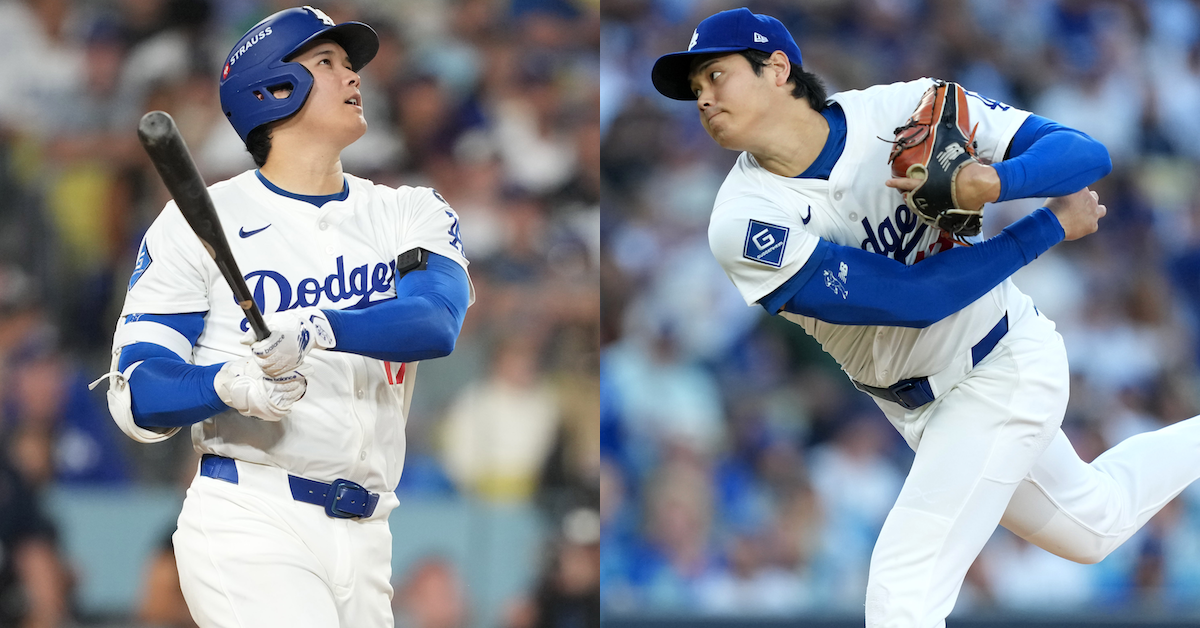
Let’s be more direct: Ohtani just had the greatest individual game in postseason history. On the mound, he threw six scoreless innings, allowing two hits and three walks while striking out 10. He got pulled after giving up two straight baserunners to start the seventh, which kind of mucked up his line, which is ironic, because that’s what the Dodgers offense has been doing to other starting pitchers over the past two weeks.

At the plate: 3-for-3 with a walk. All of those hits were solo home runs: 116.5 mph off the bat and 446 feet in the first, 116.9 mph and 469 feet in the fourth, 113.6 mph and 427 feet to center in the seventh. That second one, man, what a tank.

This is the perfect distillation of the value proposition for Ohtani. Given that this win, 5-1 over the Brewers in NLCS Game 4, clinched the pennant for the Dodgers, either one of those performances would’ve been memorable-bordering-on-legendary for Dodger fans. Put together? Well, after that fourth-inning home run, I started asking that question from a couple paragraphs back: Was this the best game in playoff history? … Read More

(via FanGraphs)

Time Again For An MLB.TV.PSA

If you thought 2025 was the year ALDLAND let Rob Manfred off the hook, you thought wrong. See above and at MLB.tv for access to what’s becoming a tradition unlike any other: MLB.TV briefly goes on sale in early May for an assertedly steep discount that more often than not hooks your correspondent but also compels him to stir up an old screed about the league’s poor media conduct. Before you click over there to grab the deal, recall this commentary on the same offering from 2022:

Readers of this website know that this author is among the last people on Earth who would go out of his way to promote an MLBAM business decision, but here you are, reading a post by me notifying you that MLB.tv is on sale today for a loosely speaking fair-ish price.

Of course, this occasion mostly serves as a reminder of MLB’s callous media-distribution practices. Six years ago, the league settled an antitrust lawsuit attacking things like its telecast blackout policy and centralized MLB.tv product by agreeing to make pricing and offering concessions to fans. Specifically, the seasonal price of the full MLB.tv package at that time would drop from $129.99 to $109.99, and the league would create a new, single-team package at a seasonal price of $84.99. These prices were to remain fixed for five years (i.e., through the 2020 season), subject to annual increases only up to the higher of three percent or the rate of inflation.

Now, that settlement agreement has expired, and MLB is seizing the opportunity to undo its effects. Most obviously, across-the-board pricing is up, doubly insulting as the league simultaneously excludes games from the full MLB.tv package for the benefit of its new partnerships with NBC and Apple.

Perhaps even more underhanded, however, is the soft killing of the single-team MLB.tv package. When first offered, the single-team option was priced at seventy-seven-percent of the full package price, then a twenty-five-dollar difference. MLB now has aggressively closed that gap. At today’s sale pricing, for example, the cost of the single-team option has jumped to eighty-six-percent of the full package price, just a ten-dollar difference. Stated otherwise, someone considering a single-team package can receive a thirty-fold increase in programming for just ten additional dollars. “Even you dummies know that’s a good deal,” fans hear Rob Manfred saying in their heads, even as they wonder why it doesn’t quite feel like a deal. The move to neutralize the single-team package feels like a purely spiteful move designed to achieve the functional undoing of one of the settlement agreement’s most visible achievements without any meaningful cost savings to MLB.

As I have been writing here for years, the message should be a simple one: “Rather than changing the game he wants people to watch . . . Manfred ought to change the way people can watch the game, obviously by making it easier for them to do so.” For how much longer can Manfred continue to squeeze baseball’s fans– including, as a recent example, Padres fans required to purchase yet another streaming service to watch this morning’s Peacock-exclusive game against the Atlanta Braves beginning at 8:35 am San Diego time– remains to be seen.

As the traditional regional sports network model of television crumbles, Manfred has not hesitated to recapture territory once ceded to independent providers and the outside revenue streams they created. The result, for now, is that MLB.tv now includes in-market offerings for ten teams: the Athletics, Diamondbacks, Dodgers, Guardians, Giants, Mets, Padres, Phillies, Rockies, and Twins. I naturally hesitate to call this a sign of progress, since the intent does not appear to be in the direction of eliminating blackouts, for example. But maybe it’s a start, and at least people in Sacramento have another way to follow their newfound MLB team.

Sailing Away: Chris Sale and the Atlanta Braves start 2025 by charting the wrong course

At the time of drafting, the Atlanta Braves mercifully are on an off day, drudging into their home opener with an 0-7 record, a start from which no team ever has recovered to reach the postseason.

Chris Sale was supposed to be an anchor for the entire Braves team, and especially its rotation. All he did last year, his first in Atlanta, was lead the team in fWAR (6.4) by nearly two wins and receive the National League Cy Young award. As with the Braves, Sale’s 2025 season is trending in the wrong direction, however.

Sale turned thirty-six on Sunday. The next day, he pitched five innings against the Los Angeles Dodgers, allowing three runs on four hits and no walks while striking out five. Not bad against a potent Dodgers offense, but his team only scored one run, so it counted as another loss.

If I’m reading this graph I generated correctly, the real trouble looming for Sale wasn’t that he fell apart in the sixth inning after holding LA scoreless and seeing just three batters over the minimum through five innings; instead, it was that he threw the slowest fastball he’s thrown since late 2023. Visually, this illustration tracks an inverse correlation between Sale’s xFIP- (lower is better) and his fastball velocity: When he’s throwing his fastball faster, his expected results tend to be better. For example, when he was locking up the Cy Young award last year, particularly in July and August, his average fastball velocity was rising and his xFIP- was plummeting. Very good. By contrast, as his average fastball velocity is dipping to start 2025, his xFIP- is climbing. Not so good.

It’s only two games, one each against two of the best teams in the National League (he also started opening day in San Diego against the Padres). But Sale is critical to Atlanta’s hopes in 2025, moreso even than last year given Spencer Strider’s injury and the departures of Max Fried and Charlie Morton, both free agents who left Atlanta to sign with AL East teams. The team needs him to be healthy and effective in carving up opposing lineups the way he once carved up his own team’s jerseys with a hunting knife.

Sale likely will be back in action this weekend as the Braves make their 2025 home debut against the Miami Marlins.

Athletes Find New Way To Avoid Taxes (via Reason)

It felt groundbreaking when Shohei Ohtani did it with the Los Angeles Dodgers over a year ago. By the time Frank Vatrano did it with the Anaheim Ducks earlier this month, it was a certified California trend.

Athletes, like everyone else, don’t like paying taxes. California has a top marginal income tax rate of 13.3 percent, plus there’s the top federal rate of 37 percent, so high-earners like athletes are forking over a lot of hard-earned money. But if the team a player wants to sign with is in California, what can they do to avoid the state’s high taxes? As Ohtani and Vatrano have now done, they can defer the income until they likely won’t be living in the Golden State anymore.

The key to avoiding taxes on deferred payments is paying them out in equal amounts over at least a decade. “A 1996 federal law forbids states from taxing retirement income on out-of-state residents when payments are made in ‘substantially equal periodic’ amounts over at least 10 years,” The Athletic‘s Evan Drellich explained.

Those deferred payments won’t just help athletes avoid taxes—they might help ease the pain felt by franchises in high-tax states when they’re negotiating with players in free agency.

Plenty of factors go into a free agent athlete’s decision on where to sign: taxes, cost of living, and climate, not to mention team-related factors. But research has shown state income taxes really do hold back teams in high-tax states. … Read More

(via Reason)

Baseball Notes: Just a Perfect Day

This column returns on a Thursday evening with two notes as lovely as forgetting your problems and drinking sangria in the park.

Scott Harris and the Young Tigers are Going Streaking:

The Detroit Tigers are off today, and, based on their recent performance, only the MLB schedule-maker can stop them from winning. On August 10, Detroit was 55-63, and, according to FanGraphs, their odds of earning a playoff berth stood at 0.5%. Since then, they’ve been the best team in baseball, going 25-10 to push their record to 80-73. They just completed a series sweep of the Kansas City Royals and, amazingly, now sit just a half game out of the American League’s last wild card spot. Those playoff odds accordingly have skyrocketed to 42.3%.

Without a game, I spent the evening listening to an interview (video below) with second-year GM Scott Harris. It’s from June 25, when the team was 36-41. It of course is exciting to hear about all of the front office’s plans and aspirations when, almost three months later, they seemingly are coming to their near-term fruition. It is pretty illuminating to hear Harris speak with confidence about those plans at a time when, at least from the outside, things were not looking too hopeful, though. I also enjoyed this interview because hosts Dan Dickerson and Jason Benetti were able to draw Harris, a self-described introvert, out into the public light in a way in which he has not previously shown himself. The public hasn’t seen or heard very much from Harris since he arrived in Detroit, and what I had observed prior to today wasn’t particularly compelling or illuminating. This, by contrast, was both insightful and enjoyable.

The MLB playoff hunt officially is on in Detroit. The team has nine games left to play, three each against the Orioles, Rays, and White Sox.

Shohei Ohtani, and only Shohei Ohtani:

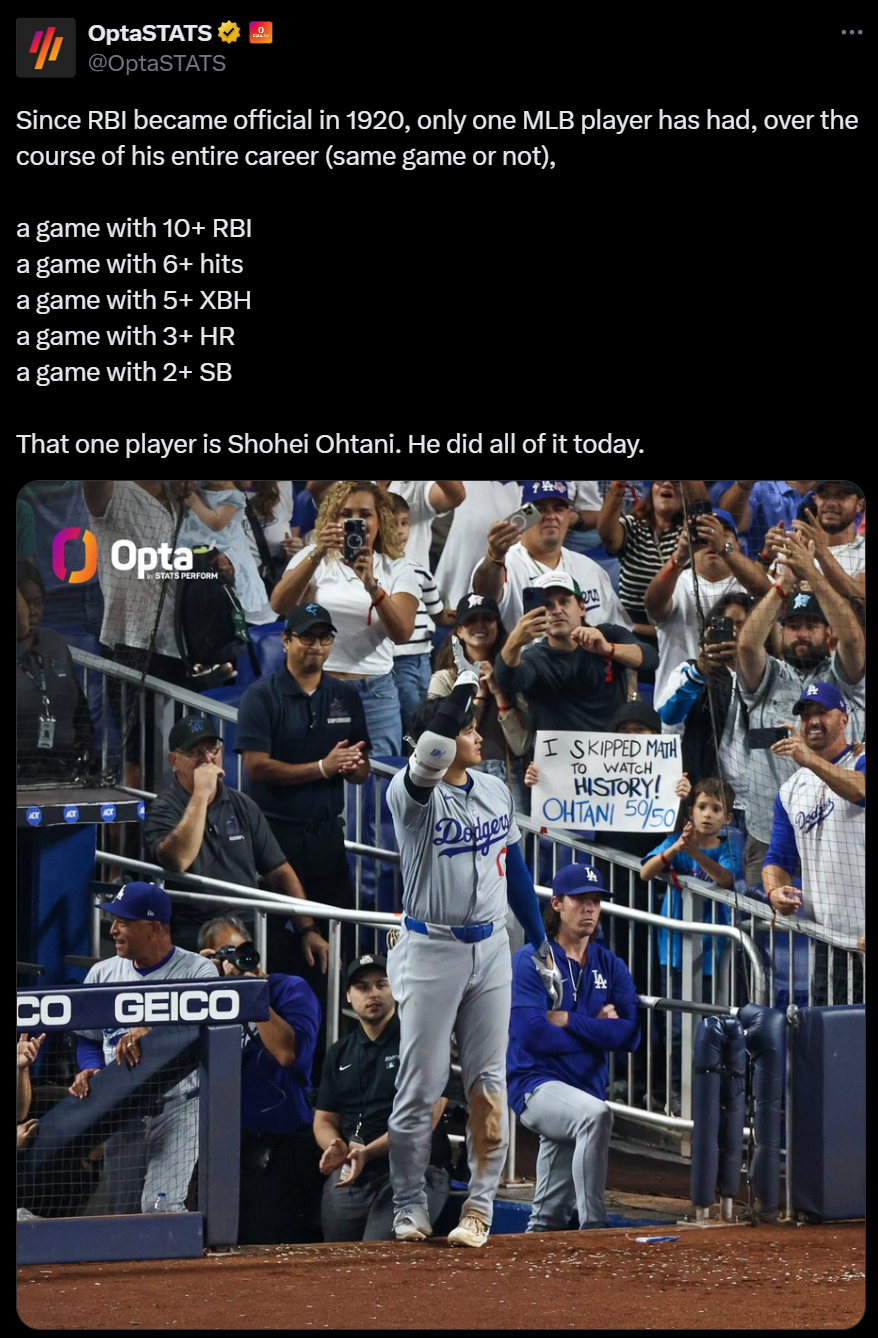
Today certainly was not an off day for the Los Angeles Dodgers. Not only did the team, in routing the Miami Marlins 20-4, clinch a playoff berth for the twelfth consecutive season, but Shohei Ohtani may have had the best single day a major-league hitter ever has had on the diamond. He went six-for-six– including three home runs and two doubles– and stole two bases.

In the process, Ohtani also became the first MLB player ever to hit fifty home runs and steal fifty bases in one season and actually stands at 51/51 with nine games remaining. We knew and hoped Ohtani would be special, but this is uncharted territory.

A perfect baseball day? I’d say so.

___________________________________________________________________

Previously
Baseball Notes: New WAR Without an Act of Congress
Baseball Notes: Offensive Discrimination
Baseball Notes: Current Issues Roundup
Baseball Notes: Baseball’s growth spurt, visualized

Baseball Notes: The WAR on Robbie Ray
Baseball Notes: Save Tonight
Baseball Notes: Current Issues Roundup
Baseball Notes: The In-Game Half Lives of Professional Pitchers
Baseball Notes: Rule Interpretation Unintentionally Shifts Power to Outfielders?
Baseball Notes: Lineup Protection
Baseball Notes: The Crux of the Statistical Biscuit

Baseball Notes: Looking Out for Number One
Baseball Notes: Preview

Related
Ronald Acuna’s 40/70 season in context

No Spin Mizer: If the glove doesn’t stick, we must acquit; or, Spin Doctors: Tracking possible reactions to MLB’s announced crackdown on pitchers using foreign substances

On June 2, 2021, MLB’s rumored crackdown on pitcher use of foreign substances took a significant step toward reality. That morning, USA Today published a story describing the enforcement of the policy as “imminent.” The same day, four minor-league pitchers who had been ejected from games during the preceding weekend for using foreign substances received ten-game suspensions.

MLB pitchers, it seemed, took note. To many, Gerrit Cole, now the top starter in the New York Yankees rotation, has become the face of elite spin rates, and he was continuing to earn that reputation in 2021. In his first start after June 2, however, his spin rate plunged.

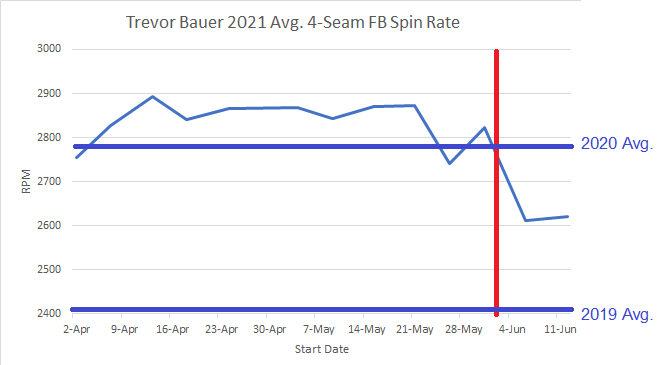
Trevor Bauer, the defending NL Cy Young winner now pitching for the Los Angeles Dodgers, forced his way into the group of spin-rate leaders last season following years of public comments criticizing pitchers who used foreign substances to increase their spin rates. Like Cole, Bauer saw his spin rate plummet after June 2.

Another leader in this category in recent seasons is Yu Darvish, now a starter for the San Diego Padres. Unlike Cole and Bauer, Darvish appeared unfazed by the June 2 announcement, at least judging by the relative consistency in his spin rates this season.

Since the June 2 announcement and enforcement of minor-league suspensions, MLB yesterday announced that it would apply the ten-game-suspension policy to major leaguers as well, with a progressive-discipline scheme for repeat offenders.

While a variety of factors can affect measured spin rates, it’s difficult to interpret the spin-rate dips from Cole and Bauer in their post-June-2 starts as anything other than an acknowledgement of the use of substances that go beyond providing the sort of control-improving grip that even batters appreciate from a safety standpoint and facilitate extreme spin rates (Spider Tack has become the brand name associated with that latter variety of substance). Cole and Bauer don’t come to this point by the same route, however. Bauer’s well-documented history of criticizing Cole and his former teammates in Houston for what Bauer strongly implied– and later seemed to demonstrate in a live-action experiment– were artificially high spin rates arguably places him in a different category than others in this conversation. On the other hand, perhaps he’s just more media-savvy. Should it make a difference if Bauer publicly changed his game to capitalize on and make a point of highlighting MLB’s underenforcement of foreign-substance rules, while Cole did, well, whatever this is?

Nor can we draw any firm conclusions from Darvish’s spin-rate graph. Not only did Darvish’s RPMs not drop after June 2, but they continued to climb. Was he undaunted by the “imminent” threat of enforcement, and, if so, why?

All of this brings us to Casey Mize’s start last night, immediately following MLB’s declaration that it would begin enforcement of its zero-tolerance policy against major-league pitchers. In his short professional career, Mize has not been a high spin guy, nor has he been publicly associated with what he calls the “sticky.” Which is why he was so upset when an umpire forced him to change gloves during the game:

Mize was walking off the mound following the first inning of his start on Tuesday in Kansas City against the Royals, when John Tumpane stopped him for what looked like a friendly conversation.

According to Mize, Tumpane said Mize’s glove was too light-colored.

Mize said the glove, which he’s worn for every one of his big-league starts, was originally charcoal-colored, but may have faded a bit in the sun.

“He said the gray color was too light,” Mize said.

Color judgement aside, Mize was most angry because Tumpane’s order came on the same day that Major League Baseball announced a widespread crackdown on the use of sticky substances that some pitchers have used to help them grip the baseball and increase the spin rate on their pitches.

“I assume everyone thinks that I was using sticky stuff now, which I was not,” Mize said. “So I just thought the timing of it was pretty (expletive), honestly. The umpires need to get on the same page, because I’ve made 12 starts (in 2021) and everybody was fine with (the glove). Or John Tumpane just needs to have some feel and just let me pitch with the glove that the other team did not complain about. (Tumpane) brought it up himself. John’s a good umpire and a very nice guy. But I mean, just have some feel for the situation because I hate that I’m in a position now where I assume everyone thinks I was using sticky when in reality, that was not the situation at all.”

First, for visual illustration, some relevant images of Mize’s mitt:

Without more information, this seems like a questionable decision by the umpire, and, whatever his motivation, the decision did drag Mize into the broader conversation about foreign substances. So what do the spin measurements say about Mize’s pitches? Most obviously, he operates in a much lower band of RPMs than the likes of Cole, Bauer, and Darvish. That alone may be more than enough for many to exonerate him. And while Mize’s average spin rates did decline between his May 28 start and his June 3 start, the magnitude of the change was negligible relative to those Cole and Bauer exhibited. If his data suggest anything, it’s that Mize is telling the truth.

However irked Mize was after being forced into a mid-game glove change, it did not appear to alter his performance. He completed 6.2 innings, threw a season-high 103 pitches, and allowed three runs on the way to a 4-3 Tigers win in Kansas City.

To this point in the season, Mize has been the best of Detroit’s young pitchers, and he trails only Spencer Turnbull in WARP. He’s following up an interesting if inconsistent debut in 2020 with across-the-board improvements in major statistical categories. While veterans attempting to be crafty and the commissioner’s office duke it out over Spider Tack, here’s hoping Mize can avoid that fray and continue to find his footing as a leading member of Detroit’s rotation.

Payroll Flexibility Is A Lie (via Baseball Prospectus)

With news that a modified version of the Mookie Betts trade is official, the Boston Red Sox have consummated one of the most bewildering, common sense-defying trades in recent memory. Now that the dust is settling and fellow high-ranking baseball ops people are rushing to Boston General Manager Chaim Bloom’s defense, it has become clear what the true objective of the trade was. It’s not that Boston believes Alex Verdugo or Jeter Downs [are] the heirs apparent to Mookie’s crown as second-best player in baseball; the most valuable asset coming back to the Sox was actually “Financial Flexibility.”

By taking Betts and half of Price’s salary off the books, Boston stands to get under the luxury tax and put $40-$50 million back into John Henry’s pockets. It’s a coup for the already-massively-profitable corporation that owns the Sox, but past history suggests that the money they save will never find its way back to the roster. When teams have cut payroll, the “flexibility” those moves create goes right to the owners, not into the budget.

[W]hen teams trim their budgets, they don’t respond by spending more later. Sometimes, it’s the opposite: cost-cutting in one year is followed by more reduction later. … Read More

(via Baseball Prospectus)

Kobe Bryant: 1978-2020

The New Yorker’s Louisa Thomas has the obituary. Since he came into the nation’s consciousness as Charlotte’s first-round pick out of high school in the 1996 NBA draft, Kobe Bryant has been recognized as one of the most driven athletes in sports history. We’ve heard and read stories, including many in the last few hours, that serve as oral and written testaments to Bryant’s commitment to his ambitious focus to follow and surpass the legacy of Michael Jordan as the modern game’s single best player. Even as Bryant disclaimed attention to the comparison, everyone knew that’s what he wanted. In that regard, enjoy a visual testament to Bryant’s hard work and attention to detail.

In her brief but full remembrance, Thomas addresses Bryant’s legacy, explaining that, after retirement, he

didn’t withdraw from the game, either. He mentored other players—women as well as men. In the public imagination, the battle for the best player in history may be between [LeBron] James and Michael Jordan, but Bryant was the one that many players actually idolized. He had four daughters, and he understood that they were part of his legacy, too. Gianna, the second, was a talented basketball player, and . . . Bryant acknowledged that he saw something of himself in her. (She was “insanely, insanely competitive—like, mean,” he said.) They attended several Lakers games this season, and a video of them together at a Nets game went viral. In it, Bryant appears to be intensely explaining something to Gianna, and she, pursing her lips like a typical teen-ager, laughs and takes it in.

2019 NLDS Braves/Dodgers Spin Zone

bill-o-reilly-the-oreilly-factor-768x432

Last night, both National League Divisional Series went to decisive fifth games, and, in both games, the teams favored to win the series lost in dramatic fashion. For the Atlanta Braves, the drama came very early, while it arrived late for the Los Angeles Dodgers (I assume; I went to sleep when they were up 3-0). Of course, the only question today for both teams is: Whose fault is this?

For the Braves, you might think it had something to do with the disappearance of its star hitter or team’s failure to address sufficiently its lack of pitching depth and experience. For the Dodgers, it would seem to make clear and natural sense to point the accusatory finger at Clayton Kershaw, who totally and perennially stinks in October.

Obviously, those thoughts, which involve the teams’ players, coaches, and front-office management, are wrong thoughts. That’s because the blame actually lies at the feet of MLB itself and Commissioner Rob Manfred.

The Braves and Dodgers are successful teams built to succeed in the sport’s current era, the defining factor of which is the baseball itself. Changes to the baseball have driven massive increases in home runs, and the two NL favorites heretofore thrived in this extreme offensive environment.

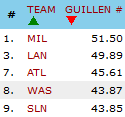
What, then, to make of a report out this morning that the baseballs used during postseason play are radically different than those used during the regular season such that the playoff baseballs effectively suppress home runs to a significant degree? In light of that news, can it be a coincidence that the NL playoff teams that were the most homer-reliant during the regular season were the losers last night?

NLDS guillen # 2019

Commissioner Manfred, whatever you have against the cities of Atlanta and Los Angeles (to say nothing of poor Milwaukee), you are reminded that it is not a crime to ask questions.

_______________________________________________________

Previously
The 2018 All-Star Game was one for the Age


The current argument against Mike Trout, MVP

Mike Trout has been an All Star in each of his seven full MLB seasons. He led the American League in fWAR in five of those seven seasons (four of seven by bWAR; led AL hitters in WARP in three of seven). During that period, he finished in the top two in AL MVP voting every season save his injury-shortened 2017 and won the award twice.

So far, 2019 looks like another MVP year for Trout, who received his eighth-consecutive All Star nod and has a commanding (roughly two-win) advantage atop all AL WAR(P) leaderboards. That Trout will win the award feels like a foregone conclusion, and it has for some time. Early in his career, though, Trout’s MVP candidacy was a contentious flashpoint for the battle between the respective adherents of “new” performance-valuation metrics and “traditionalists.” That conflict came to a head in 2013, when Miguel Cabrera repeated as AL MVP and Trout again finished second. Cabrera’s .348/.442/.636 line led the majors and represented an across-the-board improvement over his line in 2012, when he became baseball’s first triple crown winner in over forty years. On the other hand, Trout’s WAR mark clearly bested Cabrera in 2013 (10.2 versus 8.6 fWAR; 9.0 versus 7.3 bWAR), just as it had in 2012 (10.1 versus 7.3 fWAR; 10.5 versus 7.1 bWAR).

Ironically, Baseball Prospectus, long a leading publisher of work by adherents to “new” performance-valuation metrics, recently reversed course on the 2012 and 2013 AL MVP races after it incorporated changes made to its batting metric into its WAR model (i.e., WARP), acknowledging now that Cabrera really was a more valuable player than Trout in ’12 and ’13. Of course, these days, the fight between “traditionalists” and “sabermetricians” is over. In 2019, no one is arguing that Michael Brantley or Rafel Devers, the current respective AL leaders in batting average and RBI, deserve the league’s MVP award, for example. Part of that comes from the broader appreciation of the usefulness of advanced metrics, and part of that is because Trout is leading many of the traditional categories– at the moment, homers (42), OBP (.435), and SLG (.649)– too. Even if the analytical environment around baseball hadn’t changed, old-fashioned voters would have a hard time denying Trout his due in 2019. Does that mean that Trout has every vote locked up this year?

Stated otherwise, the question is whether there’s a good reason why someone would not vote for Trout as this year’s AL MVP. WAR isn’t everything, of course, but the current difference, by fWAR, between Trout and second-place Alex Bregman is Tim Anderson, or Whit Merrifield, if you prefer, or Blake Snell, last year’s Cy Young winner, all of whom currently have 2.5 fWAR. And Trout’s leads in homers and OPS fortify his position, with his positive contributions on defense and the basepaths rounding out a seemingly unassailable case. What more could he do?

The traditional MVP consideration never was just about individual numbers like batting average and RBI; voters also seemed to care about team-level winning. After all, baseball is a team sport in which the goal is for teams to win games and championships, and there is a conceptual sensibility to the notion that a player deemed “most valuable” would be one who translated his individual value into some significant measure of team value. Recall for example that, in 2012 and 2013, Cabrera’s Tigers were division-winning playoff teams that made deep runs while Trout’s Angels missed the playoffs and waffled around a .500 win percentage. If all of Trout’s good isn’t really doing the Angels any good, is he really the type of player we think of as an MVP? We can appreciate a superstar toiling in competitive obscurity, but does it make complete sense to bestow upon him or her the game’s highest individual honor?

Consider how infrequently postseason MVP awards go to players from losing teams. When it comes to formulating an MVP-award rubric, one can both prefer reliance on metrics that better account for individual performances and believe that the rubric should account for both team-success and individual-statistical components. In other words, the sabermetric revolution need not change what we’re looking for in an MVP even if it has changed how we decide if a candidate meets our criteria.

The good news is that there is a sabermetrically sound method to building an MVP-award analysis that accounts for both individual and team aspects. Continue reading