Sports Law Roundup – 12/15/2017

aslr

Here are the top sports-related legal stories from the past week:

  • Louisville basketball: The fallout from the FBI’s announced investigation of Adidas-sponsored men’s college basketball programs resulted in the termination of Rick Pitino’s  position as the head coach of Louisville’s team. That, in turn, spawned Pitino lawsuits against Louisville for wrongful termination and Adidas for intentional infliction of emotional distress. Louisville now has sued Pitino for breach of contract and negligence and seeks monetary from Pitino arising out of the school’s losses due to vacated wins, potentially including its 2013 national title, and other NCAA sanctions, lost donations, and other financial losses. Louisville’s complaint alleges Pitino admitted liability when he said in a post-termination interview that he knew about NCAA violations but did not report them and took “full responsibility” for his decisions to hire assistants who subsequently engaged in wrongful activity.
  • Television transfer: An announced transaction between 20th Century Fox and Disney involving the latter’s acquisition of more than $50 billion (exclusive of debt) of the former’s assets has potentially significant consequences for the entities’ sports properties. Included among the assets Disney (which already owns ESPN and ABC) is acquiring are all of the Fox Sports Regional Networks (e.g., Fox Sports Detroit, Fox Sports South, etc.) and the YES Network. Disney also is acquiring other substantial assets, including FX Network, Fox’s interest in Hulu, and all of Fox’s film and television studios, which would include the rights to film properties like “The Simpsons,” “Modern Family,” “Avatar” (for which one source reports there are four sequels in the works), “Deadpool,” and “X-Men.” In exchange, Fox shareholders will receive shares of Disney stock. In addition, a spinoff entity will take control of Fox’s primary national networks, including FOX, Fox News, Fox Business, FS1, FS2, and the Big Ten Network. The deal still requires approval from both existing entities’ boards of directors and shareholders, as well as government regulators.
  • Baylor sexual assaults: The flow of evidence of Baylor‘s apparently widespread sexual assault problems seems unlikely to abate anytime soon now that a judge is permitting discovery of sexual assault reports from students who are not parties to pending litigation involving the school, as well as records of third-party Code of Conduct violations limited to violations related to “sex” and is ordering Baylor to produce documents previously provided to independent auditors, those being “32,000 nonparty student records, and hundreds of thousands of additional documents, without regard to” relevance or federal privacy restrictions.
  • Gambler defamation: In June, an alleged “gambling guru” known as RJ Bell (real name: Randall James Busack) sued Deadspin (and its post-Gawker-bankruptcy owner, Gizmodo Media Group, LLC) and freelance writer Ryan Goldberg over an article Goldberg wrote and Deadspin published that was critical of Busack and which Busack alleges was libelous. On Tuesday, a New York bankruptcy judge announced that trial in the case will begin on Valentine’s Day 2018. An important legal question in the case is whether a provision in an order of the bankruptcy court overseeing the Gawker Media bankruptcy intended to operate as a release of third-party claims against Gawker Media writers applies to bar Busack’s claims against Goldberg, which is the position Goldberg takes. Busack contends that the release doesn’t apply to him because he didn’t sue Gawker during the bankruptcy and received no distribution from the Gawker bankruptcy estate. Gawker Media entered bankruptcy as a result of a prior lawsuit Hulk Hogan (real name: Terry Bollea) brought. The attorney who represented Bollea in that case also represents Busack in this case. On Wednesday, the judge, who previously indicated he found the release issue ambiguous, ruled that the release did, in fact, bar most of Busack’s claims.
  • Garbler defamation: Lou Holtz, former head football coach at Notre Dame and South Carolina and former football “analyst” for ESPN, has sued The Daily Beast and one of its writers, Betsy Woodruff, for defamation. Holtz claims that Woodruff’s article about Holtz’s comments during the 2016 Republican National Convention, in which she reported he said immigrants were “deadbeats” and “invading the U.S.,” contained information known to be false and caused Holtz to lose future speaking opportunities.
  • NFL Network sexual harassment: A former NFL Network employee has sued NFL Enterprises, LP (apparently the Los-Angeles-based television and broadcast arm of the NFL), Jessica Lee (allegedly a supervisor at NFL Network whose LinkedIn page describes her as the Network’s director of studio operations), and fifty unnamed defendants. The plaintiff’s lawsuit nominally is one for wrongful termination, but its most newsworthy allegations involve claims of sexual harassment, assault, and battery by other NFL Network employees, including former players Marshall Faulk, Donovan McNabb, Warren Sapp, Ike Taylor, Heath Evans, and Eric Davis and former executive Eric Weinberger, who now works as the president of Bill Simmons Media Group, which owns The Ringer.

Sports court is in recess.

Waive that flag: Close to the edge/Not right away (NFL 2017 week fourteen penalty update)

5a2af64939763-image

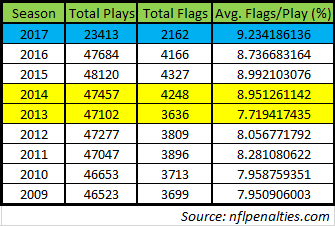
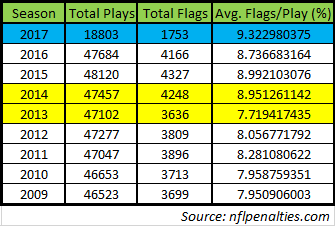
In a time-honored sporting tradition, what started out as a historic trend soon may become merely notable. While NFL officials, through week fourteen, have thrown their penalty flags at a rate that would constitute an all-time* high, that rate has been falling as the season has worn on.

nfl penalty flag data 12-14-17

My note from last week still applies: 2017 now looks quite close to the prior peaks in 2015 and 2014. If things continue as they have this season, 2017 still will be the high-water mark for penalty flags in the NFL, but the week-to-week trend strongly suggests that that is not a reasonable assumption. That trend also lends some support to the idea that abbreviated preseason training leads to worse play early in the regular season.

* The NFL Penalty Tracker has data going back to the 2009 season, but I’m pretty confident that we still are witnessing the all-time high-water mark.

______________________________________________________

Previously
Falling into a deep swell? (NFL week thirteen penalty update)
Good news but bad news (NFL week ten penalty update)
Stability of a kind (NFL week nine penalty update)
People are noticing (NFL 2017 week eight penalty update)
Is this still a thing? (NFL 2017 week seven penalty update)

Alberto’s favorite things (NFL 2017 week three penalty update)
NFL week two penalty update (2017)

The NFL returns with zebras on parade

Waive that flag: Falling into a deep swell? (NFL 2017 week thirteen penalty update)

Something that I had expected might be occurring now seems from the updated numbers like it might, in fact, be occurring, which is that my imperfect flag-rate metric is both (a) continuing to fall and (b) now close to falling out of historic* range. Come look for yourself:

nfl penalty flag data 12-5-17

As a season, 2017 now looks quite close to the prior peaks in 2015 and 2014. If things continue as they have this season, 2017 still will be the high-water mark for penalty flags in the NFL, but the week-to-week trend strongly suggests that that is not a reasonable assumption. That trend also lends some support to the idea that abbreviated preseason training leads to worse play early in the regular season.

Obviously it would be interesting to track flag rates for each of these seasons on a chronological weekly basis. A project for the offseason, perhaps. Meanwhile, since the terrible Giants have been in the news recently, an interesting note that only one team (Carolina) has been flagged fewer times than the 2-10 G-Men.

* The NFL Penalty Tracker has data going back to the 2009 season, but I’m pretty confident that we are witnessing the all-time high-water mark.

______________________________________________________

Previously
Good news but bad news (NFL week ten penalty update)
Stability of a kind (NFL week nine penalty update)
People are noticing (NFL 2017 week eight penalty update)
Is this still a thing? (NFL 2017 week seven penalty update)

Alberto’s favorite things (NFL 2017 week three penalty update)
NFL week two penalty update (2017)

The NFL returns with zebras on parade

Waive that flag: Good news but bad news (NFL 2017 week ten penalty update)

nfl referee pleading for camera time

The good news on the NFL-watchability front is that the penalty-flag rate is decreasing as the season wears on. The bad news remains that NFL referees still are throwing their flags with historically high frequency.*

nfl penalty flag data 11-16-17

Incorporating last week’s numbers shows that we’re settling into that 9.2 range. With seven weeks of games remaining, there’s plenty of time for the rate to continue to fall, so it remains possible that 2017 will end up closer to historical norms. Without examining week-to-week data from past seasons, I don’t have a sense of whether that’s likely to occur (e.g., if it’s common for officials to call fewer penalties as seasons develop).

* The NFL Penalty Tracker has data going back to the 2009 season, but I’m pretty confident that we are witnessing the all-time high-water mark.

______________________________________________________

Previously
Stability of a kind (NFL week nine penalty update)
People are noticing (NFL 2017 week eight penalty update)
Is this still a thing? (NFL 2017 week seven penalty update)

Alberto’s favorite things (NFL 2017 week three penalty update)
NFL week two penalty update (2017)

The NFL returns with zebras on parade

What happened the last time the Lions played the Browns in Detroit

In a few ways, it’s irritatingly cumbersome to write about the history of the Detroit Lions and Cleveland Browns. Long synonymous with deep NFL failure, these two teams were very competitive and successful in that period of professional football that doesn’t count anymore (i.e., the pre-Super Bowl era), meeting in multiple NFL Championship Games in the 1950s. That lengthy historical leap isn’t quite a smooth one, though, since there’s a corporate continuity problem on Cleveland’s side due to team owner Art Modell’s controversial move and (sort of) transformation of the team into the Baltimore Ravens in 1996, with the “Browns” not returning to existence until 1999.

Additionally, for teams as old and geographically proximate as these two, the Browns and Lions meet only infrequently in the regular season. In the forty-seven NFL seasons since the NFL-AFL merger, Cleveland and Detroit have played each other just eleven times. Though they faced off only twice in the 1990s, there nevertheless was an effort during that period to drum up a rivalry of sorts in the form of “The Great Lakes Classic,” which was centered around preseason meetings– there even was a trophy, which, suitably, was modeled after the region’s most famous shipwreck, the Edmund Fitzgerald. The “Classic” fizzled, though, during a particularly unmemorable stretch for both teams:

Over the GLC’s 13-year run, the Lions and Browns were two of the three losingest teams in football, per Pro Football Reference. Over those regular seasons they ran out 29 different quarterbacks, gave 13 different skippers the whistle and posted a collective .339 winning percentage.

It obviously is tough to get excited about either of these teams on their own, much less when they’re playing each other. But a recent game in this series, the last one played in Detroit and the only one played in Ford Field, offered some real drama. Thankfully, the NFL Films crew captured it.

The 2009 season was Matthew Stafford’s rookie year, and he started ten games at quarterback for Detroit that season. On November 22, the Browns came to Ford Field, where, with 5:44 left in the fourth quarter, they found themselves with a six-point lead thanks to this blast-from-the-past play:

browns 11-22-09

Stafford now is the highest-paid player in NFL history, but, in 2009, Lions fans still were in the process of figuring out what the team had in its top overall draft pick out of Georgia. He’d soon let them know:

https://www.youtube.com/watch?v=8rvIwyikbRU

____________________________________

The Lions will look to make it four in a row over Cleveland on Sunday. A win coupled with a Packers loss to the Bears (who knows) would give Detroit clear possession of second place in the division, which, in my opinion, remains winnable even if I refuse to buy into the hype train the national media runs out after Lions wins in nationally televised games. I’m thankful for the exposure, to be sure, but people are making way too much out of Monday Night Football wins over the Packers and New York Giants, two teams going firmly in reverse this year. The Sunday Night Football loss to the Steelers should serve as a strong reminder that the Lions have done nothing to demonstrate week-to-week continuity, and that red zone offense, in particular, remains a significant weakness. They’re only in the mix because of the poor quality of their divisional opponents. Here’s hoping they can capitalize on a weak nonconference opponent this week. In case you missed it, the Browns, at 0-8, are deep on the Road to XVI.

Waive that flag: Stability of a kind (NFL 2017 week nine penalty update)

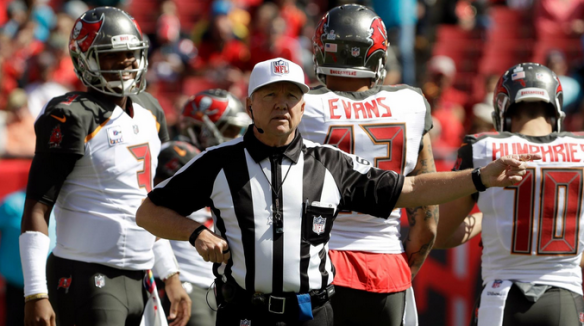
ref bucs

It has come to my attention in the course of preparing this feature on penalties in NFL games this season that the chart I’ve been using to track penalty frequency doesn’t quite show what it purports to show. First, here’s this week’s chart:

nfl penalty flag data 11-9-17

The important number is the one in the far-right column. That’s the number that represents penalty-flag frequency in a given season. The column label, “Avg. Flags/Play (%)” is a little bit misleading, though. A better label might be something like “Flags per 100 Plays.” Even better might be to rework it to be a rough estimate of flags/game based on an average plays per game number of 125 or so. For the moment, and probably for the rest of this season, though, I’m going to continue using the same chart because there’s only so much time I want to spend documenting the historic* level of monotony that is plaguing this NFL season. If you’ve been following this series of posts closely this season, you’ll notice that, as we’ve passed the halfway point, the flag rate appears to be settling into the low 9.2 range. Again, that’s down a little bit from the first few weeks, which were up around 9.6, but it’s still well above prior seasons.

Last week’s post discussed the league’s late-breaking attention to the head-injury issue, which, I suspect, is the reason for the large jump in flags from 2013 to 2014. The other aspect reflected in these data points likely is the NFL’s attempt to grow its audience by increasing excitement by increasing scoring, something it did by enforcing more defensive penalties, which, as we’ve seen, actually decreases excitement and probably should’ve raised a flag or two prior to implementation.

* The NFL Penalty Tracker has data going back to the 2009 season, but I’m pretty confident that we are witnessing the all-time high-water mark.

______________________________________________________

Previously
Waive that flag: People are noticing (NFL 2017 week eight penalty update)
Waive that flag: Is this still a thing? (NFL 2017 week seven penalty update)

Waive that flag: Alberto’s favorite things (NFL 2017 week three penalty update)
Waive that flag: NFL week two penalty update (2017)

Waive that flag: The NFL returns with zebras on parade

Sports Law Roundup – 11/3/2017

aslr

I used to write the sports technology roundup at TechGraphs, an internet website that died, and now I am writing the sports law roundup at ALDLAND, an internet website.

Here are the top sports-related legal stories from the past week:

  • Soccer relocation: Citing a duty to taxpayers, a judge in San Antonio is calling for a criminal investigation of the Columbus Crew’s announced proposal to move the team to Austin. Bexar County Judge Nelson Wolff had been involved in San Antonio’s attempt to secure an MLS franchise, which includes a joint purchase by the city and county governments of an $18 million soccer stadium. According to Wolff, Mark Abbott, the head of MLS, was supportive of San Antonio’s campaign for an expansion franchise in 2015 and said that MLS would not place teams in both San Antonio and Austin. Wolff has asked the Bexar County district attorney to investigate the situation.
  • NFL hiring collusion: Last month, free-agent quarterback Colin Kaepernick filed a labor grievance with the NFL alleging that the league’s member teams are colluding to keep him out of a job because of his leading role in player protests during the National Anthem. According to a report this afternoon, team owners Jerry Jones (Cowboys), Robert Kraft (Patriots), and Bob McNair (Texans) will be called to answer questions under oath about Kaepernick’s claims and disclose their cellular telephone records. According to the report, “others owners, teams and league officials also will be deposed, but those individuals have been confirmed for now.”
  • NASCAR pit crew: In June, a judge allowed a wrongful termination case by Brandon Hopkins, a former NASCAR pit crew member to proceed against his former employer, Michael Waltrip Racing. Hopkins injured his shoulder when a race car hit him during a race. Treatment from MWR’s training staff was ineffective, and surgery was necessary. Surgery was delayed for reasons the parties dispute, however. Days before the scheduled surgery, Hopkins met with a supervisor, who assured Hopkins his job was safe. When Hopkins left the office to go home, he brought a particular tool– the design of which MWR considered confidential– with him, which, he said, was an accident. MWR did not believe Hopkins’ story and fired him the next day. Office security camera footage also showed Hopkins removing what may have been confidential documents from the office two days prior. The judge determined that there were sufficient facts that a jury could determine that Hopkins’ firing was connected to his injury, an impermissible basis for termination, or his misappropriation of confidential company information, which would be a permissible basis. The parties now have settled the case on undisclosed terms.
  • Daily fantasy sports: On Monday, Pennsylvania legalized daily fantasy sports, and Connecticut took similar steps on Tuesday. Pennsylvania will impose a fifteen-percent tax on operator revenue and other licensing requirements and makes it easier for that state to legalize traditional sports betting. The Connecticut policy, which includes a 10.5-percent tax on operators’ gross revenue, requires amendments to the state’s agreements with the two Indian tribes that operate the Foxwoods and Mohegan Sun Casinos and will become effective only after those tribes approve the amendments.

Sports court is in recess.
Waive that flag: People are noticing (NFL 2017 week eight penalty update)

As often happens, a topic we begin covering here turns out to be a trend that the national media eventually comes around to cover, and so it is with the NFL’s penalty epidemic, which is the subject of Drew Magary’s weekly football column today:

What has changed are the rules themselves. It was back in 2013 when the NFL decided to look like it was doing something about brain injuries, so they instituted harsher penalties for kill shots on QBs and defenseless players, and that has led to a brand of football that is ostensibly “safer” in the NFL’s mind while not being particularly enthralling to watch. In other words, this increase in penalties is something of a necessary evil, at least as far as granting you, the NFL fan, the delusion that you’re watching a kinder, gentler sport.

They’re not gonna go back to 2011 and let those shots happen all over again (unless Cam Newton happens to be playing). But what the NFL can do is find a way to compensate for those extra stoppages in other ways. They can ease up on holding penalties for defensive backs and linemen. They can ditch replay. And, most crucial, they can take the goddamn microphones from the refs.

You and I have sat through miserable games where the ref has to announce so many penalties that they become the de facto emcee of the game. I have seen Ed Hochuli during football season more than my own family. And what is really the benefit of having him out there to give a 10-minute stemwinder on some dumb replay? I know the NFL thinks that explaining a call in detail will help provide clarity to fans, but fans are drunk and miserable and will disagree with any call that goes against their team, even if it’s a proper call (I know I do). All mic’ing the ref does is draw even more attention to officials who ought to be invisible during the telecast. Need to know the exact penalty and who it’s on? The PA guy and the TV announcers can do that on the ref’s behalf. Need to justify a ticky-tack call? Let the ref do that in the postgame. Need to overturn a call? Use a hand signal. There is nothing a ref can say that’s gonna make me happy. I want him fucking GONE.

If the NFL really needs this uptick in penalties, the least they can do is minimize the attention drawn to them. It’s a cheat, but muting the refs is an easy way to make these penalties less visible. It also eliminates the danger of any ref going full GLORY BOY and becoming addicted to the power of holding the mic, like they’ve anointed themselves god of the proceedings. If I were a ref, I’d treasure my time on the mic like it was the birth of my child.

And if there’s lingering confusion from a call because the mics have been taken away, that frustration usually goes away a few plays later, when there’s something new to be angry about. I can also assure you that hearing Jeff Triplette explain himself does NOTHING to ease that confusion. Basketball and baseball do fine with officials who are hilariously inconsistent but also gratefully silent. The NFL could stand to follow suit. This is a league that abhors distractions, a league that is pathologically obsessed with getting people to focus on the game. And yet, they allow distractions to pollute these very same games with near-constant whistles and speechifying. Get Hochuli off the mic, get the focus back on the players doing cool shit, and get the fuck out of the way.

Here are the numbers from week eight:

nfl penalty flag data 11-2-17

As was the case last week, the 2017 flag rate continues to fall while still staying well ahead of any in recorded history.*

* The NFL Penalty Tracker has data going back to the 2009 season.

______________________________________________________

Previously
Waive that flag: Is this still a thing? (NFL 2017 week seven penalty update)
Waive that flag: Alberto’s favorite things (NFL 2017 week three penalty update)
Waive that flag: NFL week two penalty update (2017)

Waive that flag: The NFL returns with zebras on parade

Waive that flag: Is this still a thing? (NFL 2017 week seven penalty update)

The only thing tougher to keep up with than this penalty-induced stop-and-start NFL season appears to be this series tracking those penalties. After a couple weeks off, it’s time to find out whether (mixed metaphor warning) 2017’s historic* penalty trend is continuing or flagging.

nfl penalty flag data 10-26-17Although the flag rate this season is falling, it continues to be higher than ever. With penalties trending up and viewership ratings trending down, one continues to wonder when the NFL will get the memo and let the players play.


* The NFL Penalty Tracker has data going back to the 2009 season.

______________________________________________________

Previously
Waive that flag: Alberto’s favorite things (NFL 2017 week three penalty update)
Waive that flag: NFL week two penalty update (2017)

Waive that flag: The NFL returns with zebras on parade

Sports Law Roundup – 10/20/2017

aslr

I used to write the sports technology roundup at TechGraphs, an internet website that died, and now I am writing the sports law roundup at ALDLAND, an internet website.

Here are the top sports-related legal stories from the past week:

  • Penn State child abuse: A court has denied the request of Jerry Sandusky, the former Penn State University assistant football coach who sexually abused children, for a new trial. Sandusky contends his conviction on those charges was wrongful due to the claimed inadequacy of his legal representation at trial and the prosecutor’s failure to disclose potentially exculpatory information.
  • NFL hiring collusion: Free-agent quarterback Colin Kaepernick has filed a labor grievance with the NFL alleging that the league’s member teams are colluding to keep him out of a job because of his leading role in player protests during the National Anthem. Kaepernick identifies President Donald Trump as a significant actor whose public statements condemning protesting players motivated the owners’ decision. Kaepernick faces an uphill legal climb, though, because circumstantial evidence– the observable fact that no team has hired him despite his track record and apparent needs at his position– is insufficient to prove collusion. Under the collective bargaining agreement, “no club, its employees or agents shall enter into any agreement, express or implied, with the NFL or any other club, its employees or agents to restrict or limit” a team from negotiating or contracting with a free-agent player. To make his case, Kaepernick will need to demonstrate that the owners, together and not independently, made an affirmative decision not to employ him, or that the NFL itself directed or encouraged teams to take that position. Depending upon how this matter evolves, however, the stakes for the league and union could be high, as, under certain circumstances, proof of collusion could terminate the CBA.
  • Wrigleyville: The U.S. Court of Appeals for the Seventh Circuit has denied a request for rehearing filed by owners of Wrigley Field-area owners of rooftop restaurants and bars who claimed the Chicago Cubs violated an agreement to prevent the obstruction of field views from the neighboring rooftop establishments when the team included a new, large, outfield video board in its updates to Wrigley Field. The court offered no explanation for its decision to reject the petition for a rehearing of its prior judgment that the agreement itself and MLB’s antitrust exemption barred the neighbors’ claims.
  • North Carolina academics: After spending more than six years investigating the University of North Carolina for academic fraud, the NCAA issued a final ruling subjecting the school to minimal sanctions that do not affect any of UNC’s athletic programs, a decision that, according to Mark Titus, “should come as no surprise.”

Sports court is in recess.