I’m headed back into the Pizza Cave tonight to discuss the hot topic on the Detroit sports streets, Miguel Cabrera versus Albert Pujols, with legendary Southeast Michigan restaurateur-podcaster Fredi the Pizzaman live at 5:00 pm Eastern. Although you can listen to it later on, keep in mind that this is a live podcast, meaning that you can stream it as it’s being recorded, which I recommend.
Tune in tonight at 5:00 by clicking here to listen live or check out the archives later on.
Michael Fulmer is the defending American League rookie of the year, and he’s showing no real signs of a sophomore slump. That’s good because it means he’s continuing to perform at a high level. It also is good because there was some concern that his rookie success wasn’t sustainable. The basis for that concern was the gap between his ERA and his defensive-independent pitching statistics (“DIPS”). Jeff Sullivan raised the issue late last season:
It sure is tough to trust the legitimacy of Fulmer’s ERA-FIP gap. Certainly at least to this extent. I don’t think he’s demonstrated that he’s “earned” it. You might counter that Fulmer should get more credit, given the Tigers’ defense; they’re 28th in DRS, and 23rd in UZR. But it’s important to remember that defenses don’t play exactly the same every day behind every pitcher. Bad defenses can look good, and good defenses can look bad. As a comparison, think about lineups and run support. The Red Sox are the Red Sox, right? But Rick Porcello has a run-support average of 7.0 runs per nine. Eduardo Rodriguez has a run-support average of 3.0 runs per nine. Baseball’s weird. Just because the Tigers don’t have a good defense doesn’t mean they haven’t had a good defense behind Michael Fulmer.
Fulmer finished last season with an ERA of 3.06, which would have been third-best among qualified AL pitchers had he thrown enough innings to qualify (he was three short), and a FIP of 3.76. Following the general principle that DIPS (such as FIP) are more reflective of a pitcher’s true talent than ERA, Fulmer’s negative ERA-FIP gap suggested that he wouldn’t be able to sustain his low ERA going forward.
In fact, Fulmer’s successful results have continued. Through June 25, his 3.29 ERA places him in the top ten among qualified AL pitchers, and he’s been the fourth most valuable pitcher by fWAR across both leagues. Perhaps even more significantly, he’s doing all this with a positive ERA-FIP gap. Even better, he seems to be doing it without significant alteration to his approach. The only noticeable change I detected there was an increase in velocity, which will be interesting to monitor down the stretch in light of some of the concerns voiced last season about fatigue and endurance.
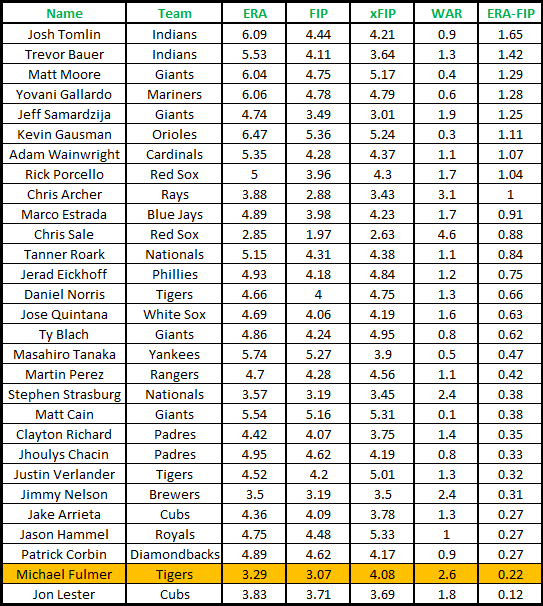
For context, this table (data pulled from FanGraphs) shows all qualified pitchers currently running positive ERA-FIP gaps:
Viewed this way, Fulmer’s differential doesn’t look all that impressive– it’s only the third-best gap among his own teammates! The point, though, is the trend. Last year, he had one of the worst ERA-FIP gaps, which is what prompted Sullivan’s concern about Fulmer’s potential for future success, and there he is, near the bottom of the list of qualified pitchers from the 2016 season: Continue reading →
The great Miguel Cabrera is thirty-four years old. His team, once a surefire contender, is stuck in neutral, and Cabrera, their ostensible offensive engine, has only been slightly above average at the plate (108 wRC+, which would be the worst of any of his seasons since his rookie year (106 wRC+)).
It looks like we are seeing the beginning of Cabrera’s inevitable decline, which has observers taking stock of Cabrera’s likely legacy and projecting his place among the greats once he puts that magic bat down for good. For example, Yooper David Laurila included this observation in a recent edition of his Sunday Notes column:
Lou Gehrig had 8,001 at bats, 534 doubles and 493 home runs. Miguel Cabrera has 8,028 at bats, 533 doubles, and 451 home runs.
The day before, conversation on Fredi the Pizzaman’s Pizza Cave Podcast turned to Cabrera as the panel debated whether he would join Albert Pujols in the 600-home run club. (Pujols, whose major-league debut came two years before Cabrera’s, passed that milestone on June 4 of this year.) That discussion prompted a broader one about both players’ achievements and legacies.
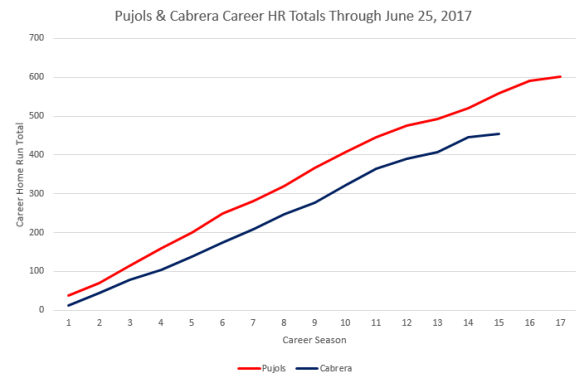
Here’s a quick graph to introduce and orient this comparative analysis:
By aligning the two players’ offensive performances (measured by wOBA) to their individual age-seasons, we can develop a rough snapshot of their careers at the plate. This graph illustrates a couple of significant trends. First, it’s easy to identify the clear tipping point in Pujols’ career, which very clearly has two distinct halves. Second, Pujols came out of the gate hotter than Cabrera, who needed a couple years to ramp things up. Both achieved production levels that make them generational talents, but when it comes to counting statistics (like career home run totals), the gap in those early years may be what will end up separating these two in the final analysis. All players eventually decline, but that just means it’s going to be tougher for Cabrera to make up for his comparatively slow start now.
Again, this graph compares Pujols and Cabrera by aligning their career seasons. Even though they’ve accumulated homers at a similar rate, merely keeping pace in that regard likely won’t be enough for Cabrera in light of Pujols’ head start unless Cabrera has more years left in his tank than Pujols has in his. And right now, that first part– keeping pace– isn’t looking so sure for Cabrera. Here’s the same graph as the one above expanded to include 2017 numbers:
This comparison to Pujols thus suggests that Cabrera is unlikely to reach the 600-homer benchmark for two reasons: 1) a slow start and 2) what looks to be an early– relative to Pujols– decline. None of this is to say that Cabrera can’t or won’t reach 600 home runs. Comparing him to the most recent guy to do it suggests that, absent some change, he’s unlikely to get there.
That change could come in the form of a late-career rejuvenation. Cabrera’s capable of ripping off amazing offensive tears, and he certainly could do that again. It always has felt a bit odd to think of Cabrera as unlucky, but there continues to be evidence that Cabrera’s offensive numbers should be even better than they already are based on the quality of contact he makes. A third change could be a positional one. Just as David Ortiz extended his career by becoming a full-time designated hitter, the thought is that Cabrera could alleviate some of the strain on his body by being relieved of his defensive obligations.
All of this is relative, of course. Failure to accumulate 600 home runs is no indictment on a player or his legacy. Only nine players ever accomplished that feat, and three of them are Barry Bonds, Alex Rodriguez, and Sammy Sosa. Three more of them are Hank Aaron, Babe Ruth, and Willie Mays.
While we’re here, two concluding notes on the overall comparison between Pujols and Cabrera. The first, which came up on the podcast episode linked above, involves postseason success. As a rookie, Cabrera was a member of the Florida Marlins team that won the World Series in 2003. Pujols was a member of the 2006 Cardinals team that swept Cabrera’s Tigers in the World Series, as well as the 2011 World Series team that beat the Rangers in seven games. Pujols also has been a better hitter in the playoffs, though both have been significantly above average (164 wRC+ vs. 136 wRC+). Postseason appearances are significantly team and context-dependent and involve small samples (seventy-seven games for Pujols and fifty-five for Cabrera), but it’s something to mention.
The second is a total career assessment. Neither player is retired, obviously, but that doesn’t mean we can’t take a peek at what their legacies look like right now. One way to do that is with JAWS, an analytical tool designed to assess Hall-of-Fame candidacy. Its creator, Jay Jaffe, explains:
JAWS is a tool for measuring a candidate’s Hall of Fame worthiness by comparing him to the players at his position who are already enshrined. It uses the baseball-reference.com version of Wins Above Replacement to estimate a player’s total hitting, pitching and defensive value to account for the wide variations in scoring levels that have occurred throughout the game’s history and from ballpark to ballpark. A player’s JAWS is the average of his career WAR total and that of his peak, which I define as his best seven years. All three are useful for comparative purposes, as Hall of Famers come in different shapes and sizes. Some—Hank Greenberg, Ralph Kiner, Sandy Koufax, Jackie Robinson—dominated over periods of time cut short by injuries, military service or the color line. Others such as Eddie Murray, Don Sutton and Dave Winfield showed remarkable staying power en route to major milestones. While it’s convenient to believe that every Hall of Famer must do both to be worthy of a bronze plaque in Cooperstown, they can’t all be Babe Ruth, Ted Williams or Willie Mays, or the institution would merely become a tomb, sealed off because so few have come along to measure up in their wake.
For the purposes of comparison, players are classified at the position where they accrued the most value, which may be different from where they played the most games, particularly as players tend to shift to positions of less defensive responsibility—and thus less overall value—as they age. Think Ernie Banks at shortstop (54.8 WAR in 1,125 games there from 1953 to ’61) as opposed to first base (12.8 WAR in 1,259 games there from ’62 to ’71). A small handful of enshrined players, including pioneers and Negro Leaguers with less than 10 years of major league service, are excluded from the calculations; Satchel Paige and Monte Irvin, for example, had major league careers too short to use as yardsticks for non-Negro League players.
By JAWS, Pujols and Cabrera both are clear Hall of Famers even if neither ever played another game, but there’s a clear separation between the two. JAWS has Pujols as the second-best first baseman ever, trailing only the aforementioned Gehrig, while Cabrera currently slots at the eleventh position, right next to Jim Thome (another one of those 600-HR guys). Pujols has two more years under his ample belt than does Cabrera, and neither is done playing. (This probably is a decent place to note contract details: Pujols has four more years on his current contract, while Cabrera has at least six.) As with the home-run chase, so too with overall career value: Cabrera has a good bit of work to do if he’s to catch Pujols.
The book is not closed on either of these two great baseball stories. Pujols and Cabrera have yet to author their final chapters. The balance of their works likely are complete, however, and from that we can make educated predictions. Both have their high points and distinct achievements, but it looks like Pujols’ early peak will prove a little too high and too long for Cabrera to close the gap. Here’s hoping I’m wrong.
Not as in “relief from the burden of Short Relief.” More like, “Short Relief (at last) has provided me with some relief.” I am not a longtime reader of Baseball Prospectus the way people who truly have been reading Baseball Prospectus for a really long time casually sprinkle into digitally transmitted discourse that they are longtime readers of Baseball Prospectus, but I have been reading the site and its books and listening to its podcasts (or one of its former ones, anyway) for a few years and been a subscriber for the balance of that time, and there is no question that the temperament of the site has changed over that period. Since I have been reading it, BP has had three editors in chief: Ben Lindbergh, Sam Miller, and Aaron Gleeman, its current EIC. Miller, who now writes for ESPN, has a special ability to blend the analytical and the fanciful (perhaps “imaginative” is a better word here, though neither are correct), and, by outward appearances, was a judicious editor. Baseball writers everywhere usually write about baseball in serious tones, and Miller was a breath of fresh air in that regard, if a measured one. It’s good to have outlets for some less seriousbaseball writing too. There used to be a whole place for that, which was called NotGraphs, but it was terminated in late 2014. Thereafter, its postmortal spirit attempted to eke out a living in an even smaller corner of the web, but that campaign fizzled.
Although Miller never misses an opportunity to credit Lindbergh, his former boss and collaborator on two significant projects who now writes for The Ringer, as the best in the business, it’s clear to me that it’s Miller who’s left a large impression on the current version of BP. Whimsy, once reserved for sidebar Hitlist one-liners and a few player comments in the BP Annual (not unusually in the form of a Simpsons reference) everyone raced to find, photograph, and post on social media web platform Twitter.com, now abounds– or, at least, attempts to abound– at BP. This is most visible in the daily Short Relief feature, a sort of refugee camp for NotGraphs alums that typically contains three essays, or maybe poems, or maybe just a picture, that effort and imitate toward the odd and purposefully absurd.
I never read every article every day at BP, but I’ve never read less of BP than I do now (Russell Carleton and Rob Mains are musts), and I very rarely read Short Relief. I’m glad a major baseball site is trying to resurrect NotGraphs, but this take just doesn’t hit me right. It feels very unessential and often forced. A lot of that probably is due to the fact that it’s an everyday feature. It’s really hard to produce original funny, silly, odd, unusual, quirky, or whatever content on a daily deadline. It’s even harder when you’re limited to one subject area. (There’s also the part about the site’s budget crunch and probably a little friction with the idea that BP is contributing resources to Short Relief rather than its core mission, which seems noticeably understaffed at the moment.)
BUT. Today’s Short Relief I did read, and today’s Short Relief I did like. It contains two entries, both by former owners of NG bylines. The first, from David G. Temple, once the managing editor of TechGraphs, is a short story about baseball cards that really hit home for me, as anyone reading ALDLAND’s late-night tweets earlier this week might have guessed. The second, from Short Relief coordinator Patrick Dubuque, provides a short metacommentary on the Short Relief series itself that resonated in light of the above-transcribed feelings about the Short Relief series. I commend both to your screen and eyes.
After a pleasantly surprising series sweep of the White Sox, the Tigers have lost eight of twelve and fallen to fourth place in the underwhelming AL Central. Rather than capitalize on a slow start by Cleveland, Detroit is struggling to keep its head about the .500 winning percentage waterline, and a deeper look into their 32-36 record suggests it’s an accurate reflection of who they’ve been to this point– no bad luck to blame so far. At least Victor Martinez is out of the hospital.
Baseball is a sport that is susceptible to, and, indeed, has subjected itself to what most regard as extremely fine-grain analysis. For example, in just a few clicks, you can pull up the spin rate of the ball on any pitch thrown in any MLB game last night. Whether we’re examining something, like baseball, for which we have relatively precise analytical tools, or something our ability to probe is more limited, we necessarily operate with certain assumptions practically taken for granted. Gravity. Air. Taxes. The general inflation of the value of U.S. currency over time. The general improvement in human health over time. While we need to monitor these somewhat ambient, environmental facts and trends, it usually doesn’t make sense to address them with great frequency and detail. We all generally know that Al Kaline’s $35,000 rookie signing bonus probably was a lot of money in the 1950s even if it doesn’t sound like a lot by today’s standards, just like we generally know 6’2″, 215 lb. Babe Ruth probably was a lot bigger than his peers, even if he wouldn’t appear out of the physical ordinary today.
On this last point, of course, we’re aware that medical and nutritional advances have resulted in general improvements in human health. Humans today live longer and grow larger than they did in the past, and baseball players are no exception.
That growth hasn’t occurred at a steady rate, however, at least as far as the population of baseball-playing humans is concerned. Here’s a graph from Russell Carleton’s article yesterday at Baseball Prospectus showing the median (50th percentile), 70th percentile, and 90th percentile Body-Mass Index (BMI) of all players who appeared in the majors between 1900-2016:
As Carleton remarks:
We see that in the mid-90s, something (*cough*something*cough*) happened that caused an inflection point in MLB. After most of a century of the same body types, players started getting bigger. Mostly, they got heavier, although players today are also taller than they had been. The median player in MLB right now would be larger (in terms of BMI) than 90 percent of players who played in any year before the 1990s.
When it comes to the 2017 Detroit Tigers, we are in full-on damage-control mode here at ALDLAND, looking high and low for fixes for everything from the bullpen to the infield defense. On an individual basis, though, no player seems to be the recipient of more scorn from those who express Tigers-related opinions on the internet than Justin Upton. The critical refrain, when it comes to the younger Upton brother, is simple: he strikes out too much.
I spent many of the pages of last season’s Tigers diary on Upton. Having watched him during his days as a member of the Atlanta Braves, I knew he was a good and exciting player, but also a streaky player, and I hoped that Detroit fans would be patient enough to see through the streakiness and hold out for the production, they generally weren’t. Some career-low offensive numbers in the middle of the season didn’t help his case, and people (this website’s readers excepted, obviously) mostly missed that, in the final analysis, his full-season production was almost exactly as anticipated: an above-average offensive profile with thirty-one home runs, matching a career high. Also likely to be forgotten is his hot September– thirteen home runs, .292/.382/.750, and 196 wRC+, basically Babe Ruth’s career line– that was the main reason the team was in contention entering the final series of the regular season.
The Tigers didn’t make the playoffs last year, though, and things are looking pretty bad right now, too, which makes it easy to continue to beat the Upton-strikeout drum. And look, he’s currently running a career-high 31.2% strikeout rate (ten percent above league average), which isn’t helping matters.
When it comes to Upton, though, it isn’t as easy as simply focusing on strikeouts. For example, he’s running a walk rate that’s substantially higher than last season’s, meaning that his BB/K ratio is in line with his career ratio. In general, though, this is what he does. Like many power hitters in today’s game, he hits a lot of home runs and he strikes out a lot. Strikeouts are frustrating, but harping on them, in Upton’s case, isn’t productive. As Dave Cameron discussed at FanGraphs today, Giancarlo Stanton has undertaken the sort of change Upton’s critics are demanding, dramatically cutting his K% and upping his contact rate. The result? A very similar, if slightly worse, overall offensive profile. Cameron explains:
To this point, the change hasn’t served to make Stanton better, just different. His 135 wRC+ this year is pretty close to his career 141 mark, as the reduction in strikeouts have also come with a small drop in BABIP and a continuing decline in his walk rate. And the latter is of particular interest, because it shows how differently he’s being pitched these days.
In his 2013/2014 heyday, only 41% of the pitches thrown to Stanton were in the strike zone, about as low a mark as pitchers will go for a hitter who doesn’t instinctively swing at anything out of their hand. This year, pitchers are throwing Stanton strikes 44% of the time, about the same rate they’re challenging Trevor Plouffe and Albert Pujols. Pitchers are coming after Stanton now, perhaps recognizing that maybe he’s not taking the herculean swings that he used to take, and the penalty for throwing him something in the zone isn’t quite what it used to be.
As his contact rate has climbed, Stanton’s doing less damage on contact than he used to be [sic], and perhaps not surprisingly, is now seeing more strikes thrown his way. These are all shifts more than total revolutions, as he’s still a power hitter who does a lot of damage when he hits the ball, but he’s now moved more towards the normal levels of contact and production, rather than being an outlier on both ends.
(emphasis added).
Could Upton stop striking out as much as he does now if he wanted to? Probably. Changes in approach have complex consequences, though, and the result of those consequences might not work a net positive on Upton’s production even if he pushed himself to a career low strikeout rate and career high contact rate like Stanton has. (It essentially is the Ichiro Suzuki home run question asked from the opposite side of the player comp spectrum.)
The broader point, I think, is one that came to me during my look at switch hitters’ approaches to defensive shifts last year: we should engage in player analysis with the initial assumptions that (1) the player is a skilled athlete capable of undertaking multiple approaches to his or her sport, and (2) the player intelligently approaches his sport by selecting the optimal approach, given his or her strengths and weaknesses, designed for performance at the highest possible level. This is a conservative outlook that essentially assumes that the player’s status quo modus operandi represents the player’s optimal modus operandi. Like the Tigers fans who assume they can fix Upton by telling him to strike out less, it’s easy to assume we know better. As more complex investigations often reveal, however, the player had it right all along.
The subtitle of this post nearly was “Weakness Abounds,” since the Detroit Tigers are in a real rough spot right now, and, until last night (and even including most of last night, really), it seemed like nearly everything that could go wrong for this team was going wrong, but then I thought of a much better and more accurate one that also allowed me to lead with that music video. The Tigers have fallen to a 24-29 record, four games out of the division, and, while all is not lost, it’s becoming quite easy to feel that way. A thing that happens sometimes when you focus on putting out the various fires– like the bullpen, as a ready example– popping up on a team struggling to hold it together is that you can take for granted the team’s presumed consistent strengths, however minor, and forget to keep an eye on them too. With the offense collectively slumping as bad as it has been and the entire pitching staff acting like it was playing for the opposing teams, this was easy to do.
One of those good things the Tigers thought they had on lock was their up-the-middle defense. When your pitchers are giving up a lot of contact, a double play can be a life-saver. Shortstop Jose Iglesias’ bat hasn’t held up this season, but we always knew he was in the lineup for his defense, and it was just last year that we were beginning to discuss Ian Kinsler’s dark-horse Hall-of-Fame candidacy. At least as far as defense was concerned, these were two guys the Tigers didn’t have to worry about.
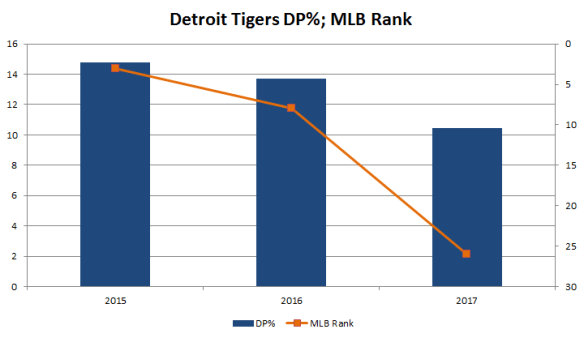
And yet, when their pitchers most needed bailouts, the defense has faltered. Baseball Prospectus tracks double-play percentage (DP%), defined as the number of times a team converts double-play opportunities into double plays. Obviously this is a coarse measure for evaluating a particular double-play tandem for a number of reasons, including the fact that it operates on a team level, and, in this case, Iglesias and Kinsler didn’t play every single game together. Double plays also commonly involve the other infielders too. Still, the DP% numbers paint a stark picture for the Iglesias-Kinsler era in Detroit.
Iglesias and Kinsler have been the Tigers’ starting shortstop and second baseman, respectively, since 2015. In the first two seasons of the current tandem, 2015 and 2016, the team did a very good job of converting double-play opportunities. As a team, the Tigers were, at very best, average when it came to overall defense during this period, but Iglesias and Kinsler were supposed to be the glue that made the whole fielding operation passable. When it came to completing double plays, they held up their end of the bargain. Something (or somethings) aren’t right so far in 2017, though, and the dramatic dropoff in DP% hardly could come at a worse time for Detroit’s floundering pitching staff.
Tonight’s game is about to start, so I’ll leave things here for now, but this may be a thing– among a great many, to be sure– to keep an eye on as the Tigers turn toward summer and begin to evaluate their team-level strategic direction.
I used to write the sports technology roundup at TechGraphs, an internet website that died, and now I am writing the sports law roundup at ALDLAND, an internet website.
Here are the top sports-related legal stories from the past week:
Basketball mugging: Moses Malone Jr., son of NBA great Moses Malone, sued James Harden, claiming that Harden paid a group of people $20,000 to mug Malone Jr. at a Houston strip club last summer after critical comments by Malone Jr. about Harden’s youth basketball camp angered Harden. Malone Jr. posted a Facebook.com comment about the $250-per-attendee cost of Harden’s camp and then was beaten and robbed at the strip club. One of the men charged in the attack reportedly told Malone Jr. during the attack that Malone Jr. “disrespected James Harden and that he needs to be punished after that.” At this time, police have not established a connection between Harden and the attack.
Golf drugs: Vijay Singh won a victory in his lawsuit against the PGA this week when a court ruled that his claim that the tour breached an implied duty of good faith it owed to Singh could proceed. Singh’s case arises out of a 2013 suspension the PGA issued to him after he told a reporter he’d used a product called The Ultimate Spray, which contains “velvet from the immature antlers of male deer,” something that supposedly aids performance. The PGA suspended Singh based on his admission before checking with the World Anti-Doping Agency (“WADA”), which maintains the tour’s agreed list of banned substances, to confirm that the spray in fact contained or constituted a banned substance. During Singh’s suspension, WADA issued a public statement clarifying that use of the spray was not prohibited. Singh’s contention is that the PGA should have confirmed this fact with WADA before it suspended him.
Football painkillers: The judge overseeing the proposed class action brought by former NFL players against the league’s thirty-two teams improper dispensation of painkillers dealt the plaintiffs another serious blow this week by dismissing almost all of the claims remaining in the case, and he does not seem to be impressed by the plaintiffs’ efforts: “perhaps the bloat of inapposite allegations is the product of some advocacy-based agenda rather than any attempt to comply with pleading requirements. For present purposes, however, this order makes clear at the outset that what matters is not whether plaintiffs have drawn attention to widespread misconduct in the NFL but whether each plaintiff has properly pled claims for relief against each individual club and, if so, whether those claims survive summary judgment.” At this time, the only claims that remain in the case are those brought by two individual players against three teams, the Green Bay Packers, Denver Broncos, and San Diego Chargers.
Baylor sexual assaults: Amazingly, Baylor’s legal troubles continue to mount. After a former student sued the university earlier this year, alleging she was the victim of a group rape committed by two football players in 2013 that the school ignored; that football players were responsible for numerous other crimes “involving violent physical assault, armed robbery, burglary, drugs, guns, and, notably, the most widespread culture of sexual violence and abuse of women ever reported in a collegiate athletic program”; and that, between 2011 and 2014, thirty-one Baylor football players committed a total of fifty-two rapes, including five gang rapes, another former student has sued the school based on similar allegations. The new case, filed by a former volleyball player for the university, is the seventh Title IX lawsuit brought against the school, and it alleges that up to eight Baylor football players drugged and raped the plaintiff in 2012. The complaint explains that the attack was photographed and videotaped and happened in connection with a football hazing program.
NBA ticket devaluation: A San Antonio Spurs fan has sued the Golden State Warriors and one of that team’s players, Zaza Pachulia, claiming that Pachulia’s contribution to the injury of Spurs star Kawhi Leonard “devastated the quality of the Spurs’ chances of being competitive,” thereby diminishing the value of the plaintiff’s tickets to future Spurs playoff games. Video of the play in question is available here. It shows Pachulia moving in front of Leonard, who is in the air releasing a shot, and Leonard subsequently landing on Pachulia’s foot, resulting in an exacerbation of Leonard’s ankle injury that caused him to miss the remainder of the first game and all of the second game of the NBA’s Western Conference finals. Leonard did not participate in practice yesterday, and his status for tomorrow’s game remains undetermined.
MLB streaming: Facebook and MLB have reached a live game streaming agreement that grants streaming rights to the social media platform for certain Friday night games. Streams will be free to users in the United States, and it appears that blackout restrictions will not be enforced, meaning fans located in the participating teams’ geographical regions should be able to watch as well. The initial deal includes twenty games, beginning with tonight’s Rockies-Reds matchup. More games may be added later. It is not clear whether this announcement has anything to do with the new lawsuit filed earlier this month by fans seeking to enforce a previous settlement agreement that required MLB to provide more live streams of in-market games by 2017, but it sure seems like it does.
Football jokes: An individual who posts jokes on the internet has sued Conan O’Brien, alleging that O’Brien stole a joke from him about Tom Brady winning the Super Bowl MVP award two years ago. Super Bowl MVPs apparently receive pickup trucks as prizes, and Brady, having won multiple such awards and having no use for a truck, has been giving them to a teammate he feels deserves it. Following New England’s last-second victory over Seattle in Super Bowl XLIX, Brady gave the truck to Malcolm Butler, who secured the game-winning interception. The essence of the joke was that Brady should’ve given the truck to Seahawks coach Pete Carroll, who, many thought, made a very bad play call on that play. I’m not sure what the statute of limitation is on joke-theft claims, but any joke that takes this long to explain probably isn’t worth stealing. (It also seems kind of obvious, at least in retrospect.) A judge has ruled that the case will go before a jury, which will decide whether O’Brien infringed the individual’s copyright on that joke and two others.