Saving Detroit: Reliever Relief

krod1280_puet24kh_yf9khwjd

Despite being pretty good at almost every aspect of building a winning baseball team, the Detroit Tigers have, for years, had as difficult a time finding a reliable closer as the Cleveland Browns have finding a quarterback. Even reading the names Jose Valverde and Joe Nathan is enough to make most fans shudder, and, unfortunately, it’s come time to add Francisco Rodriguez to that list.

There were reasons to be hopeful when Rodriguez came over to Detroit before last season. Even though, at thirty-four years old, he wasn’t the fire-breathing, overpowering force he was in his younger days, it looked like he’d traded some heat for wisdom and found a way to continue to succeed as he aged. The active saves leader did pretty well last year, and, even if there were some missteps in key moments, it was hard to be too disappointed with the overall body of work. He even seemed to help teach manager Brad Ausmus a helpful lesson about bullpen management, as Ausmus slowly broke out of the conventional mold and began using Rodriguez in high-leverage four-out situations rather than rigidly reserving him for the ninth inning alone.

Baseball famously is a game without a clock (at least for now), but humans lack such an exemption, and the clock appears to have run out on Rodriguez in his age-thirty-five season. After single-handedly blowing two games over the weekend, it sure seems like Rodriguez has turned into a dip-filled pumpkin. By one measure, Win Probability Added, he’s done more to help his team lose than any other reliever than all but one other reliever in baseball.

It’s tough to pinpoint exactly what’s wrong with K-Rod this year. His velocities are down a little bit, but they’ve been going down pretty much steadily over the course of his career. That’s nothing new, and it’s why he started prioritizing offspeed pitches over his cooling fastball as he got older. Other indicators, including location, pitch usage, and release points, all look as reasonably expected. The results don’t lie, though; batters are absolutely hammering him this year:

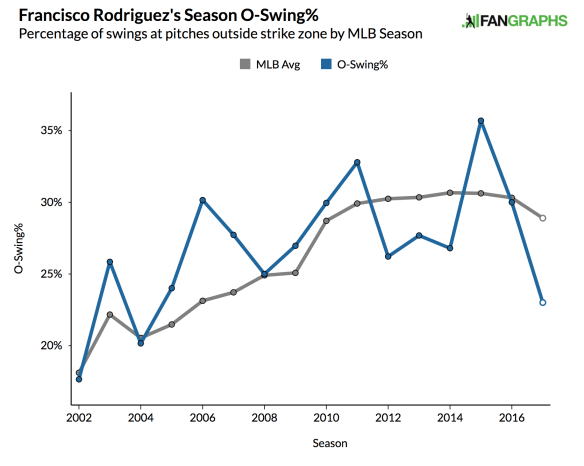
krod mapsIt looks like he’s throwing to the same places– low, and in/away– he usually has, but with much less success. It’s hard (for me, at least) to pinpoint with these various advanced tools exactly what’s happened, but it’s clear that Rodriguez no longer is fooling batters, a veritable death knell for deception-reliant pitchers like him. The way batters consistently chased– and, more often than not, missed– his diving, low and away pitches is something I marveled at last year, my first really watching him and his seemingly simple approach. For whatever reason, though, they aren’t even remotely fooled this year, as the below graph of Rodriguez’s out-of-zone swing rate from a FanGraphs article posted this evening shows:
screen-shot-2017-05-07-at-9-24-12-pm

The Tigers’ margin for error this season is extremely narrow, and Rodriguez just cost them two wins on an important West-Coast roadtrip. They don’t have time to let Rodriguez find himself in game-ending, high-leverage situations. Ausmus needs to rearrange his bullpen immediately. It already was a thin crew, but the status quo won’t do. It’s time to promote the Wilsons and find out if the rest of this motley bunch can handle a heavier load.

Sports Law Roundup – 5/5/2017

aslr - cinco

I used to write the sports technology roundup at TechGraphs, an internet website that died, and now I am writing the sports law roundup at ALDLAND, an internet website.

Here are the top sports-related legal stories from the past week:

  • NBA profiling: In 2015, Mike Scott, then a member of the Atlanta Hawks, and his brother were pulled over and subsequently arrested after a search of their rented vehicle turned up marijuana, ecstasy, and $1,684 in cash.  The deputy sheriff who made the stop later was found to have been racially profiling drivers as part of a forfeiture scheme and placed on administrative leave. Records provided by the Scotts’ attorneys show that the deputy sheriff “pulled over more than 1,400 vehicles in 2015 and 2016 but issued only eight traffic citations. He also arrested 47 people, at least 44 of whom were minorities.” As a result of the profiling, the judge overseeing the Scotts’ drug case this week threw out the key evidence against the defendants.
  • Baseball broadcast settlement: In early 2016, MLB settled a fan antitrust lawsuit targeting the league’s television blackouts and other components of its broadcast system. While the blackouts survived, the fans did win reduced-price single-team subscription options for MLB.tv (I am a subscriber, to varying degrees of satisfaction), as well as a price reduction for the full MLB.tv package. The agreement also included a component that would allow MLB to raise prices in the future in exchange for providing more live streams of in-market games by 2017. That component now is at issue in a new motion filed by the fan group demanding that the court enforce the terms of the settlement agreement. The fans allege that MLB raised prices without the required corresponding in-market streaming increase. They concede that the league may have agreements in place with local television providers to provide the in-market streams, but, the fans argue, “the obvious purpose of the settlement was not that ‘agreements’ of some kind be reached, but that the actual games be available.” The fans also argue that, contrary to what they were promised, MLB has failed to make the “follow your team” game broadcasts available when the selected team is playing the team based in the fan’s local broadcast market.
  • Cheerleader wages: The Milwaukee Bucks and Lauren Herington, a former cheerleader for the team who alleged that the team violated federal and state labor laws by underpaying her and her fellow cheerleaders, have reached a $250,000 settlement of Herington’s proposed class action lawsuit that provides for the settlement funds to be divided as follows: $10,000 for Herington; $115,000 for Herington’s attorneys; and unspecified shares of the remaining $125,000 to Herington and other would-be class members who opt into the settlement based on their hours worked during the three-year period (2012-15) at issue. While not insubstantial, the Journal Sentinel notes that Milwaukee’s $250,000 settlement amount is less than what other teams– for example, the Oakland Raiders ($1.24 million), Tampa Bay Buccaneers ($825,000), and Cincinnati Bengals ($255,000)– have paid to resolve similar lawsuits. Upon learning that Herington was wavering on whether to agree to the settlement, her lawyer, who wanted her to accept the deal, reportedly was overheard telling her that “it’s a Bucks dancer’s choice my friend, better take my advice.”
  • Minor League baseball wages: As predicted two months ago, the court overseeing  the minor-league baseball players lawsuit against MLB for higher wages and overtime pay will permit the parties to appeal its recent ruling certifying the case for class-action treatment. In doing so, the court also decided to stay the case pending resolution of the class-certification issues by the appellate court.

Sports court is in recess.

Jean Segura, disciplined aggressor

The Tigers outscored the Mariners 20-19 this week but lost two of three, and all you get is this crummy article on Seattle’s new shortstop. My latest post at Banished to the Pen takes a quick look at the ways in which Jean Segura is building on his 2016 breakout.

The full post is available here.

MLB in retrograde

mlbtv

I’m not always the quickest to notice changes in my surrounding environment, including the baseball component thereof, and I’ve had a lot (of really good things) going on that have necessarily kept me from fully jumping into the still-young MLB season thus far. Last night, I had a little window, though, so I dialed up the Tigers and Rays on MLB.tv, only to be met with a video-streaming brick wall. After a couple hours with tech support, I discovered that MLB Advanced Media (“MLBAM,” which produces MLB.tv) had discontinued service to the device model– a Lenovo tablet running Android– I’d purchased last year for the sole purpose of running MLB.tv. I have cancelled my subscription and demanded a refund.   Continue reading

Babe Ruth, Atlanta, and the Longest Home Run Ever Hit

whole20ponce20de20leon20ballpark20with20sears20building_001

The Atlanta Braves debut at their new home, SunTrust Park, tomorrow night. Today, my latest article for The Hardball Times is a look back at baseball in Atlanta in 1928, when there was a ballpark out front of what’s now Ponce City Market, and Babe Ruth hit the longest home run ever.

The full article is available here.

Sports Law Roundup – 4/7/2017

aslr

I used to write the sports technology roundup at TechGraphs, an internet website that died, and now I am writing the sports law roundup at ALDLAND, an internet website.

Here are the top sports-related legal stories from the past week:

    • MLB defamation: A judge will allow a defamation lawsuit brought by Washington Nationals first baseman Ryan Zimmerman and former Philadelphia Phillies designated hitter Ryan Howard against Al Jazeera and two of its employees to proceed. The Ryans’ case relates to a documentary that aired on the television network in 2015 that included claims that they were among a group of players who purchased performance-enhancing drugs from an anti-aging clinic. In partially denying the defendants’ motion to dismiss the case, the judge explained that the argument that Al Jazeera and its employees simply were reporting the statement of an employee at the clinic “is unpersuasive, because a reasonable viewer could certainly have understood the documentary as a whole to be an endorsement of Sly’s claims.” The ruling was not a total victory for Howard and Zimmerman, however, as the judge did dismiss claims related to a related news article about the documentary, as well as all claims against one of the Al Jazeera employees, an undercover investigator. Since the airing of the documentary, the clinic employee has recanted his statements.
    • Athlete financial adviser: A former financial adviser to former San Antonio Spurs star Tim Duncan pled guilty to wire fraud in connection with allegations that the adviser tricked Duncan into guaranteeing a $6 million loan to a sportswear company the adviser controlled. He could spend as many as twenty years in prison and owe a fine of as much as $250,000, plus restitution to Duncan. Duncan filed a separate civil lawsuit against the advisor, which was stayed pending the resolution of the criminal action.
    • NFL streaming: The NFL and Amazon have reached a one-year agreement, reportedly valued at $50 million, that grants Amazon the exclusive streaming rights for ten of the NFL’s Thursday night games in 2017. Last year, the NFL partnered with Twitter on a streaming deal for the Thursday games reportedly worth $10 million.
    • NFL fax machine: A court has preliminarily approved a settlement in a case involving a claim that the Tampa Bay Buccaneers violated federal law by faxing unsolicited advertisements for game tickets to local businesses in 2009 and 2010. Final settlement payout numbers are not yet available, but, in the meantime, we can ask: did the faxes work?
      bucs home attendance

Sports court is in recess.

Sports Law Roundup – 3/31/2017

aslr

I used to write the sports technology roundup at TechGraphs, an internet website that died, and now I am writing the sports law roundup at ALDLAND, an internet website.

Here are the top sports-related legal stories from the past week:

  • Penn State child abuse: The criminal trial of former Penn State University President Graham Spanier, who was charged in connection with the Jerry Sandusky sexual assault scandal inside the university’s football program, concluded with a jury verdict convicting Spanier of a single misdemeanor count of child endangerment. The jury, which deliberated for two days, declined to convict on the conspiracy charge. Spanier’s attorney immediately indicated an intent to appeal the verdict. Albert Lord, a PSU trustee, responded to the news of Spanier’s conviction by writing that he is “running out of sympathy” for Sandusky’s “so-called” victims.
  • Baseball fan injuries: The Cleveland Indians prevailed in a lawsuit filed by a fan struck in the face by a foul ball. The Ohio court adhered to the “Baseball Rule,” which holds that people who choose to attend baseball games assume the risk that they will be struck by flying bats and balls and therefore cannot sue teams when they are injured in such an incident. The plaintiff argued that his case presented distinguishing factual circumstances: he alleged that stadium ushers ordered him to leave his seat during play in the bottom of the ninth inning in advance of a fireworks show, such that his back was to the field when the batter hit the ball that eventually hit him in the face when he turned back to look at the field. Conflicting evidence on the timing and nature of the ushers’ instructions seems to have damaged the fan’s case, however.
  • Hockey labor agreement: The U.S. women’s national hockey team and governing body USA Hockey agreed to a confidential four-year labor deal centering around player compensation and support programming. The agreement negates the need for a planned player boycott of the International Ice Hockey Federation World Championship, which begins today. A predominantly female team of attorneys from Ballard Spahr represented the players on a pro bono basis. In disappointing related news coming just one day after the new agreement, however, the University of North Dakota announced that it is cancelling its women’s hockey program, which has been an important feeder to the national team.
  • Hockey head injuries: Pretrial disputes over document discovery continue in the head-injury lawsuit between the NHL and a group of former players. Previously, those disputes focused on research documents from Boston University’s CTE Center. Now, however, the court has dealt a victory to the players by publicly releasing certain internal NHL communications and other documents. An early review of the now-public documents already has revealed one seemingly damning email from a team doctor lamenting “situational ethics” in the context of concussion management: “We all sit around and talk and talk about concussion management. Then it’s the playoffs, someone suffers an obvious loss of consciousness and is back playing in less than 48 hours. . . . We must be [the player’s] advocate regardless of what the coach or general manager thinks.” Another email, from NHL Commissioner Gary Bettman, expressed disappointment with a former referee’s public criticism of the league’s hard-hit discipline policy, writing, upon being informed that the former official still was receiving severance pay from the NHL, writing that “maybe he should understand it’s not nice to bite the hand that feeds you. Please have someone check to see if there are any grounds to withhold. Don’t want to hurt him – maybe just get his attention.” Other communications evidence what appears to be the NHL’s willful refusal to acknowledge or examine the issue of concussions in sports.
  • Baseball DUI: Earlier this month, a South Korean court sentenced Pittsburgh Pirates infielder Jung Ho Kang to eight months in prison after the player admitted guilt on a DUI charge. The prison sentence was Kang’s first, despite two prior DUI arrests in his native country. It’s possible Kang serves no prison time, though, because the court conditionally suspended the sentence for two years, and he’ll avoid a lockup if he complies with the court’s terms. Initially, observers believed Kang would be able to return to the United States to rejoin his team for the 2017 season. He has missed all of spring training, however, and it appears he is having difficulty securing a visa to reenter the U.S., placing his season with the Pirates in jeopardy for the moment.
  • Student athletes: A federal judge has rejected a proposed class-action lawsuit filed by two former University of North Carolina student athletes against the school, which alleged that UNC pushed them into a “shadow curriculum” of “bogus courses,” which led to “a systemic failure to properly educate college athletes,” because, the judge explained, the court did not have jurisdiction over the case. In general, there are two ways a plaintiff may invoke the jurisdiction of a federal court: 1) allege a claim raising a question of federal law or 2) sue a “diverse” party (i.e., a defendant who is a resident of a state other than the one in which the plaintiff resides) on claims for which at least $75,000 is at stake. Here, the plaintiffs’ claims raised state-law questions, so the first jurisdictional path was unavailable. As for the second, while the plaintiffs are not citizens of North Carolina, theoretically setting up a “diversity” situation with UNC, the judge determined that the university is a component of the North Carolina government and thus not a citizen of any state for purposes of the federal jurisdictional analysis. The judge dismissed the case without prejudice, meaning that the plaintiffs should be able to refile in state court, although it now appears they likely will face sovereign-immunity challenges should they proceed down that route.

Sports court is in recess.

Born To Be A VandyBoy (via Baseball America)

donnyCLARKSVILLE, Tenn.—Cars never drove down the street in front of Forney Abbott’s house.

Born in Houston and raised in 1940s Palestine (No, not the Middle East. Palestine, Texas. Pronounced PaleSTEEN), Abbott’s formative years came before cellphones and Xboxes and color TVs. He didn’t even have a diamond nearby to play on, no chalky foul lines or fertile grass, just the white lines and the hot, black asphalt of a mostly deserted street.

When he was 7, 8 years old, Abbott would take a baseball and march onto that street like he was Joe DiMaggio and it was Yankee Stadium. Instead of throwing from foul pole to foul pole, he’d go light pole to light pole, hurling the ball as far as he could over the power lines that stretched above his head and aiming for the pole 100 yards away.

He did this every day, until one day, a car did drive down the street in front of Forney Abbott’s house. And inside that car were two scouts for Major League Baseball teams, one for the Pirates and one for the Cardinals. Abbott, now 77, doesn’t remember their names—a few too many blows to the head in the boxing matches of his youth sapped him of those memories. But he remembers them stopping their car, on their way to some recruiting mission in nearby Houston or Tyler, and talking to this 7-, 8-year-old kid out on the street and watching him throw. That car would continue to stop, usually once every month or so, and the Pirates scout—who lived in a small town about 15 or 20 miles away—would give the young Abbott pointers. OK, here’s how to throw a baseball.

The scout kept coming by until Abbott was 11 years old. For that, he’s always been thankful. Still, as a teenager, playing for his high school team and summer league teams, Abbott would draw criticism for the way he threw. Other kids would always tell him he was throwing the wrong way. But he knew they were the ones who were wrong. He knew he threw hard. He didn’t have a radar gun to prove it, but he always felt as though God had granted him the ability to throw a baseball with velocity.

Abbott never had the chance to test his arm in the professional ranks. He joined the Army. Served in the Korean War. And when he returned, he moved to Clarksville, Tenn. He turned his attention to coaching kids, just like that Pirates scout once coached him. He felt, again, as though God had given him this gift for a reason. God wanted him to share it.

Over his adult life, Abbott has helped thousands of kids—and some of those kids’ kids. At any time, he could have several 11- or 12-year-olds out in his front yard—instead of in the street like he was—working on drills to strengthen their bodies, arms and minds.

There was one kid, among those thousands, who was different. One kid that no uppercut to the jaw could ever jostle free from his memory.

Abbott will never forget Donny Everett. … Read More

(via Baseball America)

Can predict baseball? Guesses for the 2017 MLB season

FanGraphs released its staff (extremely broadly defined, as you’ll realize very soon) predictions for the 2017 MLB season, to which I contributed, today. This includes aggregated predictions for each division and wild card position, as well as MVP, Cy Young, and ROY winners. In a decision not my own, the post also breaks out each individual’s predictions arranged alphabetically by first name, making my guesses dangerously easy to spot (though very slightly less dangerously easy to spot than last year).

If you want to see what the baseball future could but likely will not be, click here, and then come back here and add your own predictions in a comment below.

Rob Manfred’s Use Your Illusion Tour

rob manfred

Rob Manfred has served as the Commissioner of Major League Baseball for the past two years. A series of aggressive rule proposals, followed by few actual changes, has characterized his tenure thus far. His primary focus has been on increasing the pace of gameplay (or, alternatively, reducing the temporal length of games, although, as many recognize, those aren’t exactly the same thing). To this point, reforms in that regard have been advisory– asking batters to keep at least one foot in the batters’ box between pitches– or nearly invisible– limiting the time between half innings– even as threats of more substantial changes– a pitch clock, for example, which has been installed in lower leagues– loom.

Last month, Manfred finally stepped out with his first substantial rule change at the major-league level, and it wasn’t one– a pitch clock, starting a runner on second base in extra innings, or strike-zone modification– most expected (or, in the case of the former two, feared). Instead, he made an even deeper change to the game’s infrastructure by eliminating the four-pitch intentional walk, to be replaced with a simple signal from the dugout.

Baseball is not a game of summary proceedings, and there’s a reasonable argument to be made that Manfred’s rule change is the most significant change to the sport since 1879, when the rule requiring teams to play the bottom of the ninth inning even when the home team was leading after the top of the night was removed. That change was an obvious one; this one, less so.

Though the opportunities were rare, both offensive (e.g., Miguel Cabrera, Justin Upton) and defensive (e.g., Dennis Martinez and John Hudek, both being caught by Tony Pena) players could take advantage of atypically executed intentional walks. Small things, sure, but undoubtedly exciting things.

The underlying goal of Manfred’s pace-of-play reforms, one assumes, is to make baseball more exciting, or, at least, make it seem more exciting. It’s possible that the rule change trades these small IBB-gone-wrong moments for bigger gains in excitement elsewhere, but that seems unlikely in this case, because elimination of the traditional intentional walk won’t do much either to speed up or shorten games. Cursory research by the Wall Street Journal indicates that this change will trim, on average, 14.3 seconds off each game.

In the weeks since the rule-change announcement, an increasing number of defenses– both quantitative and qualitative— of the IBB status quo have cropped up. Even for those whose aesthetic preferences align with Manfred’s expressed desire for a faster or shorter game, it’s tough to ignore the numbers that belie the minimal impact of this new rule in those regards.

What should be frustrating for everyone who likes baseball is that Manfred is aware of these countervailing realities and made the change anyway. From an interview published yesterday:

How about doing away with the four-pitch intentional walk?

RM: That’s a symbolic change. It’s not going to alter anyone’s perception of the pace of the game overall. But you know what? If you can change it and people say, “They’re being responsive to our [desires],” that’s a good thing, even if it’s a little good thing.

In essence, “The change won’t be effective, but people will be glad we made a change.”

It’s difficult to know whether fans should be insulted or merely disappointed with Manfred. It also is unclear who should be pleased by this rule change and subsequent explanation. What is clear is that Manfred will not shy away from making fundamental changes to the game in pursuit of a poorly defined goal. That means that we should expect that his past proposals, including a pitch clock and a ban on defensive shifts, absolutely are on the table going forward. As for changes that actually might help draw a younger audience to the sport, like removing local broadcast blackouts on streaming devices or decreasing the cost of attending games? Don’t hold your breath.

(HT: Alex Hume)