Smackland podcast: The Jalen Rose Show

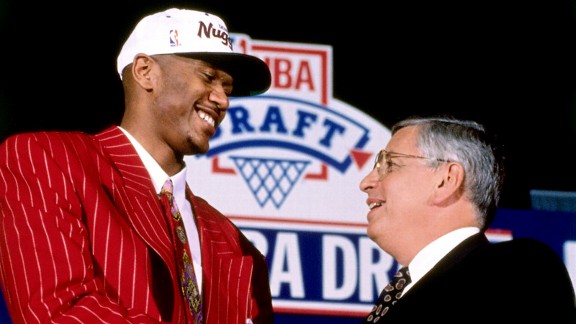
Growing up in Michigan, I knew of Jalen Rose as a member of the Fab Five, that faceless monolith of basketball greatness operating out of the east side of the state. Who these guys were wasn’t as important as the fact of their youth and the color of their socks. You knew you were supposed to be able to name them, and that was that. We soon learned to distinguish Chris Webber, though, if not for his timeout, then for his draft position. I remember his #4 Warriors jersey exploding all over the local sporting goods store. I remember it being the first time I ever knew that there was an NBA team called “the Warriors,” also learning that they played in some geographically mystical place called “Golden State.” Understanding these things became less important when he left after his first year for the Washington Bullets (whose geography I only thought I understood until reading a Sports Illustrated for Kids reader poll about new mascots for that team, which suggested “the Presidents” as one of the alternatives). I knew a couple of the other members played in the NBA– that’d be Rose and Juan Howard– and I knew the other two, Jimmy King (who did have limited NBA exposure, Wikipedia tells me as I write now) and Ray Jackson, played in the CBA, which remained popular on the west side of the state until east-side star Isiah Thomas drove it into the ground. Given our instruction as to their greatness, I at first didn’t understand why they weren’t all NBA all stars, but my concern diminished as my escalating interest in the rival Spartans grew and my interest in the NBA decreased.

It therefore was with some surprise that I began to hear Rose making post-playing-career appearances in the national sports media, first (to my ears) on Jim Rome’s radio show, where the two considered each other “brothers in smack” (not a drug reference), and then as an NBA analyst on ESPN. Later, Rose rode the social media wave, positioning himself as an independent online presence through his Twitter feed and interactive website.

I haven’t been a podcast person– until recently, my lifestyle lacked one of the two alternatively necessary elements: a long daily commute or the structure of a single, working person– which is why I didn’t mention Grantland’s podcast section in my initial assessment of that site. Since then, though, I have attempted to integrate podcasts into my regular media consumption, and so far, only one has stuck (although I did check in with The Solid Verbal during the college football season).

When I saw the announcement about the firstsecond episode of the Grantland Network’s “Jalen Rose Show” (the first time it was called that), I didn’t realize it was an actual show or series, and I thought the headline was a reference to Rose’s talkative personality, his ability to carry a segment, a show, a full podcast. Fifteen episodes later, I’m glad I was mistaken.

To give you a flavor of the program, here’s the first of two video clips they have released:

There really isn’t anyone like Rose in sports media today. He is candid, thoughtful, and unintentionally funny. Things he avoid include clichés and directly answering the question asked of him. Keep reading for another video clip…

Super Monday

Winner: The New York Giants. They scored first, with a technical safety on the Patriots’ opening drive, when Tom Brady stood in his own end zone and intentionally grounded the ball, and they scored last, when Ahmad Bradshaw carried a little more momentum than he probably expected on a largely undefended running play, to beat New England 21-17.

Loser: The New England Patriots. Despite going down 9-0 early in the game, they took a lead into halftime, thanks for a field-traversing drive on which Tom Brady was 10-10 in passing. The Pats suddenly looked like their old, domineering, mechanistic, enemy-vaporizing selves. And they got the ball to start the second half! I sent a text message to Bdoyk at halftime: “Tide has turned.” Her response: “Don’t say that.” To the hyperstitious greater Massachusetts sports community, I’m sorry if that in-game prediction of victory caused your players to develop stone hands on the final drive.  Keep reading…

A Fighter Abroad (via Grantland)

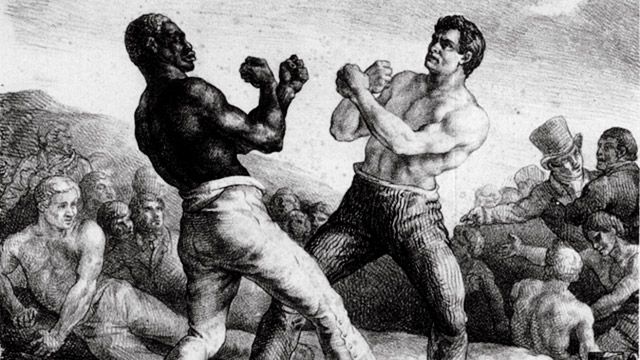
On December 10, 1810, in a muddy field around 25 miles from London, a fight took place that was so dramatic, controversial, and ferocious that it continues to haunt the imagination of boxing more than 200 years later. One of the fighters was the greatest champion of his age, a bareknuckle boxer so tough he reportedly trained by punching the bark off trees. The other was a freed slave, an illiterate African-American who had made the voyage across the Atlantic to seek glory in the ring. Rumors about the match had circulated for weeks, transfixing England. Thousands of fans braved a pounding rain to watch the bout. Some of the first professional sportswriters were on hand to record it.

It was the greatest fight of its era. But its significance went beyond that. Even at the time, it seemed to be about more than boxing, more than sport itself. More than anything, the contest between a white English champion and a black American upstart seemed to be about an urgent question of identity: whether character could be determined in the boxing ring, whether sport could confirm a set of virtues by which a nation defined itself.

The fight cemented a set of stock characters — the fast-talking, ultra-talented, self-destructive black athlete; the Great White Hope; the canny coach who’s half devoted to his pupil and half exploiting him — that have echoed down the centuries.1 In fact, so much about the fight feels familiar today, from the role of race to the role of the media, that if you had to name a date, you could make a good case that December 10, 1810, was the moment sport as we know it began. … Read More

(via Grantland)

The promise of Prince Fielder

I largely agree with Bpbrady and Dave Cameron’s assessment of the deal that made Prince Fielder a member of the team where his (estranged) father was a star. In short, the Tigers had better win a World Series by 2015. Fielder probably is close to his athletic peak right now, but, like Albert Pujols’ new contract with the Angels, compensation doesn’t really ramp up until later.
 
 
ESPN Insider’s Dan Szymborski ran a ZiPS projection for Fielder over the next nine years. Here’s what he got:


Those early-contract numbers might look a tad pessimistic, given that Fielder’s coming off a season in which he hit .299/.415/.566 and racked up 5.5 wins above replacement, and he’s just 27 years old, smack in the middle of the age range in which the average major leaguer peaks. But for all of his power potential, Fielder is a lousy defender who’ll play either first base (poorly) or DH. That means he needs to hit a metric ton to yield as much value as a player manning a premium defensive position, like Matt Kemp or even Dustin Pedroia.

The national media reaction to this deal has been pretty tepid: it just seems to be too rich for their liking, and Fielder won’t earn the money over the full length of the nine-year contract. My buddy in Detroit called me a couple hours after the announcement to discuss, and he said that the reaction over there largely remained in the surprised shock stages. The general consensus that’s filtering through there and nationally, though, is that the Tigers over-leveraged their future in an attempt to win now, making this a bad deal for the Tigers. In other words, this 275 lb (and growing), $214 million (and escalating) albatross will be such a drag on the team that it will clearly outweigh any short-term benefits.

This, of course, is hardly the case. The theory underlying the criticism of the Fielder deal is that teams should be trying to build perennial contenders, and that this contract will prevent Detroit from becoming a perennial contender once Fielder’s decline sets in. The second clause in the preceding sentence may be true and probably will be, but the first contains a cliché assumption that is bogus. Maybe it isn’t totally bogus. If some success is good, more success is better, and once having found success, it’s nice to sustain that success. The problem is that very few teams have been able to maintain top-level success. (Moreover, there was no indication that the 2011 Tigers were calibrated such that they were on the cusp of a decade of dominance or anything like that.) Detroit hasn’t won the World Series since 1984, and the years since then have been pretty thin. If presented with the option of winning the division in each of the next three seasons, winning one championship during that period, and then sinking back into mediocrity for the next six years, I can’t imagine a single Tiger fan saying no. Our willingness to forego future stability for an increased chance of present gains has put our economy in the stink pot, but when it comes to baseball, and a team that hasn’t won it all in 28 years, the strategy makes perfect sense.

Keep reading…

The steel-silver lining in Rashard Mendenhall’s season-ending injury

In Tuesday morning’s weekly update, I wrote that Pittsburgh Steelers running back Rashard Mendenhall’s season-ending ACL tear was “a literally crippling blow to Pittsburgh’s Super Bowl chances.” Observant Grantland writer Bill Barnwell offered a contrary view:

Will [Mendenhall’s absence] really affect the Steelers heading into the playoffs, though? It’s debatable. Mendenhall certainly has the biggest name of any Steelers running back, but his production is positively ordinary. He’s only averaged 4.1 yards per carry on his 228 rushing attempts this year. Meanwhile, primary backup Isaac Redman has averaged 4.4 yards a pop on 110 attempts, while third-stringers Mewelde Moore and Jonathan Dwyer have combined for 280 yards on just 38 carries, for a rushing average in excess of seven yards.

It’s not totally uncommon for a backup to produce a rushing average superior to the starter, but that usually happens because the starter is accruing a large quantity of touches, including many in less-than-ideal situations for gaining consistent yardage. It’s hard to fathom that Mendenhall is such a back, since he’s only carried the ball about 15 times a game and had just one game this season with more than 19 carries. The DVOA statistic, which adjusts for quality of opposition and game situation, says that Redman and Mendenhall are virtually identical; Mendenhall’s DVOA is at 3.8 percent, while Redman’s is at 3.5 percent.

It would be one thing if Mendenhall had a history of success, but he now has 813 NFL attempts and a rushing average at those same 4.1 yards per carry. His case for being a star basically amounts to his status as a first-rounder and two big games in 2009 against the Chargers and Broncos, in which he combined for 320 yards against two below-average run defenses. He’s never developed into a reliable receiver, catching just 68 passes in four seasons. We hoped and expected that he would take a step forward this season after a somewhat disappointing 2010, but if anything, he had taken a step backward before the torn ACL.

If the Steelers can get Moore back from a sprained MCL to serve in his customary role as the third-down back, chances are that they won’t miss Mendenhall whatsoever.

My only rejoinders are a) Barnwell’s analysis fails to consider a durability notion (the effect on Mendenhall’s replacements of having to shoulder a heavier load), and b) the combination of Mendenhall’s absence and Ben Roethlisberger’s limitations due to his own injuries, which I mentioned on Tuesday. Still, given Barnwell’s recently proven successful playing of the NFL numbers this season, I’m inclined to yield to him on this sort of thing.

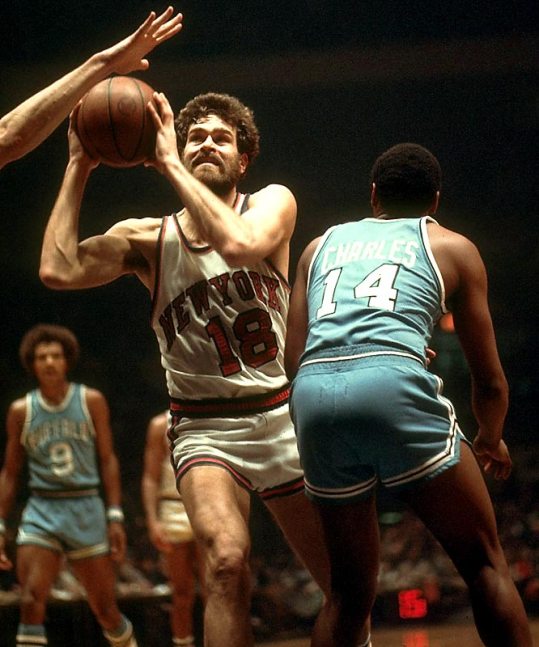
Philip Jackson’s legacy

Now that we have a few generations of organized sport under our collective belt, we have more options for assessing the greatness of its participants contextually. While many of the major sports, especially hockey and baseball, have become internationalized through broad player entry, coaching pools remain markedly small. Moreover, many of the coaches are (professionally, and occasionally familially) related to each other. Trace a current head coach’s resume backwards and you’re likely to find that he worked as a coordinator or assistant alongside other current head coaches underneath a prominent head coach of the past generation. Looking prospectively, these relationships often are described as “coaching trees” (click here for a detailed look at some of the NFL’s coaching trees), and, beyond any championships won, seasonal records set, or individual players developed, these coaching trees can represent a coach’s most lasting impact on the game. Some of the most extensive coaching trees read like the first chapter of Matthew (the begattitudes), and these relationships are important not just because a handful of people used to work together and now are running their own teams, but because they represent shared philosophies of coaching– strategy, tactics, personnel management, etc. Sort of like long-gone U.S. presidents can continue to affect public policy through their lasting legacy of federal judicial appointments, athletic strategists can find their schemes in play long after they’re gone, directed by their coaching legacies and operated by modern stars they may never have met. Having a large, relevant coaching tree is a major indicator of coaching success.

Which is why it’s surprising to realize that professional basketball’s greatest coach, Phil Jackson, essentially has no coaching tree whatsoever.

Last month, Grantland’s Chuck Klosterman wrote a piece on Jackson and the Triangle offense that offered little insight on Jackson or the Triangle. It did conclude with the following, however, and while the last sentence frames this partial paragraph as a preemptive obituary for the Triangle, the substance of the quoted portion functions to conscribe the legacy of Jackson himself:

Jackson is widely viewed as arrogant. He engenders jealousy among his rivals (and seems to enjoy doing so). His acolytes are few and far between. Unlike most coaches who’ve had major success, he hasn’t spawned a significant coaching tree of former assistants — his only real tentacles into the league have been recently fired Timberwolves coach Kurt Rambis and ex-Mavs coach Jim Cleamons (currently working in China). Neither ran the Triangle in totality. Jackson’s NBA impact has been massive, but his ongoing influence will be muted. It appears that he will not be remembered as the NBA coach who ran the Triangle best; in all likelihood, he will be remembered as the only NBA coach who ran it at all. If the Triangle truly dies, it dies with him.

The man and the scheme are inextricably connected, of course, and we’re far too close to Jackson to estimate or predict his total legacy and future perception, but at a time when the many of the best coaches are seen either as the grand culmination of an existent coaching tree or, especially, the roots of a new one, Jackson appears rather isolated, which is sort of how we’ve always thought about him anyway.

Sports Book Hall of Fame: Days of Grace (via Grantland)

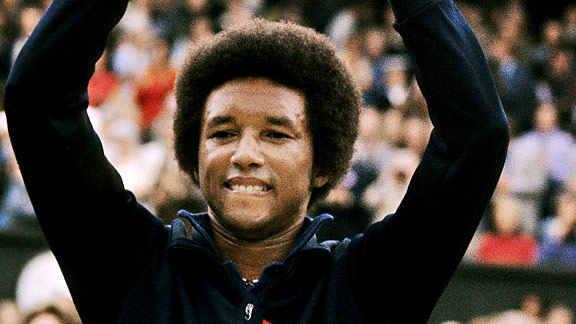
Many athletes have been referred to as being bigger than their sport. Michael Jordan was larger than basketball because kids in every corner of the Earth wanted to be “Like Mike” and had the no. 23 Bulls jersey to prove it, even if it was one of their few pieces of clothing. Muhammad Ali transcended boxing because his mouth and his beliefs made him as much of a cultural icon as his powerful fists and quick feet. Ashe was a brilliant athlete, but he was so much more. For him, tennis seemed more like a means to an end, and that final end was the completion of Days of Grace. Ashe wanted to be great, but he was far more concerned with his true greatness coming off the court than between the chalk. … Read More

(via Grantland)

LaMichael James, Tom Petty, and the Heisman Trophy

Two years ago, Wall Street Journal entertainment writer John Jurgensen wrote a retrospective on Tom Petty. The musician certainly wasn’t finished, but the then-upcoming release of a career-spanning anthology provided the occasion to look back and consider his legacy. The thesis of the piece was that, in terms of legacy, Petty was too good for his own good. Somehow, because he has been so popular and successful for so long, people almost lose track of him and forget to list him when discussing the great rock and rollers of the period.

An analogous narrative may apply to Oregon running back LaMichael James. The thought came to me while listening to the most recent episode of The Solid Verbal podcast on the Grantland Network. Ty Hildenbrandt casually referenced James’ numbers in Saturday’s Pacific Twelve championship game: 219 yards, 3 touchdowns, 8.8 yards/carry. Hildenbrandt’s co-host and acknowledged Oregon homer Dan Rubenstein appropriately led the show into a discussion of the James’ absurd statistical output and the casual response it generally receives. Indeed, the Heisman Trophy finalists were announced this week, and James’ name was not among them.

There are plenty of reasons why people may not bat an eye at James and his numbers– he plays on the West Coast, in Oregon’s offensive system, and has been doing so for a long time in relative terms (and he’s only a junior, which, along with the existence of a strong field of contenders, may help to explain his omission from the Heisman list this year)– but one can strum up plenty of reasons for Petty’s treatment in the popular realm too– he isn’t a flashy guitar shredder, his voice isn’t inherently iconic, he didn’t have a mega-hit of temporal cultural relevance, he’s kinda goofy-looking. Yet Jurgensen’s too-good-for-his-own-good thesis applies equally to both men. Indeed, these listed reasons really aren’t exceptions to the overarching notion; the fact that they are good or at least debatable factors tends to support it.

I don’t think that familiarity always breeds contempt. In the case of Petty and James, the combination of familiarity and success appear to breed forgettableness.

Running past interference

I like Grantland’s Vegas correspondent, Bill Barnwell, and it seems he had himself a pensive weekend, maybe because he lost all his money? Who knows, but he posted today his suggestions for reforming the NFL’s pass interference rule that are thoughtful and almost academic in their substance and presentation. Aside from the practical workability concerns he identifies, I think his solution– creation of minor, major, and flagrant pass interference penalties– is a good one. The details are available here.

I have long complained about pass interference calls in football too, but not for the same reasons as Barnwell. I’ve often said that 75% of pass interference calls shouldn’t be made, and while I’m no good at numbers, the point is that it’s called too much. Barnwell agrees for a derivative or secondary reason: the game-atlering nature of the sanction. I think so for a primary reason, however: the very act being punished isn’t worthy of punishment as often as it is punished, irrespective of what that punishment is.

I get that football doesn’t work if the DBs get to just tackle the receivers on every play, and I get that this is especially true today, when passing has come to dominate the pro game to the extent it now does (ESPN declared 2011 the Year of the Quarterback, so it must be true), but this is still a contact sport, and passes are still live balls, and getting a jersey tugged or an arm touched is part of the game. Watching every receiver who just missed a catch pop up and flail for a flag he more often than not gets shouldn’t have to be, though. I know we don’t really live in the world of tear-away uniforms anymore, but the jersey pull is the dumbest of all, right? “Yep…right there…grabbed the back of his jersey….”  Whether that and other similar physical interactions cost the defense five yards or fifteen yards isn’t my concern, and I don’t propose any formal rule change. Rather, the league should just tell the officials to back off on their pass interference calls. 

Barnwell, ever the Vegas man these days, writes a lot about risk and reward in his proposal for sanction modifications. Because the types of interactions the pass interference penalty punishes aren’t those that are large player safety threats, a similar analysis could apply to my proposal for treatment of the underlying act in that this is a low risk, high reward area for the league to permit back into the game some of the physicality it’s taking out in other areas.

Busy Monday

It was a busy weekend, really, and mostly because it was twice as long as most ordinary weekends. Plenty of football, including another Lions Thanksgiving day defeat at the hands of the Packers, injuries, and Ndamukong Suh (more on him later), a dominant performance by LSU over then-number 3 Arkansas that left Razorbacks head coach Bobby Petrino less than happy with the Tigers’ Les Miles (Clay Travis (who else?) has the video here), Michigan State rolling over Northwestern in a classic trap game, Michigan beating Ohio State for the first time since 2003 (more on that exciting game later), and Vanderbilt destroying Wake Forest to finish the regular season with a bowl-eligible 6-6 record, tripling their win total from last year and besting their win total of the last two seasons combined. In an era when a new coach routinely gets three or four years to “get his guys in” before he has to show success, Vanderbilt’s James Franklin turned a 2-10 team into a 6-6 team in one year, playing in the toughest conference in America, and he’s mad because they were a couple plays away from being 9-3. The Commodores’ loss to UT still stings, but the Vols’ defeat at the hands of lifeless Kentucky will keep the Big Orange out of a bowl this year, and that definitely is a silver lining for Vandy fans.

In Sunday NFL action, I have to mention Tim Tebow, who continued his improbable winning ways, and the Indianapolis Colts, who continued their extremely probable losing ways.

Two pieces of basketball news sure to be disappointing to large segments of the population: first, throwback UNLV took down top-ranked UNC in decisive fashion at the Las Vegas Invitational on Saturday, and the NBA is back, games to start piously on Christmas Day (link to the entirety of Grantland.com pending) (UPDATE: here it is.). (More seriously, the situation in Syracuse seems to have entered a new phase.)

In hockey, the Red Wings took down the pesky Predators and the Capitals fired their coach 22 games into the season.

Oh, and despite their loss in Ann Arbor, Buckeye hearts are aflutter with news of the hiring of Urban Meyer as OSU’s next head football coach. (More on that later, too.)