Sports Law Roundup – 1/6/2017

aslr

I used to write the sports technology roundup at TechGraphs, an internet website that died, and now I am writing the sports law roundup at ALDLAND, an internet website.

Here are the top sports-related legal stories from the first week of 2017:

  • Baseball stadium funding: The Arizona Diamondbacks, seeking the right to “explor[e] other stadium options,” have sued the Maricopa County Stadium District after the District refused to authorize funding for the $185 million needed for capital repairs and improvements to Chase Field, which opened in 1998, according to an assessment completed by the District.The team has expressed willingness to cover all of the District’s expenses, but the District apparently must give its permission to proceed and thus far has declined to do so.
  • Student-athlete classification: In a case we have been monitoring in this space (here and here), the U.S. Court of Appeals for the Seventh Circuit has denied the request of a group of former Penn student-athletes for full-court (en banc) review of that court’s earlier rejection of their claim that they were employees entitled to minimum-wage compensation under the Fair Labor Standards Act. The denial of the request for further review leaves in place the court’s decision handed down last month. It is unclear whether the plaintiffs will request permission to appeal to the Supreme Court.
  • Daily Fantasy Sports: A DFS website argued that daily fantasy sports actually are illegal gambling in an attempt to avoid a $1.1 million lawsuit based on an advertising and sponsorship contract with the Minnesota Wild. I wrote more about this case here earlier this week. Meanwhile, a Maryland law authorizing the lawful, regulated conduct of DFS contests in that state, which is regarded as less restrictive than similar measures in other states, went into effect on Monday; a Florida legislator introduced a bill Wednesday that would declare DFS legal in that state; and FanDuel earned another win in a patent-infringement suit brought by two gambling technology companies in Nevada.
  • Preemptive free agency:  Nathaniel Grow has an interesting article on FanGraphs that illuminates a California employment law that could apply to allow even union employees like professional athletes to unilaterally opt out of long-term contracts after seven years of employment. This poses a potentially tantalizing, if legally unproven, opportunity for someone like Mike Trout, a generational talent not yet in his prime who likely could fetch an even more historically large contract were he to hit the open market now, at age twenty-five, rather than after the 2020 season, which is when his current contract ends.

Sports court is in recess.

Baseball’s faithless electors

My latest post for Banished to the Pen considers the Tampa Bay Rays, the faithless electors of the vote on the 2016 MLB collective bargaining agreement, and it includes this picture:

drays

The full post is available here.

Sports Law Roundup – 12/9/2016

aslr

I used to write the sports technology roundup at TechGraphs, an internet website that died, and now I am writing the sports law roundup at ALDLAND, an internet website.

Here are the top sports-related legal stories from the past week:

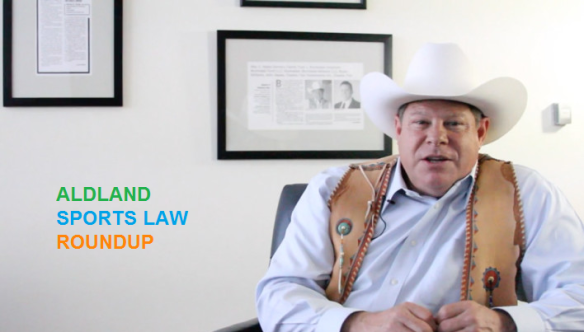
  • College football defamation: On Thursday, former Baylor head football coach Art Briles sued three Baylor regents and the university’s senior vice president and CEO claiming that they defamed him by stating that he had knowledge of sex crimes reportedly committed by his players and failed to provide that information to proper authorities. In addition, Briles alleges that the officials sought to prevent him from securing another coaching position elsewhere. He also included a claim for intentional infliction of emotional distress, and, in total, seeks unspecified damages in excess of $1,000,000. Here is a picture of Briles’ longtime attorney, Ernest H. Cannon, riding a horse at a rodeo.
  • Football player suspension challenges: In related stories covered in this space last week, two NFL players represented by the same Ohio law firm launched collateral attacks on the NFL/NFLPA collective bargaining agreement targeting alleged procedural deficiencies in the suspension-appeal process after both were suspended for drug violations. The NFL and NFLPA now have taken action in one of those cases by appointing a third arbitrator to hear a rescheduled appeal by Green Bay Packer Mike Pennel. The absence of a third arbitrator is central to the claims Pennel raised in the lawsuit he filed in Ohio federal court. In connection with that suit, Pennel also sought a temporary restraining order, which the responsive actions by the league and union were designed to moot. On Tuesday, Pennel agreed to drop his lawsuit in exchange for a reduction– from ten games to four– in his suspension, which will allow him to play in the postseason should his Packers secure a playoff berth. (Pennel’s attorneys also represent Philadelphia Eagle Lane Johnson, who filed similar complaints with the National Labor Relations Board and U.S. Department of Labor around the same time Pennel filed his lawsuit.)
  • Student-athlete classification: The United States Court of Appeals for the Seventh Circuit rejected claims by a group of former Penn student-athletes that they are employees entitled to minimum-wage compensation under the Fair Labor Standards Act. The trial court granted a motion to dismiss the defendants– the NCAA, Penn, and more than 120 other NCAA member schools– filed, and the appellate court affirmed. The court agreed that dismissal as to the non-Penn defendants was appropriate because of a lack of standing; the plaintiffs had attended only Penn and had no basis to recover wages from any school they didn’t attend. The court also agreed that dismissal was appropriate as to Penn, because the plaintiffs had failed to state a claim for relief from Penn. Noting the “revered tradition of amateurism in college sports” and the weight of judicial and regulatory precedent holding that student-athletes are not employees, the court concluded that the FLSA does not apply to student-athletes. While many disagree with this outcome, it is consistent with the original meaning and purpose behind the “student-athlete” designation. (In a concurring opinion, Judge Hamilton cautioned against broad application of the court’s decision, noting that the plaintiffs participated in a non-revenue sport– track and field– for a school that does not offer athletic scholarships, and suggested that he might have voted differently had the plaintiffs been student-athletes on athletic scholarship in a revenue sport.)
  • Hockey head injuries: A group of former NHL players suing the league for its alleged failure to warn them of known risks of head trauma now have requested class certification in that case for two classes of former players based on the different measures of relief sought: damages for those already diagnosed with neurological injuries and medical monitoring for others. Attorneys from a number of large law firms, including Skadden Arps Slate Meagher & Flom, are representing the NHL in this case. Skadden is the anchor tenant in a new commercial real estate development in Manhattan that also will be home to the NHL’s offices when it opens in 2019.
  • Minor League Baseball lobbying: MiLB has created a political action committee in order to boost lobbying efforts. The impetus for this move likely is the class-action lawsuit minor-league players filed alleging that their compensation violates federal wage and hour laws and the leagues’ attempt to snuff out that suit by way of congressional action. The proposed Save America’s Pastime Act would create a carve-out in the Fair Labor Standards Act exempting minor-league players from minimum-wage and overtime protections. There has been essentially no action on the bill since Rep. Brett Guthrie of Kentucky introduced it in June, leaving plenty of time for MLB to say dumb things about it.
  • Soccer ban: The Court of Arbitration for Sport denied former FIFA president Sepp Blatter’s request to overturn his six-year ban from all national and international soccer-related activity and fine of 50,000 Swiss francs for his involvement with bribes and kickbacks during his leadership of FIFA.
  • Canadian Super Bowl commercials: There is a thing in Congress called the House Northern Border Caucus, and four of its members, representing districts in North Dakota, New York, and Washington, sent a letter asking the Canadian government to reverse its decision to block Canadian advertisers from running commercials on the Canadian broadcast of the Super Bowl. Canadian broadcasters used to have an agreement with the NFL that allowed Canadian commercials on the Canadian broadcast of the game, but, in 2015, Canadian regulators changed course in response to viewer demands to see the popular American commercials that run during the game. Canadian broadcasters and advertisers and the NFL, which is losing out on Canadian advertising revenue as a result, all oppose that change. The company that holds the Canadian broadcast rights to the Super Bowl, Bell Media, also has sued the regulatory body in an attempt to reverse the policy.
  • Hockey logo: Things are off to a rough start for Las Vegas’ first major professional sports team after the U.S. Patent and Trademark Office denied the Golden Knights’ registration application, citing a “confusing[] similar[ity]” to a mark registered by the College of Saint Rose. Arguable visual similarities aside, I didn’t even know there was a Saint Rose, much less a College of Saint Rose, and I certainly didn’t know the school’s mascot is the Golden Knights, and neither did you, which means that, however similar these marks might be, the likelihood of confusion here is very low. This likely is little more than another instance of the USPTO seeking a moment in the sports sun.
  • Gambling: The nation of Antigua and Barbuda has issued a threat to the United States if the U.S. does not meet a year-end deadline to comply with a 2003 World Trade Organization order ruling that American online sports betting and gambling laws violate international law. If the U.S. does not comply with the WTO order, which also carries an annual noncompliance penalty of $21 million and has accrued to over $250 million, Antigua and Barbuda intends to suspend intellectual property protections for Americans, effectively permitting Antiguans to establish websites hosting royalty-free downloads of American IP (e.g., books, music, movies, television programming, etc.).
  • Baseball ambassador: Bobby Valentine, former MLB player and manager of the Mets and Red Sox, reportedly is under consideration by president-elect Donald Trump for the position of ambassador to Japan. Valentine, who currently serves as athletic director at Sacred Heart University, is popular among Japanese baseball fans thanks to two successful stints as manager of a professional baseball team there.

Sports court is in recess.

Sports Law Roundup – 12/2/2016

aslr

I used to write the sports technology roundup at TechGraphs, an internet website that died, and now I am writing the sports law roundup at ALDLAND, an internet website.

Here are the top sports-related legal stories from the past week:

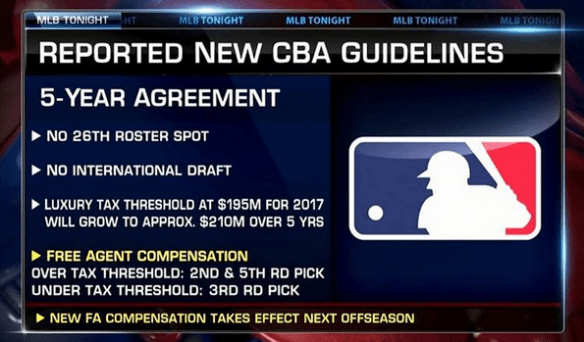
  • MLB CBA: Shortly before the December 1 deadline, MLB and the MLBPA reached agreement on a new collective bargaining agreement that will govern the sport for the next five years.
    2016-mlb-cba
    Details still are emerging, but early analyses are labeling this round of negotiations another win for ownership. (Others see it as a mere “setup for war in 2021.”) One of the most visible changes fans will notice is that the All Star Game no longer will determine home-field advantage in the World Series; instead, that perk will go to the team with the better regular-season record. Another aesthetic change: no more chewing tobacco (although current players are free to chaw down; the ban only applies to new players as they enter the league). Following in the NFL’s footsteps, MLB has indicated plans to play a regular-season game in a foreign country, possibly England or Mexico, as soon as 2018.
  • Football player suspension challenges: Lane Johnson, a fourth-year offensive tackle for the Philadelphia Eagles who is serving a ten-game suspension following a second failed test for performance-enhancing drugs, has challenged his suspension by filing complaints against the NFL and NFLPA with the National Labor Relations Board and U.S. Department of Labor, alleging that the suspension procedure violated his rights under his employment contract and federal labor law. While the filings currently are not public, Johnson’s challenge appears, based on a statement from his lawyer, to be a collateral attack on the collective bargaining agreement itself: “During Lane’s appeal, it became apparent that the written words in the collectively bargained Performance-Enhancing Substances (‘PES’) Policy, under which Lane was disciplined, are meaningless. The NFL and NFLPA have undermined these protections leaving the players — including Lane — with a hollowed-out process devoid of any protections.”
    Faced with a similar situation, Mike Pennel, a third-year defender for the Green Bay Packers, is challenging the adequacy of the suspension-appeal procedures by filing an action in federal court. Pennel’s allegation is that the use of only two arbitrators, rather than three, for his appeal hearing violated the league’s substance-abuse policy.
    Both Pennel and Johnson are represented by the same law firm, Ohio-based Zashin & Rich.
  • NBA arena: A court’s denial of two citizens’ organizations’ petitions will allow construction to proceed in San Francisco on a new, privately financed, $1 billion arena for the Golden State Warriors. The groups had sought to block the project because, in their view, the city’s environmental analysis was insufficient, specifically including an allegation that increased traffic would interfere with the operation of the nearby UCSF hospital. The Warriors will leave their current home in Oakland to begin play in the new San Francisco arena in 2019.
  • Sharper sentencing: A judge sentenced longtime NFL safety and serial rapist Darren Sharper, previously most famous for playing fourteen seasons for the Packers, Vikings, and Saints, and for his supporting “role” in this viral video, to twenty years in prison as part of a plea bargain in which Sharper admitted to drugging and raping women in four states. Sharper, whose victims number more than a dozen, previously pleaded guilty in a federal trial for drugging three women so he could rape them and is appealing the eighteen-year sentence he received in connection with that plea.
  • Inmate phone calls: Former Florida Gator and New England Patriot Aaron Hernandez, who is incarcerated in Massachusetts following his conviction for murdering one person and being charged with multiple additional murders, has sued Securus Technologies, one of the largest providers of inmate telephone services. Based on media reports of a Securus data breach, Hernandez’s suit alleges that the company failed to protect privileged and confidential information, such as telephone calls between Hernandez and his lawyers.
  • Whistleblowing coach: A judge awarded former Penn State football coach Mike McQueary an additional $5 million Wednesday after determining that the school terminated his employment as a result of his testimony against other PSU officials who failed to act in response to McQueary’s report on child sexual abuse by another football coach. McQueary previously won $7.3 million in a jury trial on claims related to the university’s investigation of the assault and its related defamation of McQueary. (Yes, the PSU community really did attack McQueary for reporting a football coach’s child sexual abuse. Four years later, that community appears to be as delusional as ever.)
  • Football painkillers: In an update to a story previously highlighted in this space, a judge has ordered Dallas Cowboys owner Jerry Jones to sit for a deposition in a lawsuit by former NFL players alleging that teams irresponsibly dispensed painkillers to their players in order to keep them on the field, granting a discovery victory to the players. The victory was a partial one, however, because the judge denied the plaintiffs’ request to depose Jim Irsay, the owner of the Indianapolis Colts, famous guitars, and a personal history of painkiller abuse.
  • Super Bowl hotel rooms: Marriott has emerged victorious in a contract dispute with a sports travel agency after a judge ruled that the hotel chain was not bound by its obligations to the agency to provide 300 rooms for the Super Bowl in Houston, because the agency, in selling 240 of the rooms to another broker, violated a no-transfer provision of the agreement with Marriott. When Marriott cancelled the contract, the agency sued, accusing Marriott of violating their contract in order to pursue a more lucrative opportunity with the NFL and alleging that Marriott knew of the agency’s practice of reselling rooms. Even if that was true, the judge explained, the no-transfer clause was clear, and the agency could not enforce a contract it had breached.

Sports court is in recess.

Baseball Notes: The WAR on Robbie Ray

baseball notes

There are a few things we know with reasonable certainty about Robbie Ray. He was born on October 1, 1991 just south of Nashville in Brentwood, Tennessee. In 2010, the Washington Nationals drafted him in the twelfth round of the amateur draft. The Nationals traded him, along with two other players, to the Detroit Tigers in 2013 in exchange for Doug Fister. A year later, the Tigers traded him to the Arizona Diamondbacks as part of a three-team trade that netted the Tigers Shane Green and the New York Yankees Didi Gregorius. So far, Ray has seen major-league action as a starting pitcher with the Tigers and Diamondbacks. He showed promise in his first three appearances (two starts and an inning of relief), for Detroit. He showed less promise in his remaining six appearances– four starts and two relief innings– for that team. Things have ticked back up for Ray since his arrival in the desert, however.

__________________________________

Most baseball fans likely have some familiarity with the player-valuation concept of wins above replacement player, usually labeled WAR. What many fans may not realize, however, is that there actually are three different versions of the WAR statistic. The goal of each version is the same: to determine a comprehensive valuation of an individual baseball player. Each takes slightly different paths to reach that comprehensive valuation, but they typically reach similar conclusions about a given player, such that it’s common to see or hear a player’s WAR cited without specific reference to the particular version utilized.

For example, the three versions– Baseball-Reference’s WAR (“rWAR”), FanGraphs’ WAR (“fWAR”), and Baseball Prospectus’ WARP (“WARP”)– all agree that Mike Trout had a great 2016. He finished the season with 10.6 rWAR, 9.4 fWAR, and 8.7 WARP, good for first, first, and second by each metric, respectively. For another example, they also agree about Trout’s former MVP nemesis, Miguel Cabrera: 4.9 rWAR, 4.9 fWAR, 3.9 WARP. (In my anecdotal experience, WARP tends to run a little lower than rWAR and fWAR for all players.)

__________________________________

While the WAR varietals typically and generally concur, that isn’t always the case. Pitchers can be particularly susceptible to this variance, because the measurement of pitching performance is one of the areas in which the three metrics are most different. Continue reading

Final 2016 MLB prediction report

giphy

Now that the individual awards are out, we can put a wrap on my preseason MLB predictions. I’ve already recapped the team-standing predictions and results here, and what follows is a look at how well I predicted the individual player awards announced this week:

American League

MVP: Mike Trout

Correct. Trout’s win was not the result of a unanimous vote, but it was a clear win. He was the favorite for the award at the beginning of the season, and, despite playing on a bad team (a factor that seems to matter to some), Trout is a generational player, and maybe more, who a not-small group of people believe should have won this award every year of his career. By the leading WAR metrics, this wasn’t even Trout’s best season (although it’s a close call by rWAR), but he was better than everybody else. Good call, BBWAA.

Cy Young: Chris Sale

Incorrect. Sale finished fourth, and Rick Porcello won the award. Let’s not talk any more about this one.

Rookie of the Year: A.J. Reed

Incorrect. This one was my biggest gamble of the entire predicting process. While the NL ROY choice was obvious even before the season started, the AL seemed to me to be wide open, so I chose a little-discussed player who seemed to be in a position to make a big impact for a good team that seemed ready to explode. Even last year, the Astros had a lineup stocked with young talent, and it appeared that they might be a bit ahead of schedule on their massive rebuilding plan. Preseason, their only real gap in the lineup looked like it was at first base, and Reed was a power-hitting first baseman waiting in the wings. Unfortunately for my prediction, which obviously is what matters most here, the Astros weren’t ahead of schedule, and Reed did not propel them to the postseason in a blaze of hitting glory. Instead, Houston’s pitching regressed, and Reed played just forty-five games of sub-replacement-level baseball. Next year could be a very different story, though, as Houston– which added Brian McCann and Josh Reddick yesterday– looks to be making a very strong push for 2017. Right on schedule.

The actual winner, Michael Fulmer, was a great choice. I wrote more about his win here.

National League

MVP: Paul Goldschmidt   Continue reading

Michael Fulmer and the changing face of the Detroit Tigers

fulmer_poy_r6n5p8h1_j3r60e3n

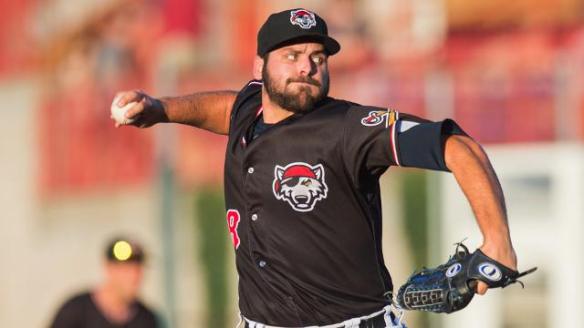
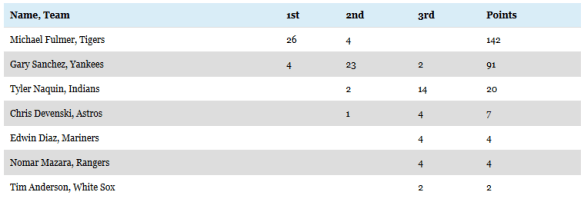
We learned Monday that Detroit Tigers starting pitcher Michael Fulmer is the 2016 American League rookie of the year. While not a unanimous selection like his National League counterpart, Corey Seager, he still claimed the award in convincing fashion:

royfulmer

Fulmer is the fifth Tiger to win the award, joining teammate Justin Verlander, Lou Whitaker, Mark Fidrych, and Harvey Kuenn. The connection between Verlander, who won his rookie of the year exactly ten years ago and is a contender for his second Cy Young award this year, and Fulmer seems to be a neat and real mentorship relationship. Here’s a snapshot statistical comparison of Verlander and Fulmer in their rookie-of-the-year seasons:

royfulmerverlander

It certainly is exciting to consider the possibility that the Tigers have found in Fulmer another Verlander, even if Fulmer’s numbers– comparatively superior to Verlander’s ROY season across the selected metrics– have some worried about his ability to repeat his rookie-year successes. (This concern boils down to the relatively large gap between Fulmer’s ERA and his FIP. It seems worth noting that Verlander had an even larger gap in 2006.) It doesn’t mean a lot, but the similarities make for a fun comparison.

Fulmer’s accolades serve as a reminder that the next generation of this Tigers team already has arrived, at least in part, and that, with business-side changes afoot, the veteran generation could be gone before we know it.   Continue reading

Offseason starts with a bang for the Detroit Tigers

maybin-gone

When the Detroit Tigers’ season ended in Atlanta last month, the message from general manager Al Avila was both clear and clearly different than it had been a season ago, when Avila took over the job from his boss, Dave Dombrowski. Then, speaking as the mouthpiece of the team’s owner, Mike Ilitch, he said that “the foot is on the pedal, hard,” and the team continued to make the kind of win-now moves that largely have defined them for the past decade. Now, though, Avila’s taking his foot off the gas and ushering in a period of austerity that’s likely to be painful. It definitely will be different.

The changes began immediately. Yesterday was the first day of the MLB offseason, and Avila wasted no time in making two of his biggest decisions on current player options. First, he “traded” center fielder Cameron Maybin to the Angels for a low-grade relief pitching prospect in a move that essentially amounts to the Tigers declining to exercise Maybin’s option.

Shortly thereafter, the team announced that it would pick up the $6 million option on closer Francisco Rodriguez. (Had they declined K-Rod’s option, they would’ve owed him a $2 million buyout.)

If, as he has said, his new mission is “making this team leaner, younger, more efficient,” I’m not certain this was the way to do it. Given the money, his track record, and his strong performance last season, I like the decision to retain Rodriguez, even considering the general year-to-year unreliability of reliever performance.

The Maybin decision is more confusing, though. By fWAR, Maybin was the Tigers’ most valuable outfielder last year, and he only played in ninety-four games. (He also was their second-best baserunner.) He missed action due to injury, but not really the kind of injury that should make teams worry. He mostly just kept getting beaned on the hands. That’s just bad luck. He’s only twenty-nine. Over the past two seasons with Atlanta and then Detroit, he finally seemed to be approaching the potential he demonstrated eleven years ago that caused the Tigers to spend the tenth overall draft pick on him in 2005. (He also was the team leader in the Instagram handle category.)

Now he’s gone again, leaving behind holes in center field and the top of the batting order. Jeff Sullivan, writing up this transaction largely from the Angels’ perspective, points a finger to JaCoby Jones as the likely replacement Avila is targeting. Jones showed memorable flashes as a late-season call-up this year, but, like many prospects, he’s still young and raw and inconsistent. The other obvious fill-in is Tyler Collins, who has the relative advantage of being a left-handed hitter but the disadvantage of being at an age and experience level where “raw” is not a baseball adjective that incorporates an element of hope.

All of this happened on offseason day number one. There will be more activity involving the Tigers this offseason, and, typically, it is wise to wait to render final judgment on a particular decision until it can be viewed within the full constellation of the team’s moves. Under austerity, though, there should be little hope for or expectation of near-term improvement through an infusion of external resources; doing better must mean doing better with what you already have. There isn’t going to be a Justin Upton trade this year (which, while we’re at it, probably will be the last year J.D. Martinez wears a Detroit uniform). What stings about the Maybin trade– besides the obvious departure of talent and the intangibles of a fun guy who seemed to be having a lot of fun himself– is that it is a move that will make the team worse in 2017, and the Tigers haven’t made too many moves like that in a good while.

Tardy 2016 World Series Preview

250px-1994-world-series-svg

The 2016 World Series started yesterday, and Cleveland now has Chicago in a one-game hole after a 6-0 shutout win last night. The Cubs were clear favorites to win the series entering last night, and while we probably still should consider them the favorites, Chicago fans can be forgiven for seeing lots of doom and gloom on the horizon this morning.

Here’s what the statistical projections on World-Series-winning odds now say:

Chicago remains favored to win game two tonight, but last night’s loss exacted a large toll on their overall series odds. (On the other hand, as one tortured Cubs fan opined yesterday, “In late October, math no longer applies.”)

At least one more game will be played in Cleveland’s JacobsProgressive Field, which has been a weird place to play baseball of late, at least relative to other places to play baseball.

This entire post has been a polite rouse designed to provide a vehicle for linking you to this World Series preview post, which is the best of its kind and the only one anyone needs to read.

Baseball Notes: Save Tonight

baseball notes

It is an accepted reality that, in general, baseball players don’t have much time for their sport’s new and advanced statistics and metrics. In many ways, this resistance makes sense. In the moment, when standing on the mound or in the batter’s box, there’s only so much thought and information a player can hold in his mind while trying to accomplish the task– make or avoid contact between bat and ball, for example– at hand. Players, like experts in other fields, also understandably tend to be skeptical of outsiders’ ability to provide baseball analysis or insight superior to their own. This skepticism is fairly well documented, most obviously when it involves changes that might impair or decrease a player’s value or role in the game, and, more surprisingly, even when new statistical revelations work in a player’s favor. (There certainly are some players, like Jake Lamb and Trevor “Drone Finger” Bauer, who have embraced sabermetric thinking, but it’s reasonable to assume they remain in the minority among their colleagues.)

A primary impetus of baseball’s sabermetric movement has been to encourage the abandonment of certain traditional statistics that, while still largely entrenched in the sport, are understood to be incomplete in important ways or much less meaningful than their use might suggest. Batting average, for example, doesn’t include walks. (Cf. On-base percentage.) RBIs require a player’s teammates to reach base ahead of him. ERA depends, to a significant extent, on a pitcher’s defensive teammates and other factors outside a pitcher’s control. (Cf. defensive-independent pitching statistics like FIP and DRA.) Pitcher wins and saves are artificial, highly circumstantial metrics that, at best, indirectly measure pitching talent.

For years, analysts have pushed baseball to rid itself of these traditional performance measures. There’s a comfort in hanging onto the statistical language with which we grew up as we learned and discussed the game, but that comfort should turn cold upon learning the degree to which these familiar stats obscure what’s really happening on the field.

So long as baseball’s current player-compensation structure remains in place, though, players aren’t likely to stop caring about things like saves; after all, that’s how they’re paid:

screenshot-2016-10-19-at-5-46-24-pm

In the course of discussing whether departures from conventional reliever usage as particularly exhibited in the 2015 and 2016 playoffs are likely to bleed over into upcoming regular season play, FanGraphs’ Craig Edwards explains one reason players are likely to prefer conventional, save-oriented bullpen strategy:

Saves get paid in a big way during arbitration. Only one player without a save, Jared Hughes, received a free-agent-equivalent salary above $6.5 million in arbitration, while all 16 players who’d recorded more than 10 saves received more than Hughes in equivalent salary. Players are more than happy to make more money, so giving more relievers higher salaries and more multi-year deals is openly welcomed. Taking saves away, however, also takes money away from players with less than six years of service time.

Although there are a number of not-uncompelling reasons why players prefer to steer clear of baseball’s newer metrics, Edwards has fingered one of the most forceful. If fans and analysts want to hear players discuss OBP, DRA, and leverage, they ought to channel their persuasive efforts less toward appeals to players’ logical sensibilities (they get it, no doubt) and more toward the education of the MLB salary arbitrators, to whom the players already listen with great attention.

___________________________________________________________________

Previously
Baseball Notes: Current Issues Roundup
Baseball Notes: The In-Game Half Lives of Professional Pitchers
Baseball Notes: Rule Interpretation Unintentionally Shifts Power to Outfielders?
Baseball Notes: Lineup Protection
Baseball Notes: The Crux of the Statistical Biscuit
Baseball Notes: Looking Out for Number One
Baseball Notes: Preview