Foreign College Basketball Stars Are Missing Out on Endorsement Money Due to Visa Rules (via Reason)

The NCAA used to bar all college athletes from making money off their names, images, and likenesses. But since a 2021 rule change, they have been eligible to earn money through endorsement deals, social media activity, and paid appearances. The NCAA had long viewed college athletes as amateurs, but the policy change—quite sensibly—recognized that students deserved to be paid as professionals. In the first year of name, image, and likeness arrangements, Opendorse, a technological platform for these deals, estimated that college athletes made $917 million. Three-quarters of all NCAA athletes had engaged in the market from July 2021 to July 2022.

But international students largely operate in “a gray zone” in American immigration law when it comes to endorsements, says James Hollis, an immigration attorney at Siskind Susser, PC who has previously advised professional sports organizations on visa matters. “Students, schools, and their lawyers are all operating within the standard student visa framework,” Hollis tells Reason. College athletes are largely in the U.S. on F-1 visas, which place tough restrictions on work. “The student visa rules say that student athletes can work part time on campus, can work if authorized as part of the curriculum…and can work after one academic year if they can demonstrate they’re experiencing economic hardship,” says Hollis.

None of that fits neatly into the name, image, and likeness apparatus. “Some foreign student athletes have been able to obtain O-1 extraordinary ability visas authorizing them to work, study, and compete,” says Hollis. Others have arranged completely “passive deals where they receive income but do nothing that could be considered work while in the United States.” According to Hollis, “the safest path has been to sign deals and then do the work to promote the NIL [name, image, and likeness] content” strictly while outside the United States.

Two years after the NCAA rule change, the Biden administration still hasn’t offered definitive guidance that would allow foreign college athletes to make money like their native-born peers. On a more basic level, this leaves foreign athletes wondering whether certain activities might be violations of their student visa terms.

According to ESPN, just one of the eight teams that played in the men’s and women’s Final Fours didn’t have at least one international student player. UConn has four. Per the NCAA, “roughly one out of every eight athletes across all Division I sports is from a foreign country,” leaving a gaping hole in the system that allows student-athletes to sign often lucrative sponsorship deals. Visa term violations can be dire—potentially as severe as deportation….Read More

(via Reason)

________________________________________________________________

Related
The NCAA’s response to Georgia’s new NIL law reveals the emperor’s new clothes

Vanderbilt Basketball’s Abyss Stepback

A week ago, we were here wondering whether the Vanderbilt men’s basketball team had, at least in its current construction, terminally cratered. We “hope,” I wrote, this “will be its nadir.” The offending event, the school’s third-worst loss ever and worst in twenty years, felt fundamental, essential, and irredeemable. The big-time coach with the small-time record sounded like he was firing himself.

Since then, things for the Commodores hardly could have gone better, at least relatively speaking. Two home conference games in magic Memorial Gym. Two wins.

To call the first a get-right game against middling Ole Miss obscures the depths from which the team necessarily climbed to claim that victory and falsely implies a level of predicate rightness that simply did not exist. Still, it’s like when you’re standing on the South Pole: any step you take in any direction is a step north.

The second was satisfying, affirming, and, for Stackhouse, likely job-saving:

It speaks for itself, as does Tennessee’s record as a top-ten ranked team in Nashville, where the Volunteers are winless in regulation.

There’s no firm basis to believe that these two wins constitute building blocks toward an imminent future of sustained success. It sure is better than losing, though.

______________________________________________________

Previously
The #StackhouseEra on Life Support in Tuscaloosa

The #StackhouseEra on Life Support in Tuscaloosa

Following the departure after the 2015-16 season of the longest-tenured coach in its program’s history, Kevin Stallings, Vanderbilt’s men’s basketball team turned for his replacement to a celebrated former player.

Continue reading

The Big O and the Merry Prankster

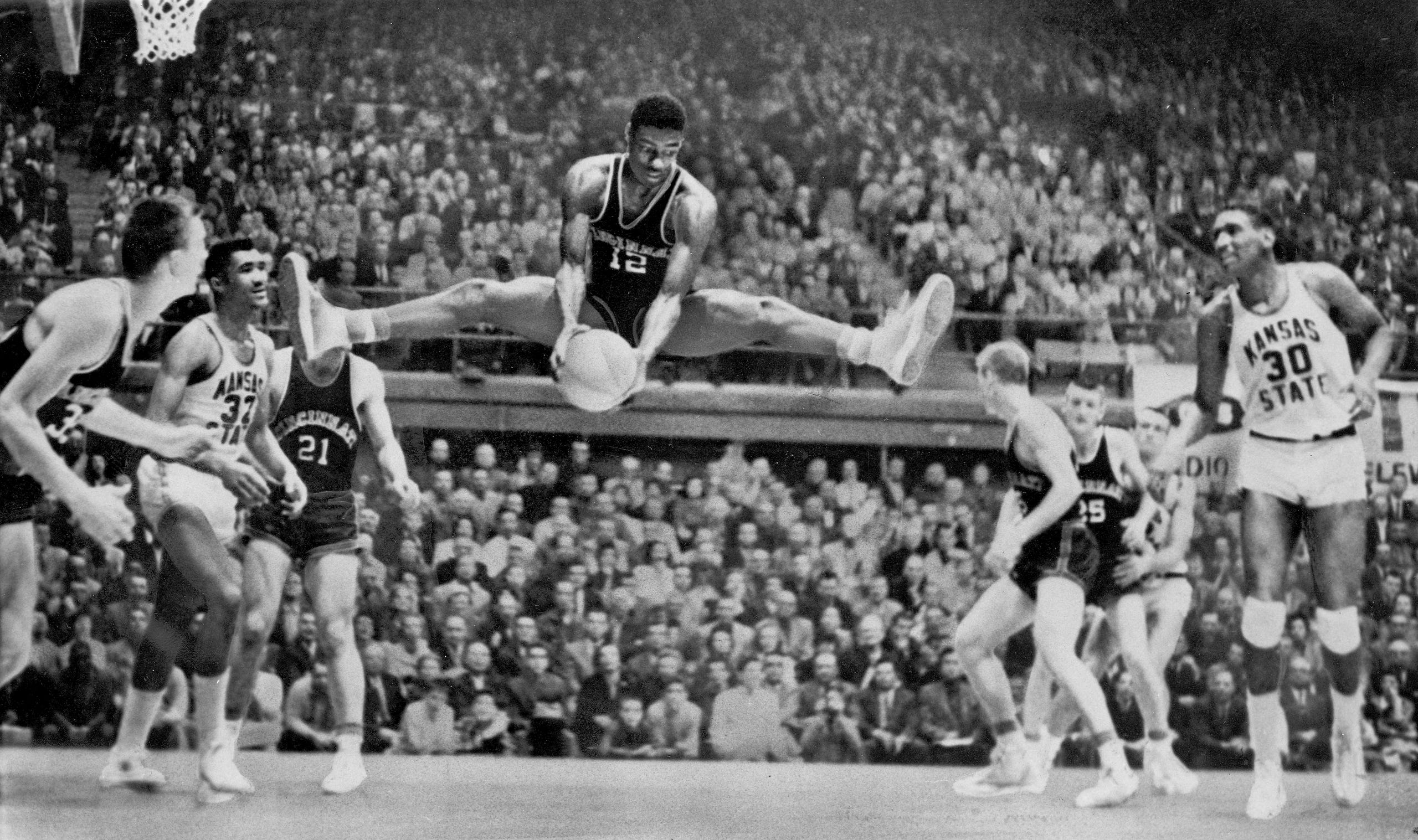
Oscar Robertson is an NBA champion, MVP, and twelve-time All-Star, and he was the first NBA player to average a triple-double over the course of a season. In college, he averaged 33.8 points per game for the Cincinnati Bearcats, and he left school as the all-time leading scorer in NCAA history.

The 1957-58 season was Robertson’s sophomore year at Cincinnati and the first in which he saw playing time for the Bearcats. Robertson immediately made his presence felt, to the tune of 35.1 points and 15.2 rebounds in 38.8 minutes per game, helping Cincinnati to a 25-3 record and a Missouri Valley Conference championship.

Meanwhile, up the road in Oxford, Miami University was on a run of its own. Behind future NBA player Wayne Embry, the RedHawks finished a respectable 18-9, but notably went 12-0 in MAC play, the last team to accomplish that feat and only the second-ever team to complete an undefeated conference schedule (the 1949-50 Cincinnati team was 10-0 in the MAC before leaving the conference). One of Miami’s reserves was Ken Babbs. Listed at 6’3″, the Mentor, Ohio native contributed eleven points and four rebounds in the ten games in which he appeared for the RedHawks that season.

On January 30, 1958, the RedHawks traveled to Cincinnati for a matchup with Robertson’s heavily favored Bearcats. A box score is not readily available, but Babbs recounted his memories of the game in a live interview streamed last night. According to him, Miami coach Richard Shrider, who was in his first season with the RedHawks, thought his team had no chance against Cincinnati and told his players as much, which rubbed the competitor in Babbs the wrong way. Miami planned a box-and-one defense against the Bearcats, with Babbs drawing the assignment of the “one” to mark Robertson. Determined to put up a fight, he said he planned to guard Roberston aggressively, “like stink on shit.” Then laughing, Babbs confessed: “I fouled out in two minutes.” Cincinnati won by twenty.

Both teams reached the NCAA tournament that spring. With their first-round win over Pitt, Miami became the first MAC team to win a tournament game. The Bearcats did not win any tournament games that year, but they made deep runs in Robertson’s two remaining seasons there, finishing third overall both times.

Robertson, of course, went on to professional basketball fame. Babbs, meanwhile, found fame of a different sort. That fall, after graduating from Miami, he pursued graduate studies in creative writing at Stanford. There, he befriended fellow student Ken Kesey, with whom Babbs and others soon would form the Merry Pranksters, whose culturally influential escapades with sound, film, and LSD were in part memorialized in Tom Wolfe’s memorable book, The Electric Kool-Aid Acid Test and would help propel the career of the Grateful Dead.

You can watch Babbs discuss his 1958 on-court encounter with Robertson and a later, off-court reunion here. A film of a Grateful Dead benefit concert supporting a Kesey-family creamery the Pranksters helped produce is available for a limited time below.

The week in “sports”: 4/10/20

tillman winston

From the Hey, We’re Trying Department:

  • Sports were cancelled again: Amidst alternatively gloomy and pie-in-the-sky loony outlooks shared on the prospect of the near-term return of anything not horse racing and NASCAR videogaming, the best hope– really– this week was UFC don Dana White’s proposal to stage MMA fights on a mysterious private island. Promptly after that story broke, the UFC announced the cancellation of its next round of scheduled fights. It also turns out White & Co. don’t actually own that island just yet. Meanwhile, plenty of viral bluster from a couple of college football’s biggest mouths, Mike “I’m a Man” Gundy and Dabo “Dabo” Swinney; NASCAR’s iRacing coverage insists on consistently using a very annoying term with regard to Bubba Wallace (not going to link that one); and MLB’s floated plan to play its 2020 season in the summer in the desert with lots of players and staff but no fans and no player or staff family members hits some too-obvious roadblocks. Also, Al Kaline died. More on him in a forthcoming post, but if you feel like just packing it in and trying again for sports in 2021, I won’t blame you.
  • A college basketball champion was crowned: The 2020 NCAA men’s basketball national championship game would have been Monday night, and the young cyborgs at FiveThirtyEight determined that, had it been played, it would have featured Michigan State and Kansas, with the Spartans prevailing to claim their third national championship in program history. (I couldn’t bear to read that article, so I’m sorry if it’s the wrong link.) In case you have the desire to empty an entire bag of Morton System Saver salt into your March Madness wound, here’s the site’s full projected 2020 bracket.
  • Other news: Chris Johnson maybe had two guys killed? And the Masters twitter account is posting pretty pictures and video highlights in memory of what would have been Masters week 2020.
  • Coming up: Previews indicate that Marshawn Lynch will return in Sunday night’s episode of Westworld.

March Madness on the Bench: Are judges distracted by the NCAA Basketball Tourney? (via The Volokh Conspiracy)

Past research suggests that natural preferences for leisure influence the ways in which federal judges carry out their work. We consider the extent to which incentives for leisure reduce the speed with which judges work and the quality of their output. We take advantage of a natural experiment caused by an annual sporting event that creates differential distractions across judges. Using a difference-in-differences design, among federal courts of appeals judges we show that a judge’s alma mater’s participation in the National Collegiate Athletic Association Men’s Basketball Tournament both slows the rate at which opinions are drafted and ultimately undermines the opinions’ quality, even accounting for the additional time judges spend writing them. The findings suggest that incentives for leisure influence important normative concerns for swift and high-quality justice. … Read More

(via The Volokh Conspiracy)

ALDLAND March Madness Update

First, due mostly to past winners not claiming their prizes created by the overworked and underpaid ALDLAND staff, I have made the decision to officially disband our March Madness bracket challenge and swing the support of our legions of readers and participants to the bracket challenge hosted by the favorite band in the AD household by ranked-choice voting, the Tedeschi Trucks Band. Enter here:

Second, there are a number of good actual and potential tournament matchups on which to keep at least one of your eyes this month:

  • First round:
    • Wisconsin-Oregon (obviously)
    • Villanova-St. Mary’s
    • Iowa State-Ohio State
    • Buffalo-St. John’s
    • Marquette-Murray State
    • Louisville-Minnesota
    • LSU-Yale
    • Virginia Tech-St. Louis
  • Second round:
    • Michigan-Nevada
    • Cincinnati-Tennessee
    • Wofford-Kentucky
  • Sweet Sixteen:
    • Houston-Kentucky
    • Texas Tech-Michigan
    • UNC-Auburn
  • Elite Eight:
    • Duke-Michigan State
  • Final Four:
    • UC Irvine-Abilene Christian

Third, in case you were wondering, the NCAA still hasn’t fixed its absurd play-in round problem. Background here.

Have fun and surrender to the madness.

2018 Rapid Review

The year 2018 was a year. Here are some of our favorite things from the year that was 2018.

  • Atlanta United winning the MLS Cup, at home, in their second year of existence.
  • America’s women’s hockey team beating Canada to win gold at the winter Olympics.
  • Phish summer tour. My first time seeing them three nights in a row. That they never repeated a song during that stretch was notable but not terribly surprising. What was remarkable and never received the treatment at this site that it deserved was the overall quality of the performances, especially on Friday, August 3 but really consistently throughout the weekend, where a wide array of songs from across their thirty-five-year catalogue provided launching pads for fresh, collaborative jams time after time. It feels like the band has reached a new level.
  • Hamilton College’s Francis Baker, the American hockey goalie who stood up to Hitler. This was your most-read story posted on this site in 2018.
  • Steve McNair: Fall of a Titan. This, from Sports Illustrated, was my first foray into the true-crime podcast genre. The gist: what we were told was an open-and-shut case probably has a lot more to it than what the investigating police department allowed to meet the public eye. Story had some additional resonance for me because I had been living in Nashville at the time.
  • Maryland-Baltimore County beating Virginia to become the first-ever sixteen seed to beat a one seed in the NCAA men’s basketball tournament.
  • Justify‘s dominant Triple Crown achievement.
  • Baseball Hall of Fame adding Alan Trammell. Still no Cooperstown spot for teammate Lou Whitaker, though.
  • The Supreme Court clearing the way for states to authorize sports wagering.
  • J.R. Smith delivering the most memorable moment of LeBron James’ final series with Cleveland.
  • Shohei Ohtani making his major-league debut.
  • The Vegas Golden Knights reaching the Stanley Cup Final in their first year of existence.
  • Vanderbilt beat Tennessee in football again. The Commodores have won five of the last seven games in this series. (If you’d lost track of him, Derek Dooley’s currently working as the quarterbacks coach at Missouri.)
  • Baseball Prospectus revised its flagship bating metric and now concedes that Miguel Cabrera, not Mike Trout, deserved the 2012 and 2013 AL MVP awards.
  • Tiger Woods winning the PGA Tour Championship at East Lake.
  • In personal news, I published my first article at Baseball Prospectus, which took a look at whether MLB teams were colluding to depress player wages.
  • In memoriam:

Thank you for your readership this year. Look for more great content here in 2019.

Loyola-Chicago’s groundbreaking title overlooked today (via USA Today)

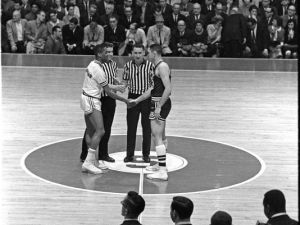
online-shake-3-13-13-4_3They are the champions you might not remember, who lived the extraordinary season you might not have known. But to begin to understand the special journey of the 1963 Loyola of Chicago Ramblers, all that is needed is one picture.

The photo, taken before an NCAA tournament game 50 years ago, shows a black player from Loyola and a white player from Mississippi State shaking hands.

The Loyola player is Jerry Harkness, captain for an upstart team that had not only stormed up the rankings but also flouted the unwritten rules of 1963 by starting four African Americans.

They are the champions you might not remember, who lived the extraordinary season you might not have known. But to begin to understand the special journey of the 1963 Loyola of Chicago Ramblers, all that is needed is one picture.

The photo, taken before an NCAA tournament game 50 years ago, shows a black player from Loyola and a white player from Mississippi State shaking hands.

The Loyola player is Jerry Harkness, captain for an upstart team that had not only stormed up the rankings but also flouted the unwritten rules of 1963 by starting four African Americans. … Read More

(via USA Today)

ALDLAND Archives: Madness: The NCAA Tournament’s structural flaw

Last night, the NCAA released the opening pairings for this year’s men’s basketball tournament. It’s nearly impossible to imagine the NCAA ever shrinking the tournament below the current number of entrants (sixty-eight). It is possible to imagine a better way to incorporate the four teams added above and beyond the traditional sixty-four-team field, however, and, in 2016, I engaged in that exercise in a post now unearthed from the ALDLAND Vault.  -Ed. 

_________________________________________________________________

Madness: The NCAA Tournament's structural flaw
MARCH 15, 2016

The organizing principle of a competition arranged in the fashion of the NCAA men’s basketball tournament is that better teams should have easier paths for advancement, the goal being for the best teams to meet as late as possible. Tournament organizers therefore employ a seeding system that awards teams believed to be the strongest with the best seeds (i.e., the lowest numbers) and first pits them against teams believed to be the weakest.This is sensible, logical, and good. Anything can happen once the games begin, of course, but if Michigan State and Kansas, for example, are the best teams in this year’s tournament, the tournament should be designed such that those two teams are most likely to face off in the final, championship round. Generally speaking, this is how the NCAA tournament is organized.

From 1985 until 2000, the tournament’s field held steady at sixty-four total teams. In 2001, it expanded to sixty-five teams, adding a single play-in game to determine which team would be the sixteenth seed to face the number one overall seed. In 2011, the tournament field expanded to sixty-eight teams, its current size, with four play-in games.

Many people dislike the fact that the tournament has expanded beyond a seemingly optimal sixty-four-team field, but all should agree that, however many teams and play-in games are included, the tournament should be organized such that the projected difficulty of each team’s path through the tournament is inversely proportional to its seed position. As currently constructed, however, the tournament deviates from this basic principle.

Read the rest…