Red Wings’ season, playoff chances coming down to the wire

635956668550867601-ap-aptopix-red-wings-bruins

It’s easy to second-guess coaching decisions after the fact, begins many post-loss sports articles, but it was immediately clear that the Detroit Red Wings, and their recently redeemed goalie, Jimmy Howard, were not 100% last night in Boston. The direct evidence? Surrendering two goals on four Bruin shots in the first 2:44 of the game. The circumstantial evidence? A hard-fought win the night before in a game that did not start until after 8:00, delaying the team’s arrival at its Boston hotel until 2:45 yesterday morning. Howard looked sluggish, and his teammates weren’t able to bail him out. Their backs against the wall, Boston hardly let up, eventually claiming a 5-2 win.

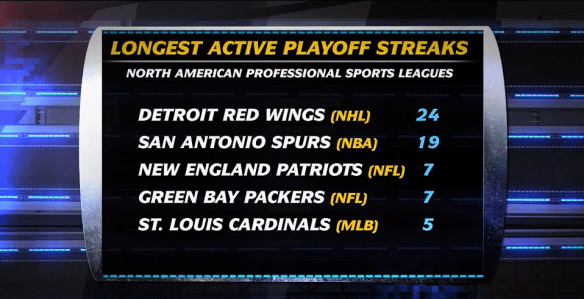
The Howard redemption story is a nice and good one, and, if the Red Wings are able to clinch a twenty-fifth-consecutive playoff berth, there’s little reason to believe it can’t continue into the postseason, but hockey, as much as any sport, is a sucker for narratives like these, and they can color strategic decisions. Continue reading

Detroit Red Wings closing in on 2016 NHL playoffs, upholding historic mantle

It’s that simple. After a very big shutout win last night over the Flyers in Detroit, the Red Wings go on the road tonight in Boston with the opportunity to extend the longest active playoff streak in all of professional sports.

playoffstreak

The Bruins, Flyers, and Red Wings are fighting for the Eastern Conference’s two remaining playoff spots. Detroit and Boston each have two games left, including one against each other, while Philadelphia has three games remaining. The Eastern Conference standings currently look like this:   Continue reading

Window Shopping: We Got Robbed

The Detroit Tigers shot out to a hot start in 2015, but things have not been too good for Detroit since then. They’ve won just five of their last thirteen series. The team’s active six-game losing streak is its longest in four seasons.

The title of this year’s serial Tigers feature at this site, Window Shopping, comes from the common theme of Detroit season previews that, with respect to a World Series championship, the team was trying to keep open its “window of opportunity,” assuming that proverbial window had not already slammed shut under the weight of expensive long-term contracts, aging players, and perceived defensive burdens.

After the last month and a half, though, it is as if these window shoppers, gazing upon the Commissioner’s Trophy in a fancy Harrod’s storefront display (did we fight the Revolution for nothing??), reached into their back pockets in consideration of making the eventual purchase, only to find they suddenly had no money, no credit cards, no traveler’s checks, nothing. They’ve been robbed.

The Tigers are in a tailspin, and it isn’t exactly anyone else’s fault. Their recent struggles have come in games against teams largely regarded as mediocre or worse, including the Athletics, Angels, and Brewers. What’s happening?

After starting the season with an 11-2 record, the Tigers have gone 17-24, and their performance somehow has felt even worse. By my count, since April 21, the date they entered with that 11-2 mark, Detroit has a -19 run differential. Only two other American League teams– the White Sox and Red Sox– have worse run differentials during that period, and only one AL team, Toronto (187), has allowed more runs over that span than Detroit’s 185. Of course, the Blue Jays also scored 213 runs in those games, a number that dwarfs the Tigers’ 166 and is the most in the league. On the other hand, just seven AL teams have scored fewer than 166 runs since April 21, and two of them, Kansas City and Tampa Bay, still maintained positive run differentials. (Both Sox teams, along with Seattle, Baltimore, and Oakland round out this low-scoring group.) In terms of offense and defense (the fundamental terms of competitive team sports), it’s hard to be worse than Detroit right now.

Offense fueled the Tigers’ strong start, and its disappearance has triggered their decline. They averaged 5.38 runs per game through April 20. Since then, though, they’ve scored just 4.05 runs per game, a drop of more than a run and a third. Omit a blowout 13-1 win against the Twins on May 14, and that per-game scoring average falls to 3.83. No bueno.   Continue reading

A fresh glance at Babe Ruth, upon the resumption of baseball

My latest post at Banished to the Pen contributes to the spirit of the opening of a new baseball season with a quick look back at one of the game’s most accomplished players.

It is nice to see the rookies of today showing respect for their elders, but modern celebrants of the game sometimes fear that reexaminations of their childhood heroes will alter their images and understandings of past giants in adverse fashion. For Babe Ruth, a truncated, targeted retrospective does serve to modify the Ruthian folk zeitgeist, but, in his case, it does so exclusively to enhance the stature of the Sultan.

The full post is available here.

When do baseball teams score runs?

baseballline

One of the marks of a smart baseball writer is the ability to sense a trend, research its existence and nature, place her findings in context, and present her conclusions in a way that meaningfully educates readers. Inherent in this ability is the wherewithal to know when to stop researching a trend or pressing on a concept, realizing that the fruits of the work have been or soon will be exhausted. Sometimes a person who is not a “smart baseball writer” by the foregoing definition will noodle about on an idea for so long, he’ll end up with a small pile of research that no longer has any bearing on any meaningful conclusions.

Two years ago, I decided to investigate a hunch that the Detroit Tigers were having trouble scoring runs late in games. My initial research mostly seemed to support my hypothesis, and a follow-up look appeared to confirm it more strongly. More than merely interesting (and fleetingly self-satisfying), it also was informatively concerning, because it placed the team’s well-known bullpen problems in a more nuanced light: relief-pitching woes alone weren’t the problem, because the lack of late-game scoring was compounding the problem of surrendering leads during the final frames. As strange as it seemed, the Tigers had interrelated shortcomings on both sides of the plate.

One comment I received in the course of sharing those findings stuck with me: I needed to place this information in context. After all, there are plausible reasons to believe that all teams might, perhaps to varying extents, experience decreased run production in the late innings.

And so it was that, two years later, I finally discovered Retrosheet, a site that compiles inning-by-inning scoring data to a more useful degree than the resources I’d utilized back in 2013. What follows are two graphs of the inning-by-inning scoring of sixteen teams for the 2014 season. Continue reading

On the Road Again: A study of NHL rink variation

One of the important background dimensions to comparative baseball statistics is known as “park adjustments,” a set of corrective factors applied to account for the physical differences (e.g., outfield wall depth) between each park. Among American sports today, only Major League Baseball and NASCAR (and golf, I suppose) permit such structural variation between the competitive arenas themselves.

Professional hockey used to be in that group too. More than merely adjusting, adding, and subtracting lines on the ice to affect the flow of play, as the NHL continues to do (cf. the NBA three-point line), the rinks themselves used to be different sizes. League rules mandate a uniform rink size, but so-called “small rinks” persisted in the NHL as late as the 1980s and 1990s in Boston, Chicago, and Buffalo.

While hockey does not face the structural differences present in baseball, there still is a need to apply rink-by-rink statistical adjustments. That’s because the compiling of basic hockey statistics (e.g., shots, hits, turnovers) requires statisticians to make judgment calls to a more significant degree than in a discrete-event sport like baseball.

By way of limited background, the NHL collects basic gameplay statistics through a computer system known as the Real Time Scoring System (RTSS). A benefit of RTSS is that it aggregates and organizes data for analysis by teams, players, and fans. A vulnerability of RTSS is the subjectivity alluded to above that comes when human scorers track a fluid, dynamic sport like hockey.

While others have noted certain biases among the RTSS scorers at different rinks, a paper by Michael Schuckers and Brian Macdonald published earlier this month analyzes those discrepancies across a spread of core statistics and proposes a “Rink Effects” model that aims to do for subjective rink-to-rink differences in hockey scoring what park adjustments do for structural differences between baseball parks.    Continue reading

ALDLAND Podcast

The World Series is here and the ALDLAND Podcast is here to talk about it. Boston . . . St. Louis . . . playing baseball. What more could you want? College football, of course, and there’s plenty of that as your favorite cohosts preview all the interesting week 9 matchups.

_______________________________

Download the ALDLAND podcast at our Podcasts Page or stream it right here:

ALDLAND Podcast

No World Series preview . . . yet, but Marcus and I are happy to share our thoughts on the ALCS and NLCS so far. We also touch on Ndamukong Suh’s latest fine, as well as all of the college football picks you could ever want.

_______________________________

Download the ALDLAND podcast at our Podcasts Page or stream it right here:

ALDLAND Podcast

Baseball is back for a second straight week as Marcus and I react to the division series in both the American and National Leagues. Elsewhere, Jadaveon Clowney fails to escape the wrath of ALDLAND as we discuss his numerous “injuries”. Finally, picks and predictions for this week in college football.

_______________________________

Download the ALDLAND podcast at our Podcasts Page or stream it right here: