The MLB had a fairly inactive trade deadline today, but luckily ALDLAND had a very active podcasting session to make up for it. Marcus and I share our semi-informed opinions on a variety of trades that were and were not made, as well as discuss the date of the MLB trade deadline and whether it should be moved. Bonus discussion of music related things. Will this podcast be the first ALDLAND podcast to be on iTunes? Who can say?
_______________________________
Download the ALDLAND podcast at our Podcasts Page or stream it right here:
With the non-waiver trade deadline set for 4:00 pm today, the Tigers got in on the action earlier this week by adding two major-league-ready players who should address the team’s short-term needs as they prepare for a postseason run.
On Monday, Detroit acquired bullpen help in the form of Houston closer Jose Veras. Continue reading →
After losing Sheldon Jeter due to a transfer this spring, Kevin Stallings’ Vanderbilt Commodores lost two starters this week. The team’s leading rebounder last season, Kevin Bright, is off to play professional basketball in Germany, while Kedren Johnson, maybe the team’s best player, has been suspended from the team and is no longer enrolled at the university.
Vandy basketball may have been on a downswing after last season, but there were pieces to build around. Now, though, it looks like the tough times will last a bit longer at Memorial Gym.
When it comes to baseball pitchers, most fans focus on pitch speed. This makes sense. The 100-mph-fastball is a pop culture/athletic touchstone, and who hasn’t been to a carnival in central Ontario and tried to throw three hard pitches at the same velocity while your ten-year-old brain realizes the km/h readings on the gun have little meaning to your life? But in general, if you throw the ball faster, it’s harder to hit, right?
One of the biggest baseball stories through the first half of the season is the noticeable (and noticed, obviously) drop in pitch velocity for flamethrower Justin Verlander. Coupled with middling success (when compared with recent, historic-level years), falling pitch speed is the ready response for writers attempting diagnoses of Verlander’s struggles. (C.C. Sabathia has fallen under similarly themed scrutiny.)
I’m pretty sure we have yet to feature any jazz in this space, making today’s selection, like that library copy of Bedknob and Broomstick that was missing the final page, criminally overdue. I’m not all-in on jazz saxophonists, but there are a few I like, including Art Pepper, Cannonball Adderly, Branford Marsalis, and Wayne Shorter, the latter two of whom I’ve been fortunate to have seen perform live. (Our own Physguy isn’t half-bad either.)
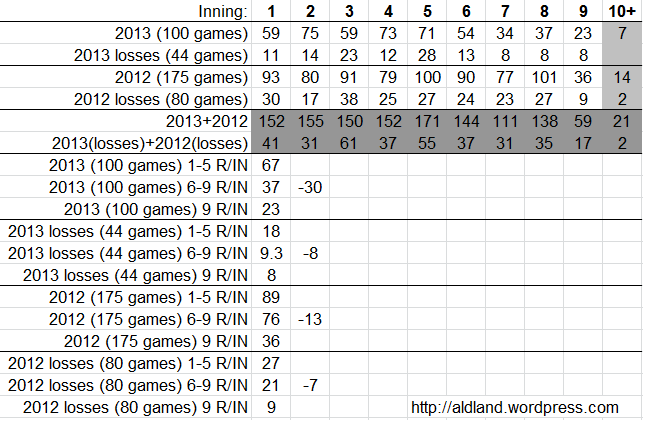
ALDLAND celebrated tax day this year by taking a dive into the numbers behind the Detroit Tigers’ offensive production. Since last season, I had developed the feeling that this should-be offensive power was having trouble scoring late in games, hamstringing their ability to mount comebacks and generally secure a win in the later innings, and I wanted to investigate to see whether that really was the case.
The evidence I gathered in April appeared to support my hypothesis. The 2013 season was just twelve games old, though, and it was difficult to ascribe too much meaning to data gathered from such a small sample set. As of today, however, Detroit has played one hundred games in the 2013 campaign, so I decided to update the numbers:
The middle of July is one of the slowest times in sports, but the MLB came through by banning Ryan Braun for the remainder of the season for violating its drug policy and provided us with more than enough fodder for a podcast. Listen as Marcus and I discuss the Braun story and related subplots, as well as our thoughts and advice on workout gear and a recap of Lefty’s big win in Scotland.
_______________________________
Download the ALDLAND podcast at our Podcasts Page or stream it right here:
As I have acknowledged in the past, I am not perfect. I realize now that I have made some mistakes. I am willing to accept the consequences of those actions. This situation has taken a toll on me and my entire family, and it has been a distraction to my teammates and the Brewers organization. I am very grateful for the support I have received from players, ownership and the fans in Milwaukee and around the country. Finally, I wish to apologize to anyone I may have disappointed — all of the baseball fans especially those in Milwaukee, the great Brewers organization and my teammates. I am glad to have this matter behind me once and for all, and I cannot wait to get back to the game I love.
Braun failed a drug test back in October 2011, but he was successful in overturning a fifty-game suspension on appeal by identifying a procedural deficiency in the testing process. During the pendency of that appeal, Braun stated:
This is all B.S. I am completely innocent.
Following its resolution in his favor in February 2012, Braun held a press conference where he issued a long statement, excerpted here:
…
[T]this is without a doubt the biggest challenge I’ve ever faced in my life, and it’s made it that much more challenging that I’ve had to deal with it publicly. But I truly view this challenge as an opportunity, just as I’ve viewed every other challenge in my life – as an opportunity. I’ve tried to respect this process, even though the confidentiality of the process was breached early on. I’ve tried to handle the entire situation with honor, with integrity, with class, with dignity and with professionalism because that’s who I am and that’s how I’ve always lived my life.
If I had done this intentionally or unintentionally, I’d be the first one to step up and say, “I did it.” By no means am I perfect, but if I’ve ever made any mistakes in my life I’ve taken responsibility for my actions. I truly believe in my heart, and I would bet my life, that this substance never entered my body at any point.
…
I’ve always stood up for what is right. Today is about everybody who’s been wrongly accused, and everybody who’s ever had to stand up for what is actually right. Today isn’t about me, it isn’t just about one player – it’s about all players. It’s about all current players, all future players and everybody who plays the game of baseball.
…
Ultimately, as I sit here today, the system worked because I am innocent, and I was able to prove my innocence. After today I look forward to returning my focus to the game of baseball, being able to get back with my teammates, allowing my life to return to some sense of normalcy and focusing on helping our team get back to the post-season.
Over the past 20 years, 101 new sports facilities have opened in the United States—a 90-percent replacement rate—and almost all of them have received direct public funding. The typical justification for a large public investment to build a stadium for an already-wealthy sports owner has to do with creating jobs or growing the local economy, which sound good to the median voter. “If I had to sum up the typical [public] perspective,” Neil deMause . . . told me via email, “I’d guess it’d be something along the lines of ‘I don’t want my tax money going to rich fat cats, but anything that creates jobs is good, and man that Jeffrey Loria sure is a jerk, huh?’” This confused mindset has resulted in public coffers getting raided. The question is whether taxpayers have gotten anything in return.
Economists have long known stadiums to be poor public investments. Most of the jobs created by stadium-building projects are either temporary, low-paying, or out-of-state contracting jobs—none of which contribute greatly to the local economy. (Athletes can easily circumvent most taxes in the state in which they play.) Most fans do not spend additional money as a result of a new stadium; they re-direct money they would have spent elsewhere on movies, dining, bowling, tarot-card reading, or other businesses. And for every out-of-state fan who comes into the city on game day and buys a bucket of Bud Light Platinum, another non-fan decides not to visit and purchases his latte at the coffee shop next door. All in all, building a stadium is a poor use of a few hundred million dollars.
This isn’t news, by any stretch, but it turns out we’re spending even more money on stadiums than we originally thought. In her new book Public/Private Partnerships for Major League Sports Facilities, Judith Grant Long, associate professor of Urban Planning at the Harvard University Graduate School of Design, shatters previous conceptions of just how much money the public has poured into these deals. By the late ’90s, the first wave of damning economic studies . . . came to light, but well afterwards, from 2001 to 2010, 50 new sports facilities were opened, receiving $130 million more, on average, than those opened in the preceding decade. (All figures from Long’s book adjusted for 2010 dollars.) In the 1990s, the average public cost for a new facility was estimated at $142 million, but by the end of the 2000s, that figure jumped to $241 million: an increase of 70 percent.
Economists have also been, according to Long, drastically underestimating the true cost of these projects. They fail to consider public subsidies for land and infrastructure, the ongoing costs of operations, capital improvements (weneedanewscoreboard!), municipal services (all those traffic cops), and foregone property taxes (almost every major-league franchise located in the U.S. does not pay property taxes “due to a legal loophole with questionable rationale” as the normally value-neutral Long put it). Due to these oversights, Long calculates that economists have been underestimating public subsidies for sports facilities by 25 percent, raising the figure to $259 million per facility in operation during the 2010 season. … Read More


 Over the past 20 years, 101 new sports facilities have opened in the United States—a 90-percent replacement rate—and almost all of them have received direct public funding. The typical justification for a large public investment to build a stadium for an already-wealthy sports owner has to do with creating jobs or growing the local economy, which sound good to the median voter. “If I had to sum up the typical [public] perspective,” Neil deMause . . . told me via email, “I’d guess it’d be something along the lines of ‘I don’t want my tax money going to rich fat cats, but anything that creates jobs is good, and man that Jeffrey Loria sure is a jerk, huh?’” This confused mindset has resulted in public coffers getting raided. The question is whether taxpayers have gotten anything in return.