Offseason starts with a bang for the Detroit Tigers

maybin-gone

When the Detroit Tigers’ season ended in Atlanta last month, the message from general manager Al Avila was both clear and clearly different than it had been a season ago, when Avila took over the job from his boss, Dave Dombrowski. Then, speaking as the mouthpiece of the team’s owner, Mike Ilitch, he said that “the foot is on the pedal, hard,” and the team continued to make the kind of win-now moves that largely have defined them for the past decade. Now, though, Avila’s taking his foot off the gas and ushering in a period of austerity that’s likely to be painful. It definitely will be different.

The changes began immediately. Yesterday was the first day of the MLB offseason, and Avila wasted no time in making two of his biggest decisions on current player options. First, he “traded” center fielder Cameron Maybin to the Angels for a low-grade relief pitching prospect in a move that essentially amounts to the Tigers declining to exercise Maybin’s option.

Shortly thereafter, the team announced that it would pick up the $6 million option on closer Francisco Rodriguez. (Had they declined K-Rod’s option, they would’ve owed him a $2 million buyout.)

If, as he has said, his new mission is “making this team leaner, younger, more efficient,” I’m not certain this was the way to do it. Given the money, his track record, and his strong performance last season, I like the decision to retain Rodriguez, even considering the general year-to-year unreliability of reliever performance.

The Maybin decision is more confusing, though. By fWAR, Maybin was the Tigers’ most valuable outfielder last year, and he only played in ninety-four games. (He also was their second-best baserunner.) He missed action due to injury, but not really the kind of injury that should make teams worry. He mostly just kept getting beaned on the hands. That’s just bad luck. He’s only twenty-nine. Over the past two seasons with Atlanta and then Detroit, he finally seemed to be approaching the potential he demonstrated eleven years ago that caused the Tigers to spend the tenth overall draft pick on him in 2005. (He also was the team leader in the Instagram handle category.)

Now he’s gone again, leaving behind holes in center field and the top of the batting order. Jeff Sullivan, writing up this transaction largely from the Angels’ perspective, points a finger to JaCoby Jones as the likely replacement Avila is targeting. Jones showed memorable flashes as a late-season call-up this year, but, like many prospects, he’s still young and raw and inconsistent. The other obvious fill-in is Tyler Collins, who has the relative advantage of being a left-handed hitter but the disadvantage of being at an age and experience level where “raw” is not a baseball adjective that incorporates an element of hope.

All of this happened on offseason day number one. There will be more activity involving the Tigers this offseason, and, typically, it is wise to wait to render final judgment on a particular decision until it can be viewed within the full constellation of the team’s moves. Under austerity, though, there should be little hope for or expectation of near-term improvement through an infusion of external resources; doing better must mean doing better with what you already have. There isn’t going to be a Justin Upton trade this year (which, while we’re at it, probably will be the last year J.D. Martinez wears a Detroit uniform). What stings about the Maybin trade– besides the obvious departure of talent and the intangibles of a fun guy who seemed to be having a lot of fun himself– is that it is a move that will make the team worse in 2017, and the Tigers haven’t made too many moves like that in a good while.

World Series Game 7 in two tweets

chart

Last night’s World Series finale had everything, and it was amazing to watch. You’ll find plenty to read about it across the web today. For now, anyway, my contribution to that plenty will be, like the bulk of what you usually find here, minimal, derivative, and frivolous.

The game had numerous memorable moments, and one of the most memorable was Rajai Davis’ game-tying home run off Aroldis Chapman in the eighth inning. You can see on the graph above right where it happened, and, if you want an even more graphical recollection, the video is here. As the above starkly illustrates, the Cubs were, more or less, cruising by this point. Sure, Chicago manager Joe Maddon was doing his best to keep the game interesting by mismanaging his pitching staff, but the Cubs’ lead appeared as solid as a lead reasonably can appear late in a game-seven setting. Roughly an hour before Davis’ world-inverting homer, though, when things seemed relatively quiet on the eastern front, came this tweet:

Then, a moment before Davis came to the plate, a second tweet arrived:

And then the rains came. What a night.

Why I don’t gamble on sports, ep. 37

I don’t shy away from writing about sports wagering. I think it should be legal, and I expect it will be as soon as the major sports leagues want it to be legal, which I suspect they will sooner rather than later. The leagues already have a taste of that sweet gambling coin, and they’re going to want more of it once their over-leveraged insurers (i.e., the sports-broadcasting networks) go belly-up and no one can or will pay the exorbitant broadcast-rights fees that fund the owners’ and players’ ballooning salaries.

That’s all speculation, of course, but I’m certain of this: I am not good at betting on sporting events. I know this from personal experience, a bit of which I have detailed here and displayed elsewhere. Unlike my favorite comedian, Norm Macdonald, who has lost all his money three times in pursuit of the thrill of sports betting, the alleged excitement of gambling never has captured me emotionally, and my experiences, which serve as mental reminders that staying away is the right move, have exacted minimal financial cost.

Typically, I keep these little reminders– like my embarrassingly low ESPN Streak for the Cash winning percentage– to myself. Sometimes, though, they’re too perfect not to share:

Good luck out there.

______________________________________________________

Related
Lose money playing DraftKings or FanDuel? File a lawsuit.MLB Rule 21(d)
The Invaders: A racetrack, a killing, and the history of organized crime in Hot Springs, Arkansas (via Grantland)
This is what is right with Grantland
Text messaging competitions: Non-sports vs. no sports

Tardy 2016 World Series Preview

250px-1994-world-series-svg

The 2016 World Series started yesterday, and Cleveland now has Chicago in a one-game hole after a 6-0 shutout win last night. The Cubs were clear favorites to win the series entering last night, and while we probably still should consider them the favorites, Chicago fans can be forgiven for seeing lots of doom and gloom on the horizon this morning.

Here’s what the statistical projections on World-Series-winning odds now say:

Chicago remains favored to win game two tonight, but last night’s loss exacted a large toll on their overall series odds. (On the other hand, as one tortured Cubs fan opined yesterday, “In late October, math no longer applies.”)

At least one more game will be played in Cleveland’s JacobsProgressive Field, which has been a weird place to play baseball of late, at least relative to other places to play baseball.

This entire post has been a polite rouse designed to provide a vehicle for linking you to this World Series preview post, which is the best of its kind and the only one anyone needs to read.

Stafford at the century mark, in context

staffffff

The 2016 Detroit Lions are doing kind of okay! Week Seven is in the books, and they’re 4-3, including a win over the probably good Eagles. In a week of very bad professional football, the Lions’ game-winning drive provided a rare highlight on Sunday. I insist you enjoy it again:

https://twitter.com/DetLionBlood/status/790303879674068992

Because the NFL media corps is an insatiable monster, Sunday and Monday found everyone except Skip Bayless launching the Matthew Stafford MVP campaign:

Sunday was Stafford’s 100th NFL game, leading one writer to tabulate a long thread of historical statistical notes, the catchiest of which is the list of quarterbacks’ passing yards through their first one-hundred career games:

  1. Stafford: 27,890
  2. Dan Marino: 27,064
  3. Kurt Warner: 26,097
  4. Peyton Manning: 26,008
  5. Aaron Rodgers: 25,616

Not unimpressive company. As with Carson Palmer’s headline-grabbing passing milestone last month, though, this accumulative distinction requires some context, Continue reading

Mike Leach Prefers Solo Cougars

1567162_still

We all know Washington State head football coach Mike Leach to be a sensible and worldly man, and that’s true even when it comes to the selection of his team’s captain. In an age when most teams send out four or more captains (plus honorary captains) to handle the game’s preliminary procedural matters, Leach prefers a simpler and more direct approach:

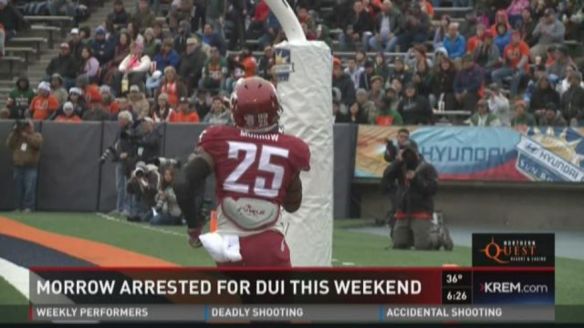
Makes sense to me. According to contemporary reports, Morrow readied himself for the show like the future D-I football captain he would become by watching lots of film: “Jamal did not come to the show unprepared. A week prior, he watched every Price is Right episode he could get his hands on.” He ended up winning “almost $2,000 worth of clothes.” (If you’re a TV weirdo, here‘s some kind of hyper-detailed breakdown of the episode.) The NCAA investigative report on whether this constituted an improper benefit remains outstanding.

At this time, our staff has been unable to locate video of Morrow’s appearance on “The Price is Right,” but we did find this visual still and commend Morrow’s attire.

Morrow took the over on the price of a Toyota Corolla on the show in 2013 and the over on his BAC in his own car in 2016.

Our staff also has been unable to locate coin toss results for the 2016 season, but, under Leach and Morrow, Washington State has won five games in a row and is undefeated (4-0) in conference play. Only two currently ranked opponents– Colorado and Washington– remain on their schedule. They play Oregon State this Saturday night on ESPN2.

____________________________________________________

Previously
Mike Leach: Prospective time traveler
Mike Leach officially ushers in the 2015 college football season
Cougar dating tips from Mike Leach
Mike Leach Favors Cougars

Vanderbilt vs. UGA: A day to be reckoned with

vuuga

As promised, we were in Athens last Saturday for Vanderbilt-Georgia, a game in which the homecoming Dawgs were favored by more than two touchdowns. Instead, the Commodores eked out a one-point victory on the road. Although it probably wasn’t too exciting on television, this was an entertainingly tense game to attend in person.

Two game notes, and then I’ll turn it over to the Vandy football video crew:

  1. The Vanderbilt defense is excellent against the run, which happens to be Georgia’s offensive strength, but they were helpless against the pass. UGA should’ve called nothing but pass plays until VU forced them to do something else.
  2. This was Vandy head coach Derek Mason’s first conference win, which is nice, but it probably should have come sooner. Like, maybe the week before in Lexington? Neither Georgia nor Vanderbilt are making much football sense in 2016.

Baseball Notes: Save Tonight

baseball notes

It is an accepted reality that, in general, baseball players don’t have much time for their sport’s new and advanced statistics and metrics. In many ways, this resistance makes sense. In the moment, when standing on the mound or in the batter’s box, there’s only so much thought and information a player can hold in his mind while trying to accomplish the task– make or avoid contact between bat and ball, for example– at hand. Players, like experts in other fields, also understandably tend to be skeptical of outsiders’ ability to provide baseball analysis or insight superior to their own. This skepticism is fairly well documented, most obviously when it involves changes that might impair or decrease a player’s value or role in the game, and, more surprisingly, even when new statistical revelations work in a player’s favor. (There certainly are some players, like Jake Lamb and Trevor “Drone Finger” Bauer, who have embraced sabermetric thinking, but it’s reasonable to assume they remain in the minority among their colleagues.)

A primary impetus of baseball’s sabermetric movement has been to encourage the abandonment of certain traditional statistics that, while still largely entrenched in the sport, are understood to be incomplete in important ways or much less meaningful than their use might suggest. Batting average, for example, doesn’t include walks. (Cf. On-base percentage.) RBIs require a player’s teammates to reach base ahead of him. ERA depends, to a significant extent, on a pitcher’s defensive teammates and other factors outside a pitcher’s control. (Cf. defensive-independent pitching statistics like FIP and DRA.) Pitcher wins and saves are artificial, highly circumstantial metrics that, at best, indirectly measure pitching talent.

For years, analysts have pushed baseball to rid itself of these traditional performance measures. There’s a comfort in hanging onto the statistical language with which we grew up as we learned and discussed the game, but that comfort should turn cold upon learning the degree to which these familiar stats obscure what’s really happening on the field.

So long as baseball’s current player-compensation structure remains in place, though, players aren’t likely to stop caring about things like saves; after all, that’s how they’re paid:

screenshot-2016-10-19-at-5-46-24-pm

In the course of discussing whether departures from conventional reliever usage as particularly exhibited in the 2015 and 2016 playoffs are likely to bleed over into upcoming regular season play, FanGraphs’ Craig Edwards explains one reason players are likely to prefer conventional, save-oriented bullpen strategy:

Saves get paid in a big way during arbitration. Only one player without a save, Jared Hughes, received a free-agent-equivalent salary above $6.5 million in arbitration, while all 16 players who’d recorded more than 10 saves received more than Hughes in equivalent salary. Players are more than happy to make more money, so giving more relievers higher salaries and more multi-year deals is openly welcomed. Taking saves away, however, also takes money away from players with less than six years of service time.

Although there are a number of not-uncompelling reasons why players prefer to steer clear of baseball’s newer metrics, Edwards has fingered one of the most forceful. If fans and analysts want to hear players discuss OBP, DRA, and leverage, they ought to channel their persuasive efforts less toward appeals to players’ logical sensibilities (they get it, no doubt) and more toward the education of the MLB salary arbitrators, to whom the players already listen with great attention.

___________________________________________________________________

Previously
Baseball Notes: Current Issues Roundup
Baseball Notes: The In-Game Half Lives of Professional Pitchers
Baseball Notes: Rule Interpretation Unintentionally Shifts Power to Outfielders?
Baseball Notes: Lineup Protection
Baseball Notes: The Crux of the Statistical Biscuit
Baseball Notes: Looking Out for Number One
Baseball Notes: Preview

Mike Leach: Prospective time traveler

tdwvqiw

We usually try to kick off the college football season with a sprinkling of wisdom from Mike Leach, but we’ve been a bit slow off the ball this year. Thankfully for our sake, Leach delivered a good comment earlier this week.

He’s back, and with the Washington State Cougars winning four straight after dropping their first two games, so is his team and, with it, college football.

____________________________________________________

Previously
Mike Leach officially ushers in the 2015 college football season
Cougar dating tips from Mike Leach
Mike Leach Favors Cougars

ALDLAND goes live to the Battle of Athens

img_20160609_103853_edit

We will be in Sanford Stadium tomorrow when Vanderbilt, based in Nashville (i.e., the Athens of the South), faces Georgia, based in Athens, in a game that will decide which city will retain its Southern Athenian identity and, maybe, third place in the SEC East.

Thus far, this season has been a disappointment for both schools, but tomorrow’s game should at least allow fans a nice look at each team’s stars. For Georgia, that means the return of the combined running attack of Nick Chubb and Sony Michele. For Vanderbilt, it means the return of the SEC rushing leader, Ralph Webb, who, I am told, will play tomorrow after suffering an injury during last week’s loss at Kentucky.

The star power of Webb distracts from the Black & Gold’s numerous deficiencies and, in some sense, Webb reminds me of Earl Bennett, a Vandy wide receiver who, ten years ago, became the SEC all-time reception leader. Following the exciting and brief James Franklin era, the Commodores have regressed under Derek Mason to a team reminiscent of those overseen by Bobby Johnson: above-average defense that worked hard to keep the team in games while the offense, with its lone leader (then Bennett, now Webb) tried to keep pace on the scoreboard until the overworked defense eventually gave out and the opposing team ran away with the game. Mason and his assistants have better resumes than Johnson and his assistants did, but the results have been the same.

During the last ten years, though, Vanderbilt has played Georgia close and even stolen a few wins. Those have tended to come in home games for the Commodores, though; the Dawgs typically have routed them in Athens. Vanderbilt nevertheless goes on the road tomorrow in search of its first conference win of 2016. Kickoff is at noon on SEC Network, and we’ll be there. Follow along here for live updates.