Herm Edwards, NFL analyst for ESPN, told ESPN Radio’s Hill & Schlereth last night that after he was a member of the Philadelphia Eagles team that lost Super Bowl XV in 1981, he didn’t watch another Super Bowl until ESPN hired him in 2009, just in time for Super Bowl XLIII.
Orlando Magic center Dwight Howard and former Orlando Magic center Shaquille O’Neal recently had a public spat over the former’s claim to the Superman mantle (cape?), but Howard’s real nomenclature-based friction actually may be with current Orlando Magic forward Glen Davis.
There won’t really be any friction between those two, of course, because Davis doesn’t want to be known as Big Baby anymore (even though everyone, including him, still wants to call him that). But that’s exactly how Howard’s acting– large, immature, and lacking in foresight.
Back when the league-wide Chris Paul trade operations were in full force, Howard made sure everyone knew he wanted out of Orlando too, and even held in his hand a faintly McCarthyesque list of names of the teams where he would like to go. When he didn’t get moved around the time that Paul finally made it to L.A., Howard pulled back on his trade request, only to slowly walk back to it ever since. Every week, it seems like he adds a new team to his list, an act that garners him headlines for at least a couple days each time. The Lakers and Nets have been on the list since the beginning. Then he added the Clippers, and, most recently, the Bulls, a decision so newsworthy it has been on ESPN.com’s front page for two days:
Most agree that Howard is the best center in the game right now, and the Magic rightly would demand a king’s ransom to part with him. Orlando is willing to pay him, but Howard doesn’t seem to believe he can win there– his trade decision is about winning championships and boosting his personal brand more than it’s about pure dollar figures. Given this reality, many have pointed out that it makes no sense for Howard to demand a trade to a contender, because that team would have to gut its roster to get him, and his new situation would probably end up looking a lot like his current one. Instead, he should play out the year in Orlando and let one of these teams sign him when he becomes a free agent at the end of the season. Howard must know this, but he keeps talking and keeps his name in the news for little other purpose than that. At this point, I’m just waiting for him to add the Columbus Blue Jackets to his “list.”
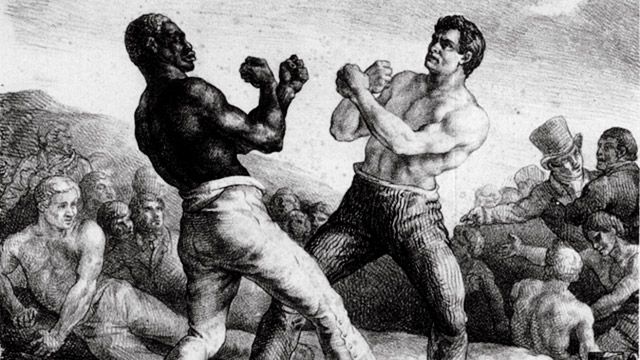
On December 10, 1810, in a muddy field around 25 miles from London, a fight took place that was so dramatic, controversial, and ferocious that it continues to haunt the imagination of boxing more than 200 years later. One of the fighters was the greatest champion of his age, a bareknuckle boxer so tough he reportedly trained by punching the bark off trees. The other was a freed slave, an illiterate African-American who had made the voyage across the Atlantic to seek glory in the ring. Rumors about the match had circulated for weeks, transfixing England. Thousands of fans braved a pounding rain to watch the bout. Some of the first professional sportswriters were on hand to record it.
It was the greatest fight of its era. But its significance went beyond that. Even at the time, it seemed to be about more than boxing, more than sport itself. More than anything, the contest between a white English champion and a black American upstart seemed to be about an urgent question of identity: whether character could be determined in the boxing ring, whether sport could confirm a set of virtues by which a nation defined itself.
The fight cemented a set of stock characters — the fast-talking, ultra-talented, self-destructive black athlete; the Great White Hope; the canny coach who’s half devoted to his pupil and half exploiting him — that have echoed down the centuries.1 In fact, so much about the fight feels familiar today, from the role of race to the role of the media, that if you had to name a date, you could make a good case that December 10, 1810, was the moment sport as we know it began. … Read More
At some point in the middle of the American night, Novak Djokovic beat Rafael Nadal to win the Australian Open in a five-set match that nearly ran six hours, the longest ever Grand Slam singles final. With the win, Djokovic became only the fifth man to win three consecutive Grand Slams (the others being Nadal, Sampras, Federer, and Rod Laver). Nadal, on the other hand, became the first to lose three consecutive Slam finals.
The Sunday before the Super Bowl is reserved for the Pro Bowl, reviled as the worst all-star game of any professional sport. I heard that the AFC “won.” I also heard that this was the worst playing of the non-game yet, even drawing fan booing early on. In a related story, national commentators continued to praise the NHL all-star game apparently without realizing it too was played on Sunday.
It’s true. Dark old theaters have been the setting for music videos before. I’m still not sure why so many people lost their business over Mumford & Sons– roughly, the indie, vested, British version of Old Crow Medicine Show. I don’t understand their broad appeal as, presumably, a crossover from the neo-old-timey genre, because they don’t seem to have enough pop, or as indie acoustic rock, because songs like the one linked above never seem to reach that point of melodic-rhythmic arrival that would appear necessary for wide popularity. And anyway, I didn’t think they and the Avett Brothers did ol’ Bob any favors at the Grammys last year. (Cf.)
Enough about what’s going to get me in trouble with Magalan and Bdoyk, and onto the Jam for this Friday, which is a bit out-of-pocket for me (perhaps especially in light of the above paragraph), but which, for reasons mostly unexplained, is today’s selection. I’ve distilled my thoughts about this video into the title of this post. An additional comment on production: I like that this video is done professionally, but not commercially (either glossy, or affected rustic, for example). It isn’t absolutely perfect, but it’s way more than enough to convey the idea, and as it is, it demonstrates the reality and genuineness of the execution, which means more than pristine slickness. Finally, if old theaters are good, adding a saloon can only help.
And there’s your Critic’s Corner for the week. Have a snobby weekend.
I largely agree with Bpbrady and Dave Cameron’s assessment of the deal that made Prince Fielder a member of the team where his (estranged) father was a star. In short, the Tigers had better win a World Series by 2015. Fielder probably is close to his athletic peak right now, but, like Albert Pujols’ new contract with the Angels, compensation doesn’t really ramp up until later.
Those early-contract numbers might look a tad pessimistic, given that Fielder’s coming off a season in which he hit .299/.415/.566 and racked up 5.5 wins above replacement, and he’s just 27 years old, smack in the middle of the age range in which the average major leaguer peaks. But for all of his power potential, Fielder is a lousy defender who’ll play either first base (poorly) or DH. That means he needs to hit a metric ton to yield as much value as a player manning a premium defensive position, like Matt Kemp or even Dustin Pedroia.
The national media reaction to this deal has been pretty tepid: it just seems to be too rich for their liking, and Fielder won’t earn the money over the full length of the nine-year contract. My buddy in Detroit called me a couple hours after the announcement to discuss, and he said that the reaction over there largely remained in the surprised shock stages. The general consensus that’s filtering through there and nationally, though, is that the Tigers over-leveraged their future in an attempt to win now, making this a bad deal for the Tigers. In other words, this 275 lb (and growing), $214 million (and escalating) albatross will be such a drag on the team that it will clearly outweigh any short-term benefits.
This, of course, is hardly the case. The theory underlying the criticism of the Fielder deal is that teams should be trying to build perennial contenders, and that this contract will prevent Detroit from becoming a perennial contender once Fielder’s decline sets in. The second clause in the preceding sentence may be true and probably will be, but the first contains a cliché assumption that is bogus. Maybe it isn’t totally bogus. If some success is good, more success is better, and once having found success, it’s nice to sustain that success. The problem is that very few teams have been able to maintain top-level success. (Moreover, there was no indication that the 2011 Tigers were calibrated such that they were on the cusp of a decade of dominance or anything like that.) Detroit hasn’t won the World Series since 1984, and the years since then have been pretty thin. If presented with the option of winning the division in each of the next three seasons, winning one championship during that period, and then sinking back into mediocrity for the next six years, I can’t imagine a single Tiger fan saying no. Our willingness to forego future stability for an increased chance of present gains has put our economy in the stink pot, but when it comes to baseball, and a team that hasn’t won it all in 28 years, the strategy makes perfect sense.
Dave Cameron, whose work I know and respect from the blog USS Mariner recently wrote this post in reaction to the Prince Fielder signing. The gist of the article is that while Fielder’s signing, coupled with the presence of Miguel Cabrera and Justin Verlander, will make the Tigers a contender for the next few years, the Tigers will eventually regret the contract as Fielder ages and presumably declines in skill.
Dave Cameron’s a sharp guy, and he can do the math and work out the expected value of Fielder in wins to the Tigers next year and over the lifetime of his contract a lot better than I can, so there’s not a whole lot I have to say that he doesn’t say in that article. In the end, I think the Tigers are incredibly short sighted for pulling the trigger on Fielder. For this deal to be worth it, the Tigers absolutely must bring Detroit its first World Series championship since 1984. A few division titles and a pennant or two aren’t going to cut it when Fielder is 34 and stumbling around the base paths en route to hitting 18 homers and batting .260. The contract might not even be worth it if the Tigers win a World Series, if it cripples the franchise for years to come afterward (although given the fact that Detroit is now paying three players 20 million dollars per year, that is not a given).
Furthermore, as Cameron notes, this money could be better spent elsewhere. He suggests Jose Reyes and CJ Wilson as two players the Tigers could have signed for around the same money they gave to Fielder. Having watched the Tigers a lot in the past year, I felt they needed a pitcher more than they needed another impact bat going into 2012. Obviously the injury to DH/C Victor Martinez changed that, however if I was Tigers GM Dave Dombrowksi, I would have signed a pitcher CJ Wilson and traded a couple prospects for a bat like Houston’s Carlos Lee who could help Detroit in 2012 without hindering the franchise’s ability to contend later on. But perhaps there’s a reason that he is a major league GM and I am not. I guess we’ll find out in four or five years.
When John Kaye sent this report it made me realize that two of my great literary touchstones — Fear and Loathing in Las Vegas and Tristram Shandy — have much more in common than I had ever noticed. They are both colossal failures of mission, spectacular performances of the art of being sidetracked, of being shanghaied by errant attention, or, perhaps, perfect examples of the way art is, at its best, a perversion, a turning away from more straightforward intentions. This piece was commissioned elsewhere to be a brief reminiscence of a weekend in New Orleans. We prefer this Shandean, heavyweight version. — Tom Lutz
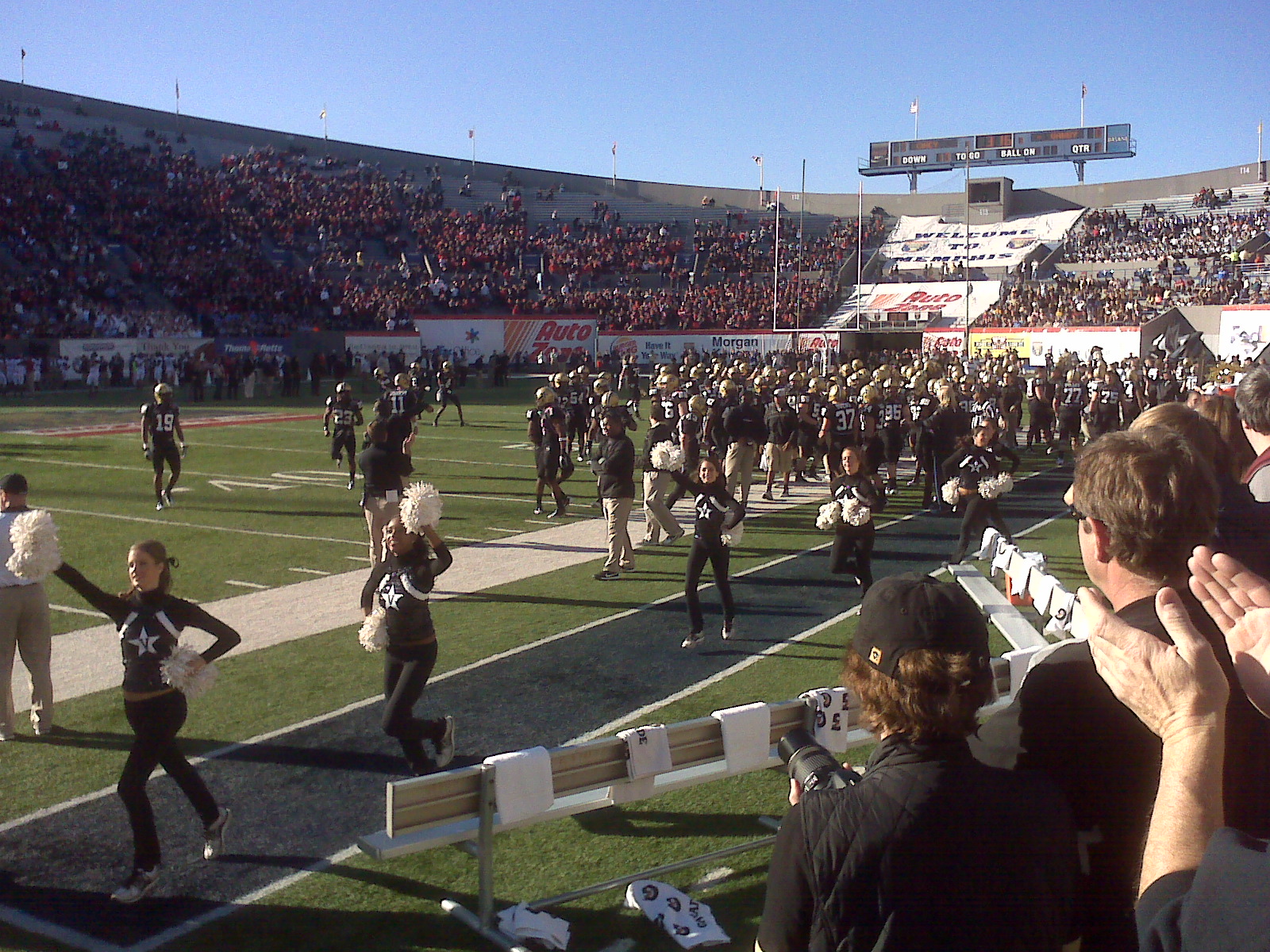
After the Red Wings fell 3-2 to the Blackhawks at the United Center, I boarded a plane from Chicago early the next morning, and touched down in the land of the Delta blues, in the middle of the pouring sunshine. It was a beautiful New Year’s Eve day in Memphis, especially by my recently recalibrated Northern standards, and I’m not sure anyone could reasonably protest the prospect of tailgating outdoors in 60 degrees and sun on December 31st. Whenever I go to Memphis, I’m always (I write this as if I go there so often) struck by the lowness of the terrain. It isn’t just flat, it’s low. (Or maybe it was the lowrider dunebuggy of a rental car we had. It’s a tossup really.)
Hearing no reasonable or unreasonable protest, tailgate we did, the site graciously hosted and organized by the VSL Braintrust. After gorging ourselves on food, drink, and conversation, we made our way into the Liberty Bowl, which presents as large and grand but operates as small and comfortable. There’s an imposing fortress-like structure at the main entrance that would be impressively and confusingly lit at the end of the game, the moat area being a concourse that certainly felt like it was in the stadium but operated as a sort of DMZ for people to finish their outside consumables and proceed into the technical, ticket-taking entryway.
Once inside, I found myself in the best seats I’ve ever had for a sporting event of consequence. It wasn’t a surprise– I knew where the seats were– but there was something pretty neat about saddling up in the second row, right behind the Vanderbilt bench and about turning around and seeing a sea of black and gold stretched from end to end of the Commodore side of the stadium. Keep reading…
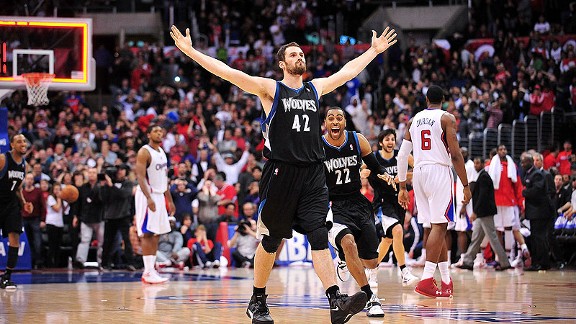
On Friday night, the Minnesota Timberwolves hung around long enough and took advantage of a Los Angeles Clippers’ offense that, despite dominating most of the game even without Chris Paul, stagnated after Mo Williams, who couldn’t miss, got himself ejected. Minnesota won the game on a Kevin Love 3-pointer off an in-bounds play with 1.5 seconds remaining. The 101-98 game-winning margin was the T-Wolves only lead of the night after going up 2-0 to start the game.
Sometime Saturday night or Sunday morning, former Penn State football coach Joe Paterno died after a battle with lung cancer. Beyond the longevity of his tenure, recent information about his handling of the Jerry Sandusky situation has obscured and clouded Paterno’s legacy. One has to wonder, though, whether Paterno would be alive today if he had been allowed to remain in his post. It isn’t a sensational suggestion: he and others addressed this very question in years past (in an article, probably in Sports Illustrated, for which I spent a good amount of time unsuccessfully searching on Sunday). The other footnote on this story right now is the mishandling of the death announcement by the media– particularly CBS Sports, which lifted a premature story without attribution from Onward State, a PSU student site, and then attempted to blame that site when the error was revealed.
Sunday featured the NFL playoffs’ final four and saw New England and New York advancing to the Super Bowl. In each game, the losing team appeared to be in control at the end, only to commit crippling special teams errors that delivered the victory to their opponent. When the teams meet in the Super Bowl, Eli Manning will have the opportunity to double his brother’s championship total, while Tom Brady could join Terry Bradshaw and Joe Montana as the only quarterbacks to win four Super Bowls. Super Bowl XLVI will be a rematch of Super Bowl XLII, which the Giants won 17-14, thanks in large part to a fourth-quarter catch by WR David Tyree.
In the Australian Open, Serena Williams lost 6-2, 6-3 to Ekaterina Makarova. Williams was the last American alive in the tournament.




 ALDLAND