Baseball Notes: Save Tonight

baseball notes

It is an accepted reality that, in general, baseball players don’t have much time for their sport’s new and advanced statistics and metrics. In many ways, this resistance makes sense. In the moment, when standing on the mound or in the batter’s box, there’s only so much thought and information a player can hold in his mind while trying to accomplish the task– make or avoid contact between bat and ball, for example– at hand. Players, like experts in other fields, also understandably tend to be skeptical of outsiders’ ability to provide baseball analysis or insight superior to their own. This skepticism is fairly well documented, most obviously when it involves changes that might impair or decrease a player’s value or role in the game, and, more surprisingly, even when new statistical revelations work in a player’s favor. (There certainly are some players, like Jake Lamb and Trevor “Drone Finger” Bauer, who have embraced sabermetric thinking, but it’s reasonable to assume they remain in the minority among their colleagues.)

A primary impetus of baseball’s sabermetric movement has been to encourage the abandonment of certain traditional statistics that, while still largely entrenched in the sport, are understood to be incomplete in important ways or much less meaningful than their use might suggest. Batting average, for example, doesn’t include walks. (Cf. On-base percentage.) RBIs require a player’s teammates to reach base ahead of him. ERA depends, to a significant extent, on a pitcher’s defensive teammates and other factors outside a pitcher’s control. (Cf. defensive-independent pitching statistics like FIP and DRA.) Pitcher wins and saves are artificial, highly circumstantial metrics that, at best, indirectly measure pitching talent.

For years, analysts have pushed baseball to rid itself of these traditional performance measures. There’s a comfort in hanging onto the statistical language with which we grew up as we learned and discussed the game, but that comfort should turn cold upon learning the degree to which these familiar stats obscure what’s really happening on the field.

So long as baseball’s current player-compensation structure remains in place, though, players aren’t likely to stop caring about things like saves; after all, that’s how they’re paid:

screenshot-2016-10-19-at-5-46-24-pm

In the course of discussing whether departures from conventional reliever usage as particularly exhibited in the 2015 and 2016 playoffs are likely to bleed over into upcoming regular season play, FanGraphs’ Craig Edwards explains one reason players are likely to prefer conventional, save-oriented bullpen strategy:

Saves get paid in a big way during arbitration. Only one player without a save, Jared Hughes, received a free-agent-equivalent salary above $6.5 million in arbitration, while all 16 players who’d recorded more than 10 saves received more than Hughes in equivalent salary. Players are more than happy to make more money, so giving more relievers higher salaries and more multi-year deals is openly welcomed. Taking saves away, however, also takes money away from players with less than six years of service time.

Although there are a number of not-uncompelling reasons why players prefer to steer clear of baseball’s newer metrics, Edwards has fingered one of the most forceful. If fans and analysts want to hear players discuss OBP, DRA, and leverage, they ought to channel their persuasive efforts less toward appeals to players’ logical sensibilities (they get it, no doubt) and more toward the education of the MLB salary arbitrators, to whom the players already listen with great attention.

___________________________________________________________________

Previously
Baseball Notes: Current Issues Roundup
Baseball Notes: The In-Game Half Lives of Professional Pitchers
Baseball Notes: Rule Interpretation Unintentionally Shifts Power to Outfielders?
Baseball Notes: Lineup Protection
Baseball Notes: The Crux of the Statistical Biscuit
Baseball Notes: Looking Out for Number One
Baseball Notes: Preview

Dusty Baker, John Lee Hooker, and the Fillmore District (via Ephus)

Excerpt from Kiss the Sky: My Weekend in Monterey at the Greatest Concert Ever by Dusty Baker:

When I met John Lee Hooker that took it to another level for me. John Lee was born in Mississippi. His daddy was a sharecropper and a Baptist preacher. He played down-home Delta blues and no one did it better, as you know if you’ve heard his versions of “Crawling King Snake” and “One Bourbon, One Scotch, One Beer.” He moved around a lot in his life, but spent a lot of time in California, especially as he got older. He was here so much that later in 1997 he opened John Lee Hooker’s Boom Boom Room in San Francisco’s Fillmore District. But John Lee and I go back farther than that. I played for the Dodgers for eight seasons starting in 1976, and John Lee was a Dodger fan. He had a house in Long Beach and would come to games. I signed a Dodger uniform for him – and I found out later he had that framed and on the wall of one of his houses in the Bay Area.

John Lee would sometimes come see me at Candlestick when I was manager of the Giants. He was a real baseball fan. At home he’d have three TV sets on at a time, each tuned to baseball, and he would pay close attention. He’d been a catcher way back when and always loved to talk baseball with me. He came to a game as my guest in September 1995 and had himself so much fun, talking to the players in the clubhouse, wearing a fedora hat made of felt with diamond and gold pins shaped like musical notes. He watched the game from a broadcast booth up in the press box, then came down afterward and we talked in my office for hours. My dad was there, and my youngest brother, Millard, from my dad’s second marriage, who picked up a love of the blues from my dad, too. Deion Sanders played for the Giants that season and he was there in my office to hang with John Lee, too. Asked who his favorite Giants player was, John Lee said, “Royce Clayton.” And why was that? “Because he’s cool.” Royce was cool. He had that right.

The next August John Lee invited me to a big birthday party he was having. He was turning seventy-nine year old, but you’d never know it from talking to him. He was having himself so much fun all the time, he might as well have been a teenager. That was John Lee. He was still performing regularly, too. I went to that birthday party and met all kinds of people, including Elvin Bishop, whose guitar work I’d first seen at the Monterey Pop Festival in 1967. He’d actually seen John Lee’s “Baker” Dodgers uniform and asked about me and John Lee said he’d introduce us.

Elvin was my kind of guy. He’s lived up in Marin County for years, and was actually born in California, but grew up in Iowa and Oklahoma and earned a National Merit Scholarship to attend the University of Chicago and study physics starting in 1960. He met Paul Butterfield a few years later and started playing guitar in his blues band. Elvin formed his own group before long and had a hit with “Fooled Around and Fell in Love” (he didn’t sing on that one, though). Elvin has played with everyone you can think of. He played with Muddy Waters. He played with Lightnin’ Hopkins. He and I could have talked music all night, or baseball, but instead we started talking fishing, which we’re both serious about. After that we became fishing buddies.

(via Ephus)

Baker’s Washington Nationals are in a decisive NLDS game five tonight against the Los Angeles Dodgers.

2016 MLB end-of-season prediction report

Unfortunately, the 2016 MLB regular season ended yesterday, making today as good a day as any to evaluate the preseason predictions I made.

anigif_enhanced-buzz-12279-1379599236-35

When I checked in on these at the halfway mark of the season, they were looking ok enough for me to rationalize all of them. Now, though, we have nothing more than cold, hard reality against which to measure these guesses. The results (excluding predicted individual award winners, whom have yet to be named):   Continue reading

Game 162: Talking baseball at the end of the 2016 regular season

Every MLB team is in action beginning at 3:00 this afternoon for the final* day of the 2016 regular season. Before heading down to Turner Field to catch the Tigers and say farewell to baseball in downtown Atlanta, I was a guest on today’s episode of the Banished to the Pen Podcast, in which I rambled about wild card scenarios and made severely underinformed playoff predictions.

Stream or download the podcast here.

* Final as to all except Detroit and Cleveland, which likely will need to play a makeup game tomorrow.

The arc of the ALDLAND universe is long, but it bends toward this weekend

maybin-upton-braves-tigers

If there are two things I’ve written about with consistency at this weblog they are 1) the Detroit Tigers and 2) the Atlanta Braves’ foolhardy abandonment of their downtown home at Turner Field. Beginning tonight, and for the next two days thereafter, these two ALDLANDic worlds will collide when the Tigers face the Braves in the final three games ever to be played at the aforementioned Turner Field. More than anything, I am grateful that we will be able to attend each of these games, live and in person. These are critical games for the 2016 Tigers, teetering as they are on the edge of postseason qualification, and they are historic games for the City of Atlanta. I have little more to add at this juncture other than that I am very excited.   Continue reading

Live podcast announcement: Enter the Pizza Cave

pizzacave.png

Tomorrow morning, I will be joining the Pizza Cave Podcast, hosted by legendary Southeast Michigan restaurateur-podcaster Fredi the Pizzaman, live at 8:30 am Eastern to pick NFL, college football, and baseball games. Although you can listen to it later on, keep in mind that this is a live podcast, meaning that you can stream it as it’s being recorded, which I recommend.

Tune in Saturday morning at 8:30 by clicking here to listen live or check out the archives later on.

Catching Fire: Cabrera leads by example

cabrera1280_xhyb8p9n_pe6ybg8z

In an odd way, it’s tough to find an excuse to write about Miguel Cabrera in a season series like this one, because he’s so consistently good that, within his own context, his day-to-day achievements don’t stand out. If, from a coverage perspective, the greats miss out on talent-correlated attention during the season, though, they tend to make up for it during the big moments, like playoff races and the postseason.

The Detroit Tigers are in the final countdown for the 2016 season. Monday was their last off-day until the season ends on October 2. Their playoff odds have tumbled, but they’ve managed to keep pace at about two games back of the second AL wild card spot, meaning that their postseason hopes remain very much alive. The reason those playoff odds are low, though, is because they’re running out of time. Every remaining game is of critical importance, and while the Tigers really need to win each of these games (or, at least, a vast majority of them), even doing that won’t guarantee a playoff berth unless the teams ahead of them falter.

Cabrera knew the stakes last night, during the team’s first game of this crucial final stretch. Detroit already was missing two of its biggest bats– Cabrera’s Venezuelan countryman Victor Martinez and Ian Kinsler, also an important vocal leader– due to a brutal triple HBP run by Cleveland’s Trevor Bauer (Cabrera also was a victim) in a costly win on Sunday, which meant Cabrera would need to shoulder even more of the offensive load than usual.

In the fourth inning, leading by a slim 1-0 margin, Cabrera decided to manufacture a run essentially all by himself, and not by way of a snappy home run blast. First, he stretched his single into a double; then advanced to third on a dangerously shallow fly-out; and, finally and amazingly, scored from there on an infield hit to the third baseman. Cabrera’s Billy Hamilton impression is one of the most impressive baseball moments I’ve seen this year (here’s the video), and he delivered it for the benefit of his teammates at the perfect moment. While it’s impossible to say whether the team’s subsequent offensive breakout– they ended up winning 8-1, with Cabrera also contributing a two-run homer– came as a result of this moment or the team simply (finally) catching up to bad Minnesota pitching, Cabrera’s baserunning in the fourth, which resulted in what ultimately proved to be the winning run, sent an unmistakable message to his teammates.   Continue reading

Braves finally strike a positive note in move to new stadium

kaminski1

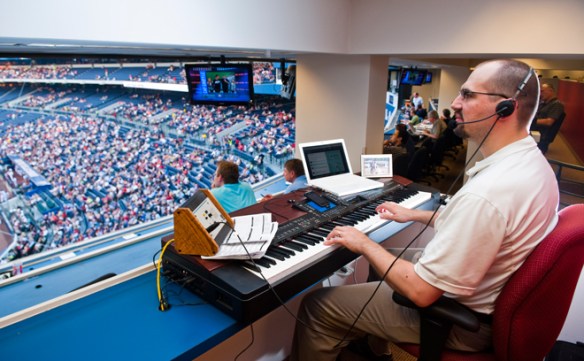
My opposition to the Atlanta Braves’ departure from their downtown home in Turner Field is well-documented in these digital pages, and it’s unlikely that we’ll make it to many games once the team moves to the corner of I-75 and I-285 (not exactly Michigan and Trumbull or 1060 West Addison). In the event we do hack our way through the asphalt jungle and make it to Cobb County, though, there’s good news. No, the team’s not likely to be much better next year, but at least Turner Field organist Matthew Kaminsky will be joining the Braves’ suburban exodus.

I didn’t know his name back then, but I remember Kaminsky’s work from my first Braves game, back in 2013. I even wrote about him here, in my post about that game:

It was good that we were closer to the game, too, because the Royals and Braves, who were off on Monday, were celebrating a belated Jackie Robinson day by having everyone wear uniform number 42 in his honor. This made it difficult to keep track of the players, particularly hitters and pitchers, a difficulty the apparent lack of an active stadium announcer compounded. Swinging hard in the other direction, though, was the overly detailed digital scoreboard in straightaway center that had almost too much information on it to be readily intelligible. Mitigating all of this, thankfully, was an organ player who kept the whole scene loose and made me smile by playing his or her own version of “Call Me Al” every time K.C.’s Alcides Escobar came up to bat.

Kaminsky’s signature is his musical puns or references played for the opposing batters’ walk-up songs, creating a fun game within the game for fans trying to follow his thought process. Other memorable selections include “Take Five,” a Dave Brubeck recording composed by saxophonist Paul Desmond, for Washington Nationals shortstop Ian Desmond, and various fish-related songs for Angels outfielder Mike Trout.

Kaminsky was a guest on a recent episode of The Ringer’s MLB podcast, hosted by Ben Lindbergh, which you can stream below. He discusses how he first was hired for the job; how he prepares for, envisions, and executes his role during games; and the particular musical equipment he uses. As mentioned above, he also discloses the news that he will be a part of games at the Braves’ new park next year, and that, as part of the move, the team will be supplying him with a real organ.

The segment with Kaminsky begins at roughly the halfway point, and is preceded by a Statcast conversation with Daren Willman (Baseball Savant) and Tom Tango (The Book) that also may be of some interest.

Kaminsky, who also plays for college teams (including Georgia Tech, Georgia, and Auburn), performs in a salsa band and a jazz band, and teaches music, takes suggestions for his baseball selections on Twitter.

_____________________________________________________________

Previously
The political costs of a new baseball stadium
Previewing the 2016 Atlanta Braves
The Braves are failing on their own terms
New Braves stadium project continues to falter
Georgia Supreme Court Upholds Cobb’s Braves Stadium Bond Deal
Braves Break Ground on Baseball Boondoggle
The yard sale at Upton Abbey continues
From Barves to Burbs: What’s happening to baseball in Atlanta?

Catching Fire: It Don’t Come Easy

With just under a month remaining in the 2016 MLB season, this is a good time to take stock of the Detroit Tigers and some of their key players.

Team Playoff Odds

Today, the team sits 5.5 games back of Cleveland in the AL Central, and one game out of the second AL wild card spot, behind Boston and Baltimore. At this point, the division likely is out of reach, but the wild card is in play. Over the last two weeks, the Tigers have moved in and out of the second wild card position, and, although it’s served them well to this point, the Orioles’ volatile combination of bad starting pitching and overreliance on home runs is subject to collapse at any moment.

Three sites– Baseball Prospectus, FanGraphs, and FiveThirtyEight– take varying stances on spaces and the capitalization of letters in their names, but all three provide MLB playoff odds for every team. These represent the percent chance, based on to-date performance, that a given team will make the playoffs. Here’s how the Tigers’ playoff chances look today:   Continue reading

Swansongs, Vol. 2

swansome

The first entry in this series featured a three-pack of defensive highlights from Atlanta Braves rookie shortstop Dansby Swanson. This series, like this website, is all about the hits, though, and now we’ve got one of those to share, in the form of Swanson’s first career MLB home run, which he hit last night in Washington.

For his first big-league four-bagger, Swanson made like fellow SEC-man James McCann and earned it the hard way. Video evidence of his inside-the-parker is here. Statcast’s breakdown video is available here. The humans who monitor that robotical statistical machine also posted this nugget:

https://twitter.com/statcast/status/773308002615103488

Here’s another nugget from a non-robot-subservient human:

Call it a long-distance runaround? Yes.

_________________________________________________________________

Previously
Swansongs, Vol. 1