Braves finally strike a positive note in move to new stadium

kaminski1

My opposition to the Atlanta Braves’ departure from their downtown home in Turner Field is well-documented in these digital pages, and it’s unlikely that we’ll make it to many games once the team moves to the corner of I-75 and I-285 (not exactly Michigan and Trumbull or 1060 West Addison). In the event we do hack our way through the asphalt jungle and make it to Cobb County, though, there’s good news. No, the team’s not likely to be much better next year, but at least Turner Field organist Matthew Kaminsky will be joining the Braves’ suburban exodus.

I didn’t know his name back then, but I remember Kaminsky’s work from my first Braves game, back in 2013. I even wrote about him here, in my post about that game:

It was good that we were closer to the game, too, because the Royals and Braves, who were off on Monday, were celebrating a belated Jackie Robinson day by having everyone wear uniform number 42 in his honor. This made it difficult to keep track of the players, particularly hitters and pitchers, a difficulty the apparent lack of an active stadium announcer compounded. Swinging hard in the other direction, though, was the overly detailed digital scoreboard in straightaway center that had almost too much information on it to be readily intelligible. Mitigating all of this, thankfully, was an organ player who kept the whole scene loose and made me smile by playing his or her own version of “Call Me Al” every time K.C.’s Alcides Escobar came up to bat.

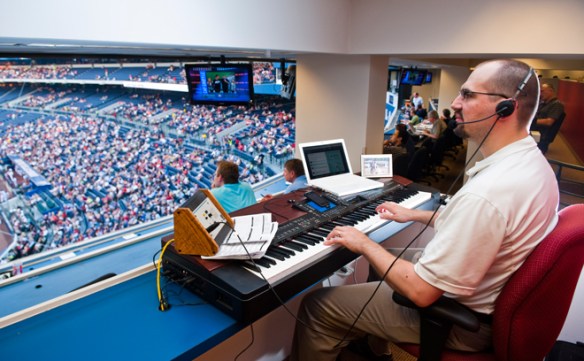
Kaminsky’s signature is his musical puns or references played for the opposing batters’ walk-up songs, creating a fun game within the game for fans trying to follow his thought process. Other memorable selections include “Take Five,” a Dave Brubeck recording composed by saxophonist Paul Desmond, for Washington Nationals shortstop Ian Desmond, and various fish-related songs for Angels outfielder Mike Trout.

Kaminsky was a guest on a recent episode of The Ringer’s MLB podcast, hosted by Ben Lindbergh, which you can stream below. He discusses how he first was hired for the job; how he prepares for, envisions, and executes his role during games; and the particular musical equipment he uses. As mentioned above, he also discloses the news that he will be a part of games at the Braves’ new park next year, and that, as part of the move, the team will be supplying him with a real organ.

The segment with Kaminsky begins at roughly the halfway point, and is preceded by a Statcast conversation with Daren Willman (Baseball Savant) and Tom Tango (The Book) that also may be of some interest.

Kaminsky, who also plays for college teams (including Georgia Tech, Georgia, and Auburn), performs in a salsa band and a jazz band, and teaches music, takes suggestions for his baseball selections on Twitter.

_____________________________________________________________

Previously
The political costs of a new baseball stadium
Previewing the 2016 Atlanta Braves
The Braves are failing on their own terms
New Braves stadium project continues to falter
Georgia Supreme Court Upholds Cobb’s Braves Stadium Bond Deal
Braves Break Ground on Baseball Boondoggle
The yard sale at Upton Abbey continues
From Barves to Burbs: What’s happening to baseball in Atlanta?

Catching Fire: It Don’t Come Easy

With just under a month remaining in the 2016 MLB season, this is a good time to take stock of the Detroit Tigers and some of their key players.

Team Playoff Odds

Today, the team sits 5.5 games back of Cleveland in the AL Central, and one game out of the second AL wild card spot, behind Boston and Baltimore. At this point, the division likely is out of reach, but the wild card is in play. Over the last two weeks, the Tigers have moved in and out of the second wild card position, and, although it’s served them well to this point, the Orioles’ volatile combination of bad starting pitching and overreliance on home runs is subject to collapse at any moment.

Three sites– Baseball Prospectus, FanGraphs, and FiveThirtyEight– take varying stances on spaces and the capitalization of letters in their names, but all three provide MLB playoff odds for every team. These represent the percent chance, based on to-date performance, that a given team will make the playoffs. Here’s how the Tigers’ playoff chances look today:   Continue reading →

Swansongs, Vol. 2

swansome

The first entry in this series featured a three-pack of defensive highlights from Atlanta Braves rookie shortstop Dansby Swanson. This series, like this website, is all about the hits, though, and now we’ve got one of those to share, in the form of Swanson’s first career MLB home run, which he hit last night in Washington.

For his first big-league four-bagger, Swanson made like fellow SEC-man James McCann and earned it the hard way. Video evidence of his inside-the-parker is here. Statcast’s breakdown video is available here. The humans who monitor that robotical statistical machine also posted this nugget:

https://twitter.com/statcast/status/773308002615103488

Here’s another nugget from a non-robot-subservient human:

Call it a long-distance runaround? Yes.

_________________________________________________________________

Previously
Swansongs, Vol. 1

Swansongs, Vol. 1

swansonleap

In 1973, Yes released Yessongs, an early greatest-hits/sampler album AMG describes as follows:

In many ways, the extravagance of this package equates the profligacy of the prog rock combo themselves. After all, how else but on a triple-LP collection could one hope to re-create (and/or contain) an adequate sampling of Yes’ live presentation?

In 2016, presumably, you now find yourself reading an early greatest-hits/sampler post regarding Atlanta Braves rookie and former Vanderbilt Commodore Dansby Swanson, which is a triple-video collection of defensive highlights, all accumulated in last night’s win over the Arizona Diamondbacks, the team that, in 2015, drafted Swanson with the top overall draft pick.

We don’t own the rights to this footage, obviously, but MLBAM was kind enough to package all three plays into one highlight video, which you can watch by clicking here. For an extra bonus, Swanson recorded his first major-league stolen base last night. Statcast’s breakdown video is available here.

Didn’t enjoy these videos? Think “Swansongs” is a dumb name that, if anything, should describe the end of a career and not the beginning? Don’t care. Sorry not sorry.

https://twitter.com/statcast/status/769198168361701376

Baseball Notes: Current Issues Roundup

baseball notes

Rather than my own attempt at fashioning a nugget of faux-wisdom, the purpose of this Baseball Notes post is to highlight a number of articles posted elsewhere addressing current issues in the sport.   Continue reading →

The Dansby Swanson Era has arrived in Atlanta

dansbydebut

On June 8, 2015, the Arizona Diamondbacks used the first overall draft pick to select Vanderbilt University shortstop and 2014 College World Series Most Outstanding Player Dansby Swanson. One of three Commodores selected in the first round of the 2015 MLB draft, Swanson spent little time in the Arizona organization before the Diamondbacks sent him, along with Ender Inciarte and Aaron Blair, to Atlanta in exchange for Shelby Miller in the consensus worst (for Arizona) trade of the offseason and one of the most lopsided in recent memory.

For his part, Swanson was happy with the trade. A Marietta native, he considered his move a homecoming. After appearing in 105 minor-league games this year, the Braves called him up to the big club, and he made his MLB debut last night in a home game against the Twins.

Just three years older than Turner Field, Swanson’s first MLB appearance came in the soon-to-be-demolished park where he watched baseball games as a child. When he came to the plate in the second inning for his first big-league plate appearance, wearing a batting helmet reminiscent of Jason Heyward’s (Swanson was hit in the face with a pitch in his first onfield practice with the Diamondbacks), the rookie received a warm ovation from the home crowd. Continue reading →

Have the Atlanta Braves discovered the secret of the ooze?

tmnt-2-screenshot

Only three teams– the Rockies, Tigers, and Phillies– declined to participate in the transaction frenzy that concluded on August 1’s non-waiver trade deadline, which means that, yes, even the lowly Braves were in on the action.

One of the clearest messages the trade-deadline market communicated was that contending teams (or teams that fancied themselves contenders, anyway) were willing to pay a premium for relief pitching. Atlanta did send pitchers Lucas Harrell and Dario Alvarez to Texas in exchange for Travis Demeritte, an infield prospect who starred across from Dansby Swanson at this year’s Futures Game, on July 27. They skipped the more obvious opportunity to sell high on the momentarily resurgent Jim Johnson, however, especially considering the fact that he’s a free agent after this season.

Instead, in the words of Fangraphs’ Jeff Sullivan, the Braves “exchange[d] toxic assets” with the Padres by trading infielder Hector Olivera for Matt Kemp.

It’s been tough to find people who think this was a good trade for the Braves. Kemp was good, once, five years ago, when he provided 8.3 fWAR in 161 games for the 2011 Dodgers. Since then, he’s been worth 4.8 fWAR total from 2012 through August 2, when he made his Braves debut at Turner Field:

IMG_20160802_190939

Kemp’s still being paid like he’s an eight-win, MVP-caliber player, but he’s playing like a half-win, DL-caliber player. He can’t run. As he demonstrated for the crowd in his Atlanta debut, he can’t defend. His bat, his only potential weapon at this point, is less consistent than that of Justin Upton, the last consequential left fielder to wear a Braves uniform. Still, when Kemp received a standing ovation from the home fans (who, to my eyes, were outnumbered by a surprisingly large cadre of Pirates fans) when he came to the plate for the first time in the bottom of the first, it so confused the Pittsburgh players that Jace Peterson, who was on first after walking to start the inning, easily stole second. So maybe there is some hidden value there.

But really, what’s the Braves’ plan with this move? Continue reading →

[UPDATED] Catching Fire: Mike Drop

http://a1.espncdn.com/combiner/i?img=%2Fphoto%2F2015%2F0513%2Fmlb_g_aviles_b1_1296x729.jpg

UPDATE: Approximately seven minutes after we published this post, the Tigers took our advice and traded Aviles to the Atlanta Braves.

It’s reassuring to know that General Manager Al Avila has joined Brad Ausmus as an ALDLAND reader. If you would like to peer inside the mind of the Tigers GM, the original post remains below.

__________________________________________________

The clock is ticking louder than ever on the Detroit Tigers’ 2016 season, and, just at the very moment the team needs to be putting its best foot forward in an effort to win crucial games that will determine whether they make the playoffs, they are running out some of the worst lineups they’ve used all season.

Injuries are largely to blame for this untimely suboptimal roster utilization, as Detroit currently is without Cameron Maybin, Nick Castellanos, Jordan Zimmermann, Jose Iglesias, Shane Greene, and (sigh) Mike Pelfrey. In addition, Miguel Cabrera left last night’s game with what appeared to be a left shoulder injury, and his status is uncertain. Manager Brad Ausmus, facing this many significant losses, obviously is handcuffed– he has little choice but to lean, undoubtedly more heavily than he would prefer, on his reserves, backups, and alternates.

Modern MLB roster construction, with its emphasis on relief-pitching specialization, leaves little room for backup position players. The Tigers, like most American League teams, essentially have three: a backup catcher, and two other “utility” fielders, who can play a variety of positions whenever a regular starter needs a break, or as a defensive replacement late in games.

For Detroit, those two guys are Andrew Romine and Mike Aviles, and they aren’t very good. Back in June, when Iglesias was struggling, I wondered whether Romine, who appeared to be a very solid stand-in at short when given the opportunity, should take over the job? Nope. Back in March, before the season even started, I was worried about the scouting report on Aviles, which was starkly negative:

Aviles is no longer useful in a baseball sense[, and] his inability to reach base (.279 OBP from 2013-15) makes him a complete zero on offense, while what’s left of his defensive and baserunning abilities have become liabilities.

Harsh and, so far, accurate. Unsurprisingly, when both Aviles and Romine are in the starting lineup, Detroit almost always loses.   Continue reading →

Catching Fire: Checking in on Justin Upton

juptigk

Everyone knows Justin Upton has had a tough go of things during his first season in Detroit, and it’s reasonable to expect that there would be an adjustment period associated with his move to the American League– new pitchers, new parks– after spending his first nine seasons in the National League.

When we last checked in on Upton, in late June, things finally seemed to be heading in the right direction:

Especially exciting for Detroit was that two of [the Tigers’ home runs in a win against the Mariners] came off the bat of Justin Upton, who finally appears to be heating up for his new team after suffering one of the worst offensive stretches of his career.

jupwrc20gmavg

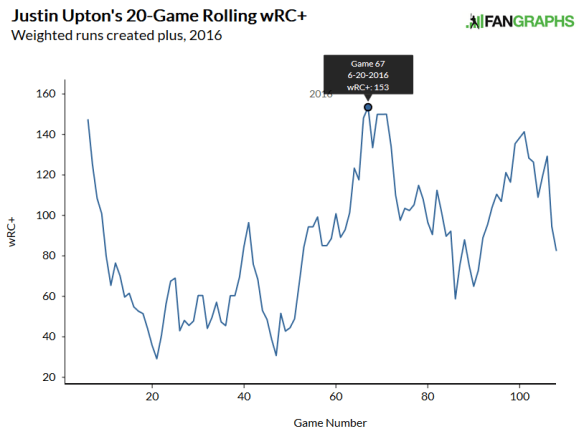
Upton has not continued in that direction, however; in fact, I seem to have caught him precisely at his peak. Here’s an updated version that same graph from the June post, above:

jupwrc20gmavgAug16

That earlier snapshot of Upton’s offensive production was through June 20, the date highlighted on this graph. Since then, Upton’s offense is declining again, and this graph (for reasons unknown to me) doesn’t even include the team’s two most-recent games, in which he went 0-7, striking out four times and grounding into two double plays.

jupmonthlysplitAug

At the moment, this season is the only full one of Upton’s career in which he has performed as a below-average batter, and, as the above all indicate, he’s been particularly bad of late. (Like, 6-wRC+-for-the-month-of-August bad.)

After the Mariners (coincidentally, the same team against which Upton appeared to break out back in June) completed a frustrating series sweep of the Tigers in Seattle early this morning, critics corralled their critical criticisms in Upton’s direction. Detroit hitting coach Wally Joyner came to Upton’s defense, however:

He’s a good player. He wasn’t sitting on the corner when they gave him the contract. He’s earned it. There’s a reason for that. Remember it. Nothing’s changed. He’s just a little bit unlucky right now.

He’s not OK with it and I’m glad he’s not OK with it. He’s working hard and he’ll be fine. He’s unlucky. He’s not playing like [crap].

Is Joyner right? Has Upton, of late, merely been unlucky?   Continue reading →

Farewell, again, dear Prince

Nearly three years ago, Detroit Tigers fans said goodbye to Prince Fielder, whom the team traded in the 2013 offseason to Texas in exchange for Ian Kinsler. At the time, many were glad to see him leave, though some, including this author, were not. All must agree, however, that when Fielder left Detroit, he became barely a shadow of his former Ironman self. In his two years as a Tiger, he didn’t miss a single game. Excluding his rookie year, in the eight years he spent in Milwaukee and Detroit, he missed a total of thirteen games, playing the full 162 in four of those eight seasons. That’s an impressive accomplishment for any player.

If one wanted to be cold about it, one might note that, 2014, Fielder’s first in Texas, was a year of insult and injury for Prince. Not only did his trade replacement, Kinsler, make the All-Star team on his way to completing the second-best season of his career, but Fielder underwent season-ending neck surgery in late May, appearing in just forty-two games for his new club. He seemed to bounce back in 2015, posting a .305/.378/.463 line in 158 games, but it has been trouble again for Fielder in 2016. Despite his team’s success, Prince arguably was the worst position player of the first half of the season, and things weren’t looking up in the second half. After playing in all but five of the Rangers’ games through July 18, Fielder again went on the disabled list and, after undergoing a second neck surgery, is expected to miss the remainder of this season.

It may not just be the rest of the season he misses, however, as shocking reports emerged this afternoon that Prince’s career may be over:

If true, then, as a number of people have pointed out, Prince will finish with a .283/.382/.506 line, .304 TAv, .377 wOBA, 133 wRC+, 26.8 fWAR / 23.8 bWAR / 30.3 WARP, and 319 home runs, the same number of home runs his father, Cecil, with whom he seems to have reconciled, hit in a career just one season longer than his son’s.

Although serious injuries seemed to dim his wattage following the trade to Texas, I always will remember Prince Fielder as a complete hitter who was one of the happiest baseball players I ever saw. His friendship with Miguel Cabrera was particularly endearing.  What follows are some of my favorite images and clips from Prince’s playing days:   Continue reading →