Catching Fire: Pelf on the shelf

Minnesota Twins v Chicago White Sox

With the 2016 MLB season roughly one-third complete, this series has touched on possible changes the Detroit Tigers might make at the catcher and shortstop positions and now turns to the starting pitching rotation.

To begin with the good news about the Detroit Tigers’ pitching, we almost have to begin with the bad news, which is that the presumptive lock for an above-slot number three starter, Anibal Sanchez, was so bad through his first eleven starts that he’s been demoted to the bullpen. Another potential starter, Shane Greene, has continued to be unable to prove he can hold down a starter role, and still-semi-prospect Daniel Norris has battled injury and efficiency problems that, so far, have kept him in Toledo and out of a rotation spot in Detroit. Thankfully, Jordan Zimmermann and Justin Verlander have, for the most part, been very solid in the first two spots, and rookies Michael Fulmer and, to a lesser extent, Matt Boyd, have arrived this year as big-league-ready starters.

bgkw8px

A weakness common to all Tigers starters this year has been an inability to pitch late into games, but the arrival of Fulmer in particular has allowed the team to bolster an already-improved bullpen with extra tweener (i.e., not quite starter material yet/anymore) arms like Sanchez and Greene, with Boyd, who has been a bit homer-prone of late, a possibility to join them in the near future. Brad Ausmus and Al Avila have done a good job of rotating these arms through a suddenly thick bullpen, making frequent use of Toledo options where available, to the point that many Tigers fans are experiencing a creeping and unfamiliar sensation of actual comfort with their team’s pitching staff. These are strange days indeed.

If they want to return to the familiar, however, they need not look too hard, because every fifth game or so begins with Mike Pelfrey on the mound.   Continue reading

Statements both obvious and only slightly less obvious about the Detroit Tigers’ finances

ponzyxfp2nxxmr76trol

By now, everyone knows The Narrative governing all things Detroit Tigers baseball: the team needs to Win Now because they have lots of money locked up in a few long-term player contracts, and, as those players age, the team’s Window Is Closing. And it’s true: the team has some expensive contracts on the books. Here’s a rough visual, created from the data available on Baseball-Reference:

tigerks

(Click here for an expanded view.) Besides noticing that I have not recently viewed Anibal Sanchez’s player page, you can see that a number of today’s already-very-familiar Detroit baseball faces are likely to remain as such for a number of additional seasons, and at significant cost to the team. This is known and obvious. That this aggregated fact has real and, on balance, probably adverse consequences for the team’s future– the ability to re-sign J.D. Martinez comes to mind– also is, if less precisely quantifiable, known and obvious.   Continue reading

Mike Ilitch’s baseball bona fides

avilamaddog

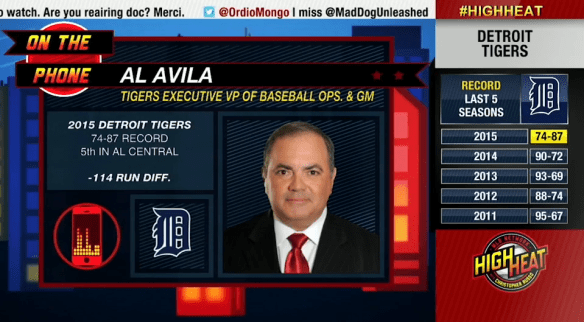
Everyone knows Mike Ilitch as the wealthy pizza baron who owns the Detroit Tigers and Red Wings, but when new Tigers General Manager Al Avila appeared on Christopher “Mad Dog” Russo’s television show today, he revealed something about Mr. I that most folks probably don’t know: Ilitch is a former professional baseball player.

Ilitch played four seasons of minor-league ball in the mid-1950s. He split the 1952 season between the Jamestown, NY Falcons, a Tigers affiliate, as chance would have it, and the unaffiliated Hot Springs, AR Bathers. He spent the entirety of the 1953 season with the unaffiliated Tampa, FL Smokers, where he was the starting second baseman and his .310 batting average was second-best on the team. In 1954, Ilitch divided his time between the Smokers and the unaffiliated Miami Beach/Greater Miami Flamingos in what would prove to be the Flamingos’ final season of existence. He continued to demonstrate an ability to hit for average, if not power (his sole home run of the season was just the second of his career to that point), finishing 1954 with a .324/.375/.400 line, the best of his career. 1955 was Ilitch’s final year as a professional baseball player. He appeared in just sixty-two games while playing for three different teams: the unaffiliated St. Petersburg, FL Saints, the Norfolk, VA Tars (Yankees), and the Charlotte, NC Hornets (Senators). Ilitch’s offense slipped in his final season, in which he hit his third career home run and batted .255/.328/.273 for the Tars (incomplete records from the other teams suggest this line is representative of his performance for the Saints and Hornets as well).

The knee injury that ended Ilitch’s playing career in 1955 probably explains the decline in his offensive production. Four years later, he and his wife opened the first Little Caesars Pizza restaurant. They bought the Red Wings in 1982 and the Tigers– from Domino’s Pizza founder Tom Monaghan– in 1992.

2016 Detroit Tigers still in search of man out standing in (left) field

After a disappointing 2015 season, which included some odd maneuvering at the trade deadline, the Detroit Tigers entered the offseason with a significant to-do list. They’ve already made acquisitions designed to address needs in the bullpen and starting pitching rotation, but, with three months until opening day, the team still has one major hole to fill.   Continue reading

Johnny Cueto vs. Daniel Murphy: World Series, Game 2

Last night, Johnny Cueto returned to the confident, successful form the Kansas City Royals expected when they traded for him earlier this season, allowing just one run and two hits (both soft singles by Lucas Duda) in the course of completing a 122-pitch complete game victory.

Early on, home-plate umpire Mark Carlson seemed to be calling a fairly large strike zone, which appeared to tighten as the game progressed. No Mets hitter looked to be more frustrated by Carlson’s calls than the suddenly homer-starved Daniel Murphy, who struck out twice and walked twice, failing to register a hit (or put the ball in play) for the first time this postseason.

What follows is a quick look at each of Murphy’s four plate appearances last night, with the goal of determining whether he or Cueto received any benefit from Carlson’s as-called strike zone.   Continue reading

The only surprising part of Will Ferrell’s tour de baseball

will ferrell baseball chopper

Everybody had a good time with Will Ferrell’s Major League Baseball debut last week, and that’s no surprise. Will Ferrell is funny and good at making people laugh, and, it’s always seemed with him, the bigger the stage, the bigger the laughs. Ferrell started Thursday as an undrafted amateur free agent signee of the Oakland Athletics, and he finished the day as a San Diego Padre. In between, he appeared in games as a member of eight other teams and played every position, including designated hitter (pictured above). He even has his own Baseball-Reference page!

All of this feels like it belongs within Ferrell’s entertaining wheelhouse. Close examination of his B-R page reveals a little surprise, however:

wfb-rWho knew Cincinnati held Norm’s rights to begin with? Maybe it has something to do with the Marge Schott joke he made on Weekend Update nineteen years ago, forever “preserved” on this broken NBC.com video? Baseball, like Norm, proves to be a continually unfolding mystery of the most enjoyable variety.

Max Scherzer scouting report (backup catcher ed.)

My first post over at Banished to the Pen, a new baseball blog, takes a very serious look at a rumor of debatable seriousness: that the Texas Rangers considered adding Max Scherzer as a backup catcher before he signed as a starting pitcher for the Washington Nationals.

The full post is available here.

On the Road Again: A study of NHL rink variation

One of the important background dimensions to comparative baseball statistics is known as “park adjustments,” a set of corrective factors applied to account for the physical differences (e.g., outfield wall depth) between each park. Among American sports today, only Major League Baseball and NASCAR (and golf, I suppose) permit such structural variation between the competitive arenas themselves.

Professional hockey used to be in that group too. More than merely adjusting, adding, and subtracting lines on the ice to affect the flow of play, as the NHL continues to do (cf. the NBA three-point line), the rinks themselves used to be different sizes. League rules mandate a uniform rink size, but so-called “small rinks” persisted in the NHL as late as the 1980s and 1990s in Boston, Chicago, and Buffalo.

While hockey does not face the structural differences present in baseball, there still is a need to apply rink-by-rink statistical adjustments. That’s because the compiling of basic hockey statistics (e.g., shots, hits, turnovers) requires statisticians to make judgment calls to a more significant degree than in a discrete-event sport like baseball.

By way of limited background, the NHL collects basic gameplay statistics through a computer system known as the Real Time Scoring System (RTSS). A benefit of RTSS is that it aggregates and organizes data for analysis by teams, players, and fans. A vulnerability of RTSS is the subjectivity alluded to above that comes when human scorers track a fluid, dynamic sport like hockey.

While others have noted certain biases among the RTSS scorers at different rinks, a paper by Michael Schuckers and Brian Macdonald published earlier this month analyzes those discrepancies across a spread of core statistics and proposes a “Rink Effects” model that aims to do for subjective rink-to-rink differences in hockey scoring what park adjustments do for structural differences between baseball parks.    Continue reading

Flying Tigers: Where are the Bats?

cabbatI have the good fortune to have spent portions of every summer at an old, out-of-the-way place in southwestern New York that historically has named among its variety of curious attributes a large bat population. The particular species is known, semi-colloquially anyway, as the little brown bat, and its surprisingly heavy presence was readily noticeable visually and environmentally (the prime example of the latter being the localized dearth of mosquitos). In the past year or two, the little brown bat population there has declined steeply, however. An invasive mold-related disease seems to be to blame. If the fact of the problem is known and the cause of the problem is suspected, the solution at this time is neither. The situation feels helpless.

Meanwhile, in Detroit, the bats have gone missing too, albeit in a far less dire context. While all eyes are on the bullpen, the simple and obvious truth is that successful baseball teams combine good pitching and good hitting. A shut-down bullpen alone does not a winner make. I’m not saying that general manager Dave Dombrowski’s priorities are misplaced in trading for a reliever (Joakim Soria) or even two (a lefty, please) before the trade deadline this afternoon, but if a trade could inject some life into a surprisingly weak Tiger offense that seems like it’s really missing Jhonny Peralta and a healthy Miguel Cabrera, that might not be a bad idea.

The Tigers plated 796 runs last year. They’re on pace for 758 this season. Continue reading

Flying Tigers: Detroit finds relief, but at what price?

Last night, the Tigers traded two of their top pitching prospects, Corey Knebel and Jake Thompson, to the Texas Rangers in exchange for reliever Joakim Soria. My immediate reaction was that Knebel and Thompson were a steep price to pay for Soria (or virtually any single relief pitcher), but two realities likely drove up the price: 1) in general, it’s a sellers’ market, because league-wide parity (some might say mediocrity) at this point in the season means there are more buyers than sellers as we approach the main trade deadline, and 2) everyone knows the Tigers need bullpen help and therefore have Detroit GM Dave Dombrowski a little bit over a barrel when it comes to negotiation leverage. However you weigh the trade pieces here, Detroit had to make a move like this if it wanted to contend this October, and the equities certainly are not as imbalanced as they were in some of the Tigers’ preseason moves.

Soria is a thirty-year-old relief pitcher who was born in Mexico and spent the first five years (2007-2011) of his career in Kansas City. After sitting out all of 2012 while undergoing Tommy John surgery, he joined on with the Texas Rangers in 2013. While a glance at his numbers suggests that he picked up in 2013 where he left off in 2011 (in a hitter-friendly park in Arlington), he has been absolutely excellent so far in 2014.

I’ve had my eye on Soria since he popped up in serious trade rumors in the past week or so, and I haven’t found much to dislike about him. Continue reading