Flying Tigers: Victor Martinez, Professional Hitter

vmart

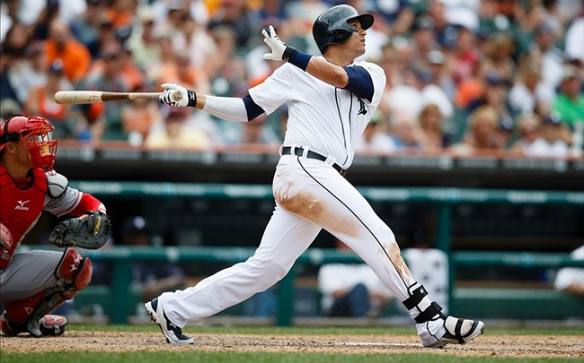
Tigers fans chuckle to themselves whenever they hear announcer Rod Allen proclaim with his special gravitas that Victor Martinez is a “professional hitter.” After watching Victor this season, though, I began to notice that Detroit’s DH seemed to be doing an especially good job not just of putting the ball in play, but of extending his plate appearances, forcing pitchers to display their arsenal for the benefit of Martinez and his teammates. As the chart below shows, few batters are seeing more pitches per plate appearance than Victor this season.

pitches per plate appearance

There are a few things to note about this chart. First and most importantly, because the season remains young, the rankings are subject to great fluctuation on a pitch-by-pitch basis. (Click the image to see the latest data.) A second observation is that the American League, and the AL Central in particular, and the Minnesota Twins in even more particular, find strong representation here. Or at least they did when I grabbed that screenshot. Again, probably too early to read too much into the positioning here.

Wherever he stands with respect to the rest of Major League Baseball, Victor’s seeing more pitches than his fellow Tigers. I like to think that’s a small piece of evidence showing that he’s fully embracing the role of designated hitter.

_____________________________________________________

Previously
Flying Tigers: Actually Mad Max – 4/29
Flying Tigers: Waiting for Takeoff – 4/28

Blogging About Blogging, vol. 40

We’re not in any way opposed to meta coverage here at ALDLAND. Blogging about blogging is basically our bread and butter. (We also cover blogging about blogging about bloggingblogging about writingblogging about writing about writingwriting about blogging, and writing about writing.) That’s why I’m glad to accept, on ALDLAND’s behalf, a Liebster Award nomination from the good folks at Musings of a Displaced Tigers Fan. Another, actual reason is that I have been a fan of their work since I first found their site last year. It’s the perfect online place for fans of the Detroit Tigers who find themselves living somewhere outside the reach of the Tigers Radio Network. This season, they’ve upped their game by increasing the volume and breadth of their Tigers coverage, and through a very impressive visual overhaul of their site.

The idea behind this nomination concept is to draw attention to strong web content that doesn’t currently draw a lot of attention, and it’s pretty cool that these DTF guys thought enough of our site to loop us into the game. Part of the drill is answering some questions they sent along. Here goes:      Continue reading

No Place Like Home: Hawks drop game six, 95-88

pacers-hawks game 6

AD and Commodawg were at Phillips Arena– a/k/a The Highlight Factory a/k/a The Hawk’s Nest– last night with the hopes of seeing eight seed Atlanta clinch a first-round series over one seed Indiana. Instead, we saw a suddenly tentative Hawks team repeatedly surrender leads, including a four-point lead with about two minutes to go in the game, while the Pacers played as steady of a game as they have all series. I don’t know enough about the NBA to offer any real insight or analysis about what happened last night, but on the offensive side, it seemed to me that Atlanta kept finding the wrong shots for the wrong people. In particular, Jeff Teague, Kyle Korver, and Paul Milsap seemed to fail to fully embrace their roles on the team last night. Korver is a starter who also is a three-point specialist. He needs to make more than three treys, and he probably needs to attempt more than eight for the Hawks to win. Atlanta was good from the free-throw line as a team (87.5%, Teague was 9-9), but it would have been great to see Teague take over in this game, which neither team really seemed to want to win. In general, the Hawks need to improve their shot selection in game seven: 35.8% from the field isn’t going to cut it.

The atmosphere at the arena last night was a fun one. All the seats were filled, and everyone was dressed in red and engaged in the game from start to finish. For one night anyway, the Hawks had captured their home town’s attention. Here’s hoping they close out the Pacers on Saturday evening in Indiana and give those fans another reason to come out and support them in the postseason.

Book Review: Up, Up, & Away

jonahkeriupup&awayJonah Keri has completed the keystone work of his young life with Up, Up, & Away: The Kid, The Hawk, Rock, Vladi, Pedro, Le Grand Orange, Youppi!, The Crazy Business of Baseball, & the Ill-fated but Unforgettable Montreal Expos. While Keri surely will continue to be one of the top baseball writers of this generation, he was born to write this book about his dearest baseball love.

The book tells the full story of the Expos franchise, beginning with pre-Expos baseball in Montreal, which included the minor league Montreal Royals, a team that counted Jackie Robinson and Roberto Clemente among its alumni, through the bitter end and the franchise’s departure to Washington, D.C. Readers learn about Montreal and the men who brought Major League Baseball to that city (and Canada) and administered it while it was there, but Up, Up, & Away really is a fan’s story of the talented characters who wore the red, white, and powder blue.

The Expos generally had two peaks in their thirty-five-year history. The first came in the early 1980s, Continue reading

Flying Tigers: Actually Mad Max

maxscherzersportsillustratedcover

Detroit starting pitcher Max Scherzer is the subject of this week’s Sports Illustrated cover story. The cover’s headline is “Mad Max’s $144 Million Bet,” and it asks whether Scherzer “Made a Dumb Wager on His Future.” Scherzer, who wanted all contract discussions to end by the time the season started regardless of whether he reached a new agreement with the Tigers, was not happy with the way SI framed the story about him, telling the Free Press he was “frustrated that they chose to put the contract stuff on the cover.” The reigning Cy Young Award winner elaborated:

When they approached us, [Tigers media relations] and I, we specifically asked not to make the story around the contract. … They assured us it wasn’t going to be like that. They chose a different route, and we felt like we were lied to and misled.

I didn’t want it to be about that. I’m a baseball player. I want to talk baseball. It’s frustrating when you get lied to about that.

The magazine responded that they knew Scherzer did not want to discuss his contract situation “in detail,” but stated that they did not make any promises about how they might present that subject in the context of the article.

The article itself (I’ll post a link once it’s available online) really does not spend much time on the contract issue at all. It’s mentioned roughly twice in the feature but never substantively analyzed. On the whole, the article actually is a nice profile of Max at an important stage of his career. It spends far more time discussing his analytical development at Missouri– the importance of the pitch following a 1-1 count, for example– and his development of a curveball with Detroit pitching coach Jeff Jones than it does his employment status and prospects.

The sensationalism of the cover’s “$144 Million Bet” language, described as a “dramatic $144 million offer” on the article’s introductory page, has the look of an editor’s efforts to boost general interest in the piece and the magazine as a whole. That introductory page asks, “What does [Scherzer] know that we don’t?” If that really was the question author Albert Chen was seeking to answer when he interviewed Max and wrote this article, he surely would have spent more time discussing broader matters of age, endurance, and pitcher decline than he did.

Those topics are there, of course, and so is the contract. It would be irresponsible not to include all of that in a Scherzer profile published this week. But Chen’s article doesn’t deliver on the sensational promises of his editor’s cover, and readers should be glad it doesn’t. They’ll learn a lot more about Scherzer in Chen’s article and have a more enjoyable time doing so than they would from a poorly sourced pot-stirring piece more suitable for ESPN First Take.     Continue reading

Flying Tigers: Waiting for Takeoff

A month into the season, the Detroit Tigers sit atop the tightly bunched AL Central with a tenuous 12-9 record. The team, guided by first-time manager Brad Ausmus, looks and feels much different than it did over the last two years. Whether due to the change at the helm or a not-quite-coherent set of offseason moves, the 2014 Tigers appear to have traded identity for tactics and strategy. Thus begins Flying Tigers,* our third Detroit baseball series.

__________________________________________________________

When Jim Leyland announced his retirement following the end of the 2013 season, we knew Motor City baseball would be different in 2014, but we didn’t realize just how different it would be.     Continue reading

Sporting Geography: Soccer’s arrival in Atlanta stirs old conflicts

Major League Soccer is expanding, and, thanks in no small part to the city’s planned new stadium, Atlanta will be the home of a new MLS franchise circa 2017.

Soccer fans are an enlightened bunch, nowhere moreso than in Ohio, apparently, where Columbus-based Massive City FFC, a soccer fan entity of some variety, reacted to the expansion news by reminding Atlanta residents that Gen. William T. Sherman, an Ohioan, burned their city to the ground 150 years ago. (Ohio has a lot going for it, you may recall.)

A work friend who has been on top of this soccer news tells me the mascot for Atlanta’s new MLS team is expected to be the Locomotive, given the city’s railroad history. Locomotive isn’t bad, but the Sherman comment made me think of another potential mascot, the Phoenix, which is central to the city’s seal and flag (pictured above) for even more obvious historical reasons. I think it would make a great mascot for any team in this town.

As a name, though, the Atlanta Phoenix carries the slight possibility for confusion, with Phoenix also being the name of another major American city. I’m sure a lot of funny internet people would have a lot of really hilarious and original comments to offer about that name. Rather than steal their thunder by listing all of the joke they could tell, I thought it would be more interesting to come up with potential sports team names in which the mascot is the name of another American city. Here’s what I have so far:

  • the Atlanta Phoenix
  • the Colorado Boulder

Here are a couple stretches:

  • the Cleveland Pitts[burgh] (almost perfect)
  • the Boston Bangors (spelling issue)
  • the Boise Grand Rapids (possible obscurity issue)

This is a fun game. Maybe even more fun than soccer or Ohio. Add your ideas in the comments below. (If you want real soccer talk from Brendan and Marcus, tune in to our latest podcast.)

Upton Abbey – S2E1 – April Showers

upton abbey banner

As planned, ALDLAND conducted a show of force during the Braves’ home-opening week, making our presence felt during game three of each series, which were played against the Mets and Nationals.

mets-braves 4-10-14

Although Atlanta lost that game and the series to the Mets that Thursday night, the game was a sign of things to come for the Braves. Continue reading

ALDLAND Podcast

Playoffs are on the mind of everyone at ALDLAND these days, most notably those of the NHL variety. The ALDLAND Podcast is ready for the most exciting postseason in professional sports, touching on each and every one of the opening round series along with some picks for who is going to be drinking out of the Stanley Cup come June. We don’t forget our friends in Europe however, and devote some time to the UEFA Champions League semifinals as well. So listen in and tweet at us with questions, concerns, and anything else you have to get off your chest.

_______________________________

Download the ALDLAND podcast at our Podcasts Page or stream it right here:

Baseball Notes: Rule Interpretation Unintentionally Shifts Power to Outfielders?

baseball notesInstant replay has been a leading topic of discussion across the baseball world during this young season. In an apparent attempt to reduce the use of replay challenges on infield double play attempts, MLB issued the following official rule interpretation statement:

Umpires and/or replay officials must consider whether the fielder had secured possession of the ball but dropped it during the act of the catch. An example of a catch that would not count is if a fielder loses possession of the ball during the transfer before the ball was secured by his throwing hand.

A baserunner running from first to second thus is safe if the second baseman drops the ball when attempting to throw it to first to complete the double play even though the second baseman cleanly caught the flip from the shortstop. (This video clip provides a clear and simple example of this scenario.)

As FanGraphs’ Dave Cameron realized, this seemingly innocuous rule interpretation actually carries sweeping implications for the defense’s control of the running game because it applies to outfielders as well as infielders. Cameron explains:

The drop at second base has no real impact on the runner’s decision making. The batter is sprinting down the first base line to try and beat out the double play, and probably will rarely even know the ball is dropped on the double play attempt. . . . 

That is absolutely not true with runners and outfielders, however; the decision of whether to advance or return to base is entirely dependent on whether the outfielder is ruled to have safely caught the ball. Runners are taught to get enough of a lead off the base to maximize their potential advancement in case the ball is not caught while still retaining their ability to return to their previous base if it is. When the ball enters the glove, the runner returns to their prior base in order to avoid a potential double play. Only now, the ball entering the glove is no longer the determining factor of whether or not the catch was made; that is now the ball moving from the glove to the hand.

A catch thus is not a catch until the receiving player secures the ball and then securely transfers it to his throwing hand. Cameron astutely realizes that there is room for exploitation here, and it comes in that second phase of the now more expansively defined catch process, the transfer to the throwing hand.     Continue reading