
The defensive shift– repositioning infielders from their conventional locations in response to a particular batter’s hitting tendencies– may be the most significant development in baseball defense since pitchers started actually trying to miss bats with their pitches. The basic idea is that defenses can take advantage of certain hitters who are known to possess extreme tendencies in terms of batted ball direction by loading up their infield defense in line with that batter’s tendencies.
David Ortiz is a decent example of a batter with a definite tendency to hit the ball in a particular direction. Here is a spray chart showing where he hit every ball during the 2012-2014 seasons:

Ortiz is a top-tier power hitter, so it isn’t surprising that he’s peppered the entire field. Focusing on his ground balls, though, reveals a pretty strong tendency to hit grounders to the right side of the infield. Opposing teams noticed and began to counter Ortiz defensively by shifting against him.
Probably the most common way to arrange a defensive shift is to move the second baseman into shallow right field, move the shortstop to the first-base side of second base, and shade the third baseman heavily toward second base. Teams also employ less and more extreme variations of this basic shift. Because a fielder needs to remain close to first base, teams almost exclusively shift to overload the right side of the infield. This, in turn, means that teams almost always shift, if at all, against left-handed hitters, who, as a population, generally hit the ball to the right. Ortiz is a lefty, and his spray chart evidences the expected pattern.
No player faced a full defensive shift more than Ortiz in 2015, when opposing defenses shifted on more than sixty-three-percent of his plate appearances. The most effective antidote for the shift is a bunt to the exposed third-base side, but Ortiz, now at forty years old and at least 6’3″ and 230 pounds, has not been the bunting sort of late or, really, ever. He’s a big, left-handed power hitter in the last year of his career, and, as concerns the defensive shift, he’s just going to have to take his lumps.
A little further down that list of 2015’s most-shifted appears Victor Martinez in the #22 spot. Martinez spent much of 2015 injured, so he only made 485 plate appearances, seeing a full shift on roughly forty-three percent of them. Like Ortiz, Martinez is heavier, slow, and hits from the left side, and his 2012-2014 spray chart shows similar batted-ball tendencies to Ortiz’s:

One way in which Martinez is unlike Ortiz, though, is that, while both bat left-handed, Martinez also bats right-handed. Continue reading



 It’s an overcast February day at Clemente Park. The late winter thaw has melted the snow revealing the dull, listless grass. A young man in sweats pulls up in a faded black Nissan Sentra and begins to pull some gear out of the back seat. Ernesto Pulido is tall and lean with flowing wavy hair, cut close on the sides and in the beard. He pulls out some ragged pink Nikes and meticulously laces them up. “I really don’t like to change shoes,” he explains. Typical of many athletes, he’s particular about keeping his gear unchanged.
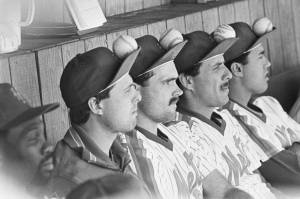 You’d see guys toward the end of a game, maybe getting ready for their final at bat, double-back into the locker room to chug a beer to “re-kick the bean” so they could step to the plate completely wired and focused and dialed in. They had it down to a science, with precision timing. They’d do that thing where you poke a hole in the can so the beer would flow shotgun-style. They’d time it so that they were due to hit third or fourth that inning, and in their minds that rush of beer would kind of jump-start the amphetamines and get back to how they were feeling early on in the game—pumped, jacked, good to go. How they came up with this recipe, this ritual, I’ll never know, but it seemed to do the trick; they’d get this rush of confidence that was through the roof and step to the plate like the world-beaters they were born to be. …

