As highlighted in this week’s Sports Law Roundup, Disney and Fox are entering into a doozy of a media deal that involves everything from movies to television shows to streaming platforms to sports programming. This transaction has Star Wars components, Hulu components, and Simpsons components that, rightfully, are making headlines. It would not be surprising, however, if some of the most visible changes for viewers that result from this asset purchase, for which approval by various supervisory entities remains pending, come for consumers of sports media.
In an article out today, Will Leitch sheds some light on how this sale may affect the sports-media landscape: Continue reading →
Here are the top sports-related legal stories from the past week:
Louisville basketball: The fallout from the FBI’s announced investigation of Adidas-sponsored men’s college basketball programs resulted in the termination of Rick Pitino’s position as the head coach of Louisville’s team. That, in turn, spawned Pitino lawsuits against Louisville for wrongful termination and Adidas for intentional infliction of emotional distress. Louisville now has sued Pitino for breach of contract and negligence and seeks monetary from Pitino arising out of the school’s losses due to vacated wins, potentially including its 2013 national title, and other NCAA sanctions, lost donations, and other financial losses. Louisville’s complaint alleges Pitino admitted liability when he said in a post-termination interview that he knew about NCAA violations but did not report them and took “full responsibility” for his decisions to hire assistants who subsequently engaged in wrongful activity.
Television transfer: An announced transaction between 20th Century Fox and Disney involving the latter’s acquisition of more than $50 billion (exclusive of debt) of the former’s assets has potentially significant consequences for the entities’ sports properties. Included among the assets Disney (which already owns ESPN and ABC) is acquiring are all of the Fox Sports Regional Networks (e.g., Fox Sports Detroit, Fox Sports South, etc.) and the YES Network. Disney also is acquiring other substantial assets, including FX Network, Fox’s interest in Hulu, and all of Fox’s film and television studios, which would include the rights to film properties like “The Simpsons,” “Modern Family,” “Avatar” (for which one source reports there are four sequels in the works), “Deadpool,” and “X-Men.” In exchange, Fox shareholders will receive shares of Disney stock. In addition, a spinoff entity will take control of Fox’s primary national networks, including FOX, Fox News, Fox Business, FS1, FS2, and the Big Ten Network. The deal still requires approval from both existing entities’ boards of directors and shareholders, as well as government regulators.
Baylor sexual assaults: The flow of evidence of Baylor‘s apparently widespread sexual assault problems seems unlikely to abate anytime soon now that a judge is permitting discovery of sexual assault reports from students who are not parties to pending litigation involving the school, as well as records of third-party Code of Conduct violations limited to violations related to “sex” and is ordering Baylor to produce documents previously provided to independent auditors, those being “32,000 nonparty student records, and hundreds of thousands of additional documents, without regard to” relevance or federal privacy restrictions.
Gambler defamation: In June, an alleged “gambling guru” known as RJ Bell (real name: Randall James Busack) sued Deadspin (and its post-Gawker-bankruptcy owner, Gizmodo Media Group, LLC) and freelance writer Ryan Goldberg over an article Goldberg wrote and Deadspin published that was critical of Busack and which Busack alleges was libelous. On Tuesday, a New York bankruptcy judge announced that trial in the case will begin on Valentine’s Day 2018. An important legal question in the case is whether a provision in an order of the bankruptcy court overseeing the Gawker Media bankruptcy intended to operate as a release of third-party claims against Gawker Media writers applies to bar Busack’s claims against Goldberg, which is the position Goldberg takes. Busack contends that the release doesn’t apply to him because he didn’t sue Gawker during the bankruptcy and received no distribution from the Gawker bankruptcy estate. Gawker Media entered bankruptcy as a result of a prior lawsuit Hulk Hogan (real name: Terry Bollea) brought. The attorney who represented Bollea in that case also represents Busack in this case. On Wednesday, the judge, who previously indicated he found the release issue ambiguous, ruled that the release did, in fact, bar most of Busack’s claims.
Garbler defamation: Lou Holtz, former head football coach at Notre Dame and South Carolina and former football “analyst” for ESPN, has sued The Daily Beast and one of its writers, Betsy Woodruff, for defamation. Holtz claims that Woodruff’s article about Holtz’s comments during the 2016 Republican National Convention, in which she reported he said immigrants were “deadbeats” and “invading the U.S.,” contained information known to be false and caused Holtz to lose future speaking opportunities.
NFL Network sexual harassment: A former NFL Network employee has sued NFL Enterprises, LP (apparently the Los-Angeles-based television and broadcast arm of the NFL), Jessica Lee (allegedly a supervisor at NFL Network whose LinkedIn page describes her as the Network’s director of studio operations), and fifty unnamed defendants. The plaintiff’s lawsuit nominally is one for wrongful termination, but its most newsworthy allegations involve claims of sexual harassment, assault, and battery by other NFL Network employees, including former players Marshall Faulk, Donovan McNabb, Warren Sapp, Ike Taylor, Heath Evans, and Eric Davis and former executive Eric Weinberger, who now works as the president of Bill Simmons Media Group, which owns The Ringer.
In a time-honored sporting tradition, what started out as a historic trend soon may become merely notable. While NFL officials, through week fourteen, have thrown their penalty flags at a rate that would constitute an all-time* high, that rate has been falling as the season has worn on.
My note from last week still applies: 2017 now looks quite close to the prior peaks in 2015 and 2014. If things continue as they have this season, 2017 still will be the high-water mark for penalty flags in the NFL, but the week-to-week trend strongly suggests that that is not a reasonable assumption. That trend also lends some support to the idea that abbreviated preseason training leads to worse play early in the regular season.
* The NFL Penalty Tracker has data going back to the 2009 season, but I’m pretty confident that we still are witnessing the all-time high-water mark.
Here are the top sports-related legal stories from the past week:
Olympic doping: The International Olympic Committee has banned Russia from the upcoming Olympic Games in South Korea due to “systemic manipulation of the anti-doping rules and system,” although it will allow individual Russian athletes who prove they aren’t doping to compete under the Olympic flag and wearing uniforms indicating they are “Olympic Athlete[s] from Russia.” Additionally, twenty-two Russian winter Olympic athletes banned for life following doping violations during the 2014 Winter Olympics have applied to the Court of Arbitration for Sport to reinstate them. The upcoming winter games begin in February.
Gymnast abuse:In February, the Michigan Attorney General charged a doctor with ties to USA Gymnastics, the national governing body for gymnastics in the United States; Michigan State University; and a gym in the Lansing area, who already was facing multiple civil and criminal accusations of improper sexual conduct, with twenty-two additional criminal counts in connection with his alleged sexual abuse of young female athletes. USA Gymnastics and Michigan State terminated their relationships with the doctor following the earlier accusations. Some of the charges added in February involved victims who were younger than thirteen at the times of the alleged acts, and all of the charges are felonies that carry a maximum sentence of life imprisonment. On Thursday, following guilty pleas on three federal charges, a federal trial judge in Grand Rapids declared the doctor “a danger to children” and sentenced the fifty-four year old to sixty years in prison, the maximum allowable sentence. In determining her sentence, the judge considered statements from victims, including U.S. gold-medalists McKayla Maroney and Aly Raisman. The doctor still is awaiting sentencing on ten state-law counts of first-degree criminal sexual conduct.
Charity fraud: Former NBA player Kermit Washington pled guilty to multiple criminal counts of making false statements on income tax returns and a single count of aggravated identity theft in connection with charges that he used charitable donations intended for a medical clinic in Africa for personal expenses. Washington allegedly induced donors, including professional athletes, to contribute to the clinic but spent the money on vacations and jewelry. In 1973, the Los Angeles Lakers drafted Washington fifth overall out of American University, the beginning of a ten-season NBA career in which he also played for the Trailblazers, Clippers, Celtics, and Warriors.
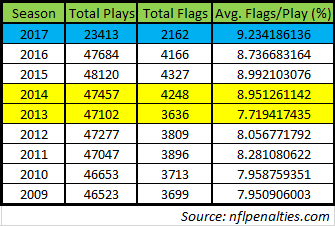
Something that I had expected might be occurring now seems from the updated numbers like it might, in fact, be occurring, which is that my imperfect flag-rate metric is both (a) continuing to fall and (b) now close to falling out of historic* range. Come look for yourself:
As a season, 2017 now looks quite close to the prior peaks in 2015 and 2014. If things continue as they have this season, 2017 still will be the high-water mark for penalty flags in the NFL, but the week-to-week trend strongly suggests that that is not a reasonable assumption. That trend also lends some support to the idea that abbreviated preseason training leads to worse play early in the regular season.
Obviously it would be interesting to track flag rates for each of these seasons on a chronological weekly basis. A project for the offseason, perhaps. Meanwhile, since the terrible Giants have been in the news recently, an interesting note that only one team (Carolina) has been flagged fewer times than the 2-10 G-Men.
* The NFL Penalty Tracker has data going back to the 2009 season, but I’m pretty confident that we are witnessing the all-time high-water mark.
Here are the top sports-related legal stories from the past week:
Streaming data: The U.S. Court of Appeals for the Ninth Circuit has ruled that ESPN may share an individual’s streaming device identification number and record of videos watched without violating the federal Video Privacy Protection Act because that information does not constitute “personally identifiable information” under that act. The First Circuit previously had ruled that such information could be personally identifiable information, especially where combined with geolocation data, but that now is regarded as the minority position.
Bird death: A Massachusetts appellate court affirmed a trial court’s grant of summary judgment in favor of a truck manufacturer and the owner of automotive-related equipment in a wrongful-death case brought by the widow of Mark Fidrych. Fidrych died in 2009 of accidental asphyxiation when his clothing became entangled in the equipment while he was working underneath his truck. The court agreed that the equipment was dangerous and could have been designed in a safer fashion, but, because those designs were not defective and the risk that led to Fidrych’s death “arose out of the addition of other components and the decisions made, and actions taken, by downstream actors, the defendants had no duty to warn of those dangers.”
The good news on the NFL-watchability front is that the penalty-flag rate is decreasing as the season wears on. The bad news remains that NFL referees still are throwing their flags with historically high frequency.*
Incorporating last week’s numbers shows that we’re settling into that 9.2 range. With seven weeks of games remaining, there’s plenty of time for the rate to continue to fall, so it remains possible that 2017 will end up closer to historical norms. Without examining week-to-week data from past seasons, I don’t have a sense of whether that’s likely to occur (e.g., if it’s common for officials to call fewer penalties as seasons develop).
* The NFL Penalty Tracker has data going back to the 2009 season, but I’m pretty confident that we are witnessing the all-time high-water mark.
In a few ways, it’s irritatingly cumbersome to write about the history of the Detroit Lions and Cleveland Browns. Long synonymous with deep NFL failure, these two teams were very competitive and successful in that period of professional football that doesn’t count anymore (i.e., the pre-Super Bowl era), meeting in multiple NFL Championship Games in the 1950s. That lengthy historical leap isn’t quite a smooth one, though, since there’s a corporate continuity problem on Cleveland’s side due to team owner Art Modell’s controversial move and (sort of) transformation of the team into the Baltimore Ravens in 1996, with the “Browns” not returning to existence until 1999.
Additionally, for teams as old and geographically proximate as these two, the Browns and Lions meet only infrequently in the regular season. In the forty-seven NFL seasons since the NFL-AFL merger, Cleveland and Detroit have played each other just eleven times. Though they faced off only twice in the 1990s, there nevertheless was an effort during that period to drum up a rivalry of sorts in the form of “The Great Lakes Classic,” which was centered around preseason meetings– there even was a trophy, which, suitably, was modeled after the region’s most famous shipwreck, the Edmund Fitzgerald. The “Classic” fizzled, though, during a particularly unmemorable stretch for both teams:
Over the GLC’s 13-year run, the Lions and Browns were two of the three losingest teams in football, per Pro Football Reference. Over those regular seasons they ran out 29 different quarterbacks, gave 13 different skippers the whistle and posted a collective .339 winning percentage.
It obviously is tough to get excited about either of these teams on their own, much less when they’re playing each other. But a recent game in this series, the last one played in Detroit and the only one played in Ford Field, offered some real drama. Thankfully, the NFL Films crew captured it.
The 2009 season was Matthew Stafford’s rookie year, and he started ten games at quarterback for Detroit that season. On November 22, the Browns came to Ford Field, where, with 5:44 left in the fourth quarter, they found themselves with a six-point lead thanks to this blast-from-the-past play:
Stafford now is the highest-paid player in NFL history, but, in 2009, Lions fans still were in the process of figuring out what the team had in its top overall draft pick out of Georgia. He’d soon let them know:
____________________________________
The Lions will look to make it four in a row over Cleveland on Sunday. A win coupled with a Packers loss to the Bears (who knows) would give Detroit clear possession of second place in the division, which, in my opinion, remains winnable even if I refuse to buy into the hype train the national media runs out after Lions wins in nationally televised games. I’m thankful for the exposure, to be sure, but people are making way too much out of Monday Night Football wins over the Packers and New York Giants, two teams going firmly in reverse this year. The Sunday Night Football loss to the Steelers should serve as a strong reminder that the Lions have done nothing to demonstrate week-to-week continuity, and that red zone offense, in particular, remains a significant weakness. They’re only in the mix because of the poor quality of their divisional opponents. Here’s hoping they can capitalize on a weak nonconference opponent this week. In case you missed it, the Browns, at 0-8, are deep on the Road to XVI.
It has come to my attention in the course of preparing this feature on penalties in NFL games this season that the chart I’ve been using to track penalty frequency doesn’t quite show what it purports to show. First, here’s this week’s chart:
The important number is the one in the far-right column. That’s the number that represents penalty-flag frequency in a given season. The column label, “Avg. Flags/Play (%)” is a little bit misleading, though. A better label might be something like “Flags per 100 Plays.” Even better might be to rework it to be a rough estimate of flags/game based on an average plays per game number of 125 or so. For the moment, and probably for the rest of this season, though, I’m going to continue using the same chart because there’s only so much time I want to spend documenting the historic* level of monotony that is plaguing this NFL season. If you’ve been following this series of posts closely this season, you’ll notice that, as we’ve passed the halfway point, the flag rate appears to be settling into the low 9.2 range. Again, that’s down a little bit from the first few weeks, which were up around 9.6, but it’s still well above prior seasons.
Last week’s post discussed the league’s late-breaking attention to the head-injury issue, which, I suspect, is the reason for the large jump in flags from 2013 to 2014. The other aspect reflected in these data points likely is the NFL’s attempt to grow its audience by increasing excitement by increasing scoring, something it did by enforcing more defensive penalties, which, as we’ve seen, actually decreases excitement and probably should’ve raised a flag or two prior to implementation.
* The NFL Penalty Tracker has data going back to the 2009 season, but I’m pretty confident that we are witnessing the all-time high-water mark.