Saving Detroit: It’s over

In a deal that went down to the final moments of Thursday night’s waiver/postseason trade deadline, the Detroit Tigers have traded franchise starting pitcher Justin Verlander to the Houston Astros in exchange for three prospects. Early reports indicate that the Astros will be taking on a substantial portion– but not the entirety– of Verlander’s remaining contract.

Verlander has spent the entirety of his thirteen-year major-league career with the Tigers, who chose him with the second overall pick out of Old Dominion in the 2004 amateur draft. In 2006, Verlander’s first full season in the big leagues, he earned American League rookie of the year honors as the team advanced to the World Series just three years after losing 119 games in 2003. That season kicked off the latest golden era for this historic franchise (“the Verlander Era,” I think we now can safely call it), a run that realistically ended in 2016; practically ended with the death of former owner Mike Ilitch in February of this year; and officially ended tonight. Verlander was a six-time All Star with the Tigers, winning both the AL Cy Young and MVP awards in 2011 (and he was robbed of the former award last year) and winning memorable postseason duels with the Yankees and A’s, among others.

Verlander has been the consistent face, leader, and spokesman of this Tigers team, and he was the author of many of its greatest hits. (Speaking of hits, Verlander earned his first major-league RBI last night in Colorado during what proved to be his final appearance in a Detroit uniform.) With respect to Miguel Cabrera, who came to Detroit in 2008 after winning a championship with the Florida Marlins, no player has been more closely associated with this team over the past decade-plus than Verlander.

That 2006 season also marked my return as a fan to baseball and the Tigers, so it’s as difficult as can be for me to envision Verlander playing for another team, even if he’ll still be in orange and, undoubtedly, dominating in the postseason. I will be watching, though, thankful for everything he did to help the team I for whatever reason care about and hopeful that he finds what he wants in Houston.

We now awake to a very new morning on Woodward Avenue and hope that the Tigers’ management and ownership pursue the rebuilding process with the same tenacity and persistent demand for excellence Verlander modeled for everyone in his days wearing the old English D.

______________________________________________

Previously
Upton There – 8/31
A bad time for a bad season – 8/29
Jordan Zimmermann takes tennis lessons – 8/20
Tigers Notes, 8/8/17
 – 8/8
Decoding the Upton Myth
 – 8/2
Even the umpires just wanna go home
 – 7/21

Yo, a J.D. Martinez trade comp – 7/19
Martinez trade triggers premature referendum on Avila – 7/19
Michael Fulmer has righted the ship
 – 6/27

Tigers in Retrograde – 6/19
Fixing Justin Upton
 – 5/31

Soft in the Middle Now – 5/30
Reliever Relief, Part 2 – 5/11
Reliever Relief – 5/8

Related

ALDLAND’s full Justin Verlander archive

Saving Detroit: Upton There

Today is the last day MLB teams can trade players the receiving team would like to use in the postseason. In what I am regarding as a surprise move, the Tigers have sent another outfielder to the Angels, who now are acquiring Justin Upton in exchange for Grayson Long. (Last fall, Detroit sent Cameron Maybin to Anaheim, and, probably not coincidentally, Maybin now is on his way to Houston.) Neil Weinberg has the early report on Long:

The Tigers got 23-year-old Grayson Long, a starter currently having a strong year in AA. He only threw 65 innings across three levels last year due to injury, but he does have the appearance of an innings eater if you buy into the archetype scouting. Based on the public scouting views and one source I spoke with this afternoon, Long’s fastball is solid in the low 90s but his secondary stuff is a bit questionable with opinions ranging from fringe to flashes of above average. He has a change and slider but it’s not clear they will play at the major league level to the point at which he could be a successful starter. That might lead him to a bullpen role, but he has pitched well so far in the minors and I’m a big believer in letting a player keep going until the performance tells you to stop. There’s definitely potential for something really exciting but even the floor seems perfectly fine given the cost.

Upton’s contract had a player opt-out provision effective as of the end of this season. I’ve expressed skepticism about the idea that Upton would exercise that option. Weinberg, on the other hand, called the “odds that Upton opts out . . . quite high.”

It appears the Tigers came to the same conclusion, because the only way this trade makes sense is if Detroit was treating Upton as if he was on an expiring contract just like J.D. Martinez and Alex Avila and needed to get something for him now before he leaves in the offseason.

After watching Upton play here in Atlanta with his older brother as members of the Braves, I have been tracking his time– a bad dip with a fierce, late recovery in 2016, followed by a very solid 2017– in Detroit on this site with some care, and I will watch how the market responds to what I now agree will be his likely free agency this offseason. While he may not get a raise, he’s likely to wind up with a team with greater playoff odds than those of the Tigers or Angels, who, against many of those same odds, remain in the American League wild card hunt. Most of all, I’m happy to see Upton have such a strong rebound. Detroit’s fans didn’t deserve him anyway.

______________________________________________

Previously
A bad time for a bad season – 8/29
Jordan Zimmermann takes tennis lessons – 8/20
Tigers Notes, 8/8/17
– 8/8
Decoding the Upton Myth
– 8/2
Even the umpires just wanna go home
– 7/21

Yo, a J.D. Martinez trade comp – 7/19
Martinez trade triggers premature referendum on Avila – 7/19
Michael Fulmer has righted the ship
 – 6/27

Tigers in Retrograde – 6/19
Fixing Justin Upton
 – 5/31

Soft in the Middle Now – 5/30
Reliever Relief, Part 2 – 5/11
Reliever Relief – 5/8

Related
Catching Fire: It Don’t Come Easy
Catching Fire: Checking in on Justin Upton
Catching Fire: Night of a thousand feet of home runs
Catching Fire: Heading for the exit velocity

ALDLAND’s full Justin Upton archive

Saving Detroit: A bad time for a bad season

For the Detroit Tigers, dark clouds have been looming on the horizon for long enough that a down season like the one they’re having now (57-73, .438) has not come as a complete surprise. That this was, in some sense, foreseeable– even if not entirely avoidable– doesn’t necessarily make it more palatable.

It’s no mystery that one of the Tigers’ most significant structural issues is the fact that they have a lot of their payroll resources tied up in a few large, long-term contracts with older players who are past their respective primes. As I observed at the beginning of last season, though, 2018 represents an important break point in the team’s present financial structure. There are two reasons for that: 1) some of those large contracts come off the Tigers’ books in 2018, and 2) the team’s current television deal with Fox Sports Detroit expires. It’s that second part that holds real financial potential:

Baseball might not grip the nation the way it once did and the way football now does, but the sport is extremely popular on a local level, making teams’ local broadcast rights as valuable as ever. The increasing price of these contracts means that the only thing better than a rich television contract is a new television contract. New television contracts are the things of which dreams are made– assuming you dream of signing a Zack-Greinke-caliber player or two.

Thus, the good news for Detroit: right about the time things could start to get ugly, payroll-wise, the team will be signing a new TV deal. Their current agreement, with Fox Sports Detroit, expires in 2018. As this Crain’s Detroit Business article highlights, the team has a few options, including negotiating an extension with FSD. It also could attempt to negotiate an ownership stake in whichever broadcast network it partners with going forward, something roughly half of the MLB clubs have done.

Team ownership and management may be seeing dollar signs after watching their rivals receive massive broadcast deals worth a billion dollars or more. Here is a portion of a FanGraphs table from 2016 showing the value of all of the MLB team television contracts signed since the Tigers executed their current TV contract in 2009:

mlb tv contracts

Of those teams for which the contract value is known, only Cleveland, Minnesota, and Colorado have reached television deals paying them less than a billion dollars, and all of the MLB television contracts signed since 2014 have been for at least $1 billion. Tigers leadership undoubtedly will be pointing to all of those recent deals in the negotiations with FSD (or another potential broadcast partner).

The bad timing of the team’s on-field struggles comes into play here too, though. After a decade of top-tier competitiveness, the 2017 Tigers won’t even sniff the wild-card chase, and everybody knows it. That probably explains why no team saw a larger relative drop in television ratings this season:

In terms of actual ratings, this isn’t the catastrophe it might appear to be, as the Tigers had been performing well, ratings-wise, in recent years. The eve of broadcast contract negotiations obviously isn’t the best time for a big dip in performance and ratings, however. One wonders whether, in light of the importance of these contracts, the team should have worked on a new TV deal a few years ago or should have instead triggered the inevitable rebuild a few years earlier in order to be able to make a more credible presentation of an upward-trending team in 2018.

Of course, it takes two to reach a meeting of the minds, so it’s possible the Tigers tried to get a jump on this during the winning days but weren’t able to make any headway with FSD at that time. It also is possible that these year-to-year fluctuations matter less than we outsiders think. Regardless, as we look toward the next era of Detroit Tigers baseball, the team’s new television contract will play as much of a role in shaping that next era as any current or future player contract.

______________________________________________

Previously
Jordan Zimmermann takes tennis lessons – 8/20
Tigers Notes, 8/8/17
– 8/8
Decoding the Upton Myth
– 8/2
Even the umpires just wanna go home
– 7/21

Yo, a J.D. Martinez trade comp – 7/19
Martinez trade triggers premature referendum on Avila – 7/19
Michael Fulmer has righted the ship
 – 6/27

Tigers in Retrograde – 6/19
Fixing Justin Upton
 – 5/31

Soft in the Middle Now – 5/30
Reliever Relief, Part 2 – 5/11
Reliever Relief – 5/8

Related
Statements both obvious and only slightly less obvious about the Detroit Tigers’ finances

Saving Detroit: Jordan Zimmermann takes tennis lessons

Following an injury-curtailed 2016, 2017 has been anything but the bounceback for which Detroit Tigers starting pitcher Jordan Zimmermann hoped. Little is trending in the right direction or going well for him in the second year of his five-year contract with the Tigers.

According to a recent report, the neck injury that caused Zimmermann to miss time in 2016 is continuing to cause mechanical problems for the pitcher in 2017. One of the consequences is a decreased ability to locate his pitches, and, while he apparently believes the needed adjustments are too significant for an in-season fix, during his most recent start, it sounds like he’d had enough:

He resorted to a quick fix Friday night, so rudimentary it seems almost silly. He wasn’t hitting his spots against the Los Angeles Dodgers’ imposing lineup — he couldn’t get the ball in to lefties, or away against righties — so he tried something he has never done before. In the fifth inning, he moved from the third-base side of the rubber, where he has pitched his entire career, to the first-base side of the rubber.

After giving up six runs over the first four innings, he figured had to try something, anything. He moved a mere five or six inches,

“Basically, I’m on the third base side and I’m missing middle. So if I move over to the middle of the rubber, I’m moving myself over five or six inches, it’s allowing me to get inside for lefties and away to righties,” Zimmermann explained.

It felt strange, but there was some marginal improvement.

Zimmermann said when he threw a fastball in, up and in, it stayed more true. It didn’t run back at all. He struck out Adrian Gonzalez in the fifth inning with three curveballs.

“It feels like I almost had to throw it in our dugout to get to the other side of the plate,” Zimmermann said. “But it went where I wanted it to, so that was the good thing.”

The difference in release points was enough to show up on these Brooks Baseball plots, which show Zimmermann’s 2017 release points excluding his last start followed by the two distinct release points he used in Friday’s game:

zimmermann

I’m highlighting this not because I think it’s any sort of meaningful solution– Zimmermann thinks it helped, and it’s hard to find sufficiently granular data to evaluate in-game strategic shifts like this (his overall zone rate on Friday night actually was slightly lower than his full-season average)– but because it shows how desperate Zimmerman is for any measure of improvement, even a false one. He undoubtedly will work on this in the offseason, but, for now, he’s just like any ordinary person who doesn’t have the time or resources for a proper adjustment and looks for something easy to keep the game going. I recognized the move immediately because it’s what I do when I play tennis. Among many faults in my game is an inability to control the depth of my serves, which usually land well deep of the service box. Some lessons with a professional probably could help identify and correct the problem in my service motion. I have so few opportunities to play, though, that I want to spend them with family and friends, not in a training session with a stranger. That’s why, if I bomb the first serve deep, I just take a couple steps backward and try it again.

Of course, Zimmermann’s more than an amateur who’s given up on his dreamshallucinations of making it as a competitive tennis player, so it will be interesting to see what real changes and adjustments we see from him in 2018, as well as how he positions himself on the mound in his remaining starts this season.

Minutiae, trivia, and the undead rumors of a Justin Verlander trade: welcome to the last six weeks of the Detroit Tigers’ 2017 season.

______________________________________________

Previously
Tigers Notes, 8/8/17 – 8/8
Decoding the Upton Myth
– 8/2
Even the umpires just wanna go home
– 7/21

Yo, a J.D. Martinez trade comp – 7/19
Martinez trade triggers premature referendum on Avila – 7/19
Michael Fulmer has righted the ship
 – 6/27

Tigers in Retrograde – 6/19
Fixing Justin Upton
 – 5/31

Soft in the Middle Now – 5/30
Reliever Relief, Part 2 – 5/11
Reliever Relief – 5/8

Related
Getting to know Jordan Zimmermann in context

Saving Detroit: Tigers Notes, 8/8/17

detroit tigers notes

While trades– including a trade of Justin Verlander– technically remain a possibility at this point in the year, it looks like the Detroit Tigers will content themselves with playing out the final two months of this season with their current crew and an eye toward the future. For this site, that probably means that the pages of this season’s Tigers diary will be a little emptier than they might be if the team were more aggressive in the trade market or competing for a playoff berth. That doesn’t mean that there aren’t interesting items to track, though. Here are a few:

    • Justin Upton: As highlighted here last week, Upton’s been trimming his bugaboo strikeout rate, but he’s continuing to strike out in bad situations. Since that post, he’s appeared in six games and added four two-out strikeouts to his total, pushing him into a tie for eleventh on the MLB-wide list (minimum 100 two-out plate appearances) in 2017. With 3.6 fWAR, Upton continues to be the team’s best position player by a comfortable margin, as well as its best overall player. In that post last week, I speculated that Upton is unlikely to opt out of his contract this offseason due, in part, to a weak market for corner outfielders with his profile. Over at The Athletic’s new Detroit vertical, Neil Weinberg is more optimistic about Upton’s open-market prospects, calling the “odds that Upton opts out . . . quite high.”
    • Miguel Cabrera: I’ve been working up a full post on Cabrera’s tough season, which has a good chance to be the worst of his career. (For a forward-looking analysis, my career comparison between Cabrera and Albert Pujols is here.) Besides the obvious drop in production, one thing that jumps out is his batting average on balls in play, which, at .296, is below .300 for the first time ever (career .345 BABIP). Last month, Weinberg did the logical thing and dove into Cabrera’s swing profile and batted-ball data tabulated by StatCast. The problem, from our perspective, is that there isn’t a ton there. Cabrera continues to rank high (currently number one, minimum 200 at bats, by a large margin) on the xwOBA-wOBA chart, an indication that he’s making good contact despite poor results. From watching games this season, it seems like Cabrera turns away from inside (but not that inside) pitches more often than in years past, which makes me wonder if he simply isn’t seeing pitches as well. (Weinberg noticed that he’s swinging less often than usual at inside pitches.)
      When observing the decline of a great player, it can be fun to take a break from the dissection to remember his youth, which the remarkable achievements of Mike Trout and Bryce Harper gave us occasion to do today:

Continue reading

Saving Detroit: Decoding the Upton Myth

“The Upton Myth” has nothing to do with the delayed Upton-Verlander nuptials and everything to do with Verlander’s teammate of no known relation to his fiancee, Justin. To hear fans tell it, the Detroit Tigers left fielder’s two-year tenure in Detroit has not been a happy one. Many of them want Upton to opt out of his $22.125 million annual contract after the current season but believe he’s been too bad since becoming a Tiger to make that a realistic possibility.

The critical Upton narrative is confounding for the reasons many external narratives about people confound: it originates in an established truth that’s treated as a surprise and subsequently serves to obscure the truth moving forward. For Upton, the established truth was that he struck out at a high rate. When he arrived in the Motor City, some seemed surprised that he continued to strike out at a high rate, pegged him as an overpaid failure, and haven’t looked back.

First impressions are powerful and sticky, so when Upton had a very poor start to his first season in Detroit last year, many gave up on him, ignoring signs that the outfielder– who was adjusting to the American League after nine years on the senior circuit– had returned to form by August but was hamstrung by bad luck. Then there was that validating September explosion– Upton hit thirteen home runs, slashed .292/.382/.750, and posted a 196 wRC+, basically Babe Ruth’s career line, nearly propelling the fading Tigers to the postseason all by himself– that somehow was forgotten amidst the sudden excitement of a playoff push and a disappointing finish in Atlanta. The thought that, with Upton, the Tigers didn’t get what they wanted in 2016 seems a bit off. There was an extended bad stretch, to be sure, but Upton’s always been a streaky, high strikeout, high home run guy, and that’s who he was in 2016, tying a career-best mark by finishing with thirty-one homers.

The current season, already an unequivocal, strong bounceback from last year’s harsh dip, has seen Upton achieve a quiet consistency that has him on track for what could be the second or third-best season of his eleven-year career.

Still, the Upton Myth persists. Nevermind that his 26.2% strikeout rate (current MLB average strikeout rate: 21.6%) remains in line with career norms and recently dipped as low as it has in years:

jup k rate 8-2-17

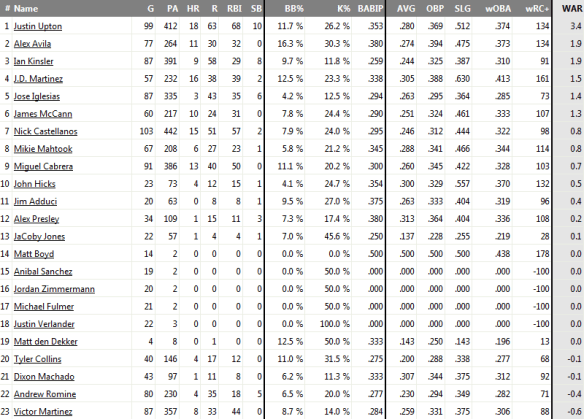
Nevermind that, by fWAR, he’s clearly been the team’s best player this season (table only showing offensive players, but Verlander (3.3 fWAR) and Michael Fulmer (2.1 fWAR) also trail):

tigers fwar 8-2-17

Tigers fans still blow their tops whenever Upton strikes out, though (and even considering that reducing his strikeout percentage– something he probably could do if he chose– likely wouldn’t alter Upton’s overall production profile). Why does the anti-Upton rhetoric remain?

There’s a kernel of truth at the heart of the Upton Myth, as it turns out. Even though his strikeout rate isn’t extreme and he’s been the team’s biggest positive contributor this season, fans still have reason to get down on Upton not because of the overall frequency of his strikeouts, but because of their in-game timing. Upton leads the team in inning-ending strikeouts, those deflating, rally killing, #TTBDNS-inducing strikeouts that have a way of sticking in observers’ minds. Among the 200 MLB hitters with at least 100 two-out plate appearances in 2017, Upton is tied for eighteenth in total strikeouts in that situation, and a majority of the guys in front of him on that list have higher strikeout rates, often significantly so. Whether it’s his position in the batting order or some other unfortunate sequencing circumstance, Upton’s strikeout propensity seems even worse because of when those strikeouts occur.     Continue reading

Saving Detroit: Even the umpires just wanna go home

Not a good showing for the Tigers tonight in Kansas City, where they backed starter Michael Fulmer with three errors, spotting the Royals a 4-0 lead after one inning, and an 8-0 lead after the third. Although Detroit managed to halve that lead with productive (if inefficient) sides of the fifth and sixth inning, the relief corps had their collective finger blown out of the hole in the dike, giving way to a 16-4 loss. By the time the ninth inning mercifully rolled around, there was zero chance of a Tigers win; indeed, it had been that way– literally– since the middle of the eighth inning, and functionally at least since the bottom of the sixth inning.

chart

This makes it hard to blame the home plate umpire, Mark Ripperger, for wanting to end things early. On the fourth pitch to Jim Adduci, who was batting for Detroit with two outs in the top of the ninth, that’s exactly what Ripperger did:

numlocation-php-pitchsel641838gamegid_2017_07_20_detmlb_kcamlb_1batterx87inningsyyyyyyyyysp_type1s_type3leaguemlbpnfzlpocache1

Ripperger put everyone out of their shared misery with that called fourth strike on a pitch that was comfortably out of the zone. As a historical, practical matter, it’s true that the strike zone for left-handed batters tends to expand on the batter’s outside edge, but the call that ended the game looks like an outlier even when placed in context with the other calls Ripperger made during plate appearances by left-handed hitters tonight:

fastmap-php-pitchselallgamegid_2017_07_20_detmlb_kcamlb_1sp_type2s_type7cache1

Here’s how it looked on MLB.com’s rendering:

adduci ripperger

Finally, here’s a very chunky GIF made with freeware I’ll never use again, which shows things in the light most favorable to Ripperger:

adduci

Not egregious, probably, but erroneous, and seemingly out of character for Ripperger, at least tonight. With the game outcome already chiseled in stone, the officiating crew probably just wanted to go home, and they probably weren’t alone in that desire. Soon, one imagines, it will be time to say goodnight to this season.

______________________________________________

Previously
Saving Detroit: Yo, a J.D. Martinez trade comp – 7/19
Saving Detroit: Martinez trade triggers premature referendum on Avila – 7/19
Saving Detroit: Michael Fulmer has righted the ship
 – 6/27

Saving Detroit: Tigers in Retrograde – 6/19
Saving Detroit: Fixing Justin Upton
 – 5/31

Saving Detroit: Soft in the Middle Now – 5/30
Saving Detroit: Reliever Relief, Part 2 – 5/11
Saving Detroit: Reliever Relief – 5/8

Related
Is the next Mike Trout already in Detroit?

Saving Detroit: Yo, a J.D. Martinez trade comp

cespedes-crabs-660x330

Last night, I provided my instant reaction to the trade that sent J.D. Martinez to the Diamondbacks for three modest infield prospects. In that post, I considered what many are calling a “very light” return for the slugging outfielder in the context of another star-for-prospects trade made just days ago between the two Chicago teams involving starting pitcher Jose Quintana and suggested that a lesser return for Martinez was appropriate in light of his contract status (expiring), age, injury history, and inconsistent defense. I further suggested that, with multiple transactions still to be made over the next two weeks, it is too early for a referendum on Detroit’s general manager, Al Avila.

Avila is a first-year GM, but he worked alongside previous Tigers GM Dave Dombrowski for many years and is an experienced and well-regarded talent evaluator, so the job isn’t exactly new to him. Yet, in some Tigers fan circles right now, Avila is being pilloried as an unqualified, incapable rookie, while Dombrowski has never been remembered more fondly.

As I wrote last night, even if this trade becomes a blemish on Avila’s resume (the more thorough analyses of the prospects involved in the trade out this morning paint a more detailed picture but don’t really contradict the experts’ immediate reactions), it’s much too soon to declare him unfit for his current position. In addition to the Quintana trade discussed last night, though, there is another trade we can look to as a rough comparison between Avila and Dombrowski: the 2015 Yoenis Cespedes trade.

With the non-waiver trade deadline rapidly approach, on July 31, 2015 Dombrowski traded Cespedes to the New York Mets for two pitching prospects: Luis Cessa and Michael Fulmer. That trade, along with two previous ones that sent David Price to Toronto (for lefty pitching prospects Daniel Norris, Matt Boyd and Jairo Labourt) and Joakim Soria to Pittsburgh (for JaCoby Jones), surprised some Tigers fans, who were not necessarily soothed when Dombrowski described what looked to some like a sudden selloff as a mere “rebooting.” Not insignificantly, these trades immediately cost Dombrowski his job.

In isolation, the Cespedes trade– from Detroit’s standpoint– looks fairly similar to yesterday’s Martinez trade. Both players were on expiring contracts and thus guaranteed only to be rentals for the receiving teams (and an unusual clause in Cespedes’ contract actually made it less likely that the Mets would be able to sign him as a free agent, though Cespedes waived that provision and did remain in Queens). In the first half of 2015 (the split most readily available to me as a rough approximation of a snapshot at the trade deadline), Cespedes had a 121 wRC+ (45th among qualified hitters) and contributed 3.3 fWAR in 366 plate appearances. In the first half of 2017, Martinez posted a 156 wRC+ (would have been eighth among qualified hitters had he played enough to qualify) and contributed 1.4 fWAR in 215 plate appearances.

Cespedes memorably caught fire at the plate upon moving to New York, but he had been a lesser hitter than Martinez was over the same stretch– both in terms of a direct comparison and relative to his in-season peers– in 2017. Without a more detailed and complex analysis of the different trade markets in the different seasons, it’s difficult to say more about the two players’ relative value in this space.

The return for Cespedes– Cessa and Fulmer– was more lauded both at the time and now, in retrospect, than the return for Martinez. Fulmer immediately was highlighted as a significant prospect, and he turned in a full-season performance the following season that earned him rookie-of-the-year honors and some Cy Young votes, and he was named to his first All-Star team this season. (Cessa never played for the Tigers, who shipped him to the Yankees that offseason as part of a package that returned Justin Wilson, the team’s current closer and valuable trade chip.)

We don’t have two years of hindsight from which to assess the future development of Dawel Lugo, Sergio Alcantara, and Jose King, but, from my review of the assessments of these players by experienced prospect writers, it’s hard to see a Fulmer-caliber player among them. It remains too early to render significant judgments about Avila’s capabilities as a front-office leader, and Lugo, Alcantara, and King may have been the best available return for Martinez on the current market. To the extent Dombrowski’s 2015 Cespedes trade is an adequate comp for Avila’s 2017 Martinez trade, though, it’s not one that– in isolation– reflects especially well on Avila.   Continue reading

Saving Detroit: Martinez trade triggers premature referendum on Avila

r74499_608x342_16-9

Shortly before tonight’s game against the Royals in Kansas City, the Detroit Tigers traded right fielder J.D. Martinez to the Arizona Diamondbacks in exchange for three infield prospects: Dawel Lugo, Sergio Alcantara, and Jose King.

As he has in every season since he joined the Tigers and reconstructed his swing, Martinez has been among the best hitters in baseball in 2017. If he had enough plate appearances to qualify, he would be the fifth best hitter in baseball by wRC+ (162) to this point in the current season. He doesn’t yet have enough plate appearances to qualify, though, because he again missed time due to injury this year, and his defensive contributions continue to oscillate between positive and negative. He’s also a rental, with free agency and a significant payday headed his direction this offseason.

That last part is the reason the Tigers had to trade Martinez this month. In the combined absence of an ability to resign him on the open market and of a currently competitive team, they had to cash out whatever value they could now. Still, most Detroit fans are reacting to this trade with extreme disappointment, and national observers are calling the Tigers’ return for Martinez “very light.”

Yes, Martinez likely is going to crush left-handed pitching in the NL West and see his power numbers soar even higher in the thin desert air, but he’s still a rental with an inky injury report. Tigers fans understandably came to love Martinez, but their apparent hopes that his always inevitable trade would return a prospect haul the likes of which the White Sox just secured from their crosstown rival in exchange for Jose Quintana are not reasonable. Since 2014, Martinez has been worth 9.2 WARP and Quintana has been worth 12.7 WARP. (Simply for context, Miguel Cabrera contributed 14.5 WARP over that period.) The new Cubs pitcher also is over a year younger than Martinez and has team-friendly years remaining on his contract. It makes sense that trading Quintana would net the White Sox a package including one of the sport’s overall top prospects. Ten weeks of Martinez simply pales in comparison.

The Tigers’ trade has generated plenty of criticism of the team’s first-year general manager, Al Avila. I am not a prospect scout, but, from the perspective of the team’s fan base, I think much of this criticism is, at a minimum, premature. Avila has many years of experience as an assistant general manager under Dave Dombrowski and is well-regarded as a talent evaluator. He is entitled to the same benefit of the doubt fans accorded Dombrowski, whose transactions were regarded with assumed confidence and assessed together, rather than individually.

Still, it is difficult not to at least be a little bit disappointed right now, when the clear weight of the initial assessments of this trade do not cast Detroit’s position in a favorable light.

For Detroit, the 2006-2016 run is over and the proverbial window is closed. The next two weeks are of critical importance to this team’s future. Maybe they stumbled out of the gate with tonight’s trade, but there are more moves to be made. Keep an eye on Justin Wilson, Alex Avila, and even Justin Verlander. Painful as it feels, this, for better and worse, is how a new age of Detroit baseball begins.

______________________________________________

Previously
Saving Detroit: Michael Fulmer has righted the ship – 6/27
Saving Detroit: Tigers in Retrograde – 6/19
Saving Detroit: Fixing Justin Upton
 – 5/31

Saving Detroit: Soft in the Middle Now – 5/30
Saving Detroit: Reliever Relief, Part 2 – 5/11
Saving Detroit: Reliever Relief – 5/8

Related
Is the next Mike Trout already in Detroit?
Man vs. Machine