Friday Jams: MAKE PLAYS!

Some readers out there might not know that the annual Michigan State-Notre Dame game is a big rivalry game.  In fact, it is probably the biggest game on Sparty’s schedule each year aside from Michigan, and the Domers take it pretty seriously too.  They even play for a megaphone.  How fun is that?  Anyway, the point of this intro is that since it is such a big rivalry, emotions often run high postgame.  That was the case in 2006, when Notre Dame came back to win after trailing by 16 entering the fourth quarter.  This inspired Detroit-area radio host and Michigan State alum Mike Valenti to go on a tirade that will undoubtedly stand for years to come as the greatest approximately 18 minutes in radio history.  Give this one a listen, I can promise you will not regret it.

Also, since I likely won’t write anything else before Sunday, I just want to say that Jim Harbaugh still sucks.  In fact, I think this calls for another Friday Jam.  So go ahead and press play on Gridiron Heroes and weep after you realize that your favorite NFL team will never have a fight song that comes close to being this awesome (unless your favorite team is the Lions, like it should be).

Why does ESPN hate Detroit?

I’ve written before about Detroit’s “inferiority/superiority complex, and one of the ways that manifests itself is in Detroiters’ (and Michiganders’) belief that national media sources ignore or marginalize them.

The reality is that it’s a big country and there’s plenty happening all over the place to fill national media broadcasts. People also probably get tired of hearing about how life is tough in the Motor City. But ESPN’s emphasis on the coastal cities, especially New York and Boston, whether things are good, bad, or uninteresting there, feels like it belies the notion that the Worldwide Leader is looking to spread its coverage evenly and objectively. There’s probably somebody who’s spent too much time next to the Belle Isle salt lick with a scientific analysis of the network’s Motown slights. Thankfully I don’t have anything like that (heck, I don’t even have a television– am I qualified to write this post? any post for this website?), but I do have a lifetime of accumulated, small experiences, little things that build up over the years like plaque, arterial blockage, uric acid, or whatever early middle age male medical condition the target sports audience has, as determined by the concordant commercial advertisers.

I’m not talking about being accustomed to only seeing the Lions on other teams’ highlight reels— that’s just a bad team making the film editors’ jobs easy. It’s things like the ESPN Radio “SportsCenter” segments on their morning show, Mike & Mike, always starting with the Yankees or Red Sox game and frequently omitting the Tigers’ score from the night before. And stuff like this, from two nights ago:

These are small things. Petty things. Sometimes undefinable things. But they’re real things, at least insofar as they’re experienced, or perceived to have been experienced. When things are bad, Detroiters want the attention to validate their sorrow. (That’s why I wanted the Tigers to lose 120 in 2003. At least the record books would have to bear witness to that misery.) When the supercharged Tigers got off to a disappointing start this season, was Jim Leyland “on the hot seat,” from a national perspective? No way. Bobby Valentine? Almost immediately.

Anyway, trotting out all these examples would be an unenjoyable exercise for me and unenjoyable reading for you. It’s about getting your fair attention for bad times and good. And times are pretty good right now. Justin Verlander won the Cy Young and the MVP in the same season last year! He got shelled as the All-Star game starter last night, but he’s dating Kate Upton! Miguel Cabrera is the best hitter in baseball! Calvin Johnson is the best receiver in football! (And ESPN’s Chris Carter can’t acknowledge that?)

Alright, enough.

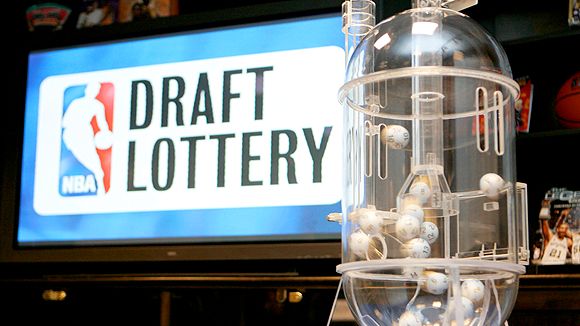
Let’s get statistical: Playing the NBA Draft Lottery

The NBA Draft Lottery is the ping-pong-ball-centered game the league plays with the four worst teams from the previous season to determine the order of selections for the next player draft. It’s basically beruit/beer pong with millions of dollars instead of Keystone Light, and, like timid lightweights, the winner doesn’t want to stay on the table for the next round.

The positions are selected in descending order, and the number of balls a team has in the hopper is inversely proportioned to how well the team finished the prior season. The ostensible idea is to give the last-place team the best shot of getting the first overall pick (i.e., the best chance at improving its lot in the future). Why not just award the worst team the first pick as a rule? I suppose the idea is to avoid the sort of tanking that allegedly is a problem in the NFL, where such a rule is in effect. Injecting an element of chance means it’s harder to game the system in a way that’s detrimental to the game– losing on purpose– although it can’t fully do away with the incentive to lose so long as it maintains its rehabilitative goal.

This year, the Charlotte Bobcats had the worst season in NBA history. The New Orleans Hornets, recently late of league ownership, merely had the fourth worst of the 2011-2012 season. This year’s draft lottery thus was arranged with the stated goal of giving the Bobcats the best shot at the first pick and the Hornets the worst.

Of course, once everyone saw that the Hornets would be in the mix for this year’s draft lottery, the conspiracy theorists, folk singers of my literary heart, rolled out their obvious prediction: the league was going to rig the lottery so that the Hornets got the top pick. Keep reading…

Bluegrass breakdown: Kentucky defeats Vanderbilt 69-63

After a rough opening period, Vanderbilt erased a thirteen-point halftime deficit to twice take the lead in the second half, but an inability to score any points for the final 4:09 of the game doomed the Commodores to defeat at the hands of the #1 Wildcats. Complete postgame coverage is available here, here, and here. My impressions of the game were 1) Kentucky is a very good team; 2) Vanderbilt showed it could overcome obstacles and come back in a game, playing the best team in the country better than anybody has since an early season ‘Cat loss to Indiana; and 3) UK and Vandy at Memorial Gym is one of the most exciting sports scenes out there.

After a late arrival into Music City Friday night, I couldn’t get myself to the gym for the early taping of ESPN’s Gameday program, but things got on track quickly with a lunch of the best fried chicken in all the land with with 2/5ths of the VSL Brain Trust, among many other notable persons. Follow that up with afternoon honky-tonking– the live sounds of Tootsie’s and Robert’s– and a fresh growler from Jackalope Brewery, and I was primed to enjoy a pregame treat in the form of watching Michigan State defeat Ohio State over some fresh brats. A Sunday morning visit to St. Augustine, and I was Northbound again. Traveling through Kentucky, picking up WKU Radio’s Barren River Breakdown program dulled the sting of the previous night’s loss just a little bit.

The ‘Dores get another regular-season chance against the Wildcats this weekend when they travel to Rupp Arena, where Kentucky has won forty-nine straight.

For more of my pictures, click here, here, here, and here.

Previous Live Coverage:
Beale Street recap: Vandy falls to Cincinnati in the Liberty Bowl, 31-24
Bpbrady’s Long Overdue Sugar Bowl Writeup

Windy City recap: Red Wings fall to Blackhawks 3-2
Michigan’s unfriendly welcoming of Nebraska
B1G Roadtrippin’: Michigan at Illinois

Nashville recap: Georgia escapes, 33-28

B1G Roadtrippin’: Michigan at Northwestern
The Little Brown Jug stays in Ann Arbor
Recap: Detroit Red Wings’ Red & White Game
Motor City recap: Tigers win, 2-1
Music City recap: Vanderbilt wins, 45-14
Concert report: Lyle Lovett and his Large Band
Concert report: An evening with Bruce Hornsby, Béla Fleck, the Noisemakers, and the Flecktones

LeBron James is the best professional basketball player ever

It might not seem like it, but, as discussed on ESPN Radio’s Mike & Mike this morning, LeBron James’ current season is the best season a professional player has ever had. John Hollinger, also of ESPN, created the Player Efficiency Rating (PER) metric for basketball players. In (his) general terms, “the PER sums up all a player’s positive accomplishments, subtracts the negative accomplishments, and returns a per-minute rating of a player’s performance.” It’s an advanced metric, and really, it’s a doubly advanced metric because it’s derivative of other advanced metrics. If you want it, the nitty gritty is here, but what PER allows us to do is compare individual players with their contemporaries and with those from other eras on equal footing.

The following is a list of the top individual full-season performances, based on PER, in the history of the NBA and ABA:

Rank    Player PER Season Tm
1. Wilt Chamberlain 31.84 1962-63 SFW
2. Wilt Chamberlain 31.76 1961-62 PHW
3. Michael Jordan 31.71 1987-88 CHI
4. LeBron James 31.67 2008-09 CLE
5. Wilt Chamberlain 31.64 1963-64 SFW
6. Michael Jordan 31.63 1990-91 CHI
7. Michael Jordan 31.19 1989-90 CHI
8. Michael Jordan 31.14 1988-89 CHI
9. LeBron James 31.10 2009-10 CLE
10. David Robinson 30.66 1993-94 SAS

The full list from Basketball-Reference is here.

James already has two of the ten best seasons, and he’s the only active player in that group. (His teammate, Dwayne Wade, is the next active player listed, at 13.) If the current season ended today, though, James would post a PER of 32.8, by far the highest mark ever recorded.

Perception is a valid and important check on the things statistics tell us. I feel like there are a million things one could write about James and perception, expectations, image, and legacy, all of which would get at the fact that the title of this post is something I’d guess most people reject as an initial, gut reaction but also something we all expected we would read, write, or say at some point. There are myriad potential lessons here. One is that these advanced metrics are a way of witnessing history in the moment, something that’s difficult to do based upon perception alone. Another is that, darn it, I hate LeBron and sabermetrics are for idiot-nerds. A third raises questions about the value we place on winning championships as a component of individual players’ legacies. A fourth is that Patrick Ewing, whose best season comes in at #117 on the big list, might not be the Dan Marino of the 1980s and 1990s NBA, and Kobe Bryant, whose best season so far comes in at #51, isn’t quite the heir to His Airness’ throne, or even Shaq’s big seat. And on and on.
The de jure national championship preview

Nick Saban* and Les Miles

The New Orleans Superdome has hosted a series of big football games over the past few days, including the Sugar Bowl, a Saints playoff game, and now the BCS national championship game tonight.

Keep reading…