Farewell, again, dear Prince

Nearly three years ago, Detroit Tigers fans said goodbye to Prince Fielder, whom the team traded in the 2013 offseason to Texas in exchange for Ian Kinsler. At the time, many were glad to see him leave, though some, including this author, were not. All must agree, however, that when Fielder left Detroit, he became barely a shadow of his former Ironman self. In his two years as a Tiger, he didn’t miss a single game. Excluding his rookie year, in the eight years he spent in Milwaukee and Detroit, he missed a total of thirteen games, playing the full 162 in four of those eight seasons. That’s an impressive accomplishment for any player.

If one wanted to be cold about it, one might note that, 2014, Fielder’s first in Texas, was a year of insult and injury for Prince. Not only did his trade replacement, Kinsler, make the All-Star team on his way to completing the second-best season of his career, but Fielder underwent season-ending neck surgery in late May, appearing in just forty-two games for his new club. He seemed to bounce back in 2015, posting a .305/.378/.463 line in 158 games, but it has been trouble again for Fielder in 2016. Despite his team’s success, Prince arguably was the worst position player of the first half of the season, and things weren’t looking up in the second half. After playing in all but five of the Rangers’ games through July 18, Fielder again went on the disabled list and, after undergoing a second neck surgery, is expected to miss the remainder of this season.

It may not just be the rest of the season he misses, however, as shocking reports emerged this afternoon that Prince’s career may be over:

If true, then, as a number of people have pointed out, Prince will finish with a .283/.382/.506 line, .304 TAv, .377 wOBA, 133 wRC+, 26.8 fWAR / 23.8 bWAR / 30.3 WARP, and 319 home runs, the same number of home runs his father, Cecil, with whom he seems to have reconciled, hit in a career just one season longer than his son’s.

Although serious injuries seemed to dim his wattage following the trade to Texas, I always will remember Prince Fielder as a complete hitter who was one of the happiest baseball players I ever saw. His friendship with Miguel Cabrera was particularly endearing.  What follows are some of my favorite images and clips from Prince’s playing days:   Continue reading

Catching Fire: Ian Kinsler is the San Francisco Giants of the MLB All Star Game

kinsler breaking records

Last night, MLB announced the rosters for the 2016 All-Star Game. Not included: Detroit Tigers second baseman Ian Kinsler. All Kinsler has done since coming to Detroit in the Prince Fielder trade is quietly build what some have called a Hall-of-Fame career.

The last time I wrote about Kinsler, I noticed that, after his rookie season (2006), he had made the All-Star Game in each even-year season and been left out each odd-year season. Basically, Kinsler is the San Francisco Giants of All-Star Games. While Kinsler’s omission from the AL’s initial ASG roster places that streak of sorts at risk, hope for its continuation remains in the form of the “Final Vote,” in which fans now may vote for one of five candidates in each league for the final roster spot on that league’s roster.

kinslerasg

That means that anyone reading this, along with the many, many people who are not reading this, can make Kinsler an all star by voting online here or texting “A1” to 89269 on your variable-intelligence mobile telephone. It’s pretty easy, minimally invasive, and needs to be done, if at all, before 4:00 pm on Friday.   Continue reading

Catching Fire: Night of a thousand feet of home runs

If not winning, the Detroit Tigers certainly have been doing a lot of home-run hitting over the last week or so, and, after some extra-inning disappointments during that stretch, they finally put it all together last night for an overtime win last night in a home series opener against the Seattle Mariners. That game featured three Tigers homers, each of which gave the team the lead. Especially exciting for Detroit was that two of them came off the bat of Justin Upton, who finally appears to be heating up for his new team after suffering one of the worst offensive stretches of his career.

jupwrc20gmavg

Upton’s first of the night was a dead-center bomb in the seventh that gave the Tigers a 7-6 lead, and his second, which clinched the game in walk-off fashion in the twelfth, landed beyond the bullpen in left. There likely is no one happier about this apparent return to power than Upton himself, and, especially with J.D. Martinez out with an elbow injury, it couldn’t be more timely for the team.

Upton’s homers last night inspired celebration, but Miguel Cabrera’s, which gave the Tigers a 2-0 lead in the first inning, inspired awe. I’ve never seen a Comerica Park home run hit where Cabrera hit his last night. No one has.

Have a look:   Continue reading

Catching Fire: Heading for the exit velocity

vacation-walley-matte-today-150527_25aa56597af71bd8b926763d3272e7cd-today-inline-large

Thanks to MLB Advanced Media’s new Statcast technology, fans can learn more than ever about the activity taking place on the field (and off it) during a baseball game. One such aspect into which Statcast offers insight is exit velocity, which refers to the speed with which a batted ball leaves a hitter’s bat. These velocities can communicate something meaningful about batter success. (Very generally, and possibly very obviously, higher exit velocity is better.)

Statcast came on-line last season, but there were significant flaws in its batted-ball data gathering in 2015. The shortcomings in the 2015 data will affect any analysis that relies on Statcast information from that season, and while Statcast seems to be doing a better job of gathering a more complete set of batted-ball data this year, some imperfections remain. Fortunately, it appears that those imperfections– apparently due in part to differences in hardware installations at each park– can be accounted for. Baseball Prospectus now publishes something called adjusted exit velocity, which aims to control for various influences on Statcast-measured exit velocity that are outside batters’ control. (None of those adjustments can recapture the data the system failed to collect in 2015, of course.)

Early in the season, I went to the Statcast well to compare home runs by Anthony Gose and Giancarlo Stanton. The purpose of this post is not to undermine lazy media narratives but to present a simple comparison between various Detroit Tigers’ adjusted exit velocities in 2015 and so far in 2016.

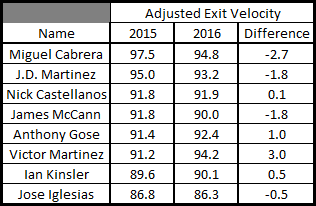
Keeping in mind the imperfections in the source data, here are the 2015 and to-date 2016 adjusted exit velocities (in miles per hour) of the Tigers’ primary hitters who played for the team in both seasons:

adjev15-16det

While recalling that we still are dealing with small sample sizes for 2016, particularly for James McCann, who’s spent much of the young season injured, and Anthony Gose, who now is down in the minors, I’d guess that the differences in adjusted exit velocity roughly comport with how well fans think each hitter is performing this year: Miguel Cabrera hasn’t heated up yet; J.D. Martinez has been struggling since moving to the second spot in the lineup after a hot start batting deeper in the order; Nick Castellanos has been breaking out; Victor Martinez is healthy again and showing it; Ian Kinsler seems to be in fine form yet again (credit those Jack White-designed bats?); and Jose Iglesias is continuing to rely on weak contact.

Cabrera was second overall in adjusted exit velocity last season, so his drop-off seems like a possible source of concern. Sluggers like Cabrera can take a while to warm up, though, so it’s not unreasonable to think that his adjusted exit velocity will climb as the current season progresses. (Cf. Giancarlo Stanton, 2015’s adjusted exit velocity champ, who, so far in 2016, is down 9.4 MPH.)

The elder Martinez has the largest change of any of the highlighted batters in either direction, but his 2015 doesn’t offer much of a baseline because he was playing through obvious injury. It therefore is reasonable to assume that some portion of that +3.0 MPH of adjusted exit velocity is due to a return to health.

Not only do these changes in adjusted exit velocity correlate with anecdotal observations of these players this season, but they also– loosely but consistently across this sample– track changes in raw power (measured as isolated power, or ISO):   Continue reading

Highlights from MLB Network’s visit to Detroit Tigers spring training

avilamaddog2

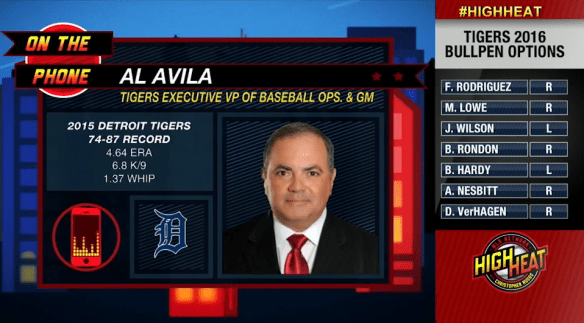
As it has done in the past, MLB Network’s “30 Clubs in 30 Days” feature spends a day with each major-league team during spring training. They spent St. Patrick’s Day with the Detroit Tigers in Lakeland, Florida. Here are the highlights:   Continue reading

Window Shopping: Ian Kinsler’s Walking, Not Running

While the Detroit Tigers’ decision to trade Prince Fielder to the Texas Rangers for Ian Kinsler prior to last season initially came as a shock to Tigers fans, the positive early returns on the trade seemed to provide a calming influence. As I wrote in late April 2014,

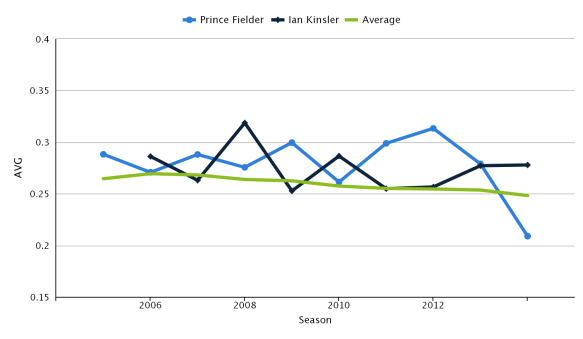
Kinsler has provided some real spark, though. Looking at the right side of this graph, you can see that, while he and Prince posted similar batting averages last season, Kinsler has kept the pace this year, but Prince has dropped off sharply with the Rangers.

chart

While Fielder has the edge in on-base percentage, probably due to his ability to draw walks (of the intentional and unintentional varieties), Kinsler’s hitting for more power (.133 ISO vs. .121 ISO) and is posting a better wOBA— a catch-all offensive metric– than Fielder (.319 vs. .277). They also have the same number of home runs (two), with Kinsler driving in nearly twice as many runs as Fielder (14 vs. 8), while stealing three bases (to Fielder’s zero, obviously).

Less than a month later, Prince’s season would be over, a completely understandable side effect of probably overdue neck surgery.

Kinsler powered right along, though, making 726 plate appearances in a career-high 161 games. His bat seemed to cool off in the second half of 2014 (.353 wOBA vs. .276), but he still managed to finish the season tied with Miguel Cabrera for the title of most valuable Tiger, as determined by fWAR (5.1 fWAR apiece), although much of that was due to Kinsler’s defense (and Cabrera’s lack thereof).

In reviewing last year’s statistics in anticipation of this season, Kinsler’s numbers jumped off the page for one main reason: his walks had disappeared. Continue reading

Window Shopping: Tigers Roaring Out of the Gate

At one month old, the MLB season now has accrued a sufficient sample size of free time to permit me to compile the opening post of this site’s regular Detroit Tigers series for 2015, Window Shopping. Last year, I came out of the gate a bit too hot, burned out, and had to take the month of June off. This year finds your resident Tiger tracker more balanced and measured in his approach. This year’s Detroit Baseball Tigers have a more balanced look too.   Continue reading

Mr. Scherzer goes to Washington


Overnight, the long-anticipated news of this baseball offseason finally broke: The Washington Nationals won the Max Scherzer sweepstakes by signing the former Detroit Tiger to a seven-year, $210 million contract.

Scherzer made news last March when, heading into his final season before becoming a free agent, he turned down the Tigers’ six-year, $144 million offer to stay with the team. That failed (from the team’s perspective) dance fouled up a variety of personnel matters for Detroit. They had already traded Prince Fielder and much, but not all, of his contract to Texas and starter Doug Fister to Washington for figuratively literally nothing all probably in an attempt to clear the books for Scherzer’s new contract. When Scherzer balked at the offer, the team responded by giving Miguel Cabrera all the money. Last season got off to a rough start, and, at least from a business perspective, Scherzer was at the center of it.

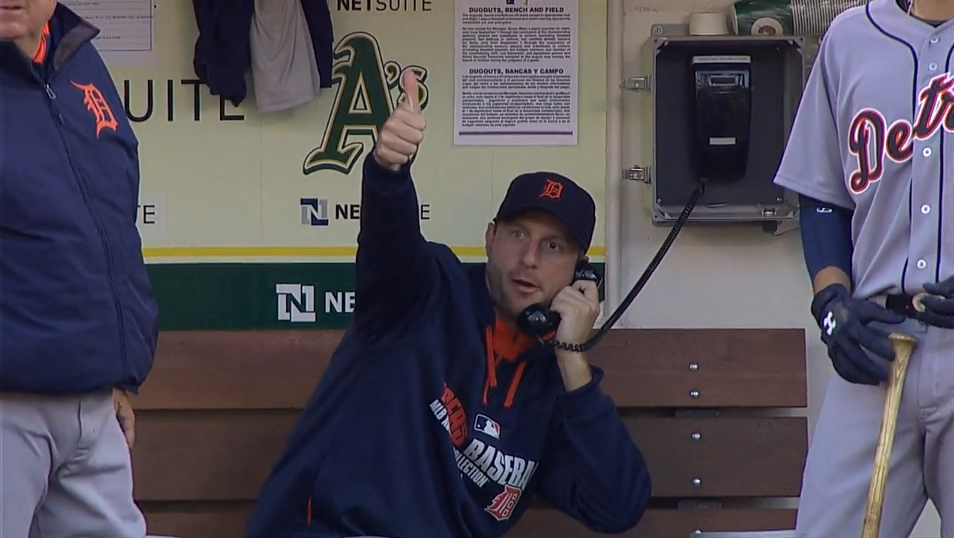
Max probably was my favorite amongst a very likable group of guys playing for the Tigers over this last stretch of seasons. His relief appearance against Oakland in the 2013 playoffs always will be among my most favorite half-innings of baseball.   Continue reading

Flying Tigers: Closing the Book on 2013

https://www.youtube.com/watch?v=fdkVsnZk2MI

Rock and Roll never forgets, and neither does ALDLAND. Last season, I took a look at whether the Tigers struggled to score later in games, a trend that, if shown and in combination with the team’s bullpen woes, would make comeback wins less likely. While the preliminary numbers suggested I was onto something, the trend appeared even more pronounced with one-hundred games’ worth of data. The purpose of this post is to make good on the promise implicit in that last one by completing the full season’s worth of data.

First, an aside on data collection. I previously gathered and organized these inning-by-inning run totals by hand because I didn’t realize Baseball Reference actually tracks that information. In order to maintain the same error potential, and because B-R doesn’t separate the runs/inning between wins and losses, I’ve updated (a simplified version of) my chart as I did before.

r-in 2013

Continue reading

Flying Tigers: Waiting for Takeoff

A month into the season, the Detroit Tigers sit atop the tightly bunched AL Central with a tenuous 12-9 record. The team, guided by first-time manager Brad Ausmus, looks and feels much different than it did over the last two years. Whether due to the change at the helm or a not-quite-coherent set of offseason moves, the 2014 Tigers appear to have traded identity for tactics and strategy. Thus begins Flying Tigers,* our third Detroit baseball series.

__________________________________________________________

When Jim Leyland announced his retirement following the end of the 2013 season, we knew Motor City baseball would be different in 2014, but we didn’t realize just how different it would be.     Continue reading