Window Shopping: Step Back From the Window, or, Thank You Very Much, Mr. Rebooto

The July 31 non-waiver trade deadline was an especially active period for the Detroit Tigers franchise, which made big moves both with player and front-office personnel.

Detroit traded three of the best players on its 2015 roster in the days and minutes prior to the trade deadline. The team’s biggest move, and arguably the biggest of one of the most active trade-deadline periods ever, was their decision to trade number-one starter David Price to the Toronto Blue Jays. They also sent closer Joakim Soria to Pittsburgh, and, in the final moments before the deadline, Yoenis Cespedes to the Mets.

The basic logic behind each of these moves is that, even prior to these trades, each of these players was, for all practical purposes, not going to be a member of the Detroit Tigers in 2016. That’s because each is in the final year of his current contract, meaning that each becomes a free agent at the end of this season. The Tigers would have no special ability to keep Price, Cespedes, or Soria in Detroit after the end of the 2015 season, and, given their individual successes, each is likely to fetch contract offers on the free market too rich even for Mike Ilitch’s blood. Rather than keep Price, Cespedes, and Soria for August and September on a team that’s unlikely to even make the playoffs, only to watch them walk away in the winter, the Tigers, with an eye on the post-2015 future, decided to cash in some of the value of these assets by trading them now. In doing so, Detroit converted these three expiring assets into six prospects, including five pitchers and one infielder.

Baseball analysts widely praised these transactions as beneficial to the Tigers, who, general manager Dave Dombrowski announced were “rebooting,” selling with the goal of remaining competitive in the near term, rather than undergoing a full rebuilding. The top return for Detroit was Daniel Norris, a now-former Blue Jay who lives in a van and shaves his beard with an ax. They also received Matt Boyd from Toronto, a younger starter who, in his recent Tigers’ debut, beat Johnny Cueto and the Royals.

Of course, the only real question for Detroit was not whom to trade but whether to trade. As July 31 approached, that question divided fans and, it later would be revealed, members of the team’s front office and ownership. As for the former group, most fans recognized the Tigers’ slim playoff odds and supported selling, although a minority that included this writer held out hope that the team could make one more postseason push before initiating a rebuild. Ultimately, Dombrowski’s “rebooting” seemed to satisfy both camps: Detroit would get close-to-ready prospects in exchange for their expiring assets. No long rebuilding process– a full surrender– was in store, just a quick retooling.

Two additional notes in the context of these trades: 1) one week before the trade deadline, Toronto, the biggest buyers, and Detroit, the biggest sellers, sat four and five games out of the last American League wild card position, respectively, and 2) while it isn’t at all likely that Price, Soria, or Cespedes will return to Detroit in the offseason, the effect of an unusual clause in Cespedes’ contract is that the Tigers actually increased whatever chance they have of resigning Cespedes by trading him.

_________________________________________

As the Tigers and their fans were settling into life without Price, Soria, and Cespedes, and enjoying their first trial run with Norris, who had a strong start on Sunday in Baltimore, unbeknownst to them, even more action was afoot behind the scenes.    Continue reading

Free Baseball: Patient Braves fashion dramatic comeback to beat the Giants in extra innings

giant bravesOn a muggy night in Atlanta, the Braves opened a three-game series with the visiting Giants at 7:10 pm– actually a bit before then, by our watches– Monday. Atlanta’s starter, Mike Foltynewicz must’ve missed the memo, though, because he spent about an hour of game time serving batting practice to the San Francisco hitters, who responded by bombing fly balls to the deep reaches of Turner Field, netting them three homers to left, one to center, and a 6-0 lead by the fourth inning.

The rain that fell amidst the sunshine– likely the prompt answer to a desperate prayer from Foltynewicz, who, unbelievably, was sent back out to pitch the fifth and sixth innings– seemed to cool the Giants’ bats and, eventually, nurture the opposite effect for the home team. In the bottom of the sixth, Jace Peterson’s three-run homer halved the Giants’ lead, and (remember this name) Adonis Garcia’s follow-up double chased San Francisco starter Matt Cain. A Nick Markakis RBI single scored Garcia, and the Braves ended their productive sixth inning having trimmed the Giants’ six-run lead to two.

Atlanta would edge even closer in the next inning, thanks to a solo shot from the once and prodigal BABIP king Chris Johnson, but a two-out rally in the top of the ninth allowed the Giants to extend their lead to 7-5.

Two San Francisco relievers later, the Braves were down to their final out, trailing by two with no men on. Johnson kept his team alive with a hard-hit single, and A.J. Pierzynski’s third hit of the night landed in the outfield seats, tying the game and sending it to extra innings. Continue reading

Window Shopping: oY?

The notion of a “platoon split” refers to the fact that, on average, batters have more success against opposite-handed pitchers than they do against same-handed pitchers. Thus, right-handed batters generally fare better against left-handed pitching, and left-handed batters generally fare better against right-handed pitching. If you think this sounds like some Monty Hall voodoo, take a look at the numbers. It’s one of the oldest tricks in baseball.

Occasionally, however, a player will buck the trend and find himself with a reverse platoon split, meaning that he hits same-handed pitching better than opposite-handed pitching. Such appears to be the case this year for Detroit outfielder Yoenis Cespedes.

The 2015 season is shaping up to be a career-best for Cespedes. Here are his current offensive numbers:

yo2015His 3.2 fWar is good for twenty-second overall, and his 120 wRC+ (a comprehensive measure of offensive value) is third-best on his team, behind only Miguel Cabrera and the sensational J.D. Martinez. Pretty good.

What’s lurking behind those numbers, though, is something seemingly odd and definitely obviously foreshadowed by the words in this post you’ve read so far: a reverse platoon split. Cespedes bats exclusively right-handed, but, contrary to the long-prevailing trend, he has much more success against right-handed pitchers than left-handed pitchers. These are his current splits:

yo2015splitThese numbers aren’t even close. Continue reading

Detroit Tigers Midseason Status Update

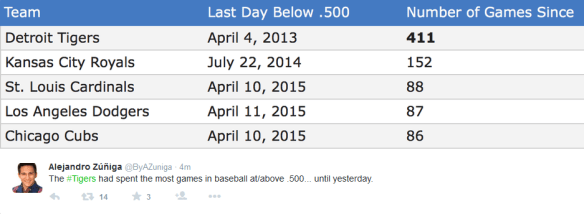
500

The anticipated events of the next two weeks will go a long way toward shaping the identity of the next phase of the Detroit Tigers organization. Will they push for a World Series run or cash out their movable assets while they’re at their highest values? This is the time to decide. My latest contribution to Banished to the Pen is a quick assessment of where the team stood at the All-Star Break that should help contextualize their options and actions as they enter the second half of the season.

The full post (scroll down for my segment) is available here.

Georgia Supreme Court Upholds Cobb’s Braves Stadium Bond Deal (via Fulton County Daily Report)

The Cobb County Braves stadium deal is safe. The Georgia Supreme Court on Monday unanimously upheld the bond issue for up to $397 million to finance the deal, affirming a ruling by Cobb County Superior Court Judge Robert Leonard.

But the high court also underscored some of the concerns brought up by the three plaintiffs who challenged the deal. In the opinion, written by Justice David Nahmias, the justices said, “We do not discount the concerns” raised in the three appeals “about the wisdom of the stadium project and the commitments Cobb County has made to entice the Braves to move there.”

Cobb County surprised Atlanta in November 2013 with a deal to lure the Braves away from downtown and into a suburban site near Interstates 285 and 75 off Cobb Parkway. Construction is underway on the new SunTrust Park, which will supplant Turner Field.

The court said the residents’ objections to Cobb’s financial incentives “lie predominantly in the realm of public policy entrusted to the county’s elected officials for decision, not in the realm of constitutional or statutory law. And to the extent the concerns affect whether the bond proposal is sound, feasible and reasonable, we defer to the trial court’s findings on those factors, which were supported by evidence in the record.”

The court concluded with a warning. “If the stadium deal does not fulfill the high expectations that have been set for it, there may be a significant political price to pay for those who negotiated and signed onto it,” Nahmias wrote. “But under the law of Georgia as construed in the precedents of this court, we cannot say that the trial court erred in validating the bonds or that the validation process was deficient. Accordingly, we affirm the trial court’s judgment.” … Read More

(via Fulton County Daily Report)

Max Scherzer: All-Star, Secret Agent

maxsmart

During Home Run Derby batting practice this evening, the MLB Network crew on the field in Cincinnati snagged an interview with Max Scherzer. At the end of the interview, the on-field crew asked Scherzer to throw back to Dan Plesac in the booth by saying “Hello Chief, it’s Max.” After some brief clarification, an apparently unwitting (or merely unwilling?) Scherzer got the line right, to the great enjoyment of Plesac, who was ready in the booth with his shoe phone to his ear.

Plesac, an established fan of the 1960s detective comedy television program “Get Smart,” has made the reference before, but this appears to be the first time Scherzer has been a willing participant.

As for what, if anything, Scherzer misses about his time in Detroit, the former Tiger offered that he misses being able to make fun of a certain equipment manager who was bad at fantasy football in person, lamenting that now he only can do so by text message. As the host in the second clip linked in the preceding paragraph seemingly correctly infers, Scherzer is much more interested in fantasy football than real great T.V. shows, which is his loss. As demonstrated again tonight, though, Plesac’s love for the bit is the fan’s gain.

Window Shopping: Pigs in the Pen

It’s July, which means it’s time for MLB teams to sort out their trade-deadline strategy. While fans distract themselves with All-Star festivities, general managers are preparing to execute player transactions in attempts to load up for a playoff run or, in acceptance of their near-term fates as noncontenders, build for the future.

In this context, the Detroit Tigers find themselves in a bit of a bind. After a very strong start, they’ve slid back to a .500 record and have been entrenched in the middle of the AL Central, never too far out of first place, but never really within striking distance. Would a first-place finish from this position be unprecedented? Hardly. Can they claim a fifth-consecutive division title without making a significant trade this summer? Almost certainly not. The Tigers’ record is not a product of underperforming their potential; instead, it likely is a reasonably accurate reflection of this team’s collective ability to date, warts, lower-body injuries, and all.

There is no question that the Tigers should be buyers this month, however thin their wallet may be with currency in the form of desirable prospects. I can’t say with any certainty whom Detroit should acquire this month– starting pitchers Johnny Cueto and Cole Hamels are the most valuable targets on the market, but the sellers’ prices may be too rich for the blood of the Tigers’ farm system– but I do agree with the prevailing preference for bolstering the pitching rotation. Shane Greene‘s floor proved too low to allow the team to continue to wait to see how high his ceiling might go, Alfredo Simon’s regressed to the very average levels we should have expected out of him as a starter, and, with appearances in just four games in 2015, Justin Verlander’s projected resurgence isn’t happening. The return of game-calling extraordinaire Alex Avila to his precarious post behind the plate can’t fix that many holes, and neither, I suspect, can J.D. Martinez‘s unsustainable home-run rate. Detroit needs to find another starter.

The trade-deadline attention on the pitching rotation represents a shift of attention away from their bullpen, the conventionally identified leading source of all of the Tigers’ problems. Continue reading

What does Adam Schefter’s publication of Jason Pierre-Paul’s medical records mean for the future of athlete health information?

In the context of yesterday’s Jason Pierre-Paul fireworks/amputation news, my latest post for TechGraphs asks whether the increasing use of wearable sports technology could have negative consequences for athletes, and, further, whether athletes may be effectively powerless to avoid those consequences.

The full post is available here.