The organizing principle of a competition arranged in the fashion of the NCAA men’s basketball tournament is that better teams should have easier paths for advancement, the goal being for the best teams to meet as late as possible. Tournament organizers therefore employ a seeding system that awards teams believed to be the strongest with the best seeds (i.e., the lowest numbers) and first pits them against teams believed to be the weakest.This is sensible, logical, and good. Anything can happen once the games begin, of course, but if Michigan State and Kansas, for example, are the best teams in this year’s tournament, the tournament should be designed such that those two teams are most likely to face off in the final, championship round. Generally speaking, this is how the NCAA tournament is organized.
From 1985 until 2000, the tournament’s field held steady at sixty-four total teams. In 2001, it expanded to sixty-five teams, adding a single play-in game to determine which team would be the sixteenth seed to face the number one overall seed. In 2011, the tournament field expanded to sixty-eight teams, its current size, with four play-in games.
Many people dislike the fact that the tournament has expanded beyond a seemingly optimal sixty-four-team field, but all should agree that, however many teams and play-in games are included, the tournament should be organized such that the projected difficulty of each team’s path through the tournament is inversely proportional to its seed position. As currently constructed, however, the tournament deviates from this basic principle.
All play-in games are not created equal. Two of the four fill sixteenth-seeded positions, while the other two fill eleventh-seeded positions, and the latter grouping is the culprit here. The NCAA and its broadcast partners no longer refer to the play-in games as the “first round,” thankfully, but, however labeled, these games constitute a significant structural hurdle for their participants. It’s difficult enough to win five consecutive games against the nation’s top competition; adding a sixth game places the play-in teams at a major disadvantage.
If a tournament organized in this fashion is to proceed with sixty-eight participants, play-in games are a necessity. The heavy burden of participating in an extra round of competition should be apportioned in accordance with the tournament’s organizing principle, however. In this instance, that should mean applying it to the lowest-seeded (i.e., highest number) teams. Using two of the play-in games to determine eleventh-seeded positions inappropriately and adversely distorts the degree of difficulty for those two positions.

This year, the unduly burdened teams are Vanderbilt, Wichita State, Michigan, and Tulsa, which are competing in play-in games for eleventh-seeded spots in the tournament’s first full round. Each of these teams would be better off as a twelfth, thirteenth, or even fourteenth seed (to say nothing of an eleventh seed in the West or Midwest regions, where eleven seeds are not similarly encumbered) than they are as participants in eleventh-seed play-in games.
If the tournament committee really believes each of those four teams belongs in the tournament and is deserving of an eleven seed, or thereabouts, it should pick one from each pairing– Vandy/WSU and Michigan/Tulsa– to be the eleventh seed, make the other the twelfth, bump the remaining lower seeds in the region down by one, and have the existing fifteenth seed play the existing sixteenth seed in a play-in game instead. (This wouldn’t be a clean fix in the East region, which already has a Florida Gulf Coast/Fairleigh Dickinson play-in game for the sixteenth seed, but the Midwest region has no play-in games, so one of Michigan/Tulsa could be moved to the eleventh or twelfth seed there, bumping Hampton and MTSU into a play-in game for the sixteenth-seed position in that region.)
Two of the eleventh-seed play-in participants, Vanderbilt and Michigan, likely were two of the last teams to earn at-large bids to this year’s tournament. Even if that’s true, though, it shouldn’t matter. The in/out decision is binary: a team is either in the tournament or it isn’t. Once the field is determined, the committee then should seed the teams based on their basketball merit. If the committee thinks so little of Vanderbilt, Wichita State, Michigan, and Tulsa that it wants to put them through the paces of a play-in game, it should have seeded them lower than eleventh.
The current arrangement of the NCAA tournament play-in games constitutes a structural flaw not because those preliminary games exist, but because of the seed positions they involve. If the NCAA insists on using the play-in-game arrangement to include sixty-eight teams in the tournament, it should use those play-in games in a manner that aligns with the tournament’s overall organizing principle of strength-based seeding. In practice, no tournament of this sort will be perfectly balanced in its initial arrangement, but the current structure clearly is contrary to that fundamental organizational principle and unnecessarily distorts the balance of the entire tournament.
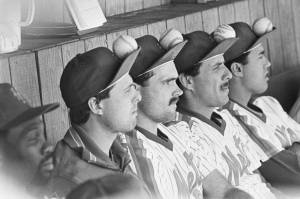 You’d see guys toward the end of a game, maybe getting ready for their final at bat, double-back into the locker room to chug a beer to “re-kick the bean” so they could step to the plate completely wired and focused and dialed in. They had it down to a science, with precision timing. They’d do that thing where you poke a hole in the can so the beer would flow shotgun-style. They’d time it so that they were due to hit third or fourth that inning, and in their minds that rush of beer would kind of jump-start the amphetamines and get back to how they were feeling early on in the game—pumped, jacked, good to go. How they came up with this recipe, this ritual, I’ll never know, but it seemed to do the trick; they’d get this rush of confidence that was through the roof and step to the plate like the world-beaters they were born to be. …



 ALDLAND