Saving Detroit: Reliever Relief, Part 2

anibal sanchez bench

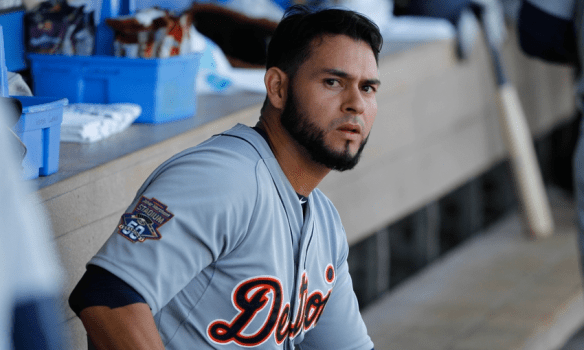
In the history of Major League Baseball, there’s only been one player with the first name Anibal. Anibal Alejandro Sanchez broke into the majors in 2006 with the Florida Marlins. He, along with Omar Infante, came to Detroit in the middle of the 2012 season in a trade. In 2013, his first full season as a Tiger, Sanchez produced by far the best season of his career (6.1 bWAR, 6.0 fWAR, 5.1 WARP). It’s been all downhill since then, though, and his move to the bullpen in 2016 seemed inevitable if only because he remained signed to a starter-magnitude contract that made totally cutting bait a pill too difficult to swallow. Sanchez didn’t make the transition especially well, however, and things have not improved in 2017. It’s come time for the Tigers to release this former fish.

After an especially bad weekend in Oakland capped a rough start to this season for incumbent closer Francisco Rodriguez, I (along with everyone else in the world) wrote on Monday that manager Brad Ausmus needed to demote K-Rod immediately. Ausmus agreed and did so, promoting Justin Wilson to the closer role, although the first run with the new top-line bullpen arrangement showed Ausmus still has room for improvement there. Dynamic, leverage-oriented bullpen management is pretty difficult to accomplish, though, and Sanchez has become a much clearer and more present danger to the team’s success than any further usage optimization of the capable portion of the relief corps.

Sanchez, as a converted starter who used to be good, would seem to be the optimal long relief guy, but he has foundered in that role, and if it seems like he gives up a home run every time he comes into a game, well, you’re not far off.

Last night in Arizona, Sanchez made his first appearance in over a week and immediately surrendered back-to-back home runs to the first two batters he faced. Although the Tigers’ offense had evaporated in the desert heat that night, those two homers Sanchez allowed felt like the real mortal blow that destroyed any hope for a comeback.

This is who Sanchez is at this point. Among qualified relievers in 2017, only one pitcher is allowing home runs at a higher rate than him (none have allowed more, total, than him), and Sanchez has been used more than everybody in the “top” twenty on that list. This now is an untenable situation, and it probably has been for some time. Continue reading
Saving Detroit: Reliever Relief

krod1280_puet24kh_yf9khwjd

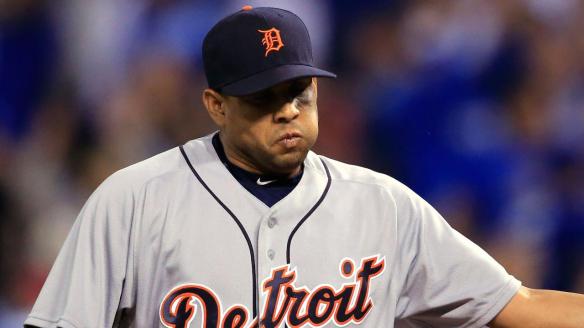
Despite being pretty good at almost every aspect of building a winning baseball team, the Detroit Tigers have, for years, had as difficult a time finding a reliable closer as the Cleveland Browns have finding a quarterback. Even reading the names Jose Valverde and Joe Nathan is enough to make most fans shudder, and, unfortunately, it’s come time to add Francisco Rodriguez to that list.

There were reasons to be hopeful when Rodriguez came over to Detroit before last season. Even though, at thirty-four years old, he wasn’t the fire-breathing, overpowering force he was in his younger days, it looked like he’d traded some heat for wisdom and found a way to continue to succeed as he aged. The active saves leader did pretty well last year, and, even if there were some missteps in key moments, it was hard to be too disappointed with the overall body of work. He even seemed to help teach manager Brad Ausmus a helpful lesson about bullpen management, as Ausmus slowly broke out of the conventional mold and began using Rodriguez in high-leverage four-out situations rather than rigidly reserving him for the ninth inning alone.

Baseball famously is a game without a clock (at least for now), but humans lack such an exemption, and the clock appears to have run out on Rodriguez in his age-thirty-five season. After single-handedly blowing two games over the weekend, it sure seems like Rodriguez has turned into a dip-filled pumpkin. By one measure, Win Probability Added, he’s done more to help his team lose than any other reliever than all but one other reliever in baseball.

It’s tough to pinpoint exactly what’s wrong with K-Rod this year. His velocities are down a little bit, but they’ve been going down pretty much steadily over the course of his career. That’s nothing new, and it’s why he started prioritizing offspeed pitches over his cooling fastball as he got older. Other indicators, including location, pitch usage, and release points, all look as reasonably expected. The results don’t lie, though; batters are absolutely hammering him this year:

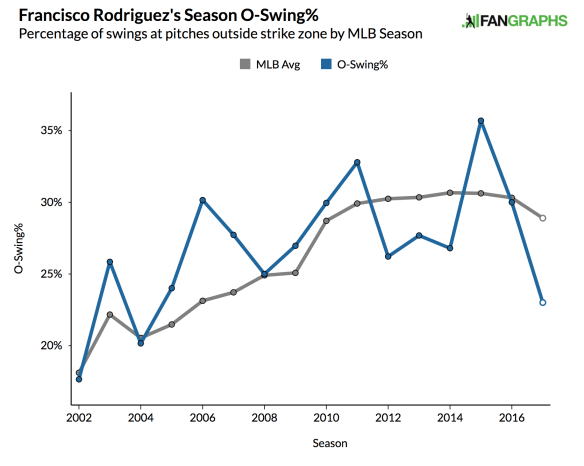
krod mapsIt looks like he’s throwing to the same places– low, and in/away– he usually has, but with much less success. It’s hard (for me, at least) to pinpoint with these various advanced tools exactly what’s happened, but it’s clear that Rodriguez no longer is fooling batters, a veritable death knell for deception-reliant pitchers like him. The way batters consistently chased– and, more often than not, missed– his diving, low and away pitches is something I marveled at last year, my first really watching him and his seemingly simple approach. For whatever reason, though, they aren’t even remotely fooled this year, as the below graph of Rodriguez’s out-of-zone swing rate from a FanGraphs article posted this evening shows:
screen-shot-2017-05-07-at-9-24-12-pm

The Tigers’ margin for error this season is extremely narrow, and Rodriguez just cost them two wins on an important West-Coast roadtrip. They don’t have time to let Rodriguez find himself in game-ending, high-leverage situations. Ausmus needs to rearrange his bullpen immediately. It already was a thin crew, but the status quo won’t do. It’s time to promote the Wilsons and find out if the rest of this motley bunch can handle a heavier load.

Sports Law Roundup – 5/5/2017

aslr - cinco

I used to write the sports technology roundup at TechGraphs, an internet website that died, and now I am writing the sports law roundup at ALDLAND, an internet website.

Here are the top sports-related legal stories from the past week:

  • NBA profiling: In 2015, Mike Scott, then a member of the Atlanta Hawks, and his brother were pulled over and subsequently arrested after a search of their rented vehicle turned up marijuana, ecstasy, and $1,684 in cash.  The deputy sheriff who made the stop later was found to have been racially profiling drivers as part of a forfeiture scheme and placed on administrative leave. Records provided by the Scotts’ attorneys show that the deputy sheriff “pulled over more than 1,400 vehicles in 2015 and 2016 but issued only eight traffic citations. He also arrested 47 people, at least 44 of whom were minorities.” As a result of the profiling, the judge overseeing the Scotts’ drug case this week threw out the key evidence against the defendants.
  • Baseball broadcast settlement: In early 2016, MLB settled a fan antitrust lawsuit targeting the league’s television blackouts and other components of its broadcast system. While the blackouts survived, the fans did win reduced-price single-team subscription options for MLB.tv (I am a subscriber, to varying degrees of satisfaction), as well as a price reduction for the full MLB.tv package. The agreement also included a component that would allow MLB to raise prices in the future in exchange for providing more live streams of in-market games by 2017. That component now is at issue in a new motion filed by the fan group demanding that the court enforce the terms of the settlement agreement. The fans allege that MLB raised prices without the required corresponding in-market streaming increase. They concede that the league may have agreements in place with local television providers to provide the in-market streams, but, the fans argue, “the obvious purpose of the settlement was not that ‘agreements’ of some kind be reached, but that the actual games be available.” The fans also argue that, contrary to what they were promised, MLB has failed to make the “follow your team” game broadcasts available when the selected team is playing the team based in the fan’s local broadcast market.
  • Cheerleader wages: The Milwaukee Bucks and Lauren Herington, a former cheerleader for the team who alleged that the team violated federal and state labor laws by underpaying her and her fellow cheerleaders, have reached a $250,000 settlement of Herington’s proposed class action lawsuit that provides for the settlement funds to be divided as follows: $10,000 for Herington; $115,000 for Herington’s attorneys; and unspecified shares of the remaining $125,000 to Herington and other would-be class members who opt into the settlement based on their hours worked during the three-year period (2012-15) at issue. While not insubstantial, the Journal Sentinel notes that Milwaukee’s $250,000 settlement amount is less than what other teams– for example, the Oakland Raiders ($1.24 million), Tampa Bay Buccaneers ($825,000), and Cincinnati Bengals ($255,000)– have paid to resolve similar lawsuits. Upon learning that Herington was wavering on whether to agree to the settlement, her lawyer, who wanted her to accept the deal, reportedly was overheard telling her that “it’s a Bucks dancer’s choice my friend, better take my advice.”
  • Minor League baseball wages: As predicted two months ago, the court overseeing  the minor-league baseball players lawsuit against MLB for higher wages and overtime pay will permit the parties to appeal its recent ruling certifying the case for class-action treatment. In doing so, the court also decided to stay the case pending resolution of the class-certification issues by the appellate court.

Sports court is in recess.

First I Look at the Jam

It’s fair to say that every band that made it big played in a bar at some point on its way up. It’s equally fair to say that the J. Geils Band was the best bar band to make it big. Last month, guitarist J. Geils died at the age of seventy-one. Along with singer/hype-man Peter Wolf (the face of Facebook), Magic Dick on harmonica, and some other guys with less interesting names, they brought high-energy, Boston-barroom-soaked rock and roll to the national stage. The best snapshot of their sound came on Live: Full House, an album recorded in Detroit in 1972. The band’s later success on the pop charts, with hits like “Freeze Frame” and “Centerfold,” provided a surprising– and, one assumes, more lucrative– second act for the group, but, minus a few reunion efforts, it would be their last. Geils himself had a muted solo career, making two blues albums with Magic Dick and in the mid-1990s and some jazz recordings a decade later.

Sports Law Roundup – 4/28/2017

aslr

I used to write the sports technology roundup at TechGraphs, an internet website that died, and now I am writing the sports law roundup at ALDLAND, an internet website.

After a slow news week off, we’re back with the top sports-related legal stories from the past week:

  • Hockey head injuries: The NHL suffered another loss in the pretrial discovery process in the ongoing head-injury lawsuit between the league and a group of former players. Last month, the court ordered the public release of certain internal NHL communications and other documents, some of which contained embarrassing and damaging statements by team and league officials, including Commissioner Gary Bettman. Now, the court has mostly denied the NHL’s motion to force Boston University’s CTE Center to produce research documents and information about test subjects, although it will allow production of documents pertaining to deceased players whose families authorize the release of those records, as well as documentation of the Center’s public statements to the press regarding research on NHL players. The league responded by filing its opposition to the plaintiffs’ request for class-action treatment, arguing that there is not a scientifically established link between head trauma and “neurodegenerative” diseases like CTE. According to the NHL’s filing, “any causal relationship between head injury in contact sports and later-in-life development of CTE remains scientifically unproven.” The league also argued that it would be inappropriate to certify a nationwide class for a medical-monitoring claim, since the applicable laws vary on a state-by-state basis.
  • More hockey head injuries: With the NHL already embroiled in head-injury litigation, two of its teams, the St. Louis Blues and New Jersey Devils, now face another lawsuit filed by a former player, Mike Peluso, addressing the same situation. Peluso, an enforcer for the Blues and Devils (as well as the Blackhawks, Senators, and Flames) in the 1990s, alleges that the teams had actual knowledge of the medical risks of additional head injuries he personally faced, yet continued to encourage him to play and fight on the ice. According to Peluso’s complaint, which also names an insurance provider as a defendant, “This is not simply a case were [sic] defendants are alleged to know the link between head injuries and permanent brain damage. This is a case where defendants knew the link between Mr. Peluso’s head injuries and permanent brain damage because they had their own Board Certified Team Neurologist tell them that Mr. Peluso would have brain damage if they allowed him to continue to receive head injuries” and hid that information from him. The complaint also alleges that Peluso suffers from permanent brain damage and dementia and is permanently disabled. Peluso, now fifty-one years old, claims he engaged in 240 fights in his nine-year NHL career and suffered at least nine grand mal seizures. A member of New Jersey’s 1995 Stanley Cup-winning team, Peluso finished among the top-ten players in the league in penalty minutes in four of his nine seasons, leading the league in the 1991-92 season. Mike Peluso should not be confused with his cousin, Mike Peluso, who had a brief NHL career with the Blackhawks and Flyers in the early 2000s.
  • Football biometric data: The NFLPA and Whoop, a company that sells wearable fitness monitoring devices, have entered into an agreement in which Whoop will provide players with devices that track “strain, recovery, and sleep” and can transmit that data to Whoop’s web-based applications. As part of the agreement, the players will be able to customize the aesthetic design of their device for their own use and for retail sale. Significantly, the agreement grants each player ownership rights of all data his device collects. While headline-writers have feasted on the possibility (apparently authorized under the agreement) that players may sell their data in some manner, the real purpose of this deal likely is to stem growing concerns that it would be the teams or leagues that would own (and potentially misappropriate) players’ biometric data.

Sports court is in recess.

Jean Segura, disciplined aggressor

The Tigers outscored the Mariners 20-19 this week but lost two of three, and all you get is this crummy article on Seattle’s new shortstop. My latest post at Banished to the Pen takes a quick look at the ways in which Jean Segura is building on his 2016 breakout.

The full post is available here.

ALDLAND Archives: Is the Worldwide Leader not long for this world? Imagining the end of ESPN

ESPN is in the midst of a significant layoff of on-air talent this week, and most of the casualties’ names are coming to light today. The cuts are leading many to ask some fundamental questions about the network’s future. Below, from the past, a potential answer to one such question.

_________________________________________________________________

espnfade

Is the Worldwide Leader not long for this world? Imagining the end of ESPN

December 7, 2015

My latest post at TechGraphs asks a simple question: why does ESPN still exist?

The full post is available here.

MLB in retrograde

mlbtv

I’m not always the quickest to notice changes in my surrounding environment, including the baseball component thereof, and I’ve had a lot (of really good things) going on that have necessarily kept me from fully jumping into the still-young MLB season thus far. Last night, I had a little window, though, so I dialed up the Tigers and Rays on MLB.tv, only to be met with a video-streaming brick wall. After a couple hours with tech support, I discovered that MLB Advanced Media (“MLBAM,” which produces MLB.tv) had discontinued service to the device model– a Lenovo tablet running Android– I’d purchased last year for the sole purpose of running MLB.tv. I have cancelled my subscription and demanded a refund.   Continue reading

Sports Law Roundup – 4/14/2017

aslr

I used to write the sports technology roundup at TechGraphs, an internet website that died, and now I am writing the sports law roundup at ALDLAND, an internet website.

Here are the top sports-related legal stories from the past week:

  • Aaron Hernandez: This afternoon, a jury acquitted Aaron Hernandez, who played tight end for the New England Patriots and Florida Gators, of charges that he murdered two people in Boston in 2012. Hernandez already is serving a life term without parole for a 2013 murder. Despite the acquittal on the murder charges, the jury did convict Hernandez on a firearm charge.
  • St. Louis Rams: The City of St. Louis has sued the NFL and all thirty-two of its teams for losses related to the Rams’ departure to Los Angeles in 2016. The suit alleges that the team failed to make a good-faith effort to stay in St. Louis before leaving in violation of league rules. According to a public statement by the city’s mayor, the city spent a substantial amount of public money in the hopes of keeping the team, and it did so in reliance on the expectation that the team would comply with NFL team-relocation rules.
  • Baylor sexual assault: Earlier this year, a former Baylor student sued the university because, she alleged, she was the victim of a group rape committed by two football players in 2013 that the school ignored. She also alleged that football players were responsible for numerous other crimes “involving violent physical assault, armed robbery, burglary, drugs, guns, and, notably, the most widespread culture of sexual violence and abuse of women ever reported in a collegiate athletic program.” She further claimed that, between 2011 and 2014, thirty-one Baylor football players committed a total of fifty-two rapes, including five gang rapes. Now, the judge overseeing the case has largely denied the defendants’ motion to dismiss, narrowing the plaintiff’s emotional distress claim but otherwise allowing her case to proceed, calling the allegations “disturbing.”
  • Volleyball sponsorship: Kerri Walsh Jennings, who won three Olympic gold medals for the United States beach volleyball team, is suing the Association of Volleyball Professionals for breach of a sponsorship contract. Walsh Jennings alleges that AVP still owes her $150,000 on a $450,000 agreement despite her compliance with all of the contract’s terms. Part of the backdrop of this dispute may be another dispute between Walsh Jennings and AVP over whether she will play in AVP’s 2017 professional tournament.
  • NFL memorabilia: What purports to be new evidence in two 2014 lawsuits against Eli Manning, Steiner Sports (a memorabilia company with which Manning has a formal relationship), the Giants, and a team equipment manager alleging that the defendants worked together to sell collectors “game-worn” items that were not, in fact, game-worn emerged this week in the form of an email exchange between Manning and the equipment manager. In it, Manning requests “2 helmets that can pass as game used,” and the manager responded that he “should be able to get them for tomorrow.” The collectors who filed the lawsuits contend that this exchange proves that Manning knowingly provided Steiner with “fraudulent” items to sell to fans. The team now says the email exchange was taken out of context, and that its release now constitutes an attempt to defame Manning.

Sports court is in recess.

Babe Ruth, Atlanta, and the Longest Home Run Ever Hit

whole20ponce20de20leon20ballpark20with20sears20building_001

The Atlanta Braves debut at their new home, SunTrust Park, tomorrow night. Today, my latest article for The Hardball Times is a look back at baseball in Atlanta in 1928, when there was a ballpark out front of what’s now Ponce City Market, and Babe Ruth hit the longest home run ever.

The full article is available here.