WTF: Which Tigers may move in deadline deals?

The upcoming non-waiver trade deadline, July 31, doesn’t generate the same level of excitement in Detroit Tigers fans it did a few years ago, when the team was in contention and Dave Dombrowski had free reign over Mike Ilitch’s wallet. Now operating as (at least would-be) sellers in the current trade market, the Tigers don’t have any obvious candidates to ship out, which further limits the already diminished excitement that typically surrounds this time of the baseball year.

Some commentators think that’s a sentiment that’s spreading across the sport:

[T]he trade deadline wasn’t so packed with action a year ago, and it might be even slower this season.

The trade deadline just might not matter that much anymore.

Teams knew early last year whether they were buyers or sellers. They’ve known earlier still this season. They also know the deadline doesn’t typically provide much impact.
. . .
What this means is the game doesn’t need July 31st to spur action and decisions between buying and selling status. More and more, the contenders and sellers know their status earlier in the season and sometimes even before the season. Moreover, in a game loaded with rebuilding clubs, non-contenders are perhaps more incentivized to beat the market. There is incentive for activity to begin — if it is to begin — earlier. That makes for a less dramatic deadline.

It may be worth pausing here to ask why this is happening. I don’t think it’s better information that now is providing teams with knowledge of their relative positions earlier in the season. While the new analytical approach may lead teams that do trade at the deadline to act more conservatively and uniformly and avoid badly imbalanced trades, it doesn’t make sense that that would inform teams’ earlier knowledge of their contention positions. The cause should be something new, and I suspect that cause is intentional tanking. Teams used to “find themselves out of contention” by early July; now, they begin the year that way, purposely designed to fail. This is part of the method that helped the Cubs and Astros win championships, so it’s hard to be too upset about it right now. Like other copycat strategies, though, this one soon should begin generating diminishing returns, which is why I’m glad the Tigers have chosen a more traditional rebuilding model.

To the question at hand: which current Tigers might be trade targets this month?   Continue reading

[UPDATED] WTF: Bos to the Races, Part II

chris-bosio-31cf2671b0969640

While there were positive indications that the Detroit Tigers’ new pitching coach was connecting well with his charges, Chris Bosio’s tenure in Detroit already has come to an end. On Wednesday, general manager Al Avila– without consulting manager Ron Gardenhire— fired Bosio “for ‘insensitive comments’ directed toward a team employee on Monday.” It eventually emerged that Bosio’s “insensitive comments” were of a racial nature, and now we know that, according to Bosio,

he was fired because he used the term “spider monkey” in a conversation that was overheard by an African-American clubhouse attendant. Bosio insisted that the term was not directed at the clubhouse attendant, nor was it said in a racially disparaging fashion.

Bosio said the comment was made in reference to Daniel Stumpf, a white pitcher currently on the disabled list.

“I’ve got protect myself someway, because this is damaging as hell to me. . . . I’ve got to fight for myself. Everyone knows this is not me. I didn’t use any profanity. There was no vulgarity. The N-word wasn’t used. No racial anything. It was a comment, and a nickname we used for a player.”

Bosio elaborated on the “nickname” aspect:

“Someone in our coaches’ room asked me [Monday afternoon] about Stumpf,” Bosio told USA Today. “And I said, “Oh, you mean ‘Spider Monkey.’ That’s his nickname. He’s a skinny little white kid who makes all of these funny faces when he works out.

“The kid [clubhouse attendant] thought we were talking about him. He got all upset. He assumed we were talking about him. I said, ‘No, no, no. We’re talking about Stumpf.’

“And that was it. I swear on my mom and dad’s graves, there was nothing else to it.”

Stumpf has not exactly rushed to his former coach’s defense, however. He told the Free Press that he had no knowledge of the alleged nickname: “Spider Monkey is not a nickname I have been called or I’m familiar with.”

When I first heard the news, I couldn’t help thinking about the public clashes between Bosio and Gardenhire pertaining to bullpen strategy that emerged during spring training as both men adjusted to their roles with their new team, particularly in light of the fact that Gardenhire named Rick Anderson as Bosio’s replacement. Anderson is a Gardenhire man through and through, someone Rod Allen referred to as Gardenhire’s “best friend.”

Bosio has indicated that he plans to explore legal action against the Tigers. If he pursues a claim for wrongful termination, he may face an uphill battle. As a coach, Bosio is not a union member, so state and federal law– rather than any collective bargaining agreement– would govern his employment and any legal claims arising therefrom. Since 2013, Michigan is a right-to-work state, meaning that employers like the Tigers generally can terminate their employees for any reason or no reason at all. Of course, it’s possible that team policies (as might be contained in an employee handbook) or Bosio’s employment contract with the team limited the team’s ability to fire him, however. Seemingly looking in that direction, Avila stated that Bosio’s conduct violated both team policy and his contract.

Without being able to review the Tigers’ employee handbook or Bosio’s contract, it’s difficult to offer much more in the way of an assessment of how a lawsuit between Bosio and the Tigers might go. What is clear is that, with the team’s record since the Rally Goose graced Comerica Park with its feathery presence having fallen below .500 thanks largely to two consecutive series sweeps, the Tigers have found their new diversion from the quality of their on-field performance.

UPDATE: The Athletic now is reporting a new version of the event that led to Bosio’s termination, citing four team sources:

Bosio called the attendant, who is African-American, a “monkey,” according to four team sources. The remark was directed toward the young man, who was collecting towels from the coaches’ room at the time, during a post-game gripe session in which Bosio was lamenting about a pitcher.

During this exchange, Bosio made a derogatory comment about one of the Tigers pitchers and then gestured toward the attendant before adding, “like this monkey here,” the sources said. The attendant pushed back at Bosio for the comment, and an additional team employee witnessed the exchange. Bosio was provided an opportunity to apologize to the attendant after his outburst but declined to do so, according to multiple sources.

All four sources who spoke to The Athletic disputed Bosio’s account.

Regarding potential legal action involving Bosio, this new report also notes:

If Bosio decides to pursue a lawsuit against the Tigers, it will not be his only pending legal action. Bosio has multiple liens and judgments against him and he continues to be embroiled in proceedings with his ex-wife, Suzanne, for whom he filed for divorce in 2012 and was granted a divorce in 2014.

______________________________________________

Previously
WTF: Bad Company? – 6/26
WTF: Busted – 6/13
WTF: Bos to the Races – 5/22
WTF: Welcome Back Kozma – 5/9

Related
2018 Detroit Tigers Season Preview
Highlights from MLB Network’s visit to Detroit Tigers spring training

WTF: Bad Company?

american-league

Today’s article at The Hardball Times sets in print what most baseball fans already have intuited: the American League’s Central Division stinks. The article doesn’t provide much insight or analysis, but, for those who chronicle such things, its thesis statement is worth recording:

As of June 25, FanGraphs’ projected standings show the Central teams will wind up, in total, losing 88 games more than they win, with only Cleveland, as the worst of the six division winners, over .500. Since Major League Baseball split itself six ways in 1994, no division has had a worse season by that measure.

Alas, it’s nothing new. Blame it on small markets, blame it on these teams’ inability to attract the very best free agents, blame it on unwise or tightfisted ownership; heck, blame it on Midwest weather. There’s a history of this. Thirteen times in the 24 years we’re looking at, the AL Central or its National League middle-of-the-continent cousin has been the worst division in baseball. This looks like 14.

There’s more to this story, as with any other, but how much more depends upon your tolerance for a detailed observation of mediocrity. For a short-term example, I could point out that those same FanGraphs projected standings see every team in the division except Detroit playing significantly better, though still not great, over the remainder of this season. Another way of looking at that is to say that, while no one predicted greatness out of this division in 2018, the group has performed below its modest expectations to this point.

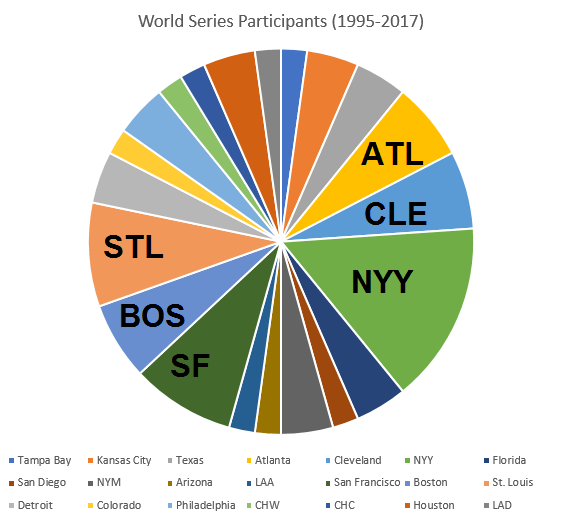
A long-term example is that, despite its collective woes, the AL Central has done a decent job of representing itself in the sport’s highest stage. Since 1995, there have been twenty-three World Series matchups. In theory, that means that forty-six different teams could have reached the playoffs’ championship round. The distribution of World-Series contenders has not been nearly so even, however. Twenty-one different teams have accounted for all forty-six World-Series openings over that span:

distribution of world series participants by team 95-17

Here’s how things look if we break down the American League’s representatives by division:

distribution of world series participants by AL division 95-17

Despite this era of AL East (really, Yankees) preeminence, the Central has managed to hold its own by representing the American League in thirty-five-percent of the World Series during that time, with four of its five teams carrying the load. To some extent, this speaks to the randomness of MLB’s playoff results, but it also isn’t exactly the picture of a division perpetually in dumpster. If nothing else, regular championship runs are a balm for the the equally regular dark days checking the summer standings.

_________________________

While we’re here visualizing some data and thinking about some 2018 projections, have a look at Nicholas Castellanos. The good news for Nick is that, according to FanGraphs, he’s already produced more value for the Tigers this season than he did all of last season. The bad news is that his offensive contributions, which are the sole driver of that production value, are trending in the wrong direction. Entering yesterday’s game, his monthly splits for 2018 looked like this:

  • March/April: 122 wRC+
  • May: 163 wRC+
  • June: 89 wRC+

(Recall that, for wRC+, 100 is average.) After going 2-5 with a double and a home run yesterday afternoon, Castellanos is back above 100 (102 wRC+) for June, but that still is a substantial tumble from his hot start. A quick glance at his other splits suggest that same-side pitching and the shift have been bugaboos for Castellanos this season, and it looks like teams are using defensive shifts on Castellanos more than ever.

______________________________________________

Previously
WTF: Busted – 6/13
WTF: Bos to the Races – 5/22
WTF: Welcome Back Kozma – 5/9

Related
2018 Detroit Tigers Season Preview
Highlights from MLB Network’s visit to Detroit Tigers spring training
Guitar Jam

Matt “Guitar” Murphy passed on to a more soulful realm late last week. Murphy played with Howlin’ Wolf and many other blues and rock ‘n’ roll notables, including Memphis Slim, and was a member of the Blues Brothers. This week’s Jam has three parts: first, a 1963 selection featuring Murphy with Memphis Slim; second, a portion of Murphy’s appearance in the 1980 movie The Blues Brothers, in which he played a fictionalized version of himself and appears alongside Aretha Franklin, who portrays his wife; and third, a 1978 live performance by the Blues Brothers that features Murphy:

Baseball Notes: Offensive Discrimination

baseball notes

Although they may continue to cite them because of their familiarity as reference points, baseball analysts largely have moved on from the historically conventional hallmarks of pitcher and batter performance– ERA and batting average (“BA”), respectively– in favor of more comprehensive metrics that provide a more accurate picture of player performance by addressing some of those traditional statistics’ blind spots.

Focusing here on hitters, some of BA’s most notable blind spots include walks; the fact that each park has different dimensions; and the significant variance in the values of different types of hits (e.g., a single versus a home run). As they have with WAR, the three main baseball-analytics websites each offer their own improved versions of BA: Baseball Prospectus’ True Average (“TAv”); Baseball-Reference’s adjusted on-base-plus-slugging (“OPS+”); and FanGraphs’ Weighed Runs Created Plus (“wRC+”). Visually, TAv looks like a batting average but is scaled every year such that an average hitter has a TAv of .260, while OPS+ and wRC+ are scaled to an average of 100.

If you’ve read baseball articles here or at those websites, then you’ve seen those metrics cited, sometimes seemingly interchangeably, in the course of an examination of hitting performance. As BP’s Rob Mains notes in the first part of a recent two-part series at that site, there’s good reason to treat these three metrics similarly: they all correlate very strongly with each other. (In other words, most batters who are, for example, average according to TAv (i.e., .260) also are average according to OPS+ and wRC+ (i.e., 100).)

There are differences between the three, however, and those differences arise because each regards the elements of batting performance slightly differently. As Rob explained:

How the three derive the numbers themselves, including their respective park factors, is pretty small ball. Bigger ball, though, it what goes into them.

  • OPS+ incorporates the same basic statistics as OPS: At-bats, hits, total bases, walks, hit by pitches, and sacrifice flies.
  • wRC+ weights singles, doubles, triples, home runs, walks, and HBPs, with the weighting changing from year to year. For example, a home run had a weight of 2.337 in 1968 but only 1.975 in 1996, reflecting the scarcity of runs in the former year. Additionally, wRC+ considers only unintentional walks.
  • TAv also weights outcomes, including strikeouts (slightly worse than other outs) and sacrifices (slightly better than other outs). TAv also includes batters reaching base on error and incorporates situational hitting[, which refers to hitting that occurs only when runners are on base: Sacrifice hits, sacrifice flies, and hitting into double and triple plays].

So while all three measures look at the same thing—hitting—they’re not doing it quite the same. For OPS+, a walk is as good as a hit, from an OBP perspective, and a home run is four times as good as a single, per SLG. FanGraphs’ wRC+ weights them, but it doesn’t weight outs, as TAv does. Only TAv considers situational hitting.

When applied to players who are especially good or bad in those areas where the three metrics diverge, the result is a lack of correlation between the three with respect to that player. (Cf. the divergent views of the three WAR metrics with respect to Robbie Ray.) Mains’ second article examines some of those players of whom TAv, OPS+, and wRC+ take different views (e.g., Barry Bonds, Kris Bryant, Ian Kinsler, and David Ortiz) before explaining a few general conclusions:

[TAv, OPS+, and wRC+ are] very similar. You can use any of them and feel confident that you’re usually capturing the key characteristics of a batter.

If you want to drill down, though, here are the differences I found:

  • The lack of weighting in OPS+ means that it gives slightly less weight to singles and slightly more weight to home runs and walks than TAv and wRC+.

  • TAv’s inclusion of situational hitting means that batters who are extremely good or bad at avoiding double plays are going to get rewarded or penalized. (Situational hitting also includes bunting, but nobody does that anymore anyway.)

  • The black box factor in these calculations is park factors. Each of the three sites calculates them their own way. They can account for some changes, though not in a predictable or transparent way like high walk totals or low GIDP rates can.

I expect I’ll continue to use these three metrics somewhat interchangeably in articles at this site, although my preexisting (mostly uneducated) preferences for TAv and wRC+ likely will continue. Articles like Rob’s serve as both an important reminder that, at the edges, these updated metrics aren’t exactly the same and an entry point into thinking more precisely about what we ourselves value in the process of evaluating hitter performance.

___________________________________________________________________

Previously
Baseball Notes: Current Issues Roundup
Baseball Notes: Baseball’s growth spurt, visualized

Baseball Notes: The WAR on Robbie Ray
Baseball Notes: Save Tonight
Baseball Notes: Current Issues Roundup
Baseball Notes: The In-Game Half Lives of Professional Pitchers
Baseball Notes: Rule Interpretation Unintentionally Shifts Power to Outfielders?
Baseball Notes: Lineup Protection
Baseball Notes: The Crux of the Statistical Biscuit
Baseball Notes: Looking Out for Number One
Baseball Notes: Preview

WTF: Busted

mlbf_2147243383_th_48

One swing of the bat. Detroit Tigers radio broadcaster and former catcher Jim Price always said that this team, particularly its harder-hitting versions in the earlier part of this decade, could change its fate with one swing of the bat. While Price’s statement always came from a place of optimism, the line was no less true last night, albeit in a far unhappier context, when Miguel Cabrera swung through a 1-1 breaking ball from Minnesota’s Jake Odorizzi in the bottom of the third inning of what eventually would be a 6-4 loss to the Twins and ruptured a tendon in his left biceps. Later that night the news that would become this morning’s headlines arrived: Cabrera was done for the year.

The 2018 season began as a hopeful one for Cabrera. After missing significant time in 2015 and 2017 with leg and back injuries, he reportedly entered the current in good health and physical condition. Early returns on the field backed up that story. His March/April (154 wRC+) was one of his best starts of the last five years. Some trouble surfaced at the end of April, though, when spasms in his left biceps caused him to leave an April 29 game in Baltimore.  A few days later, he made his return in a game in Kansas City but again left early, this time hitting the disabled list with a hamstring strain.

Cabrera, seemingly frustrated, was in no rush to return from the hamstring injury:

Nobody appreciates when you play hurt, so I’m going to take my time and play when I’m good. I play a lot of years hurt here in Detroit. They don’t appreciate that. When you are doing bad, they crush you. They crush you. They say you are bad. You should go home. You don’t deserve anything. That you are old. I say “OK. I’m done playing hurt.” When you are going good they say, “Oh, oh, you’re good.” Now I take my time.

That Kansas City game ended up being the only game in which he played in the month of May.

After a twenty-six-game absence, Cabrera returned to action in a home win against the Blue Jays on June 1 and didn’t miss a game this month. He struggled (June: .244/.367/.293, 86 wRC+) in his return, however, exhibiting weak power at the plate. And now he’s done for the season. His 2018, comprised essentially of a good month and a bad half-month, sum to .299/.395/.448, 128 wRC+, 3 HR, 0.8 fWAR/0.4 bWAR/0.5 WARP. In large part due to the time he missed prior to last night’s injury, Cabrera has been the Tigers’ seventh-most-valuable player in 2018, behind Jeimer Candelario, Leonys Martín, Nicholas Castellanos, Jose Iglesias, Matt Boyd, and Joe Jimenez.

Now is the time on Sprockets when we provide the obligatory reminder that Cabrera is thirty-five years old and has, beyond 2018, a minimum of five years and $16 a2 million remaining on his contract. While I’ve argued it wasn’t crazy to believe that Cabrera might continue to earn that contract for a few more seasons if you believe that a win currently is worth $10 million, Cabrera already was likely to be shifting to DH on a much more consistent basis in 2019 (following Victor Martinez’s exit), and this injury raises new and serious questions about his ability to contribute going forward.

Comments from doctors and trainers experienced with this type of injury will appear in the coming days and provide a somewhat clearer picture of Cabrera’s possible future with the Tigers. In the meantime, I suggest we might consider the case of former Tiger Cameron Maybin, who, while playing for the San Diego Padres, ruptured a tendon in his left biceps four years ago while making a defensive play during a spring training game. Maybin, who was a month shy of his twenty-seventh birthday at the time and had missed most of the prior season with wrist and knee injuries, chose a rest-and-rehabilitation approach over surgery and was given a two-to-three-month return timetable. Maybin was back in the Padres’ lineup faster than that, though, missing only about a month of the regular season. (Articles about Maybin at the time note that the injury is more common in football and cite the case of John Elway, who also chose the non-surgical route and returned to action after just three weeks off.) Maybin’s somewhat stunted and injury-riddled career makes it difficult to compare his performance before and after the injury. Moreover, the numerous differences between Cabrera and Maybin, including age, body type, and style of play, probably limit the usefulness of the comparison for the purpose of understanding Cabrera’s prognosis. In addition, the fact that Cabrera is choosing surgery suggests that his injury is more severe than Maybin’s, although there aren’t many details available right now.

With Cabrera out, the already probable likelihood that the Tigers try to sell at the trade deadline becomes a certainty. Last night’s loss bumped Detroit out of second place in the AL Central, and one assumes that the team will continue to follow that trajectory in the standings. Keep an eye on some of those players listed above, especially Iglesias and Martín, as trade candidates next month. Expect General Manager Al Avila to field plenty of calls about Michael Fulmer. Look for the new-faces trend to continue. Hope that Cabrera can make a full and productive return in 2019.

______________________________________________

Previously
WTF: Bos to the Races – 5/22
WTF: Welcome Back Kozma – 5/9

Related
2018 Detroit Tigers Season Preview
Highlights from MLB Network’s visit to Detroit Tigers spring training
Is it time to worry about Mike Leach’s allegiances in the event of a Planet-of-the-Apes situation?

leach monkey

I only saw one of the Planet of the Apes movies, and I don’t remember it very well, but I take the basic premise to be that monkeys get their act together and fight humans for control of Earth. It’s not implausible to think that our planet, sick and tired of humans’ environmentally destructive habits, might rise up against us, and monkeys seem as good a candidate as any to lead the charge of nature’s backlash. When that happens, it probably means our time as a species is up, and, assuming we haven’t invested sufficiently in space travel, we’ll need to transition quickly from long-term goals to short-term ones. That means banding together to stave off the simian attack as long as possible. Humans uniting on anything seems like a long-shot these days, but if we can manage that, I like our chances.

Mike Leach, head football coach at Washington State, has me worried though. On June 1, without additional comment, he tweeted a video comprised of a few different clips of monkeys attacking people. When I saw it, I figured he simply was spreading some standard-issue viral web content just like anyone else would. Nothing to worry about. I didn’t even watch the whole video at that time, because I don’t like thinking about monkey attacks.

What’s a little bit concerning, though, is that Coach Leach just retweeted his own tweet of the video, and I watched it all this time. Again, there’s no comment from him with the tweet, but it has me worried, because it makes me think he thinks the activities depicted in the video are funny or good, and that’s a bad sign for humans in a battle of humans against monkeys. Coach Leach is the type of guy we need on our side if we want to win. Granted, the monkeys will be lobbying hard to sign him to their team because he represents their best chance of developing an air attack (besides just jumping out of trees onto our heads), so we need to keep that in mind regardless.

On the other hand, this may be a warning from Coach Leach about the danger of monkey attacks, and that’s how I’m going to choose to interpret it, because he has good judgment and monkey attacks are dangerous. Be safe out there.

____________________________________________________

Previously
Mike Leach: Selling Bigfoot, buying aliens
Mike Leach Prefers Solo Cougars
Mike Leach: Prospective time traveler
Mike Leach officially ushers in the 2015 college football season
Cougar dating tips from Mike Leach
Mike Leach Favors Cougars

Was Not Jam

As with the talk radio shows that preceded them, successful podcasts come in two general types: those that draw listeners due to a robust guest list, and those that draw listeners due to the charisma of and chemistry created by the host(s). You tune into the first one because it has Taylor Swift on this week, and you just love Taylor and everything about her. You tune into the second one because you think the host is funny or insightful, and you understand that the format calls for guest interviews but just wish it would get back to the action of the show itself. Marc Maron’s WTF Podcast is the first sort of podcast, and I wish he didn’t have such a good guest list.

Maron is the Larry King of the podcast world. I don’t really mean that as a compliment, although it does attest to a certain accomplishment of volume and recognition of relative status. The comparison arises out of the apparent fact that neither do much preparation prior to interviewing their subjects. Standing alone, it’s at least an academically interesting approach, but, as with many such approaches, it can fall apart under practical application, especially when coupled with proclivity for interrupting the subject. For Maron, the interview organization almost always takes the form of a chronological, biographical framework, and the result often essentially is a guest haltingly reciting his or her Wikipedia page. As a means of introducing a subject to an unfamiliar audience, I suppose one could do worse. The point of podcasts in general, I’d thought, and podcasts like Maron’s, I’d assumed, though, was to do more than that, to go deeper than that. Maybe not. Maybe the point of podcasts is to sell underwear and postage stamps. The point: if you aren’t going to do much prep, let the thing breathe. It’s ok if you don’t quite know what you’re talking about, but it might be better to acknowledge that and let the person who does do the talking.

_______________

Don Was has to be one of the coolest guys around. The Detroit native is an instrumentalist, bandleader, movie director, and Grammy-winning producer whose list of credits nearly is as long as it is prestigious. He also serves as the president of Blue Note Records. Was should make an excellent interview subject. Maron’s handling of him revealed little in the way of beneath-the-surface insights, however; the host seemed more intent on having his guest drop as many famous names as possible than delving into interesting stories.

One very small nugget that managed to leak out from the smothering, Chris-Farley-Show-without-the-laughs treatment, though, was an early musical memory Was recalled with some detail, “a really important thing that happened to me when I was about fourteen.” While waiting in the car for his mother, he heard a Joe Henderson song called “Mode For Joe” and described Henderson’s saxophone solo as “howling with anguish through the horn. He was speaking to me. I was stunned to hear this.” (Maron cuts in, confusing “anguish” with “anger,” and things move on from there.)

Because Was seems like the kind of guy who has musical recommendations up on which you actually ought to follow, this week’s Jam is “Mode For Joe,” a Memorial Day weekend offering to the fallen memory of the potential of an engaging Don Was podcast interview:

WTF: Bos to the Races

bosio topps

Not many Tigers fans were excited when the team named Ron Gardenhire as its new manager this past offseason, but Gardenhire’s decision to add former Chicago Cubs pitching coach Chris Bosio to his staff seemed promising. After all, Bosio brought a championship pedigree by virtue of his five-year tenure with Theo Epstein’s Cubs. With Justin Verlander gone from Detroit, the Tigers pitching staff looked especially young and vulnerable. Bosio’s recent track record lent hope to the idea that he could be a secret weapon on the bench and, in particular, help mold an inconsistent rotation into a stronger, more developed group. In spring training, Bosio also showed a willingness to clash publicly with Gardenhire, which suggested an independence and division of developmental responsibility not necessarily out of place on a rebuilding team.

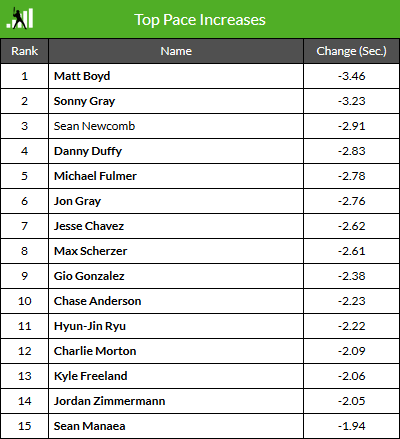
One of Bosio’s announced modifications he wanted his new charges, especially Jordan Zimmermann, to make, was to work faster on the mound. So far, they appear to have taken his advice. Fourteen pitchers have shortened their inter-pitch times by more than two seconds as compared to 2017, and three of them are Tigers starters:

pitcher pace

Zimmermann, Michael Fulmer, and Matt Boyd have upped their respective paces substantially this season over last season. I think that alone is a good sign, because it demonstrates both a willingness and ability to make changes in approach designed (or believed, at least) to improve outcomes. That’s the bigger question, though. Zimmermann, Fulmer, and Boyd are working faster, but are they doing better?

To try to answer that question, I propose a DRA-based comparison, which should allow us to see, on a rate basis, whether these three Tigers starters also have been pitching better in 2018 than they did during their slower days in 2017.

delta dra re pace

Of the three, Zimmermann had the smallest pace increase but the largest improvement according to DRA. Boyd, who’s shown the biggest pace increase of any pitcher, also has been better, while Fulmer has been a bit worse.

Without more digging, I don’t know that there are any broad statements to make about the consequences of speeding up on the mound. Importantly, we don’t know how the 2018 versions of these players would perform had they continued to work at their slower paces; the results might be exactly the same. The above does provide some circumstantial evidence that increasing pace can help some players, however, and it also suggests that Bosio was right to target Zimmermann as a guy who could benefit from operating at a faster pace.

______________________

The Tigers don’t have any of the top fifty players of 2018, as ranked by fWAR, on their roster. Third baseman Jeimer Candelario used to be on that list, but he now sits sixty-fifth (1.3 fWAR) after missing time with wrist tendinitis. He could return to the team later this week.

______________________________________________

Previously
WTF: Welcome Back Kozma – 5/9

Related
2018 Detroit Tigers Season Preview
Highlights from MLB Network’s visit to Detroit Tigers spring training

Continuing Education Jam

Before lunch yesterday, I learned two things. The second was that former St. Louis Cardinals shortstop Ozzie Smith, one of the most talented and popular players in MLB history, began his career in San Diego. Smith made his major-league debut with the Padres in 1978 and spent four seasons with them before they traded him to the Cardinals following the strike-shortened 1981 season. (In digging into this news-to-me, I also discovered that the Detroit Tigers were the first team to draft Smith, but he didn’t sign with them after they picked him in the seventh round in 1976. San Diego picked him in the fourth round the following year and he signed.)

The first thing I learned yesterday morning was that Dolly Parton is the author of the Whitney Houston hit “I Will Always Love You.” Parton’s original version is this week’s Jam: