No Place Like Home: Hawks drop game six, 95-88

pacers-hawks game 6

AD and Commodawg were at Phillips Arena– a/k/a The Highlight Factory a/k/a The Hawk’s Nest– last night with the hopes of seeing eight seed Atlanta clinch a first-round series over one seed Indiana. Instead, we saw a suddenly tentative Hawks team repeatedly surrender leads, including a four-point lead with about two minutes to go in the game, while the Pacers played as steady of a game as they have all series. I don’t know enough about the NBA to offer any real insight or analysis about what happened last night, but on the offensive side, it seemed to me that Atlanta kept finding the wrong shots for the wrong people. In particular, Jeff Teague, Kyle Korver, and Paul Milsap seemed to fail to fully embrace their roles on the team last night. Korver is a starter who also is a three-point specialist. He needs to make more than three treys, and he probably needs to attempt more than eight for the Hawks to win. Atlanta was good from the free-throw line as a team (87.5%, Teague was 9-9), but it would have been great to see Teague take over in this game, which neither team really seemed to want to win. In general, the Hawks need to improve their shot selection in game seven: 35.8% from the field isn’t going to cut it.

The atmosphere at the arena last night was a fun one. All the seats were filled, and everyone was dressed in red and engaged in the game from start to finish. For one night anyway, the Hawks had captured their home town’s attention. Here’s hoping they close out the Pacers on Saturday evening in Indiana and give those fans another reason to come out and support them in the postseason.

Book Review: Up, Up, & Away

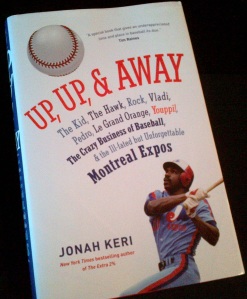
jonahkeriupup&awayJonah Keri has completed the keystone work of his young life with Up, Up, & Away: The Kid, The Hawk, Rock, Vladi, Pedro, Le Grand Orange, Youppi!, The Crazy Business of Baseball, & the Ill-fated but Unforgettable Montreal Expos. While Keri surely will continue to be one of the top baseball writers of this generation, he was born to write this book about his dearest baseball love.

The book tells the full story of the Expos franchise, beginning with pre-Expos baseball in Montreal, which included the minor league Montreal Royals, a team that counted Jackie Robinson and Roberto Clemente among its alumni, through the bitter end and the franchise’s departure to Washington, D.C. Readers learn about Montreal and the men who brought Major League Baseball to that city (and Canada) and administered it while it was there, but Up, Up, & Away really is a fan’s story of the talented characters who wore the red, white, and powder blue.

The Expos generally had two peaks in their thirty-five-year history. The first came in the early 1980s, Continue reading

Flying Tigers: Actually Mad Max

maxscherzersportsillustratedcover

Detroit starting pitcher Max Scherzer is the subject of this week’s Sports Illustrated cover story. The cover’s headline is “Mad Max’s $144 Million Bet,” and it asks whether Scherzer “Made a Dumb Wager on His Future.” Scherzer, who wanted all contract discussions to end by the time the season started regardless of whether he reached a new agreement with the Tigers, was not happy with the way SI framed the story about him, telling the Free Press he was “frustrated that they chose to put the contract stuff on the cover.” The reigning Cy Young Award winner elaborated:

When they approached us, [Tigers media relations] and I, we specifically asked not to make the story around the contract. … They assured us it wasn’t going to be like that. They chose a different route, and we felt like we were lied to and misled.

I didn’t want it to be about that. I’m a baseball player. I want to talk baseball. It’s frustrating when you get lied to about that.

The magazine responded that they knew Scherzer did not want to discuss his contract situation “in detail,” but stated that they did not make any promises about how they might present that subject in the context of the article.

The article itself (I’ll post a link once it’s available online) really does not spend much time on the contract issue at all. It’s mentioned roughly twice in the feature but never substantively analyzed. On the whole, the article actually is a nice profile of Max at an important stage of his career. It spends far more time discussing his analytical development at Missouri– the importance of the pitch following a 1-1 count, for example– and his development of a curveball with Detroit pitching coach Jeff Jones than it does his employment status and prospects.

The sensationalism of the cover’s “$144 Million Bet” language, described as a “dramatic $144 million offer” on the article’s introductory page, has the look of an editor’s efforts to boost general interest in the piece and the magazine as a whole. That introductory page asks, “What does [Scherzer] know that we don’t?” If that really was the question author Albert Chen was seeking to answer when he interviewed Max and wrote this article, he surely would have spent more time discussing broader matters of age, endurance, and pitcher decline than he did.

Those topics are there, of course, and so is the contract. It would be irresponsible not to include all of that in a Scherzer profile published this week. But Chen’s article doesn’t deliver on the sensational promises of his editor’s cover, and readers should be glad it doesn’t. They’ll learn a lot more about Scherzer in Chen’s article and have a more enjoyable time doing so than they would from a poorly sourced pot-stirring piece more suitable for ESPN First Take.     Continue reading

Flying Tigers: Waiting for Takeoff

A month into the season, the Detroit Tigers sit atop the tightly bunched AL Central with a tenuous 12-9 record. The team, guided by first-time manager Brad Ausmus, looks and feels much different than it did over the last two years. Whether due to the change at the helm or a not-quite-coherent set of offseason moves, the 2014 Tigers appear to have traded identity for tactics and strategy. Thus begins Flying Tigers,* our third Detroit baseball series.

__________________________________________________________

When Jim Leyland announced his retirement following the end of the 2013 season, we knew Motor City baseball would be different in 2014, but we didn’t realize just how different it would be.     Continue reading

Sporting Geography: Soccer’s arrival in Atlanta stirs old conflicts

Major League Soccer is expanding, and, thanks in no small part to the city’s planned new stadium, Atlanta will be the home of a new MLS franchise circa 2017.

Soccer fans are an enlightened bunch, nowhere moreso than in Ohio, apparently, where Columbus-based Massive City FFC, a soccer fan entity of some variety, reacted to the expansion news by reminding Atlanta residents that Gen. William T. Sherman, an Ohioan, burned their city to the ground 150 years ago. (Ohio has a lot going for it, you may recall.)

A work friend who has been on top of this soccer news tells me the mascot for Atlanta’s new MLS team is expected to be the Locomotive, given the city’s railroad history. Locomotive isn’t bad, but the Sherman comment made me think of another potential mascot, the Phoenix, which is central to the city’s seal and flag (pictured above) for even more obvious historical reasons. I think it would make a great mascot for any team in this town.

As a name, though, the Atlanta Phoenix carries the slight possibility for confusion, with Phoenix also being the name of another major American city. I’m sure a lot of funny internet people would have a lot of really hilarious and original comments to offer about that name. Rather than steal their thunder by listing all of the joke they could tell, I thought it would be more interesting to come up with potential sports team names in which the mascot is the name of another American city. Here’s what I have so far:

  • the Atlanta Phoenix
  • the Colorado Boulder

Here are a couple stretches:

  • the Cleveland Pitts[burgh] (almost perfect)
  • the Boston Bangors (spelling issue)
  • the Boise Grand Rapids (possible obscurity issue)

This is a fun game. Maybe even more fun than soccer or Ohio. Add your ideas in the comments below. (If you want real soccer talk from Brendan and Marcus, tune in to our latest podcast.)

Upton Abbey – S2E1 – April Showers

upton abbey banner

As planned, ALDLAND conducted a show of force during the Braves’ home-opening week, making our presence felt during game three of each series, which were played against the Mets and Nationals.

mets-braves 4-10-14

Although Atlanta lost that game and the series to the Mets that Thursday night, the game was a sign of things to come for the Braves. Continue reading

Baseball Notes: Rule Interpretation Unintentionally Shifts Power to Outfielders?

baseball notesInstant replay has been a leading topic of discussion across the baseball world during this young season. In an apparent attempt to reduce the use of replay challenges on infield double play attempts, MLB issued the following official rule interpretation statement:

Umpires and/or replay officials must consider whether the fielder had secured possession of the ball but dropped it during the act of the catch. An example of a catch that would not count is if a fielder loses possession of the ball during the transfer before the ball was secured by his throwing hand.

A baserunner running from first to second thus is safe if the second baseman drops the ball when attempting to throw it to first to complete the double play even though the second baseman cleanly caught the flip from the shortstop. (This video clip provides a clear and simple example of this scenario.)

As FanGraphs’ Dave Cameron realized, this seemingly innocuous rule interpretation actually carries sweeping implications for the defense’s control of the running game because it applies to outfielders as well as infielders. Cameron explains:

The drop at second base has no real impact on the runner’s decision making. The batter is sprinting down the first base line to try and beat out the double play, and probably will rarely even know the ball is dropped on the double play attempt. . . . 

That is absolutely not true with runners and outfielders, however; the decision of whether to advance or return to base is entirely dependent on whether the outfielder is ruled to have safely caught the ball. Runners are taught to get enough of a lead off the base to maximize their potential advancement in case the ball is not caught while still retaining their ability to return to their previous base if it is. When the ball enters the glove, the runner returns to their prior base in order to avoid a potential double play. Only now, the ball entering the glove is no longer the determining factor of whether or not the catch was made; that is now the ball moving from the glove to the hand.

A catch thus is not a catch until the receiving player secures the ball and then securely transfers it to his throwing hand. Cameron astutely realizes that there is room for exploitation here, and it comes in that second phase of the now more expansively defined catch process, the transfer to the throwing hand.     Continue reading

The “unkillable” Detroit Red Wings make the playoffs again

drwpitt

When a late goal sent their game into overtime and then a shootout against the Penguins in Pittsburgh last night, the Red Wings earned a point in the standings and secured a playoff spot for the twenty-third consecutive year, keeping alive the longest postseason streak in professional sports. As Deadspin put it this morning,

“the Red Wings sneaking into the playoffs” sounds like an underachievement. But this is a team that has absolutely no business being where it is, and it’s a triumph as big as anything Detroit’s achieved in years.

More on the Red Wings soon.

Upton Abbey: Season Two Preview

upton abbey banner

Upton Abbey is our Atlanta Braves series, now in its second season. B.J. and Justin Upton are off to rough starts, but overall, the state of Upton Abbey is strong. Tune in all season long right here on ALDLAND.

The Braves are opening at home this week with series against division foes New York and Washington. They started the season on the road in Milwaukee and Washington, going 4-2 on that trip, dropping just one game in each city.

Atlanta’s young, ascendant starting pitchers were the story heading into the season. That talent vanished with still-shocking swiftness, duplicate round-two Tommy John surgeries, and other injuries clearing out the bulk of the rotation. Still, the remaining starters, led by Julio Teheran and Alex Wood, have looked pretty good so far. Craig Kimbrel remains the best closer in the game, so that’s something that will help reassure a young, trembling group of starters. Reliever Luis Avilan’s hamstring injury, suffered this week, is cause for concern, but you’re getting the theme pretty clearly at this point.

The main non-injury offseason personnel event was the departure of free agent catcher Brian McCann to the Yankees. While the still-raw Evan Gattis (and the wily Gerald Laird) may be able to replace some of McCann’s hitting, we should pause here to note the likely dropoff when it comes to the glove. From 2008-13, McCann was the best catcher in baseball in terms of pitch framing; Laird and fellow Braves backup catcher Ryan Doumit were among the ten worst over that period.

______________________________________________________________

ALDLAND will be at Turner Field for two games this week. Tonight, Commodawg and AD will catch the rubber match in this opening series with the Mets. On Sunday, Physguy comes to town to join AD for the third game of the Nationals series. Stay tuned here and on twitter for the freshest insights and hottest updates.

______________________________________________________________

Related
Preseason BP Nuggets
A Boy, His Granddad and the Monumental Courage of Henry Aaron (via The Bitter Southerner)

Baseball Notes: Lineup Protection
From Barves to Burbs: What’s Happening to Baseball in Atlanta?

A Boy, His Granddad and the Monumental Courage of Henry Aaron (via The Bitter Southerner)

bitteraaronI was seven years old and my grandfather, who had not yet been diagnosed with leukemia and did not know he had only two years to live, was seventy-two when Hank Aaron stepped up to the plate to break Babe Ruth’s home run record.

For more than a year Granddad and I had been tracking Aaron’s climb up this Mount Everest of baseball statistics. No other player, not even the legends, had come close to hitting 714 home runs: Willie Mays ended his career with 660, while Mickey Mantle had finished with 536.

Ruth had retired from baseball in 1935 and died in 1948 but decades later remained an unassailable icon, flush with nicknames that lived vividly in the American imagination: the Babe, the Bambino, the Sultan of Swat. He is credited with no less than canonizing the home run, anchoring the preternatural status of the New York Yankees franchise, and cursing the rival Boston Red Sox to a century of futility. He still ranks on most lists as the greatest player who ever played the game.

But by April 1974, Aaron, who had grown up in Mobile, Ala., played in the Negro Leagues, and moved into the majors as the Civil Rights Movement began, sat poised to knock the Sultan of Swat down into second place. … Read More

(via The Bitter Southerner)