[UPDATED] Catching Fire: Mike Drop

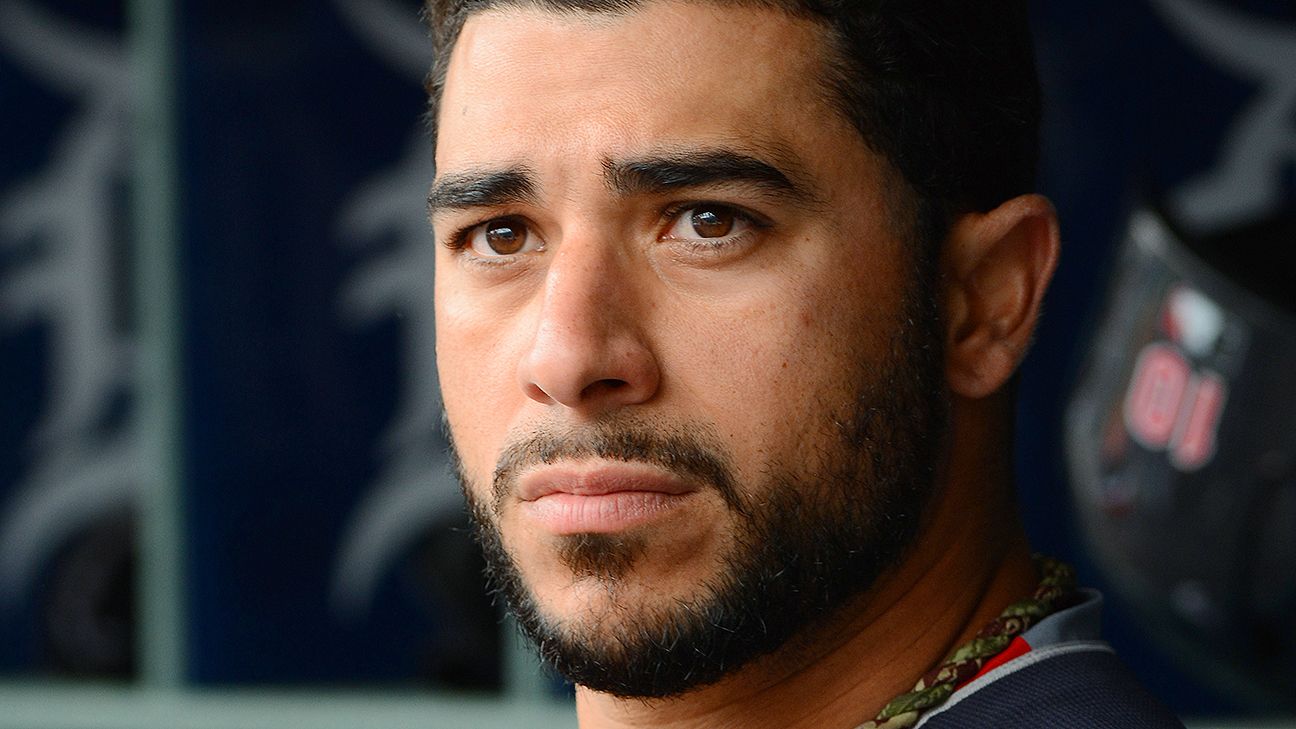
http://a1.espncdn.com/combiner/i?img=%2Fphoto%2F2015%2F0513%2Fmlb_g_aviles_b1_1296x729.jpg

UPDATE: Approximately seven minutes after we published this post, the Tigers took our advice and traded Aviles to the Atlanta Braves.

It’s reassuring to know that General Manager Al Avila has joined Brad Ausmus as an ALDLAND reader. If you would like to peer inside the mind of the Tigers GM, the original post remains below.

__________________________________________________

The clock is ticking louder than ever on the Detroit Tigers’ 2016 season, and, just at the very moment the team needs to be putting its best foot forward in an effort to win crucial games that will determine whether they make the playoffs, they are running out some of the worst lineups they’ve used all season.

Injuries are largely to blame for this untimely suboptimal roster utilization, as Detroit currently is without Cameron Maybin, Nick Castellanos, Jordan Zimmermann, Jose Iglesias, Shane Greene, and (sigh) Mike Pelfrey. In addition, Miguel Cabrera left last night’s game with what appeared to be a left shoulder injury, and his status is uncertain. Manager Brad Ausmus, facing this many significant losses, obviously is handcuffed– he has little choice but to lean, undoubtedly more heavily than he would prefer, on his reserves, backups, and alternates.

Modern MLB roster construction, with its emphasis on relief-pitching specialization, leaves little room for backup position players. The Tigers, like most American League teams, essentially have three: a backup catcher, and two other “utility” fielders, who can play a variety of positions whenever a regular starter needs a break, or as a defensive replacement late in games.

For Detroit, those two guys are Andrew Romine and Mike Aviles, and they aren’t very good. Back in June, when Iglesias was struggling, I wondered whether Romine, who appeared to be a very solid stand-in at short when given the opportunity, should take over the job? Nope. Back in March, before the season even started, I was worried about the scouting report on Aviles, which was starkly negative:

Aviles is no longer useful in a baseball sense[, and] his inability to reach base (.279 OBP from 2013-15) makes him a complete zero on offense, while what’s left of his defensive and baserunning abilities have become liabilities.

Harsh and, so far, accurate. Unsurprisingly, when both Aviles and Romine are in the starting lineup, Detroit almost always loses.   Continue reading

Catching Fire: Checking in on Justin Upton

juptigk

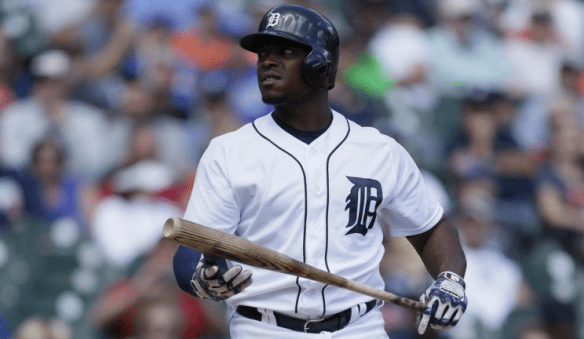
Everyone knows Justin Upton has had a tough go of things during his first season in Detroit, and it’s reasonable to expect that there would be an adjustment period associated with his move to the American League– new pitchers, new parks– after spending his first nine seasons in the National League.

When we last checked in on Upton, in late June, things finally seemed to be heading in the right direction:

Especially exciting for Detroit was that two of [the Tigers’ home runs in a win against the Mariners] came off the bat of Justin Upton, who finally appears to be heating up for his new team after suffering one of the worst offensive stretches of his career.

jupwrc20gmavg

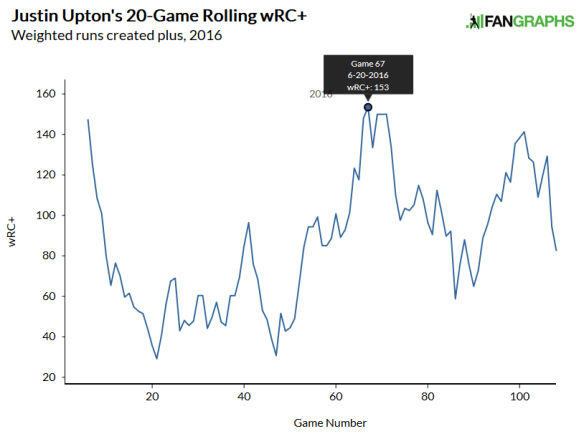
Upton has not continued in that direction, however; in fact, I seem to have caught him precisely at his peak. Here’s an updated version that same graph from the June post, above:

jupwrc20gmavgAug16

That earlier snapshot of Upton’s offensive production was through June 20, the date highlighted on this graph. Since then, Upton’s offense is declining again, and this graph (for reasons unknown to me) doesn’t even include the team’s two most-recent games, in which he went 0-7, striking out four times and grounding into two double plays.

jupmonthlysplitAug

At the moment, this season is the only full one of Upton’s career in which he has performed as a below-average batter, and, as the above all indicate, he’s been particularly bad of late. (Like, 6-wRC+-for-the-month-of-August bad.)

After the Mariners (coincidentally, the same team against which Upton appeared to break out back in June) completed a frustrating series sweep of the Tigers in Seattle early this morning, critics corralled their critical criticisms in Upton’s direction. Detroit hitting coach Wally Joyner came to Upton’s defense, however:

He’s a good player. He wasn’t sitting on the corner when they gave him the contract. He’s earned it. There’s a reason for that. Remember it. Nothing’s changed. He’s just a little bit unlucky right now.

He’s not OK with it and I’m glad he’s not OK with it. He’s working hard and he’ll be fine. He’s unlucky. He’s not playing like [crap].

Is Joyner right? Has Upton, of late, merely been unlucky?   Continue reading

Farewell, again, dear Prince

Nearly three years ago, Detroit Tigers fans said goodbye to Prince Fielder, whom the team traded in the 2013 offseason to Texas in exchange for Ian Kinsler. At the time, many were glad to see him leave, though some, including this author, were not. All must agree, however, that when Fielder left Detroit, he became barely a shadow of his former Ironman self. In his two years as a Tiger, he didn’t miss a single game. Excluding his rookie year, in the eight years he spent in Milwaukee and Detroit, he missed a total of thirteen games, playing the full 162 in four of those eight seasons. That’s an impressive accomplishment for any player.

If one wanted to be cold about it, one might note that, 2014, Fielder’s first in Texas, was a year of insult and injury for Prince. Not only did his trade replacement, Kinsler, make the All-Star team on his way to completing the second-best season of his career, but Fielder underwent season-ending neck surgery in late May, appearing in just forty-two games for his new club. He seemed to bounce back in 2015, posting a .305/.378/.463 line in 158 games, but it has been trouble again for Fielder in 2016. Despite his team’s success, Prince arguably was the worst position player of the first half of the season, and things weren’t looking up in the second half. After playing in all but five of the Rangers’ games through July 18, Fielder again went on the disabled list and, after undergoing a second neck surgery, is expected to miss the remainder of this season.

It may not just be the rest of the season he misses, however, as shocking reports emerged this afternoon that Prince’s career may be over:

If true, then, as a number of people have pointed out, Prince will finish with a .283/.382/.506 line, .304 TAv, .377 wOBA, 133 wRC+, 26.8 fWAR / 23.8 bWAR / 30.3 WARP, and 319 home runs, the same number of home runs his father, Cecil, with whom he seems to have reconciled, hit in a career just one season longer than his son’s.

Although serious injuries seemed to dim his wattage following the trade to Texas, I always will remember Prince Fielder as a complete hitter who was one of the happiest baseball players I ever saw. His friendship with Miguel Cabrera was particularly endearing.  What follows are some of my favorite images and clips from Prince’s playing days:   Continue reading

ESPN: Child Actually a Man

ESPN reports: “Manute Bol’s son Bol Bol is truly a man among boys on the basketball court.” And it’s true. Just look at the video. In it, we see the younger Bol among boys on a basketball court. Bol, the man, is at least a foot taller than even the tallest of the boys among whom he is on the basketball court, and, in terms of playing basketball, mature human Bol is superior to his infantile competition in every observable way. Further confirming the ESPN report are the facts that Bol is married with children, has a mortgage and a 401k, has completed a vision quest, goes to bed early, drives a sensible car, wears suits to church, hired a CPA to do his taxes and monitor his credit score, tells lame jokes, has a union job, may go to Home Depot, if there’s time, and (actually sadly) no longer lives with his father. Bol truly is a man among boys on the basketball court.

___________________________________________

Previously
No, ESPN, this very much could be someone’s granddaddy’s top five

How to put an end to the dark side of the Olympics (via The Volokh Conspiracy)

The Olympics are a great sports event. But they also cause great harm. Host cities routinely lose enormous amounts of money on the games, and end up with decaying stadiums that have little or no value. Even worse, governments often forcibly displace large numbers of people from their homes and businesses in order to make room for Olympic venues. Over 1 million people lost their homes for the 2008 Beijing games alone. Brazil has similarly evicted large numbers of people for the currently ongoing Rio Olympics, and even more to build stadiums for the 2014 World Cup. Most of those evicted are the poor and people lacking in political power. The Olympics also often become propaganda showcases for authoritarian regimes, as happened win the 2008 Olympics in China, and the 2014 Winter Olympics in Sochi, Russia. In an earlier era, the the same problem arose on an even more egregious scale with the 1936 Olympics in Nazi Berlin, and the 1980 games in the Soviet Union.

None of this has to happen. We can reform the Olympics to put an end to it. … Read More

(via The Volokh Conspiracy)

Catching Fire: The Tigers are not Utilitarians

jeremy_bentham

In the late 1700s, Jeremy Bentham introduced the modern world to utilitarianism, a political theory organized around the “fundamental axiom” that “it is the greatest happiness of the greatest number that is the measure of right and wrong.” Bentham believed that happiness is quantifiable (unit of measurement: util) and argued that governments should legislate so as to create the greatest amount of happiness for the greatest number of people.

Utilitarianism has its blind spots and, at least at its Benthamite core, is subject to the conceptual critique that it prioritizes majority preferences over minority rights (a classic critical example here), as well as the practical one that utils aren’t as susceptible to arithmetic in the policy-making context as other measurements of value, like, say, dollars. One of Bentham’s students, John Stuart Mill, later updated and expanded utilitarianism in an attempt to address some of its critics, and although some of the theory’s broader ideas remain in the modern political milieu, utilitarian is viewed as a relatively primitive approach today.

Mike Aviles, Andrew Romine

The 2016 Detroit Tigers are, to some extent, a team out of time. They are neither aggressively modern (e.g., Tampa Bay) nor hopelessly mired in the past (e.g., Arizona). With the trade deadline rapidly approaching, they are neither obvious buyers (e.g., Toronto) nor obvious sellers (e.g., San Diego). Observers have been declaring for years that the team’s “window is closing,” while conceding that it still is open and may remain as such for another season (in which they will repeat their hand-wringing diagnosis all over again). Given their aging roster, though, time is something out of which this team may be running.

All of that leaves the Tigers with two utility players, arguably a practical necessity in an age of limited rosters and relief pitching specialization, Andrew Romine and Mike Aviles. Unlike Bentham’s utils, it is fairly easy– and easier than ever– to calculate how much these two utility men contribute to the team. Readers may recall Aviles’ preseason scouting report (sayeth BP: “Aviles is no longer useful in a baseball sense,” and “his inability to reach base . . . makes him a complete zero on offense, while what’s left of his defensive and baserunning abilities have become liabilities”) or this more recent peek at Romine’s poor offensive numbers. To keep this part of the offensive update simple, the palindromic Romine (73 wRC+) and Aviles (37 wRC+) have been decidedly below average and aggressively below average hitters, respectively, to this point. Aviles, who’s received twice as many plate appearances as Romine, has been worse than all but ten other batters in baseball (minimum 80 PA), and four of those ten no longer have major-league jobs.

Since spring training, manager Brad Ausmus has insisted that carrying two utility players is not redundant, but the question remains: do Aviles and Romine, together, provide utility to their team?

In one basic, immediate respect, the answer clearly is no. Continue reading

The political costs of a new baseball stadium

braves_lee_deal

In his role as Cobb County Commission Chairman, Tim Lee probably thought that pushing through an expensive plan to relocate the Atlanta Braves from their downtown home to his northern suburban jurisdiction by skirting public referendum and delivering the pork for large business interests would, in return, lead to his reelection.

Once again, however, Lee has miscalculated. Challenger Mike Boyce, a retired Marine colonel, nearly defeated Lee outright in an election this spring. Boyce only secured forty-nine-percent of the vote, however, which sent him into a runoff election with Lee this summer.

As the Atlanta Journal-Constitution explained last month, “Boyce’s candidacy is drawing on a deep well of resentment over the deal, which was struck in secret without a public vote.”

Last night, that resentment drove Boyce to victory. He toppled Lee by securing sixty-four-percent of the runoff vote.

This won’t reverse the new stadium deal, of course, but it may serve as a warning to other politicians who, in the future, contemplate similar boondoggles.

_____________________________________________________________

Previously
Previewing the 2016 Atlanta Braves
The Braves are failing on their own terms
New Braves stadium project continues to falter
Georgia Supreme Court Upholds Cobb’s Braves Stadium Bond Deal
Braves Break Ground on Baseball Boondoggle
The yard sale at Upton Abbey continues
From Barves to Burbs: What’s happening to baseball in Atlanta?

Catching Fire: Is Brad Ausmus Evolving?, Or, Evidence That Brad Ausmus Definitely Reads ALDLAND

usa-today-8775862-0

Although it did not happen precisely as I predicted, the Tigers scored enough runs off new Red Sox pitcher Drew Pomeranz to allow rejuvenated starter Justin Verlander to depart after the sixth inning with a 2-1 Detroit lead. The offense added insurance runs in the seventh and eighth, but, with Justin Wilson on to take care of the power portion of the Boston batting order in the bottom of the eighth, the situation quickly became dicey:

chart

Those skyrocketing green leverage index bars right before the red ones are what pop up when you load the bases before you get any outs. Not good if you’re on defense. Wilson secured the first out by way of a strikeout, but the next batter singled, driving in a run and narrowing Detroit’s lead to two, with the bases loaded and only one out. That will earn you your first red leverage index bar of the night.

Wilson always looks a bit fidgety on the mound, and with the home crowd mockingly chanting his name like they would that of a visiting hockey goalie who appeared to be cracking under pressure, Wilson mustered his second strikeout of the inning. The reliever appeared, if not relieved, then not unhappy when manager Brad Ausmus came out to fetch him, surrendering the ball without protest. The team’s closer, Francisco Rodriguez, would be coming in to attempt a four-out save.

Not three weeks ago, a nearly identical situation presented itself to Ausmus and the Tigers. They were on the road in Toronto– another team they’re chasing in the AL Wild Card race– that night, and Verlander left in the sixth inning with Detroit up one. That favorable margin held through the top of the eighth inning, and Wilson was back out to handle the bottom of the eighth. He quickly got himself in trouble, putting two men on base. The next two batters made outs, but Wilson walked the third, leaving himself with bases loaded, two outs, and the slimmest of leads to protect. Last night, Ausmus went to his surest option, Rodriguez, in that spot, but on that night in Toronto, he turned to Alex Wilson, a decidedly less sure option, who immediately proved as such by surrendering the lead for good.

At the time, I criticized Ausmus for the decision to bring in Alex Wilson instead of Rodriguez, as well as for his stated reason for making that decision:   Continue reading

Catching Fire: Tigers offered another opportunity tonight against Pomeranz

pom

The Detroit Tigers are not out of the playoff hunt, but without any new faces likely to join their band during this in-season trade period, the team is going to need to take advantage of every beneficial opportunity the schedule affords them if their playoff push is to succeed.

The good news: on balance, that schedule is a favorable one.

remaining-schedule-strength

Detroit has the easiest post-All-Star break schedule among the AL Central teams, and they’ve held steady in second place for a few weeks now. First-place Cleveland has maintained a roughly six-game lead, though, and the Tigers also have been stuck at about four games back in the AL Wild Card chase as well.

Recent losses by relevant teams in both of those races– Boston, Cleveland, and Toronto– created an opportunity for the Tigers to make significant gains on both the divisional and wild card fronts. Detroit fumbled that opportunity, though, dropping two of three against the Twins and two of four against the White Sox.

They have yet another opportunity tonight at Fenway Park, though. Justin Verlander has been excellent again this season, and he’ll start tonight against the newest member of the Red Sox rotation, Drew Pomeranz. Detroit’s batters should be salivating.

As Joe Sheehan pointed out when Boston dealt a top prospect to San Diego in exchange for the Padres pitcher, Pomeranz isn’t exactly a model of endurance:

Pomeranz is up to 105 innings pitched heading into tonight’s start, and the twenty-seven-year-old doesn’t exactly have a track record of getting better as the season progresses:

pomxfiproll

Those late-season climbing trends in his xFIP indicate that Pomeranz, like many pitchers, tends to perform worse as his seasonal workload accumulates. He’s made one start for Boston so far, and it went badly. He lasted only three innings, surrendering five earned runs on eight hits, two of them homers.

Tonight’s game represents another good opportunity for Detroit to make progress toward a playoff spot. Even if that’s just a one-game wild card spot, this may be the closest they come to postseason action for some time, and they need to make the most of it.

First pitch is at 7:10 on ESPN.

______________________________________________

Previously
Catching Fire: Brad Ausmus is not saying, he’s just saying – 7/8
Catching Fire: Ian Kinsler is the San Francisco Giants of the MLB All Star Game – 7/6
Catching Fire: Night of a thousand feet of home runs – 6/21
Catching Fire: Pelf on the shelf – 6/16
Catching Fire: When is it okay to stop short? – 6/15
Catching Fire: Heading for the exit velocity – 5/17

Catching Fire: Boy, the starters need to carry that weight a longer time – 5/3
Catching Fire: Who’s Number Two? – 5/2

Related
Statements both obvious and only slightly less obvious about the Detroit Tigers’ finances
Shift the shift: Victor Martinez and counter-strategies
Feel like they never tell you the story of the Gose?
Getting to know Jordan Zimmermann in context
Highlights from MLB Network’s visit to Detroit Tigers spring training
2016 Detroit Tigers Season Preview: They’re Not Dead Yet