College football wrapup: 2014-15

The 2014 college football season is in the books, and Ohio State is the first school to win a national championship determined by a postseason playoff system.

Beyond the usual discussion of champions and coaching legacies (quickly: Urban Meyer– three national championships at two different schools, evil; Nick Saban– four national championships at two different schools, merely soulless), one of the central season-in-review topics of conversation, at least in these parts, is whether the SEC is over. Surprisingly but also not surprisingly, Paul Finebaum, voice of the SEC, answers the question implied in the previous sentence in the affirmative. (UPDATE: PFT Commenter emphatically concurs.) Although he’s been developing his position over the course of his daily radio show since roughly the first of the year, he summed up the general point in his appearance on Keith Olbermann’s show just before the national championship game:

In short: “It was a pretty bad year for the SEC.”

Although I contemplated the notion of Peak SEC at least as early as December 2012 and later pegged the possible date somewhat more recently, I’m not sure I agree that the SEC is over.

The SEC’s bowl record was 7-5. (They were 7-3 last year.) The Pacific Twelve was 6-2 (exclusive of Oregon’s national championship loss), the Big Ten was 5-5 (exclusive of Ohio State’s national championship win), the Big XII was 2-5, and the ACC was 4-7. In other words, among the power five conferences, the SEC had the most teams playing in bowl games and notched the second-best winning percentage.

What seems to concern Finebaum, though, is a sudden lack of championships. That people think the SEC is done for because one of its members hasn’t played for a national championship in a whole year and hasn’t won one in a whole two years is a testament to the never-before-seen degree of dominance the conference produced during the BCS era. Prior to Ohio State’s inaugural CFP championship on Monday, the Big Ten had 1.5 national championships since 1970. The SEC had nine in the BCS era (i.e., since 1998) alone. The ACC had two BCS championships, the ACC had two, the (now-defunct for football purposes) Big East had one, and the then-Pac Ten had one, since vacated.

After the hunt for Mississippi October turned up empty and OSU knocked Alabama out in the semis, the SEC may need to do a little more to earn its seeds next year, but I’m not sure we can say the conference is measurably weaker simply because it failed to produce a national champion this year. If anything, the above suggests the conference is as deep as ever.

_____________________________________________________

Transitioning toward the offseason and the 2015 season, I’ll use this space to remind everyone that Michigan State’s only losses in 2014 were to Ohio State and Oregon. The Spartans face both teams again in 2015, albeit without the aid of their departed defensive coordinator, Pat Narduzzi. Continue reading

College Football Playoff Selection Committee takes credibility hit with Manning departure

With news that Archie Manning is leaving his role as a Selection Committee member, the College Football Playoff © has taken another credibility hit. Despite his personal and familial ties to Ole Miss and the SEC, Manning actually was one of the less-concerning members of the Selection Committee from a conflict-of-interest standpoint. From that perspective, his departure will serve to magnify the already significant conflicts existing with the remaining committee members.

Read more about the potential problems with the new College Football Playoff, including conflicts of interest, here.

The committee will issue its first rankings after this week’s games.

Football: America’s Sport

Everyone knows that football, even college football, is all about the money. The SEC finally figured it out with their own TV network. Heck, even the Northwestern football players themselves figured it out.

What makes any sport America’s sport? Football often requires the word “American” in front of it to differentiate it from the football that the rest of the world knows. What about an option for enterprise? In major league sports, players, coaches, and the media all make buckets of money, but not the players in college football. Until recently.

Let’s take a step back. Imagine needing a source of cash flow and having some experience with the collegiate football process, but not enough skills (or motivation) to necessarily get hired anywhere as a coach or athletic director. Where is there an open source of money to be made? Well, there are those games where one team plays another of a vastly inferior caliber and division and pays that team for the right to lay the smack down. The lower tier conferences and divisions don’t rake in the cash like the top tier leagues do, so they are happy to take a loss for the money before going back to playing teams their own size (North Dakota State aside). Who is to stop me from making my own football “team” made up of eleven dropouts and getting paid to get smashed to bits every single week? Everyone else is raking in the dough in this industry, why not me?

What sentiment could be more American than that?

Of course, no legitimate team would schedule such a disreputable opponent, and there must be rules against that sort of thing, right?

The frontline journalists at reddit‘s college football discussion group, /r/cfb, uncovered just such an enterprise. User Honestly_ posted his/her findings yesterday. The post and many of the top comments are worth reading, but I will summarize a few of the highlights here.   Continue reading

Book Review: Paul Finebaum’s Conference has Beaten Your Conference (Probably)

IMG-20140814-00138For someone who spends twenty hours a week on national airwaves as the host of an eponymous radio show, now simulcast on cable television, and makes regular television appearances on a major network, Paul Finebaum sure does manage to keep himself hidden.
I am not a longtime listener of Finebaum’s show by any means. I first remember hearing about him when I moved back to SEC country during the 2012 football season and he was still broadcasting on Birmingham’s WJOX. Due largely to my own preconceived misconceptions, I was surprised when I first heard the show following its move to ESPN Radio in 2013 to find that it was an extremely caller-driven show, to the point where Finebaum rarely asserted his own voice for purposes other than briefly sparring with or otherwise egging on his admittedly bombastic callers. At that time, the majority of those callers remained Alabama-based, and the Alabama-Auburn football rivalry served as nearly every item on the host’s go-to menu.

While a lot of this struck me as fairly standard cheap talk radio tactics, I remained intrigued by this person, who had risen to such prominence and reported influence, despite, I thought, hardly taking active steps to exert much in the way of influence. I therefore read the then-recent and still-surprising long feature on Finebaum in The New Yorker with great interest and anticipation. I found the piece to be more an introduction for Manhattanites to the other SEC and its attendant culture than a deep dive on Finebaum himself. Finebaum as access point, rather than Finebaum as subject. (A long Deadspin feature from the same year had a similar effect.) It’s a worthwhile read if you like college football. Still, I did not feel like I knew or understood this man, though, or why he was so widely regarded.

Fast forward (the lazy blogger wrote) to August 14, 2014. The SEC Network, an ESPN entity, launches (on Tim Tebow’s birthday, naturally), and Finebaum’s book, My Conference Can Beat Your Conference: Why the SEC Still Rules College Football, arrived in my mailbox.

Continue reading

Vanderbilt wins the College World Series, claims its first-ever mens’ national championship

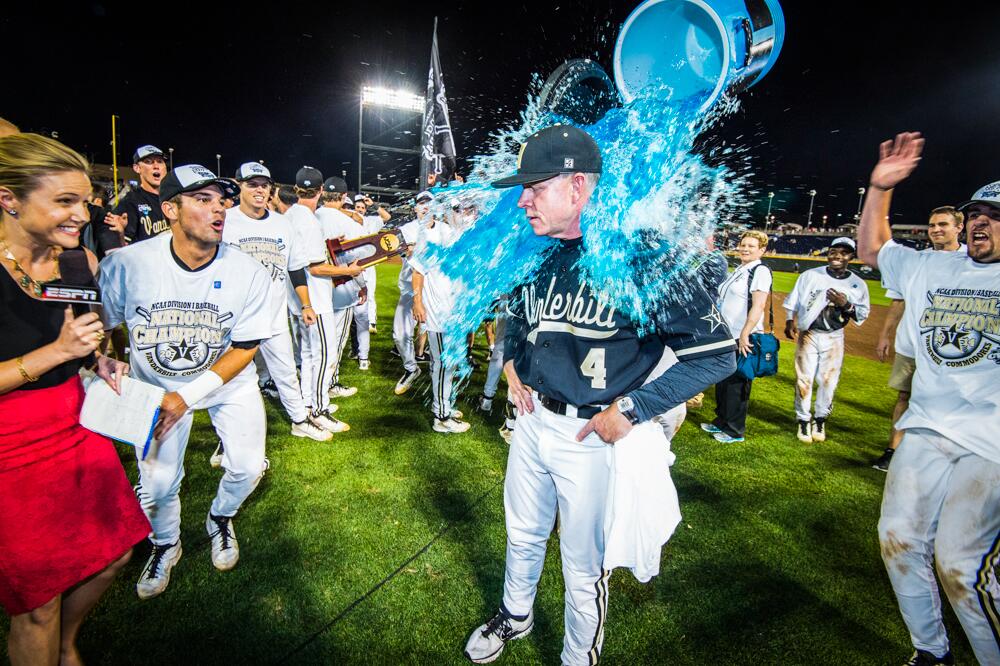
After struggling through the first two games of the College World Series, Vanderbilt came out looking like a team that belonged in the final pairing in a much tighter game three. The Commodores drew inspiration from energetic and emotional starting pitcher Carson Fulmer, who really limited the Virginia bats for the first time this series. Timely hitting finally arrived for Vandy as well: Although they only plated one run in an extended first inning, the only inning for UVA starting pitcher Josh Sborz, VU claimed the only home run of the series, John Norwood’s solo blast that proved to be the game winner, in the eighth. After that, Vanderbilt reliever Adam Ravenelle dealt two innings of solid relief to close the door on Virginia and secure the 3-2 victory. (Fans of the MLB team that drafted Ravenelle, the Detroit Tigers, are already asking whether he’s available to help stem the club’s bullpen woes this season.)

For Vanderbilt, a charter member (1932) of the Southeastern Conference and a university with an interscholastic athletic history dating to the 1800s, last night’s win was especially remarkable, because it was the school’s first-ever national championship for a men’s team, and just its second national championship overall. (The women’s bowling team claimed the school’s first national championship in 2007.) This win certainly feels like the culmination of the steady development of the VU baseball program by coach Tim Corbin, and with a very young roster, it shouldn’t be surprising if his Commodores are back in Omaha next year to defend their title.

______________________________________

Postscript: Like any overdue collegiate athletic victory, last night featured a post-game marriage proposal. After his team won it all, Vanderbilt pitcher Brian Miller came away with a win of his own as well. Long live college sports.

History at stake in the College World Series finale tonight

The outcome of tonight’s game between Vanderbilt and Virginia will decide the College World Series. A victory for the end of the alphabet is guaranteed, but for Vanderbilt, the stakes are higher: a win would be the school’s first national championship for a men’s team, and only its second overall. (The VU women’s bowling team won it all in 2007.)

After winning game one of the best-of-three series on Monday, the Commodores had a chance to clinch last night. They were unable to hold an early 2-1 lead, however, and ended up falling 7-2. While some are criticizing Vandy coach Tim Corbin’s decision to leave starting pitcher Tyler Beede in to pitch the seventh inning, during which Virginia’s 4-2 lead expanded to a 6-2 lead, the real problem lies with Vanderbilt’s absentee offense. There remains plenty of attention on Vanderbilt’s nine-run third inning in the first game, but UVA still owns the run differential advantage, 15-11, over the two games. Take out that wild third in the opening contest, which was as much a result of an early and unexpected pitching collapse as it was Vandy plate discipline or hitting, and that expands to a 15-2 advantage for Virginia. The truth is that VU has been unable to generate its own offense in this series, and outside of one disastrous frame, Virginia has been in control. The Commodores aren’t a power-hitting bunch, and the conditions in Omaha won’t do anything to change that, but one has to believe the Vandy bats are due to come alive. They must do so tonight if the Dores are going to claim this national championship.

While a Vanderbilt win tonight would make school history, and last night’s bid may itself have been historic as (possibly, I haven’t researched this) the school’s first actual opportunity to win a men’s national championship, the Cav-Hoos are carrying the mantle and burden of a conference into tonight’s game: The ACC has just one College World Series win, and it came in the 1950s, when Wake Forest topped the Broncos of Western Michigan.

SEC Disclosure: An Intellectual Separation as Manziel Moves North?

kylefield

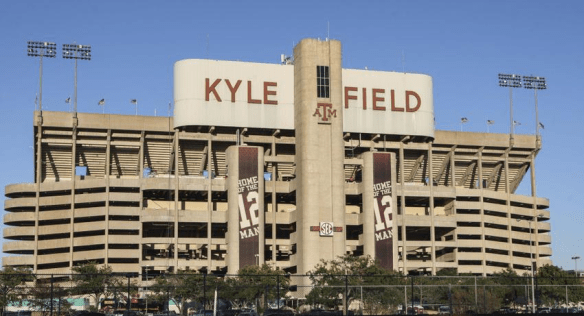
No-longer-suspended-from-Twitter ESPN “Sports Business Reporter” Darren Rovell buried the lede in a story published yesterday related to the news that some leaders at Texas A&M are considering renaming the schools’ football stadium “Kyle Field: The House That Johnny Built.” Rather than a foolhardy, if historically accurate, branding exercise, the real story here is the apparent rift between former Aggie quarterback Johnny Manziel and “Uncle” Nate Fitch, Manziel’s longtime friend and manager of sorts.

The details of Fitch’s relationship with the former Heisman Trophy winner are sketchy, but the story seems to be that Fitch saw a star in his high-school friend and went all-in:

[Fitch is] a college dropout, in the entrepreneurial sense of the word, more dreamer than slacker. He’s Manziel’s assistant, media coordinator, business manager, designated driver. He goes by Uncle Nate, which is a nickname Manziel says Fitch gave himself. Fitch, 20, allegedly works for free, betting on the come, looking into the future when Manziel is an NFL star. He wears a gold rope bracelet, acting like an agent on a television show, talking with confidence about tit-for-tat horse trading and his deep knowledge of the NCAA rulebook. . . . As publicists go, he handled himself like a pro.

Now, however, the news of the possible renaming of Kyle Field has shed new light on the relationship between Fitch and Manziel, and it looks like the two aren’t on the same page. According to the Rovell story, Fitch’s family attempted to register “The House That Johnny Built” as a trademark, but the U.S. Patent & Trademark Office refused the requested registration. Manziel himself already applied for the same trademark back in January.

What’s going on between these two? I obviously don’t know, and my sources in the Houston area aren’t talking, but it sure looks like Manziel and Fitch have gone from collaborators to competitors.

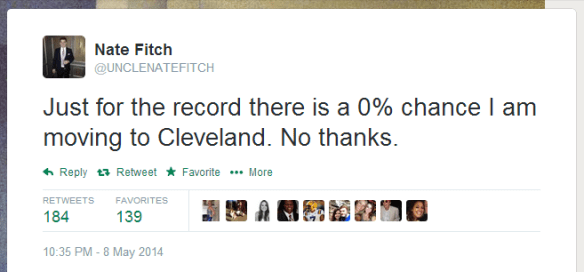
About an hour after the Cleveland Browns drafted Manziel late in the first round of the NFL draft last week, Fitch posted a tweet:

fitchtweet

There are plenty of obvious potential narratives here, but the fact that no one seems to be investigating the apparent discord between Manziel and Fitch may simply be a testament to the overwhelming scope of the NFL stage. Over the past two years, reporters couldn’t get enough of Johnny Manziel, SEC quarterback. As of last Thursday, though, he’s just another NFL rookie.

ALDLAND Podcast

Hello ALDLAND listeners, its the ALDLAND Podcast team, and we have quite the episode for you this week. Lip service is paid to the end of the Olympics and Canada is blamed for things that are assuredly their fault. If that’s not enough, your two favorite co-hosts get deep into discussing the NCAA tournament bubble.

_______________________________

Download the ALDLAND podcast at our Podcasts Page or stream it right here:

The OKTC-Fox Sports merger is complete

I’ve been keeping an eye on Clay Travis’ SEC-football-oriented site, Outkick the Coverage, since its inception, more recently tracking changes associated with the site’s acquisition by Fox Sports. As detailed in the comments here, certain small changes indicating the Fox connection had been appearing on OKTC as early as last July, and today, that transformation appears to be complete, as evidenced by the site’s facade redesign.

oktcnewEven the base URL and browser tab icon have become those of FoxSports.com:

oktctabPerhaps most importantly, OKTC now has a permanent link on FoxSports.com’s college football portal page, favorably situated right under the College Football header.

fscomThis can only portent well for Travis, who has continued to expand his television role with Fox Sports 1, even parlaying that into a Super Bowl assignment. Travis has been public about his expiring contract with what has been his main employer, WGFX, 104.5 FM in Nashville. While Clay seems unlikely to leave Music City and the SEC football beat entirely, he definitely is expanding his reach and the scope of his coverage. The only thing that seems unlikely for Travis in the near future, given his deepening ties with Fox and a possibly distant relationship with Paul Finebaum (or at least Finebaum’s callers), is a move to ESPN’s SEC Network, which launches this August. Fox undoubtedly recognizes the value of the SEC and the Southeast. How heavily they’ll rely on Travis to bring that audience to Fox remains to be seen, but they certainly aren’t running away from him.

2014 BCS National Championship Preview

The final BCS National Championship Game is tonight at 8:30 pm on ESPN between Auburn and Florida State. The Seminoles, behind Heisman winner Jameis Winston and a robust defense, are heavily favored, but that’s no reason to think the Eagles/Tigers/Plainsmen can’t win. When I previewed all the bowl games last month, I wrote of this one:

Florida State and Auburn round things out in the final BCS National Championship Game before the implementation of the College Football Playoff next season. If this game was being played this weekend, I’d have an easier time picking Auburn to win. Although the Eagles/Tigers/Plainsmen have beaten Alabama, Missouri, Texas A&M, and everyone else on their schedule with the exception of LSU on the road, I think all of the time off will allow Florida State to better prepare for Auburn’s packaged offensive scheme. I can’t help being reminded of Auburn’s last national championship, in a game in which I also thought they were severely overmatched. Auburn’s giving up forty-two points to Missouri in the SEC championship game worries me, but they’re still my tentative pick to win it all on January 6.

I don’t know that anything has happened since then to make me feel more confident that Auburn can win, so I’m going to leave my prediction as it is. Feel free to add yours in the comments below.

(Sidebar: Picking bowl games is a little bit difficult. This year, my picks were pretty scattered, none worse than picking Rice to beat Mississippi State in the Liberty Bowl, which ended up being one of the few bad games this postseason. Still, I would like to note that ESPN the Magazine went 0-fer in its BCS bowl predictions. They had Alabama by 14 in the Sugar (Oklahoma by 14), Baylor by 20 in the Fiesta (UCF by 10), Ohio State by 6 in the Orange (Clemson by 5), and Stanford by 15 in the Rose Bowl (Michigan State by 4).)

For your pregame reading, I offer the following selections:

  • The Making of a Modern-Day Guru: How Gus Malzahn went from high school defensive coordinator to college offensive mastermind, and took Auburn to the brink of championship glory in the process Grantland
  • Florida State: Unbeaten and Untested. In contrast to Tigers, Seminoles Took the Path of Least Resistance Wall Street Journal
  • Equal Justice Under College Football Playoff: College football will take a big step forward when it adds a two-round, four-team playoff, but it will take a step backward when it replaces the BCS ranking system with the College Football Playoff Selection Committee ALDLAND

Enjoy the game tonight.