We’re not really into class politics around here, but, in this day and age, one can’t help but ask: did you really make a good tweet if you didn’t thereafter blog that tweet? I don’t know but I’ll give it a shot, if for no other reason than to create an excuse to post some music on a Wednesday.
After Phish released its St. Louis ’93 box set, which chronicles two separate concerts four months apart in that city’s American Theater, I had the idea that I would write a two-part review of the release. In the first part, I would explain how the recording of the April 13 performance fit nicely between the raw, excitable energy exhibited on the At the Roxy box set, which captured three nights at the former Roxy Theater in Atlanta in 1992, and their breakout in 1994 (most widely distributed in the form of the two-disc release entitled A Live One).
That’s about as far as I got, because I came up with the idea after listening to the April concert, but I hopefully anticipated that, after listening to the August 16 performance, I’d be able to note something about the band’s noticeable growth over a short but very dynamic period in the group’s history.
As those of you who read this website with due care already know, I wrote neither of those reviews. That happened (or didn’t) in not-insignificant part because I don’t think the second night demonstrated the sort of growth, coalescence, or development I had believed it might. Top to bottom, the first night clearly is better, in my opinion, and I have returned to it more often than the second.
It wasn’t a mistake to include the August performance, though. The theme of the set wouldn’t make much sense, or really even exist at all, without it, of course, and if the plan simply was to release one night from 1993, maybe there were better options even than the April date in St. Louis. I don’t know. More than mere marketing logic, however, the August concert belongs because of its peaks. For example, the second set Mike’s Groove opener is solid, and the “Rocky Top” encore finisher is fun.
The real highlight, though, and what I suspect was a major factor in the decision to do this release at all, is the first-set “Reba.” Listen for yourself, and have a sublime weekend.
John Perry Barlow, an advocate for an internet free of government regulation and longtime Bob Weir friend and songwriting collaborator died this week. I don’t know for sure where Barlow is right now, but if he’s on his way to Hell in a bucket, I at least am reasonably confident he enjoyed the ride thus far.
In a time-honored sporting tradition, what started out as a historic trend soon may become merely notable. While NFL officials, through week fourteen, have thrown their penalty flags at a rate that would constitute an all-time* high, that rate has been falling as the season has worn on.
My note from last week still applies: 2017 now looks quite close to the prior peaks in 2015 and 2014. If things continue as they have this season, 2017 still will be the high-water mark for penalty flags in the NFL, but the week-to-week trend strongly suggests that that is not a reasonable assumption. That trend also lends some support to the idea that abbreviated preseason training leads to worse play early in the regular season.
* The NFL Penalty Tracker has data going back to the 2009 season, but I’m pretty confident that we still are witnessing the all-time high-water mark.
Something that I had expected might be occurring now seems from the updated numbers like it might, in fact, be occurring, which is that my imperfect flag-rate metric is both (a) continuing to fall and (b) now close to falling out of historic* range. Come look for yourself:
As a season, 2017 now looks quite close to the prior peaks in 2015 and 2014. If things continue as they have this season, 2017 still will be the high-water mark for penalty flags in the NFL, but the week-to-week trend strongly suggests that that is not a reasonable assumption. That trend also lends some support to the idea that abbreviated preseason training leads to worse play early in the regular season.
Obviously it would be interesting to track flag rates for each of these seasons on a chronological weekly basis. A project for the offseason, perhaps. Meanwhile, since the terrible Giants have been in the news recently, an interesting note that only one team (Carolina) has been flagged fewer times than the 2-10 G-Men.
* The NFL Penalty Tracker has data going back to the 2009 season, but I’m pretty confident that we are witnessing the all-time high-water mark.
New York Yankees starting pitcher CC Sabathia had a big night last night, giving his team a much-needed six-inning shutout start and a chance to even the series against the Houston Astros in the ALCS. With Sabathia, at age thirty-seven, in the final year of his current contract, Sabathia’s performance made some wonder about his Hall-of-Fame credentials, a subject I attempt to parse in only slightly greater detail in my latest post for Banished to the Pen.
Another empty rocking chair in the Wilbury household this week, sadly, as Charlie T. rode the late train out of town to join Lefty and Nelson at the end of the line.
Tom Petty was a hitmaker on the volume scale of Motown’s song factories, and the “was” in this sentence is doing a lot of grim work, because, in contrast to some other mourned celebrity passings, Petty, at sixty-six, remained an active and strong performer. We saw him in concert just this spring, my first time, and he was just as good and strong as I hoped. There’s a real loss here.
A 2009 Wall Street Journal article published in conjunction with the release of Petty’s career-retrospective Live Anthology memorably made the case that Petty’s slightly lower situation in the proverbial Rock Pantheon was due, in my reading, to the irony that his songs were too popular. It’s funny because it’s true, but it says more about the fans than the artist. We hold Springsteen, to borrow the foil from that WSJ piece, in higher regard because he had fewer hits? I don’t know why, or if that’s how it really works, but at some point it misses the mark to parse the greats like this.
It also misses the mark on Petty, who always seemed to belie his deep catalogue of radio-friendly tunes with his ability to wink at that great big world of entertainment with a sly smile worn by one who could take or leave the trappings of celebrity that pop stardom can offer. As he told the Journal in ’09, “We were never really Boy Scouts, you know. My vision of a rock and roll band wasn’t one that cuddled up to politicians, or went down the red carpet. That kind of thing you see so much of today. I felt like once that stuff starts happening your audience doesn’t know whether to trust you or not.” That article continues:
Mr. Petty set himself apart in other ways. While Dylan and the Stones have licensed their music to advertisers, Mr. Petty says, what for? “We don’t really need the dough that bad.” The singer has sought keep his concert tickets affordable. And unlike, say, Mr. Costello, who has collaborated with string quartets, Mr. Petty says he’s satisfied with being a workaday auteur: “To write a good song is enough. That was the loftiest ambition I had: to write a song that would endure.”
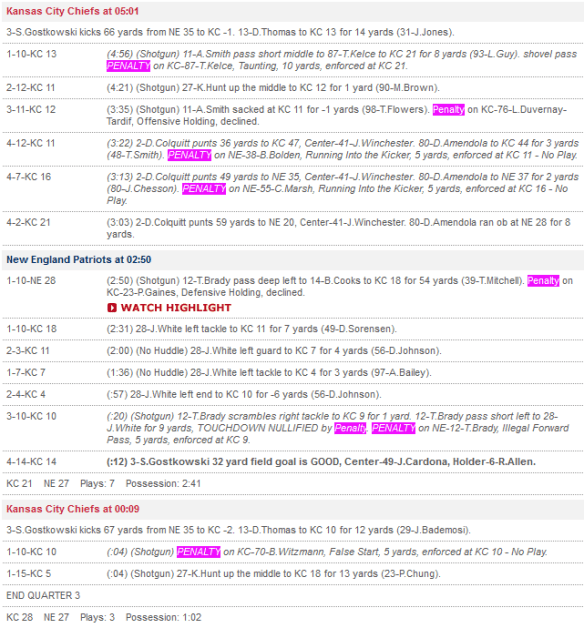
The NFL’s back, and oh man is it boring. Last night’s Chiefs-Patriots game, the first of the 2017 regular season, should have been exciting. Kansas City hung close with the defending champions in Foxboro until they pulled away later in the fourth quarter. What should have been a compelling contest instead dragged. The third quarter alone took nearly an hour. Even if the NFL has eliminated the touchdown-commercial-PAT-commercial-kickoff-commercial sequence, the penalty flags literally are getting out of hand too often.
The last five minutes of the third quarter was comprised of fifteen plays from scrimmage. Officials threw flags on seven of them.
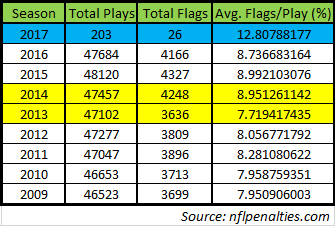
If it seems to you like penalty flags are on the rise, you aren’t wrong. From the NFL Penalty Tracker, a website I just found:
The 2017 data comes from one game, of course, but the referees were significantly more active last night as compared to an average game last season.
Another interesting point in that penalty-flag data is the jump in total flags beginning in 2014. It isn’t immediately obvious to me why that happened (here‘s a list of rule changes heading into that season), so I’ll just quote from my Super Bowl XLVII preview post:
Call it the Efficient Breach Bowl. According to the Wall Street Journal, the Seattle defense is so successful against the pass, in part, because they just don’t care about being penalized for pass interference. They know that officials won’t call PI on every single play (and the number of penalties called in the playoffs is significantly lower than during the regular season), so they take their lumps with a few flags over the course of a game, disrupting receiver routes all the while. In a follow-up article in advance of the Super Bowl, the Journal suggests that Denver may look to combat Seattle’s aggressive secondary through so-called “pick plays,” in which receivers run routes designed to shed defenders by drawing them into collisions with another player. Though subject to recent controversy following a play in the AFC Championship game that resulted in a game-ending injury for New England corner Aqib Talib, picks or “rub routes” are not necessarily against the rules. As The MMQB’s Greg Bedard explained, the key question is whether the offensive player initiated the contact or whether the contact was incidental: “within one yard of the line of scrimmage, anything goes . . . but beyond that one-yard buffer it is illegal for an offensive player to initiate contact with a defender.”
The Seahawks won that Super Bowl (if you can name the MVP of that game without looking, I’ll send you some ALDLAND merchandise), so it isn’t unreasonable to speculate that other teams would mimic their aggressive defensive approach beginning in the next season, thereby triggering more penalty flags leaguewide, but I haven’t looked at an offensive/defensive breakdown of those numbers in the table above.
For years, people have been predicting that football would end as a result of its potential for dangerous, lasting injury, including brain injury, but we need to consider the possibility that a different and more immediate market force– boredom– might trigger its decline even sooner.



 ALDLAND