On the Road Again: A study of NHL rink variation

One of the important background dimensions to comparative baseball statistics is known as “park adjustments,” a set of corrective factors applied to account for the physical differences (e.g., outfield wall depth) between each park. Among American sports today, only Major League Baseball and NASCAR (and golf, I suppose) permit such structural variation between the competitive arenas themselves.

Professional hockey used to be in that group too. More than merely adjusting, adding, and subtracting lines on the ice to affect the flow of play, as the NHL continues to do (cf. the NBA three-point line), the rinks themselves used to be different sizes. League rules mandate a uniform rink size, but so-called “small rinks” persisted in the NHL as late as the 1980s and 1990s in Boston, Chicago, and Buffalo.

While hockey does not face the structural differences present in baseball, there still is a need to apply rink-by-rink statistical adjustments. That’s because the compiling of basic hockey statistics (e.g., shots, hits, turnovers) requires statisticians to make judgment calls to a more significant degree than in a discrete-event sport like baseball.

By way of limited background, the NHL collects basic gameplay statistics through a computer system known as the Real Time Scoring System (RTSS). A benefit of RTSS is that it aggregates and organizes data for analysis by teams, players, and fans. A vulnerability of RTSS is the subjectivity alluded to above that comes when human scorers track a fluid, dynamic sport like hockey.

While others have noted certain biases among the RTSS scorers at different rinks, a paper by Michael Schuckers and Brian Macdonald published earlier this month analyzes those discrepancies across a spread of core statistics and proposes a “Rink Effects” model that aims to do for subjective rink-to-rink differences in hockey scoring what park adjustments do for structural differences between baseball parks.    Continue reading

Who’s conflicted about sports? Giancarlo Stanton theme-and-variation edition

I didn’t expect the opportunity to write another post about an ESPN SportsNation poll to arise so soon after the last one, but rumors of a $300 million contract for Miami slugger Giancarlo Stanton have ESPN asking its totally equipped to answer this question audience whether they think the potential contract is a good idea.
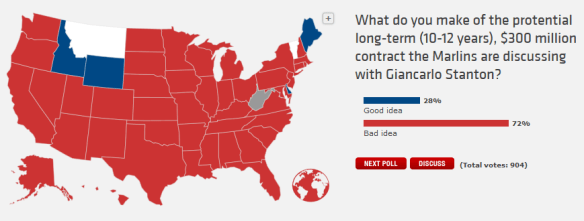
Here’s how the responses look:

stanstentiaWhile we could discuss angsty West Virginia’s inability to make up its mind on this question, the interesting twist, for our purposes, is that Montana and Vermont have entirely declined to weigh in. Their silence leaves us with a void into which we are left to impute existential meaning (or, in Vermont’s case, ice cream). Are Montanans and Vermonsters so disgusted by the very asking of the question that they refuse to dignify it with any response? Or, in an act of humility, have they recognized their own shortcomings with respect to the ability to analyze the relative merits of a long-term arrangement fraught with numerous physical, financial, and psychological components, a task that escapes mastery by even the leading minds in the field, and decided to refrain from acting beyond the scope of their limited, though completely normal, faculties? Or, to consider yet a third alternative, are they already out skiing and/or loaded up on Heady Topper and thus too busy to be bothered to respond?

Based on my hypothetical polling of my actual friend, a Vermont native who lived in Montana, I suspect these two electorates simply may not have an opinion on the matter. As we now have seen, such a posture so confounds ESPN/SportsNation’s “embrace debate” mentality that their reaction is to wipe you off the map.

UPDATE: Montana and Vermont have broken their silences, unanimously agreeing that this contract is a really bad idea! As always, click the map above to see the latest results.

Bronson Arroyo: Songsmith

Last week’s Sports Illustrated closed with a remembrance of Adam Dunn’s career that included the following information:

While hip-hop paeans name-checked Jeter, the only tune anyone ever composed about Dunn came from his Reds teammate, and part-time musician, Bronson Arroyo. The pitcher reworked a song to reflect his friend’s typical late September demeanor. Says Arroyo, “The lyrics were like, ‘I’m Adam Dunn, I’m so glad the season’s over, I just want to get home and be sipping on a beer by the pool and get away from this b.s.'”

Yeah, I don’t know either.

ALDLAND Podcast

Although it is less regular than you might be used to, the ALDLAND Podcast has not decreased in quality at all. This episode is no exception, as topics of conversation run from usage of Ebola to drive traffic at ALDLAND to the NFL to the Kansas City Royals. With that kind of coverage, you should listen to this podcast at least two or three times and tell every single one of your friends to do the same.

 _______________________________

Download the ALDLAND podcast at our Podcasts Page or stream it right here:

ALDLAND Podcast

ALDLAND is finally back with another podcast. Things like work and vacation could only stop us for so long, and now it’s time to get back into the podcast game. We catch up on a lot of things, but mainly baseball and college football. So take a listen and get ready for the return of the best sports podcast ever recorded.

_______________________________

Download the ALDLAND podcast at our Podcasts Page or stream it right here:

Braves Break Ground on Baseball Boondoggle

The Atlanta Braves broke ground this morning on their new Cobb County stadium, which makes today a good day to remember that the whole thing is a shameful crock.

The new field will be known as SunTrust Park. The only things I know about SunTrust are that they provided bad customer service once and now are providing material support to baseball terrorists.

At the unveiling of the brand-new park, the (almost) brand-new MLB commissioner, Rob Manfred took the opportunity to say something nonsensical:

I think what is special about this project is the scope of the project itself. It could geometrically change the economics of this particular franchise and really provide it with a great foundation for being competitive for a very long time.

?

Finally, a reminder that the traditional justification for publicly funded sports stadiums is a sham. SunTrust Park is no exception.

The (Walking) Death of Sports on Earth

soe

Last month, in a story that was poorly reported to the then-staff of the site Sports on Earth, to say nothing of the general public, it snuck out that, in some order, USA Today had pulled out of its partnership with MLB that supported the site and ninety-five percent of the site’s staff had been let go. The soldiering-on of “senior writer” Will Leitch (which is far from nothing) aside, SoE exists today at best as a sort of undead shell of the vibrant self Leitch and its former staff had built in what I called an important “second chapter” of the site’s history.

As David Roth, Keith Olbermann, and even Leitch himself have commented, the whole thing came as a surprise even to the writers, many of whom found out about the great “unwinding” for the first time on Twitter.

We have tracked the rise of Sports on Earth since its birth, and we’ve highlighted plenty of their many well-done stories in the past. From a technical standpoint, SoE was designed for optimal reading on a tablet, and, for me, it held the position of go-to breakfast-table reading for a long time.

I was just a reader. For The Classical’s David Roth, the whole thing was more personal, as he was friends and colleagues of many of the dispatched writers, many of whom also had written for The Classical. I learned about Sports on Earth’s demise from Roth’s extended obituary, which also expounds upon the challenges of sustaining and supporting interesting sports writing in today’s media landscape.   Continue reading

Flying Tigers: The State of Baseball in Detroit

The Detroit Tigers, once unequivocal favorites to run away with the AL Central, today find themselves clinging to a wild-card spot. And today is a good day. A if-the-season-ended-today-the-Tigers-would-make-the-playoffsish day. Not all days are those days these days.

Even with a 7-3 record over the last ten games (you’re glad I didn’t write this post ten games ago), Detroit has a losing record so far in the second half of the season (23-24, -4 run differential). While the offense, unaddressed before the trade deadlines, continues to be a problem, injuries to Anibal Sanchez, Justin Verlander, and Joakim Soria effectively negated any defensive gains resulting from the team’s only two late-season trades.

The group of “rational Tigers fans” beat back even the slightest hint of worry with blanket appeals to the greatness of the historically great members of this Tigers team. “Don’t read too deeply into the struggles you’re seeing because this team has MIGUEL CABRERA, who can’t possibly lose” or whatever. It’s important to vent, though. And to be honest (and, you know, rational). Cabrera can barely walk right now. Yes, he’s leading the sport in doubles this season, but that’s because his power has evaporated (i.e., he’ll probably finish the year with half as many homers as he hit last year and, at very best, the third-worst HR season of his career). His injuries mean that Victor Martinez has to spend more time playing first base. At age thirty five, Victor’s having a breakout power year, but he has no knees, which makes it tough for him to defend first. J.D. Martinez and Ian Kinsler’s bats have cooled off after hot starts. None of the various replacement-level players filling time at short can hit, and there’s a noticeable problem with catching the ball to tag out base stealers.

How do things look with a month, twenty-four games, to go? Continue reading

Big Leagued: Durham Bulls comeback fails, fall to Charlotte 6-5

IMG00547-20140816-1931Nobody hit the bull and won a steak, but there was plenty of offense, and not quite enough defense, in Durham on Saturday night, where the Bulls (AAA-Tampa Bay) lost to the Charlotte Knights (AAA-White Sox) 6-5.

There was a decent helping of recent, and probably future, MLB-level talent on display too. The Bulls’ starting lineup featured David-Price-trade-acquisition Nick Franklin, rehabbing 2013 AL rookie of the year Wil Meyers, and former Detroit Tiger and Atlanta Brave Wilson Betemit. The Knights sent out former Tigers outfielder Matt Tuiasosopo.

IMG00546-20140816-1930

The game was so tight through the first five innings that when Charlotte finally plated the first run of the night with two out in the top of the sixth, the Knights’ 1-0 lead felt insurmountable. They built it to 3-0 in the top of the seventh, seemingly sucking the energy out of the home crowd.    Continue reading

Flying Tigers: How the David Price trade could help the bullpen

dpvu

As the aftershocks of the David Price trade continue to ripple across the baseball landscape, Tigers fans still are trying to understand the meaning and implications of the move. My immediate reaction was mixed, generally because starting pitching seemed like the least of Detroit’s postseason needs, one of the most glaring of which remains a shallow, untrustworthy bullpen with nothing to speak of from the lefthanded side.

While I do think the Tigers should move Justin Verlander to the ‘pen in October, Price may be able to address the team’s relief-pitching deficiencies in his role as a starter. In 2014, Price has pitched more innings and more innings per start than any other Detroit pitcher (numbers from Baseball-Reference):

TigersPitchingDepth

Price has been going deeper into games this year than any member of the Tigers rotation. If he can continue to pitch into the seventh or eighth inning on a regular basis, that could reduce the number of relievers needed in that game and preserve bullpen options in other games.

The measure of this impact is likely to be small, but like Victor Martinez’s extended plate appearances, these could be the sorts of small advantages that, in the aggregate, push one team past another.

_____________________________________________________

Previously
Trade Deadline Explosion – 7/31
Where are the Bats?
– 7/31
Detroit finds relief, but at what price? – 7/24
Closing Time? – 6/4
Closing the Book on 2013
– 6/2
Victor Martinez, Professional Hitter
 – 5/7
Actually Mad Max
 – 4/29
Waiting for Takeoff – 4/28