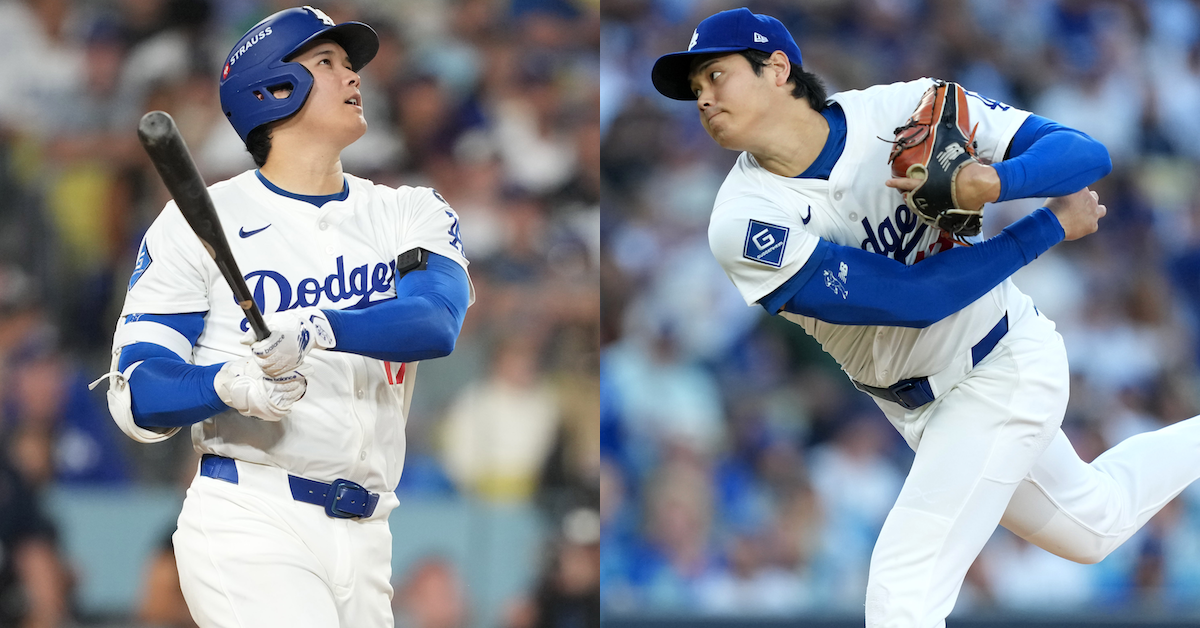
Let’s be more direct: Ohtani just had the greatest individual game in postseason history. On the mound, he threw six scoreless innings, allowing two hits and three walks while striking out 10. He got pulled after giving up two straight baserunners to start the seventh, which kind of mucked up his line, which is ironic, because that’s what the Dodgers offense has been doing to other starting pitchers over the past two weeks.
At the plate: 3-for-3 with a walk. All of those hits were solo home runs: 116.5 mph off the bat and 446 feet in the first, 116.9 mph and 469 feet in the fourth, 113.6 mph and 427 feet to center in the seventh. That second one, man, what a tank.
This is the perfect distillation of the value proposition for Ohtani. Given that this win, 5-1 over the Brewers in NLCS Game 4, clinched the pennant for the Dodgers, either one of those performances would’ve been memorable-bordering-on-legendary for Dodger fans. Put together? Well, after that fourth-inning home run, I started asking that question from a couple paragraphs back: Was this the best game in playoff history? … Read More
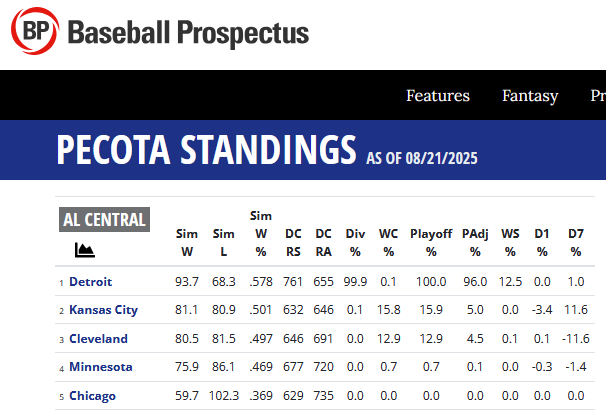
To be sure, I would not blame anybody for downgrading Detroit after Tarik Skubal surrendered a grand slam during a five-run seventh inning that ignominiously crowned a Tigers loss last night to a vagrant team playing in a minor-league park. Far from the August heater the team generated to fuel their run to the 2024 postseason, however, these Tigers have struggled in the second half with the likes of the Twins, Pirates, and A’s in a manner belying a true talent level perhaps somewhere below their overall winning percentage. And Javy Baez doing that bad thing again feels like a microcosm of team-wide regression trends in action:
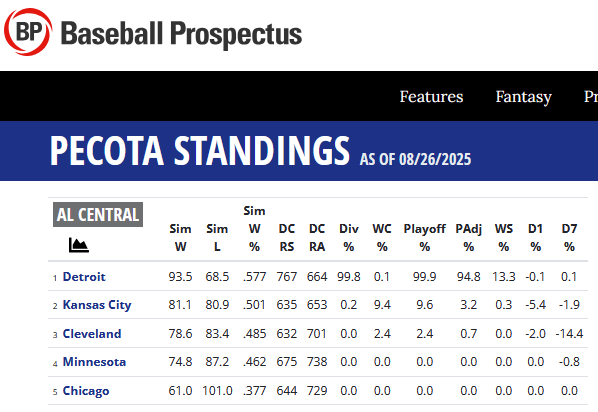
But BP’s PECOTA conceded none of that reasonable skepticism. It said this final outcome was a guaranteed certainty; no hedge, error margin, or other reservation of any kind. Presumably, it knew that Skubal could have a bad night, Baez could turn back into a pumpkin, and Jack Flaherty could continue to melt down, but it said it was not concerned. Having crossed that triple-digit threshold of certitude, it probably did not love what it saw in Sacramento last night, but one envisioned PECOTA taking that on the chin with an unwavering forward stare into a known and unavoidable future.
In short, once you go to 100%, you simply cannot go back. Again a concession from me: I will grant force majeure: If the season suddenly and prematurely ended due to a public-health catastrophe, war, or series of natural or Manfred-made disasters, then PECOTA probably gets a pass. Short of that, though? If 100% means Fool me once, shame on you. But fool me twice, baseball robot? My promise to the ALDLAND readers is that I will not be fooled again.
You serious, Clark? Yes. As basically first reported by ALDLAND.com months ago, the Detroit Tigers have clinched a spot in the 2025 MLB playoffs. Look for yourself:
If you thought 2025 was the year ALDLAND let Rob Manfred off the hook, you thought wrong. See above and at MLB.tv for access to what’s becoming a tradition unlike any other: MLB.TV briefly goes on sale in early May for an assertedly steep discount that more often than not hooks your correspondent but also compels him to stir up an old screed about the league’s poor media conduct. Before you click over there to grab the deal, recall this commentary on the same offering from 2022:
Readers of this website know that this author is among the last people on Earth who would go out of his way to promote an MLBAM business decision, but here you are, reading a post by me notifying you that MLB.tv is on sale today for a loosely speaking fair-ish price.
Of course, this occasion mostly serves as a reminder of MLB’s callous media-distribution practices. Six years ago, the league settled an antitrust lawsuit attacking things like its telecast blackout policy and centralized MLB.tv product by agreeing to make pricing and offering concessions to fans. Specifically, the seasonal price of the full MLB.tv package at that time would drop from $129.99 to $109.99, and the league would create a new, single-team package at a seasonal price of $84.99. These prices were to remain fixed for five years (i.e., through the 2020 season), subject to annual increases only up to the higher of three percent or the rate of inflation.
Now, that settlement agreement has expired, and MLB is seizing the opportunity to undo its effects. Most obviously, across-the-board pricing is up, doubly insulting as the league simultaneously excludes games from the full MLB.tv package for the benefit of its new partnerships with NBC and Apple.
Perhaps even more underhanded, however, is the soft killing of the single-team MLB.tv package. When first offered, the single-team option was priced at seventy-seven-percent of the full package price, then a twenty-five-dollar difference. MLB now has aggressively closed that gap. At today’s sale pricing, for example, the cost of the single-team option has jumped to eighty-six-percent of the full package price, just a ten-dollar difference. Stated otherwise, someone considering a single-team package can receive a thirty-fold increase in programming for just ten additional dollars. “Even you dummies know that’s a good deal,” fans hear Rob Manfred saying in their heads, even as they wonder why it doesn’t quite feel like a deal. The move to neutralize the single-team package feels like a purely spiteful move designed to achieve the functional undoing of one of the settlement agreement’s most visible achievements without any meaningful cost savings to MLB.
As I have been writing here for years, the message should be a simple one: “Rather than changing the game he wants people to watch . . . Manfred ought to change the way people can watch the game, obviously by making it easier for them to do so.” For how much longer can Manfred continue to squeeze baseball’s fans– including, as a recent example, Padres fans required to purchase yet another streaming service to watch this morning’s Peacock-exclusive game against the Atlanta Braves beginning at 8:35 am San Diego time– remains to be seen.
As the traditional regional sports network model of television crumbles, Manfred has not hesitated to recapture territory once ceded to independent providers and the outside revenue streams they created. The result, for now, is that MLB.tv now includes in-market offerings for ten teams: the Athletics, Diamondbacks, Dodgers, Guardians, Giants, Mets, Padres, Phillies, Rockies, and Twins. I naturally hesitate to call this a sign of progress, since the intent does not appear to be in the direction of eliminating blackouts, for example. But maybe it’s a start, and at least people in Sacramento have another way to follow their newfound MLB team.
Entering Opening Day, Baseball Prospectus’ PECOTA announced the Tigers’ playoff odds at below twenty-percent. FanGraphs’ ZiPS, while less hateful, still came in worse than a coin flip at under forty-four-percent. Then Detroit started playing the games. And then they started winning the games. In fact, they won nineteen games before May 1 for the first time in their 124-year history, and, the next day, they became the first AL team to reach twenty wins on the season.
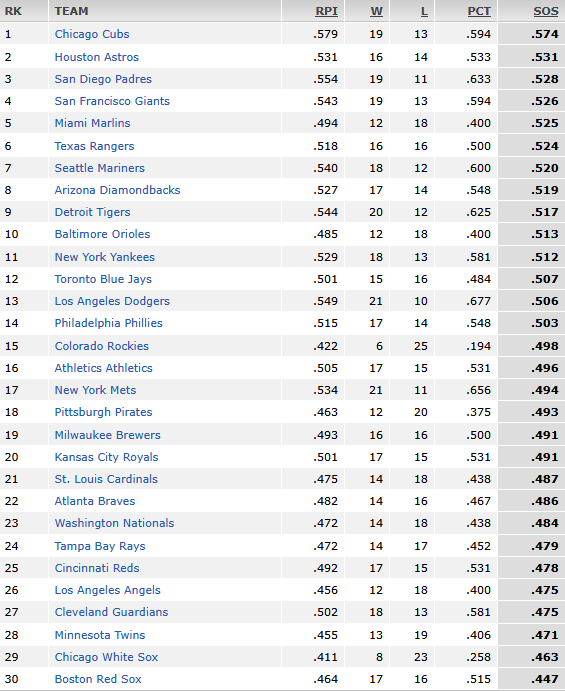
Some bitter Cleveland fans pointed out that Detroit has notched all of those wins while playing a lot of teams with sub-.500 records. That may be true. I don’t know. I do know that, according to ESPN, the Tigers overall have faced the tenth-toughest opponent schedule to date, while the rest of the AL Central has been coasting on cupcakes:
Regardless, postseason eligibility depends on standings, and standings depend only on wins, and wins are wins, and the Tigers now have twenty wins in a month’s worth of games that even PECOTA and ZiPS can’t ignore. As a result, those playoff odds have skyrocketed. BP is up from 19.9% to 61.1%, and FanGraphs is up from 43.6% to 81.1%!
There inevitably will be fluctuations, but banked wins cannot be unwon, and if relative breakouts from the on-the-ropes gang of Javy Baez, Spencer Torkelson, and Casey Mize can last, so too can this team. At least for right now, this is the fun baseball place.
Detroit Tigers first baseman Spencer Torkelson could come crashing down to Earth at any moment. For most people, the only surprising part of that statement would be the suggestion that the former top draft pick’s metaphorical elevation recently has been anywhere other than firmly entrenched beneath Comerica Park’s newly turf-covered keyhole path. But Torkelson has had himself a year in a week, or just about anyway. He clubbed eleven hits in nine games, including two home runs and four doubles, the latest of which walked off a ninth-inning comeback win against the White Sox on Sunday afternoon:
In 2024, Torkelson’s performance across ninety-two games for the Tigers was just above replacement value, contributing 0.1 fWAR. He’s already has bested that and more in a tenth of the time, pacing all Detroit batters (alongside Riley Greene) in 2025 with 0.6 fWAR.
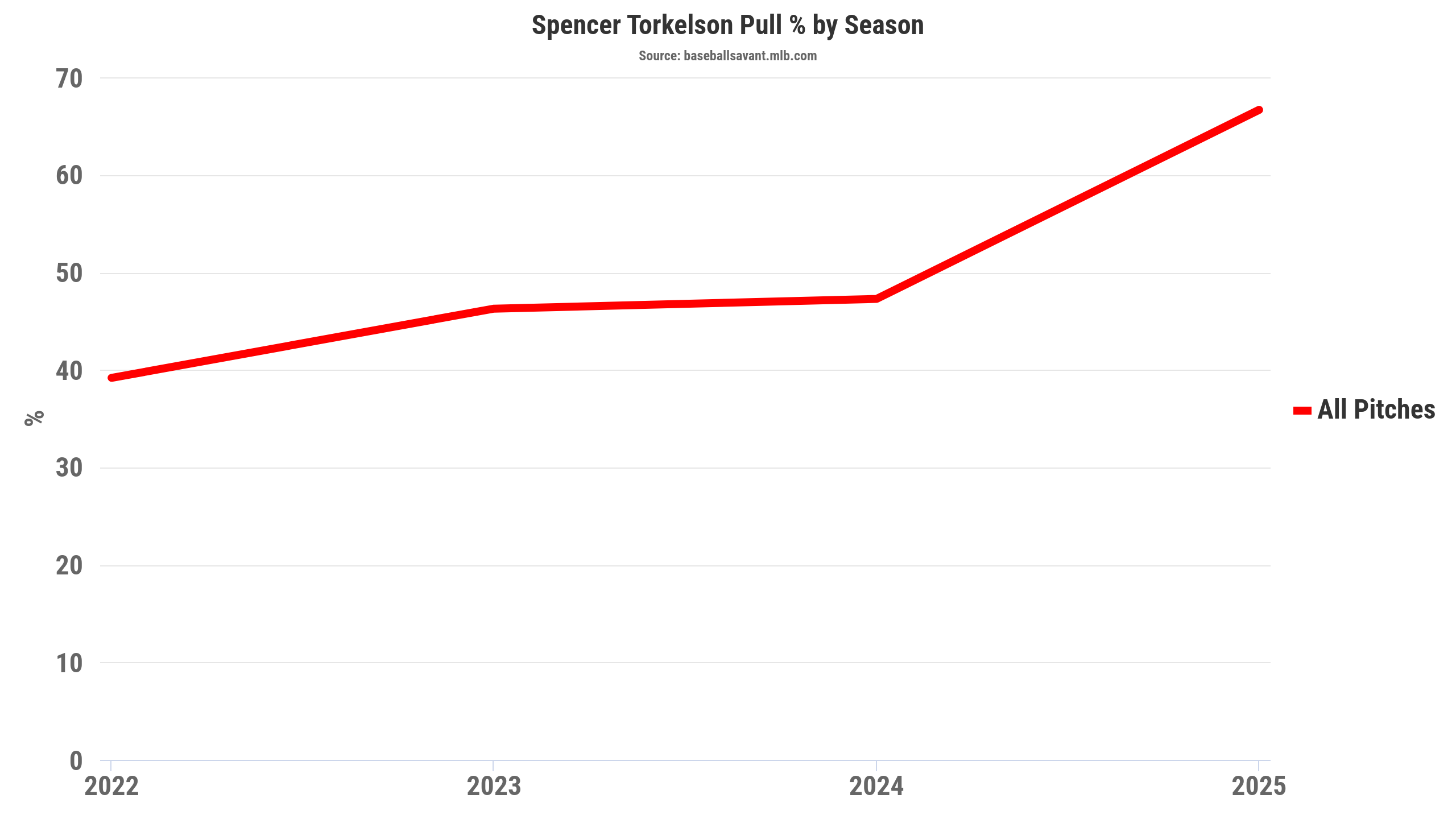
How is the former confirmed bust doing this? To my amateur eye, the key thing looks like pull rate. He isn’t swinging faster or generating more hard contact than before, nor has he increased his launch angle; in fact, all of those things are ticking down in 2025. Instead of trying to spread his contact to all fields, though, Torkelson is absolutely cranking on everything on which he can get his bat to his pull (power) side. Not everybody can be Miguel Cabrera, obviously, and sometimes it can help to stop pretending otherwise.
Probably associated with that, Torkelson also appears to have made a conscious decision to alter his stance, moving back in the batters box and farther away from the plate while widening the angle of his feet. This, one assumes, allows him more time to see balls and turn on the meaty ones.
No, Torkelson is not going to maintain a .474 BABIP over the course of an entire season. But if he says good enough to justify his appearance in the lineup over the course of an entire season, that will be a win. And if he continues to deliver in some more key moments throughout the rest of the season, that’s icing on the cake and, even better, a real reason to rethink Torkelson’s career trajectory.
Chris Sale was supposed to be an anchor for the entire Braves team, and especially its rotation. All he did last year, his first in Atlanta, was lead the team in fWAR (6.4) by nearly two wins and receive the National League Cy Young award. As with the Braves, Sale’s 2025 season is trending in the wrong direction, however.
Sale turned thirty-six on Sunday. The next day, he pitched five innings against the Los Angeles Dodgers, allowing three runs on four hits and no walks while striking out five. Not bad against a potent Dodgers offense, but his team only scored one run, so it counted as another loss.
If I’m reading this graph I generated correctly, the real trouble looming for Sale wasn’t that he fell apart in the sixth inning after holding LA scoreless and seeing just three batters over the minimum through five innings; instead, it was that he threw the slowest fastball he’s thrown since late 2023. Visually, this illustration tracks an inverse correlation between Sale’s xFIP- (lower is better) and his fastball velocity: When he’s throwing his fastball faster, his expected results tend to be better. For example, when he was locking up the Cy Young award last year, particularly in July and August, his average fastball velocity was rising and his xFIP- was plummeting. Very good. By contrast, as his average fastball velocity is dipping to start 2025, his xFIP- is climbing. Not so good.
It’s only two games, one each against two of the best teams in the National League (he also started opening day in San Diego against the Padres). But Sale is critical to Atlanta’s hopes in 2025, moreso even than last year given Spencer Strider’s injury and the departures of Max Fried and Charlie Morton, both free agents who left Atlanta to sign with AL East teams. The team needs him to be healthy and effective in carving up opposing lineups the way he once carved up his own team’s jerseys with a hunting knife.
Sale likely will be back in action this weekend as the Braves make their 2025 home debut against the Miami Marlins.
As highlighted in our 2025 Opening Day post, PECOTA, the projection engine at Baseball Prospectus, sees the Detroit Tigers with a less than one-in-five chance of returning to the playoffs in 2025, the longest odds it projected for any team that also appeared in the 2024 postseason. That feels like a personal attack.
But how much weight should Tigers fans accord this relatively dim outlook? In a field of competing inexact-science offerings, PECOTA has earned a reputation as one of the least-inexact baseball projectors. It still makes mistakes, though. Would it be relevant to those Tigers’ fans’ answers to the immediately preceding question that PECOTA recently produced another extreme, negative projection about the team that turned out to be very wrong? If your answer to the now-immediately preceding question is “yes,” then read on.
PECOTA sees Detroit’s likely starting backstop completely forgetting how to catch in 2024:
Rogers was a top-ten defensive catcher in 2023. (The BP website has different defensive numbers for Rogers and other catchers than those appearing in the book. I’ve inquired and it sounds like their stats team made some post-publication tweaks to their average benchmarks that may account for the variance.) Most of this projected thirteen-point drop comes in the form of a projected swing from being a top-ten framer to a bottom-thirty guy at that skill. Ironically, Rogers’ BP annual blurb mentions his “unseat[ing of] Eric Haase for the starting catching job” even as PECOTA projects him to frame as poorly as Haase did in 2023. (To fully square this circle, Haase’s 2024 framing projection is -3.2 runs.)
This is not the first time PECOTA has thought lowly of Rogers’ defense. In the 2023 BP annual, for example, it forecast him for -7 DRP, with a -6.5 on the framing component, both huge misses. Undaunted, the computer has doubled down for 2024.
Everyone in baseball will tell you that defensive metrics are especially difficult to define and measure and therefore probably should be regarded a little more cautiously than other performance metrics. That’s sensible and unobjectionable. What creates undue difficulty, in my opinion, is what seem like wild year-to-year oscillations in players’ defensive numbers. Of course players aren’t going to be exactly the same person every season, and many factors– injury, age, chance, drugs, etc.– can cause production value to vary outside a “normal” career development curve. Breakouts can happen quickly. Careers can end quickly. When we’re told a player’s defensive performance has yo-yoed erratically from season to season without ready explanation, though, it makes it very difficult to ascribe any meaning to defensive metrics, even on their own terms and within their own contexts. Maybe Rogers really is a definitively unremarkable catcher who just had his Brady Anderson framing season. Probably not, though.
If that big whiff is enough of a reason for you to throw out the 2025 PECOTA projections in their entirety, I won’t stop you. So far as the actual team is concerned, though, there’s not going to be anything good left to project if they don’t start winning. The Tigers, still hunting their first win, are back in action tonight in Seattle after a Sunday of rest following a tough Dodgers’ sweep.
What does the future hold for the Detroit Tigers? Skubal has more influence on that than most, so his pronouncement carries great weight. Other observers are a bit more cautious than him, though. FanGraphs (ZiPS) projects an 81-81 record and a 43.6% chance of making the playoffs. Baseball Prospectus (PECOTA) is much less optimistic, chiming in at 78.5-83.5, with just a 19.9% chance of making the playoffs.
There’s quite a bit of variance between those two systems’ projections, particularly with respect to the likelihood Detroit makes it back to the postseason again this year. Considering the path the Tigers took to get there last year, catching fire in mid-August and never looking back, it’s reasonable to wonder whether that was a fluke. With due respect to Alex Cobb, Gleyber Torres, Tommy Kahnle, Jack Flaherty (welcome back!), Bailey Horn (welcome back, sort of!), Andrew Chafin (welcome back again again!), Jose Urquidy, and Manuel Margot, you can be excused for thinking the Tigers underwhelmed in the building-on-success department. There’s also a ripe case of subtraction by addition in the outfield, which is where you’ll see Javier Baez, just coincidentally absent for Detroit’s amazing August-October run last year, returning and making his debut as a real live outfielder. (In case you were wondering, yes, Baez remains under contract through 2027.)
Last year’s team went 86-76. They were 78-84 in 2023. The combination of late overachievement; middling offseason moves plus absence of history of strong in-season moves from current ownership and management; Meadows-family injuries; emerging whispers of Riley Greene fragility; and the return of Baez have me projecting an 80-82 record.
No affiliate links here, but multiple sports books currently have Detroit’s win-total line at 83.5.
The Tigers’ season opens tonight on the road against the Los Angeles Dodgers on ESPN. After three games in LA, they head north for three games in Seattle before opening at home against the Chicago White Sox on the afternoon of Friday, April 4. If nothing else, keep an eye on Skubal: he’s increased his production value each season. Repeating that feat this season would mark a very special performance.
It felt groundbreaking when Shohei Ohtani did it with the Los Angeles Dodgers over a year ago. By the time Frank Vatrano did it with the Anaheim Ducks earlier this month, it was a certified California trend.
Athletes, like everyone else, don’t like paying taxes. California has a top marginal income tax rate of 13.3 percent, plus there’s the top federal rate of 37 percent, so high-earners like athletes are forking over a lot of hard-earned money. But if the team a player wants to sign with is in California, what can they do to avoid the state’s high taxes? As Ohtani and Vatrano have now done, they can defer the income until they likely won’t be living in the Golden State anymore. … The key to avoiding taxes on deferred payments is paying them out in equal amounts over at least a decade. “A 1996 federal law forbids states from taxing retirement income on out-of-state residents when payments are made in ‘substantially equal periodic’ amounts over at least 10 years,” The Athletic‘s Evan Drellich explained.
Those deferred payments won’t just help athletes avoid taxes—they might help ease the pain felt by franchises in high-tax states when they’re negotiating with players in free agency.
Plenty of factors go into a free agent athlete’s decision on where to sign: taxes, cost of living, and climate, not to mention team-related factors. But research has shown state income taxes really do hold back teams in high-tax states. … Read More







 ALDLAND