Catching Fire: Tigers offered another opportunity tonight against Pomeranz

pom

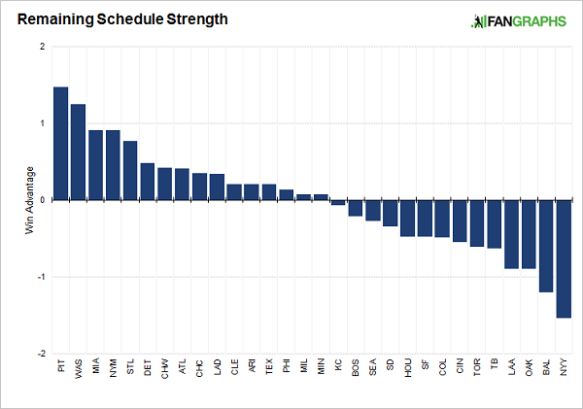
The Detroit Tigers are not out of the playoff hunt, but without any new faces likely to join their band during this in-season trade period, the team is going to need to take advantage of every beneficial opportunity the schedule affords them if their playoff push is to succeed.

The good news: on balance, that schedule is a favorable one.
remaining-schedule-strength

Detroit has the easiest post-All-Star break schedule among the AL Central teams, and they’ve held steady in second place for a few weeks now. First-place Cleveland has maintained a roughly six-game lead, though, and the Tigers also have been stuck at about four games back in the AL Wild Card chase as well.

Recent losses by relevant teams in both of those races– Boston, Cleveland, and Toronto– created an opportunity for the Tigers to make significant gains on both the divisional and wild card fronts. Detroit fumbled that opportunity, though, dropping two of three against the Twins and two of four against the White Sox.

They have yet another opportunity tonight at Fenway Park, though. Justin Verlander has been excellent again this season, and he’ll start tonight against the newest member of the Red Sox rotation, Drew Pomeranz. Detroit’s batters should be salivating.

As Joe Sheehan pointed out when Boston dealt a top prospect to San Diego in exchange for the Padres pitcher, Pomeranz isn’t exactly a model of endurance:

Pomeranz is up to 105 innings pitched heading into tonight’s start, and the twenty-seven-year-old doesn’t exactly have a track record of getting better as the season progresses:
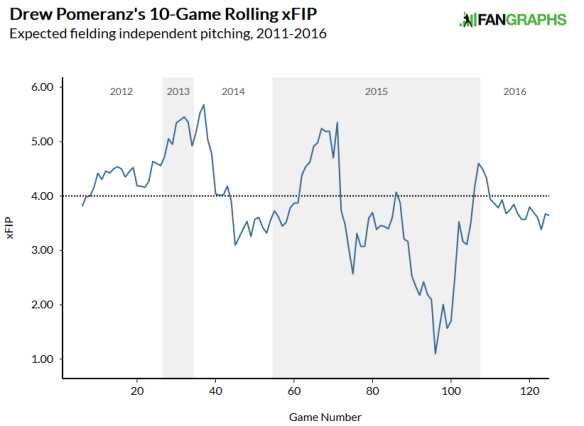
pomxfiproll

Those late-season climbing trends in his xFIP indicate that Pomeranz, like many pitchers, tends to perform worse as his seasonal workload accumulates. He’s made one start for Boston so far, and it went badly. He lasted only three innings, surrendering five earned runs on eight hits, two of them homers.

Tonight’s game represents another good opportunity for Detroit to make progress toward a playoff spot. Even if that’s just a one-game wild card spot, this may be the closest they come to postseason action for some time, and they need to make the most of it.

First pitch is at 7:10 on ESPN.

______________________________________________

Previously
Catching Fire: Brad Ausmus is not saying, he’s just saying – 7/8
Catching Fire: Ian Kinsler is the San Francisco Giants of the MLB All Star Game – 7/6
Catching Fire: Night of a thousand feet of home runs – 6/21
Catching Fire: Pelf on the shelf – 6/16
Catching Fire: When is it okay to stop short? – 6/15
Catching Fire: Heading for the exit velocity – 5/17

Catching Fire: Boy, the starters need to carry that weight a longer time – 5/3
Catching Fire: Who’s Number Two? – 5/2

Related
Statements both obvious and only slightly less obvious about the Detroit Tigers’ finances
Shift the shift: Victor Martinez and counter-strategies
Feel like they never tell you the story of the Gose?
Getting to know Jordan Zimmermann in context
Highlights from MLB Network’s visit to Detroit Tigers spring training
2016 Detroit Tigers Season Preview: They’re Not Dead Yet


Catching Fire: Brad Ausmus is not saying, he’s just saying

ausmus tantrum

The Detroit Tigers were winning last night, but then they lost. This is not a new narrative for this team, for which unrecoverable, late-inning blown leads are a recurring symptom of an unstable bullpen that’s as much a part of this era’s Detroit baseball identity as Miguel Cabrera and Justin Verlander.

Incidentally, it was Verlander who started last night’s game, the first of a road series against the Blue Jays. He did well to hold Toronto to two runs, but he had to exit in the sixth inning, having thrown 103 pitches. At that point, the Tigers led 3-2. They extended the lead to 4-2 in the next inning, thanks to an Ian Kinsler RBI GDIP.

When Shane Greene allowed a run in the bottom of the seventh, Justin Wilson relieved him, getting two key outs and preserving what then was a 4-3 Detroit lead.

After newish Toronto reliever Jason Grilli made disappointingly light work of the meat of the Tigers lineup, Wilson came back out to pitch the bottom of the eighth. Allowing two quick hits that gave the Blue Jays men on first and third with nobody out, Wilson suddenly found himself in an extremely tight position. He did very well to strike out the always-dangerous Edwin Encarnacion for the first out of the inning, and a well-handled grounder by Cabrera allowed James McCann to employ a nice bit of pickle strategy to nab the runner on third, who had attempted to score, for the second out.

Two outs, but still, two on base. Make that three on base, after Wilson walked the next batter on five pitches. “Time for a new pitcher,” one person in our residence said. The other agreed, as did Brad Ausmus, who pulled Wilson for…Alex Wilson. That Wilson promptly allowed a two-RBI single, providing the Jays a 5-4 lead they would not surrender.

chart

Some immediately wondered why Ausmus turned to Alex Wilson in what, as illustrated above, was the highest leverage moment of the game (7.88 LI), rather than Francisco Rodriguez, who is the team’s nominal closer. K-Rod was very well-rested and has been performing very well in recent weeks. To all but the most rigid of old-school managers, this seemed like a fairly obvious move. Ausmus addressed the subject in his post-game media conference:   Continue reading

2016 MLB midseason prediction report

grading

This week marks the halfway point in the 2016 MLB season, which seems like a good time to check in on the preseason predictions I made.

American League

East: Boston

The Red Sox are playing pretty well, and some of their young prospects are rising to stardom, but they trail the “surprise” Orioles by 4.5 games, and are only a game up on third-place Toronto. Still, I don’t think it would surprise anyone if Boston made moves and won this division in the second half, especially with new GM/master dealmaker Dave Dombrowski at the helm.

Central: Detroit

Minnesota aside, the Central is a tight race, but it looked a lot tighter last week, prior to Cleveland’s current rampage. Until then, no team had held a sustainable stay atop the division, though, of the four contenders, Detroit’s time in first was briefest and most tenuous. This obviously was a pick on the emotional side of the ledger for me (though it’s one I share with Dave Cameron), but if the Tigers can’t beat Cleveland– currently 0-9 on the year– this season, it’s difficult to see them claiming the crown in the second half.   Continue reading

Catching Fire: Night of a thousand feet of home runs

If not winning, the Detroit Tigers certainly have been doing a lot of home-run hitting over the last week or so, and, after some extra-inning disappointments during that stretch, they finally put it all together last night for an overtime win last night in a home series opener against the Seattle Mariners. That game featured three Tigers homers, each of which gave the team the lead. Especially exciting for Detroit was that two of them came off the bat of Justin Upton, who finally appears to be heating up for his new team after suffering one of the worst offensive stretches of his career.

jupwrc20gmavg

Upton’s first of the night was a dead-center bomb in the seventh that gave the Tigers a 7-6 lead, and his second, which clinched the game in walk-off fashion in the twelfth, landed beyond the bullpen in left. There likely is no one happier about this apparent return to power than Upton himself, and, especially with J.D. Martinez out with an elbow injury, it couldn’t be more timely for the team.

Upton’s homers last night inspired celebration, but Miguel Cabrera’s, which gave the Tigers a 2-0 lead in the first inning, inspired awe. I’ve never seen a Comerica Park home run hit where Cabrera hit his last night. No one has.

Have a look:   Continue reading

Catching Fire: When is it okay to stop short?

iglesias_nosepick

A quick glance at the Detroit Tigers’ seemingly unremarkable current record– 33-31, good enough for third place in a tight AL Central pack– likely would fail to reveal the fairly high degree of volatility that has defined the first two months of the team’s 2016 campaign, including long losing streaks punctuated by spurts of blowout wins and more changes in the pitching staff than, seemingly, in the last three years combined.

All of this– the pitching changes serving as a positive reminder of the relationship between rotational and bullpen depth–  largely has distracted from the things that haven’t changed since the season began. One is the catcher position, which I’ve contended since season-preview time is ripe for an in-season upgrade if this team is going to continue to pursue a championship. Recent numbers only serve to confirm this:

2016-team-extra-strikes

2016teamextrastrikes

What this graph and this chart from this recent article illustrate is that Detroit has operated under a severe strike-zone disadvantage thus far in 2016. As the breakdown chart shows, the blame for that disadvantage falls at the feet of their (catching) defense. We knew James McCann and Jarrod Saltalamacchia were bad pitch framers. Now we can begin to see the relative consequences of that weakness.

Another thing we can and may want to do at this juncture is ask whether it’s time for a change at the shortstop position. When the Tigers traded for Jose Iglesias as a replacement for the then-suspended Jhonny Peralta in 2013, we figured they were acquiring a defense-first short stop with a probably unsustainably high batting average.

Almost three years later, that basic assessment remains essentially correct. Iglesias wowed early and often with highlight-reel plays in the field and keeping his average up at the plate, hitting .300 again in 2015 after missing all of 2014 with ankle injuries. He was an All Star last year, whatever that means anymore, but 2016 is shaping up a bit differently.   Continue reading

Catching Fire: Heading for the exit velocity

vacation-walley-matte-today-150527_25aa56597af71bd8b926763d3272e7cd-today-inline-large

Thanks to MLB Advanced Media’s new Statcast technology, fans can learn more than ever about the activity taking place on the field (and off it) during a baseball game. One such aspect into which Statcast offers insight is exit velocity, which refers to the speed with which a batted ball leaves a hitter’s bat. These velocities can communicate something meaningful about batter success. (Very generally, and possibly very obviously, higher exit velocity is better.)

Statcast came on-line last season, but there were significant flaws in its batted-ball data gathering in 2015. The shortcomings in the 2015 data will affect any analysis that relies on Statcast information from that season, and while Statcast seems to be doing a better job of gathering a more complete set of batted-ball data this year, some imperfections remain. Fortunately, it appears that those imperfections– apparently due in part to differences in hardware installations at each park– can be accounted for. Baseball Prospectus now publishes something called adjusted exit velocity, which aims to control for various influences on Statcast-measured exit velocity that are outside batters’ control. (None of those adjustments can recapture the data the system failed to collect in 2015, of course.)

Early in the season, I went to the Statcast well to compare home runs by Anthony Gose and Giancarlo Stanton. The purpose of this post is not to undermine lazy media narratives but to present a simple comparison between various Detroit Tigers’ adjusted exit velocities in 2015 and so far in 2016.

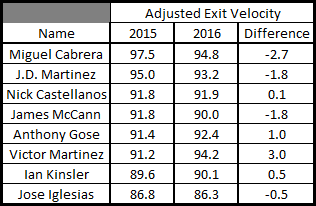
Keeping in mind the imperfections in the source data, here are the 2015 and to-date 2016 adjusted exit velocities (in miles per hour) of the Tigers’ primary hitters who played for the team in both seasons:

adjev15-16det

While recalling that we still are dealing with small sample sizes for 2016, particularly for James McCann, who’s spent much of the young season injured, and Anthony Gose, who now is down in the minors, I’d guess that the differences in adjusted exit velocity roughly comport with how well fans think each hitter is performing this year: Miguel Cabrera hasn’t heated up yet; J.D. Martinez has been struggling since moving to the second spot in the lineup after a hot start batting deeper in the order; Nick Castellanos has been breaking out; Victor Martinez is healthy again and showing it; Ian Kinsler seems to be in fine form yet again (credit those Jack White-designed bats?); and Jose Iglesias is continuing to rely on weak contact.

Cabrera was second overall in adjusted exit velocity last season, so his drop-off seems like a possible source of concern. Sluggers like Cabrera can take a while to warm up, though, so it’s not unreasonable to think that his adjusted exit velocity will climb as the current season progresses. (Cf. Giancarlo Stanton, 2015’s adjusted exit velocity champ, who, so far in 2016, is down 9.4 MPH.)

The elder Martinez has the largest change of any of the highlighted batters in either direction, but his 2015 doesn’t offer much of a baseline because he was playing through obvious injury. It therefore is reasonable to assume that some portion of that +3.0 MPH of adjusted exit velocity is due to a return to health.

Not only do these changes in adjusted exit velocity correlate with anecdotal observations of these players this season, but they also– loosely but consistently across this sample– track changes in raw power (measured as isolated power, or ISO):   Continue reading

Catching Fire: Boy, the starters need to carry that weight a longer time

r78923_608x342_16-9

The Detroit Tigers’ new starting pitcher, Jordan Zimmermann, has been excellent in 2016. He’s only allowed two earned runs in five starts, all Detroit wins,  and he didn’t allow a single run of any variety through his first three games. He’s been the number-one starter the Tigers needed, especially with Justin Verlander and Anibal Sanchez offering good-but-not-great performances as they settle into the season. Ostensible fourth starter Mike Pelfrey has not been good at all, posting career-worst numbers virtually across the board. Shane Greene started strong, as he did last season, but a blister has temporarily sidelined him, which allowed the team’s top prospect, Michael Fulmer, to snag a big-league start in Greene’s absence. Daniel Norris showed promise as a starter last season and this spring, but he’s currently on a rehab assignment recovering from a back injury.

As a group, the rotation has been decent, and there are indications that they’ll continue to improve, especially if Verlander can find his groove now that news of his preseason engagement to Kate Upton is public and healthy mixtures of Greene, Norris, and Fulmer can replace Pelfrey before too long.

Overall, this is good news for Tigers fans, who also are enjoying a blissful period of strange and unusual– in light of the team’s recent history– bullpen success. After a month of play, this feels like a satisfyingly complete team.

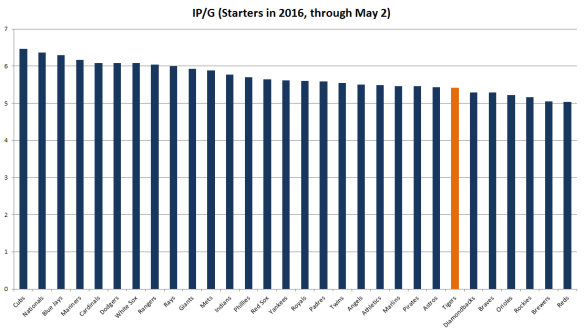
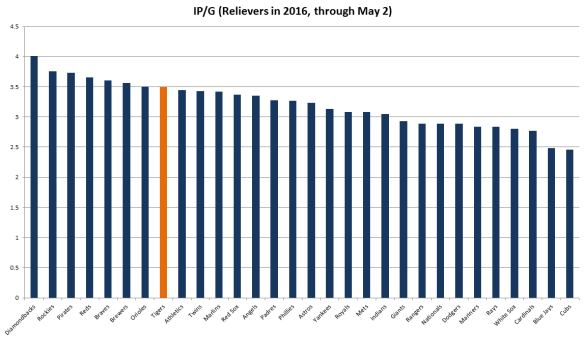
One potential cause for concern (a Tigers fan always can locate at least one) in all of this good news is that the shiny new Detroit bullpen may have been on display a bit too much through this first month of the season. It’s lovely that they’ve been doing so well, but they need to last to October. I don’t think Brad Ausmus has done a poor job of allocating relief innings among his bullpen staff in 2016, but I think his starters’ collective failure to pitch late into games so far this year has forced him to make more calls to the pen than he’d have preferred at this point.

In fact, among American League teams, only the Orioles are getting less in the way of innings pitched from their rotation than the Tigers:

ip-g 5-2-16 (starters)

Viewed from back to front instead of front to back also finds Detroit essentially tied with Baltimore for the AL lead in relief innings pitched per game:

ip-g 5-2-16 (relievers)

The beginning of May finds the Tigers with a comfortable 14-10 springtime record. We knew the early part of their schedule would be difficult, so it isn’t surprising that the path to 14-10 was somewhat akin to that of a roller coaster. It also is not unreasonable to expect that better teams would chase starters earlier in games than usual.

Even if the heavy bullpen usage has been justified, or, at least, explainable, it isn’t a trend Detroit should try to continue, for obvious reasons, and if you weren’t certain how to interpret this information, a glance at the bad company the Tigers are keeping at each end of the above graphs should offer undeniable clarification of any lingering doubt.

The team has the opportunity to reverse this course tonight, when their once (and future) workhorse takes the hill in Cleveland and tries to reverse a losing trend of his own.

______________________________________________

Previously
Catching Fire: Who’s Number Two? – 5/2

Related
Statements both obvious and only slightly less obvious about the Detroit Tigers’ finances
Shift the shift: Victor Martinez and counter-strategies
Feel like they never tell you the story of the Gose?
Getting to know Jordan Zimmermann in context
Highlights from MLB Network’s visit to Detroit Tigers spring training
2016 Detroit Tigers Season Preview: They’re Not Dead Yet

Statements both obvious and only slightly less obvious about the Detroit Tigers’ finances

ponzyxfp2nxxmr76trol

By now, everyone knows The Narrative governing all things Detroit Tigers baseball: the team needs to Win Now because they have lots of money locked up in a few long-term player contracts, and, as those players age, the team’s Window Is Closing. And it’s true: the team has some expensive contracts on the books. Here’s a rough visual, created from the data available on Baseball-Reference:

tigerks

(Click here for an expanded view.) Besides noticing that I have not recently viewed Anibal Sanchez’s player page, you can see that a number of today’s already-very-familiar Detroit baseball faces are likely to remain as such for a number of additional seasons, and at significant cost to the team. This is known and obvious. That this aggregated fact has real and, on balance, probably adverse consequences for the team’s future– the ability to re-sign J.D. Martinez comes to mind– also is, if less precisely quantifiable, known and obvious.   Continue reading

Shift the shift: Victor Martinez and counter-strategies

victormartinez_2014_2

The defensive shift– repositioning infielders from their conventional locations in response to a particular batter’s hitting tendencies– may be the most significant development in baseball defense since pitchers started actually trying to miss bats with their pitches. The basic idea is that defenses can take advantage of certain hitters who are known to possess extreme tendencies in terms of batted ball direction by loading up their infield defense in line with that batter’s tendencies.

David Ortiz is a decent example of a batter with a definite tendency to hit the ball in a particular direction. Here is a spray chart showing where he hit every ball during the 2012-2014 seasons:

dortizspray2012-14

Ortiz is a top-tier power hitter, so it isn’t surprising that he’s peppered the entire field. Focusing on his ground balls, though, reveals a pretty strong tendency to hit grounders to the right side of the infield. Opposing teams noticed and began to counter Ortiz defensively by shifting against him.

Probably the most common way to arrange a defensive shift is to move the second baseman into shallow right field, move the shortstop to the first-base side of second base, and shade the third baseman heavily toward second base. Teams also employ less and more extreme variations of this basic shift. Because a fielder needs to remain close to first base, teams almost exclusively shift to overload the right side of the infield. This, in turn, means that teams almost always shift, if at all, against left-handed hitters, who, as a population, generally hit the ball to the right. Ortiz is a lefty, and his spray chart evidences the expected pattern.

No player faced a full defensive shift more than Ortiz in 2015, when opposing defenses shifted on more than sixty-three-percent of his plate appearances. The most effective antidote for the shift is a bunt to the exposed third-base side, but Ortiz, now at forty years old and at least 6’3″ and 230 pounds, has not been the bunting sort of late or, really, ever. He’s a big, left-handed power hitter in the last year of his career, and, as concerns the defensive shift, he’s just going to have to take his lumps.

A little further down that list of 2015’s most-shifted appears Victor Martinez in the #22 spot. Martinez spent much of 2015 injured, so he only made 485 plate appearances, seeing a full shift on roughly forty-three percent of them. Like Ortiz, Martinez is heavier, slow, and hits from the left side, and his 2012-2014 spray chart shows similar batted-ball tendencies to Ortiz’s:

vmartspray2012-14lh

One way in which Martinez is unlike Ortiz, though, is that, while both bat left-handed, Martinez also bats right-handed. Continue reading

Can predict baseball? Guesses for the 2016 MLB season

FanGraphs released its staff (extremely broadly defined, as you’ll realize very soon) predictions for the 2016 MLB season, to which I contributed, today. This includes aggregated predictions for each division and wild card position, as well as MVP, Cy Young, and ROY winners. In a decision not my own, the post also breaks out each individual’s predictions arranged alphabetically by first name, making my guesses dangerously easy to spot.

If you want to see what the baseball future could but likely will not be, click here, and then come back here and add your own predictions in a comment below.