2016 MLB end-of-season prediction report

Unfortunately, the 2016 MLB regular season ended yesterday, making today as good a day as any to evaluate the preseason predictions I made.

anigif_enhanced-buzz-12279-1379599236-35

When I checked in on these at the halfway mark of the season, they were looking ok enough for me to rationalize all of them. Now, though, we have nothing more than cold, hard reality against which to measure these guesses. The results (excluding predicted individual award winners, whom have yet to be named):   Continue reading

The arc of the ALDLAND universe is long, but it bends toward this weekend

maybin-upton-braves-tigers

If there are two things I’ve written about with consistency at this weblog they are 1) the Detroit Tigers and 2) the Atlanta Braves’ foolhardy abandonment of their downtown home at Turner Field. Beginning tonight, and for the next two days thereafter, these two ALDLANDic worlds will collide when the Tigers face the Braves in the final three games ever to be played at the aforementioned Turner Field. More than anything, I am grateful that we will be able to attend each of these games, live and in person. These are critical games for the 2016 Tigers, teetering as they are on the edge of postseason qualification, and they are historic games for the City of Atlanta. I have little more to add at this juncture other than that I am very excited.   Continue reading

Catching Fire: Cabrera leads by example

cabrera1280_xhyb8p9n_pe6ybg8z

In an odd way, it’s tough to find an excuse to write about Miguel Cabrera in a season series like this one, because he’s so consistently good that, within his own context, his day-to-day achievements don’t stand out. If, from a coverage perspective, the greats miss out on talent-correlated attention during the season, though, they tend to make up for it during the big moments, like playoff races and the postseason.

The Detroit Tigers are in the final countdown for the 2016 season. Monday was their last off-day until the season ends on October 2. Their playoff odds have tumbled, but they’ve managed to keep pace at about two games back of the second AL wild card spot, meaning that their postseason hopes remain very much alive. The reason those playoff odds are low, though, is because they’re running out of time. Every remaining game is of critical importance, and while the Tigers really need to win each of these games (or, at least, a vast majority of them), even doing that won’t guarantee a playoff berth unless the teams ahead of them falter.

Cabrera knew the stakes last night, during the team’s first game of this crucial final stretch. Detroit already was missing two of its biggest bats– Cabrera’s Venezuelan countryman Victor Martinez and Ian Kinsler, also an important vocal leader– due to a brutal triple HBP run by Cleveland’s Trevor Bauer (Cabrera also was a victim) in a costly win on Sunday, which meant Cabrera would need to shoulder even more of the offensive load than usual.

In the fourth inning, leading by a slim 1-0 margin, Cabrera decided to manufacture a run essentially all by himself, and not by way of a snappy home run blast. First, he stretched his single into a double; then advanced to third on a dangerously shallow fly-out; and, finally and amazingly, scored from there on an infield hit to the third baseman. Cabrera’s Billy Hamilton impression is one of the most impressive baseball moments I’ve seen this year (here’s the video), and he delivered it for the benefit of his teammates at the perfect moment. While it’s impossible to say whether the team’s subsequent offensive breakout– they ended up winning 8-1, with Cabrera also contributing a two-run homer– came as a result of this moment or the team simply (finally) catching up to bad Minnesota pitching, Cabrera’s baserunning in the fourth, which resulted in what ultimately proved to be the winning run, sent an unmistakable message to his teammates.   Continue reading

Catching Fire: It Don’t Come Easy

With just under a month remaining in the 2016 MLB season, this is a good time to take stock of the Detroit Tigers and some of their key players.

Team Playoff Odds

Today, the team sits 5.5 games back of Cleveland in the AL Central, and one game out of the second AL wild card spot, behind Boston and Baltimore. At this point, the division likely is out of reach, but the wild card is in play. Over the last two weeks, the Tigers have moved in and out of the second wild card position, and, although it’s served them well to this point, the Orioles’ volatile combination of bad starting pitching and overreliance on home runs is subject to collapse at any moment.

Three sites– Baseball Prospectus, FanGraphs, and FiveThirtyEight– take varying stances on spaces and the capitalization of letters in their names, but all three provide MLB playoff odds for every team. These represent the percent chance, based on to-date performance, that a given team will make the playoffs. Here’s how the Tigers’ playoff chances look today:   Continue reading

Baseball Notes: Current Issues Roundup

baseball notes

Rather than my own attempt at fashioning a nugget of faux-wisdom, the purpose of this Baseball Notes post is to highlight a number of articles posted elsewhere addressing current issues in the sport.   Continue reading

Have the Atlanta Braves discovered the secret of the ooze?

tmnt-2-screenshot

Only three teams– the Rockies, Tigers, and Phillies– declined to participate in the transaction frenzy that concluded on August 1’s non-waiver trade deadline, which means that, yes, even the lowly Braves were in on the action.

One of the clearest messages the trade-deadline market communicated was that contending teams (or teams that fancied themselves contenders, anyway) were willing to pay a premium for relief pitching. Atlanta did send pitchers Lucas Harrell and Dario Alvarez to Texas in exchange for Travis Demeritte, an infield prospect who starred across from Dansby Swanson at this year’s Futures Game, on July 27. They skipped the more obvious opportunity to sell high on the momentarily resurgent Jim Johnson, however, especially considering the fact that he’s a free agent after this season.

Instead, in the words of Fangraphs’ Jeff Sullivan, the Braves “exchange[d] toxic assets” with the Padres by trading infielder Hector Olivera for Matt Kemp.

It’s been tough to find people who think this was a good trade for the Braves. Kemp was good, once, five years ago, when he provided 8.3 fWAR in 161 games for the 2011 Dodgers. Since then, he’s been worth 4.8 fWAR total from 2012 through August 2, when he made his Braves debut at Turner Field:

IMG_20160802_190939

Kemp’s still being paid like he’s an eight-win, MVP-caliber player, but he’s playing like a half-win, DL-caliber player. He can’t run. As he demonstrated for the crowd in his Atlanta debut, he can’t defend. His bat, his only potential weapon at this point, is less consistent than that of Justin Upton, the last consequential left fielder to wear a Braves uniform. Still, when Kemp received a standing ovation from the home fans (who, to my eyes, were outnumbered by a surprisingly large cadre of Pirates fans) when he came to the plate for the first time in the bottom of the first, it so confused the Pittsburgh players that Jace Peterson, who was on first after walking to start the inning, easily stole second. So maybe there is some hidden value there.

But really, what’s the Braves’ plan with this move? Continue reading

[UPDATED] Catching Fire: Mike Drop

http://a1.espncdn.com/combiner/i?img=%2Fphoto%2F2015%2F0513%2Fmlb_g_aviles_b1_1296x729.jpg

UPDATE: Approximately seven minutes after we published this post, the Tigers took our advice and traded Aviles to the Atlanta Braves.

It’s reassuring to know that General Manager Al Avila has joined Brad Ausmus as an ALDLAND reader. If you would like to peer inside the mind of the Tigers GM, the original post remains below.

__________________________________________________

The clock is ticking louder than ever on the Detroit Tigers’ 2016 season, and, just at the very moment the team needs to be putting its best foot forward in an effort to win crucial games that will determine whether they make the playoffs, they are running out some of the worst lineups they’ve used all season.

Injuries are largely to blame for this untimely suboptimal roster utilization, as Detroit currently is without Cameron Maybin, Nick Castellanos, Jordan Zimmermann, Jose Iglesias, Shane Greene, and (sigh) Mike Pelfrey. In addition, Miguel Cabrera left last night’s game with what appeared to be a left shoulder injury, and his status is uncertain. Manager Brad Ausmus, facing this many significant losses, obviously is handcuffed– he has little choice but to lean, undoubtedly more heavily than he would prefer, on his reserves, backups, and alternates.

Modern MLB roster construction, with its emphasis on relief-pitching specialization, leaves little room for backup position players. The Tigers, like most American League teams, essentially have three: a backup catcher, and two other “utility” fielders, who can play a variety of positions whenever a regular starter needs a break, or as a defensive replacement late in games.

For Detroit, those two guys are Andrew Romine and Mike Aviles, and they aren’t very good. Back in June, when Iglesias was struggling, I wondered whether Romine, who appeared to be a very solid stand-in at short when given the opportunity, should take over the job? Nope. Back in March, before the season even started, I was worried about the scouting report on Aviles, which was starkly negative:

Aviles is no longer useful in a baseball sense[, and] his inability to reach base (.279 OBP from 2013-15) makes him a complete zero on offense, while what’s left of his defensive and baserunning abilities have become liabilities.

Harsh and, so far, accurate. Unsurprisingly, when both Aviles and Romine are in the starting lineup, Detroit almost always loses.   Continue reading

Catching Fire: Checking in on Justin Upton

juptigk

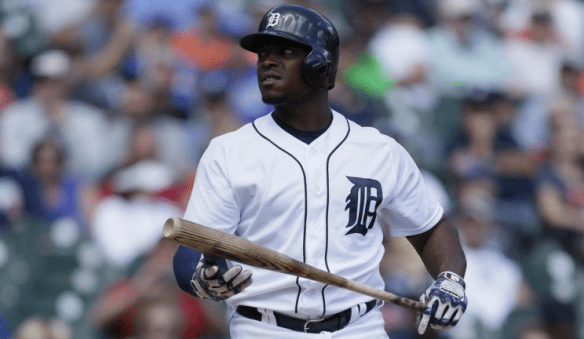
Everyone knows Justin Upton has had a tough go of things during his first season in Detroit, and it’s reasonable to expect that there would be an adjustment period associated with his move to the American League– new pitchers, new parks– after spending his first nine seasons in the National League.

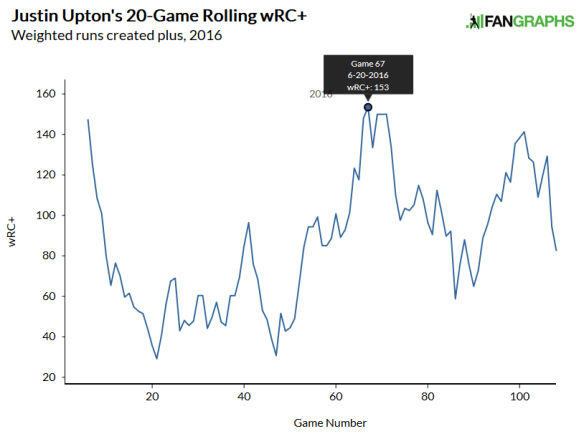
When we last checked in on Upton, in late June, things finally seemed to be heading in the right direction:

Especially exciting for Detroit was that two of [the Tigers’ home runs in a win against the Mariners] came off the bat of Justin Upton, who finally appears to be heating up for his new team after suffering one of the worst offensive stretches of his career.

jupwrc20gmavg

Upton has not continued in that direction, however; in fact, I seem to have caught him precisely at his peak. Here’s an updated version that same graph from the June post, above:

jupwrc20gmavgAug16

That earlier snapshot of Upton’s offensive production was through June 20, the date highlighted on this graph. Since then, Upton’s offense is declining again, and this graph (for reasons unknown to me) doesn’t even include the team’s two most-recent games, in which he went 0-7, striking out four times and grounding into two double plays.

jupmonthlysplitAug

At the moment, this season is the only full one of Upton’s career in which he has performed as a below-average batter, and, as the above all indicate, he’s been particularly bad of late. (Like, 6-wRC+-for-the-month-of-August bad.)

After the Mariners (coincidentally, the same team against which Upton appeared to break out back in June) completed a frustrating series sweep of the Tigers in Seattle early this morning, critics corralled their critical criticisms in Upton’s direction. Detroit hitting coach Wally Joyner came to Upton’s defense, however:

He’s a good player. He wasn’t sitting on the corner when they gave him the contract. He’s earned it. There’s a reason for that. Remember it. Nothing’s changed. He’s just a little bit unlucky right now.

He’s not OK with it and I’m glad he’s not OK with it. He’s working hard and he’ll be fine. He’s unlucky. He’s not playing like [crap].

Is Joyner right? Has Upton, of late, merely been unlucky?   Continue reading

Catching Fire: The Tigers are not Utilitarians

jeremy_bentham

In the late 1700s, Jeremy Bentham introduced the modern world to utilitarianism, a political theory organized around the “fundamental axiom” that “it is the greatest happiness of the greatest number that is the measure of right and wrong.” Bentham believed that happiness is quantifiable (unit of measurement: util) and argued that governments should legislate so as to create the greatest amount of happiness for the greatest number of people.

Utilitarianism has its blind spots and, at least at its Benthamite core, is subject to the conceptual critique that it prioritizes majority preferences over minority rights (a classic critical example here), as well as the practical one that utils aren’t as susceptible to arithmetic in the policy-making context as other measurements of value, like, say, dollars. One of Bentham’s students, John Stuart Mill, later updated and expanded utilitarianism in an attempt to address some of its critics, and although some of the theory’s broader ideas remain in the modern political milieu, utilitarian is viewed as a relatively primitive approach today.

Mike Aviles, Andrew Romine

The 2016 Detroit Tigers are, to some extent, a team out of time. They are neither aggressively modern (e.g., Tampa Bay) nor hopelessly mired in the past (e.g., Arizona). With the trade deadline rapidly approaching, they are neither obvious buyers (e.g., Toronto) nor obvious sellers (e.g., San Diego). Observers have been declaring for years that the team’s “window is closing,” while conceding that it still is open and may remain as such for another season (in which they will repeat their hand-wringing diagnosis all over again). Given their aging roster, though, time is something out of which this team may be running.

All of that leaves the Tigers with two utility players, arguably a practical necessity in an age of limited rosters and relief pitching specialization, Andrew Romine and Mike Aviles. Unlike Bentham’s utils, it is fairly easy– and easier than ever– to calculate how much these two utility men contribute to the team. Readers may recall Aviles’ preseason scouting report (sayeth BP: “Aviles is no longer useful in a baseball sense,” and “his inability to reach base . . . makes him a complete zero on offense, while what’s left of his defensive and baserunning abilities have become liabilities”) or this more recent peek at Romine’s poor offensive numbers. To keep this part of the offensive update simple, the palindromic Romine (73 wRC+) and Aviles (37 wRC+) have been decidedly below average and aggressively below average hitters, respectively, to this point. Aviles, who’s received twice as many plate appearances as Romine, has been worse than all but ten other batters in baseball (minimum 80 PA), and four of those ten no longer have major-league jobs.

Since spring training, manager Brad Ausmus has insisted that carrying two utility players is not redundant, but the question remains: do Aviles and Romine, together, provide utility to their team?

In one basic, immediate respect, the answer clearly is no. Continue reading

Catching Fire: Is Brad Ausmus Evolving?, Or, Evidence That Brad Ausmus Definitely Reads ALDLAND

usa-today-8775862-0

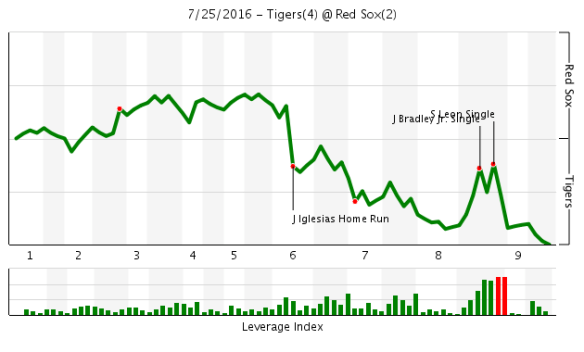
Although it did not happen precisely as I predicted, the Tigers scored enough runs off new Red Sox pitcher Drew Pomeranz to allow rejuvenated starter Justin Verlander to depart after the sixth inning with a 2-1 Detroit lead. The offense added insurance runs in the seventh and eighth, but, with Justin Wilson on to take care of the power portion of the Boston batting order in the bottom of the eighth, the situation quickly became dicey:

chart

Those skyrocketing green leverage index bars right before the red ones are what pop up when you load the bases before you get any outs. Not good if you’re on defense. Wilson secured the first out by way of a strikeout, but the next batter singled, driving in a run and narrowing Detroit’s lead to two, with the bases loaded and only one out. That will earn you your first red leverage index bar of the night.

Wilson always looks a bit fidgety on the mound, and with the home crowd mockingly chanting his name like they would that of a visiting hockey goalie who appeared to be cracking under pressure, Wilson mustered his second strikeout of the inning. The reliever appeared, if not relieved, then not unhappy when manager Brad Ausmus came out to fetch him, surrendering the ball without protest. The team’s closer, Francisco Rodriguez, would be coming in to attempt a four-out save.

Not three weeks ago, a nearly identical situation presented itself to Ausmus and the Tigers. They were on the road in Toronto– another team they’re chasing in the AL Wild Card race– that night, and Verlander left in the sixth inning with Detroit up one. That favorable margin held through the top of the eighth inning, and Wilson was back out to handle the bottom of the eighth. He quickly got himself in trouble, putting two men on base. The next two batters made outs, but Wilson walked the third, leaving himself with bases loaded, two outs, and the slimmest of leads to protect. Last night, Ausmus went to his surest option, Rodriguez, in that spot, but on that night in Toronto, he turned to Alex Wilson, a decidedly less sure option, who immediately proved as such by surrendering the lead for good.

At the time, I criticized Ausmus for the decision to bring in Alex Wilson instead of Rodriguez, as well as for his stated reason for making that decision:   Continue reading