More Likely Than Not: The 2025 Detroit Tigers are winning, and winning matters

Before the start of the 2025 MLB season, I noted the relatively dim projections of the Detroit Tigers’ chances to earn a postseason berth for the second consecutive season. And while I also noted a reason to be skeptical of those dour forecasts, I cannot say I thought things would turn so rosy so quickly.

Entering Opening Day, Baseball Prospectus’ PECOTA announced the Tigers’ playoff odds at below twenty-percent. FanGraphs’ ZiPS, while less hateful, still came in worse than a coin flip at under forty-four-percent. Then Detroit started playing the games. And then they started winning the games. In fact, they won nineteen games before May 1 for the first time in their 124-year history, and, the next day, they became the first AL team to reach twenty wins on the season.

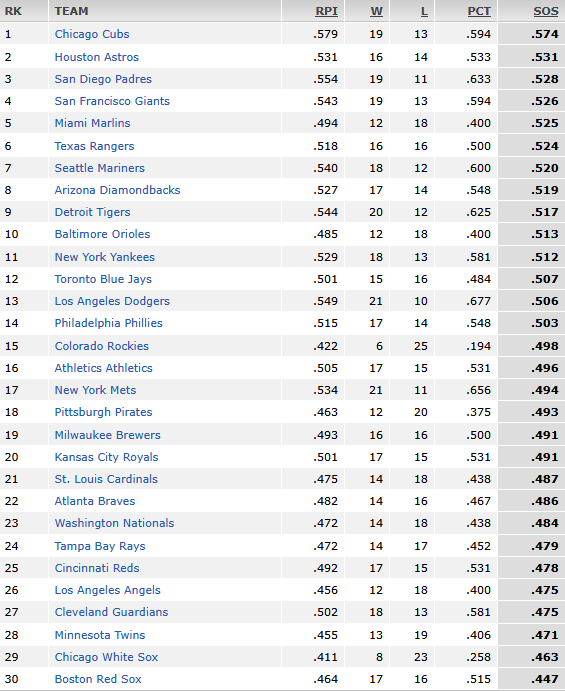
Some bitter Cleveland fans pointed out that Detroit has notched all of those wins while playing a lot of teams with sub-.500 records. That may be true. I don’t know. I do know that, according to ESPN, the Tigers overall have faced the tenth-toughest opponent schedule to date, while the rest of the AL Central has been coasting on cupcakes:

Regardless, postseason eligibility depends on standings, and standings depend only on wins, and wins are wins, and the Tigers now have twenty wins in a month’s worth of games that even PECOTA and ZiPS can’t ignore. As a result, those playoff odds have skyrocketed. BP is up from 19.9% to 61.1%, and FanGraphs is up from 43.6% to 81.1%!

There inevitably will be fluctuations, but banked wins cannot be unwon, and if relative breakouts from the on-the-ropes gang of Javy Baez, Spencer Torkelson, and Casey Mize can last, so too can this team. At least for right now, this is the fun baseball place.

___________________________________________________________________

Previously
Maximum Tork: How Spencer Torkelson is cranking up his hot start in 2025
Before you accuse me, take a look at Jake Rogers
Is it Tiger Time? Tarik Skubal says so

Is it Tiger Time? Tarik Skubal says so

On the eve of his Opening Day start, the second of his career and just the fourth time a reigning Cy Young winner will make his season debut against the defending World Series champions, Tarik Skubal published an open letter in which he declared the beginning of “a new era of Tigers baseball.” After last year’s surprise sprint to the playoffs and win over the Houston Astros, this is exciting stuff. Skubal’s declaration addresses the current moment and looks forward, his letter also predicting this team’s “eventual greatness.”

What does the future hold for the Detroit Tigers? Skubal has more influence on that than most, so his pronouncement carries great weight. Other observers are a bit more cautious than him, though. FanGraphs (ZiPS) projects an 81-81 record and a 43.6% chance of making the playoffs. Baseball Prospectus (PECOTA) is much less optimistic, chiming in at 78.5-83.5, with just a 19.9% chance of making the playoffs.

There’s quite a bit of variance between those two systems’ projections, particularly with respect to the likelihood Detroit makes it back to the postseason again this year. Considering the path the Tigers took to get there last year, catching fire in mid-August and never looking back, it’s reasonable to wonder whether that was a fluke. With due respect to Alex Cobb, Gleyber Torres, Tommy Kahnle, Jack Flaherty (welcome back!), Bailey Horn (welcome back, sort of!), Andrew Chafin (welcome back again again!), Jose Urquidy, and Manuel Margot, you can be excused for thinking the Tigers underwhelmed in the building-on-success department. There’s also a ripe case of subtraction by addition in the outfield, which is where you’ll see Javier Baez, just coincidentally absent for Detroit’s amazing August-October run last year, returning and making his debut as a real live outfielder. (In case you were wondering, yes, Baez remains under contract through 2027.)

Last year’s team went 86-76. They were 78-84 in 2023. The combination of late overachievement; middling offseason moves plus absence of history of strong in-season moves from current ownership and management; Meadows-family injuries; emerging whispers of Riley Greene fragility; and the return of Baez have me projecting an 80-82 record.

No affiliate links here, but multiple sports books currently have Detroit’s win-total line at 83.5.

The Tigers’ season opens tonight on the road against the Los Angeles Dodgers on ESPN. After three games in LA, they head north for three games in Seattle before opening at home against the Chicago White Sox on the afternoon of Friday, April 4. If nothing else, keep an eye on Skubal: he’s increased his production value each season. Repeating that feat this season would mark a very special performance.

Officially Confirmed: The 2022 Monday Night Football season was the worst ever

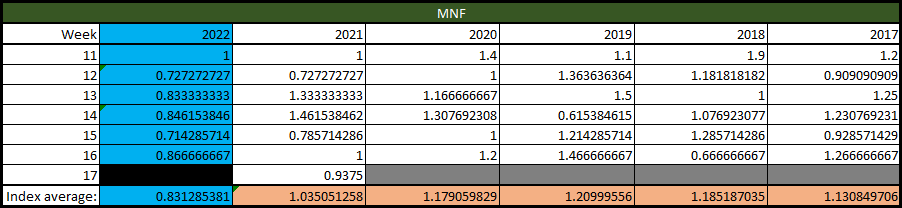
Well, it is finally official: The 2022 Monday Night Football season was the worst season of Monday Night Football in the recorded history of Monday Night Football. We here at ALDLAND were on this early, and, in a report published on December 6, 2022, disclosed the preliminary and then-conclusive findings derived from our proprietary MNF Index: “This has been the worst slate of Monday-night games in NFL history….Monday Night Football never has been less worthy of its billing than in 2022.” Today, ALDLAND updates and confirms that conclusive conclusion conclusively for the now-completed 2022 NFL season.

As a reminder:

Unlike Monday Night Football’s ascendant sibling, Sunday Night Football, or its soon-to-be-terminated cousin, SEC on CBS, all MNF matchups must be chosen well before the season starts. This means that the NFL and its media partners have to make significant, long-range predictions based on minimal data when they are setting all of the pairings for their premier weekly showcase. How well do they do this?

To answer this question, the MNF Index evaluates the quality of Monday Night Football games immediately prior to kickoff to present a quality score illustrating the schedule-makers’ degree of success at presenting enticing games likely to live up to the expectations of a nationally televised, Monday-night event. The MNF Index therefore does not consider any in-game performance data.

Looking ahead from that early December vantage point, we wondered whether the three remaining Monday-night games– Rams at Packers, Chargers at Colts, and Bills at Bengals– might offer a meaningful chance at redemption. They did not. Indeed, Rams-Packers (Week 15) was, according to the ALDLAND MNF Index, the worst MNF game of the season. And although the no-doubt quality matchup between the Bills and Bengals (Week 17) would have been the best MNF game ever, the game (a) correctly was canceled due to Damar Hamlin’s frightening, serious injury and (b) would not remotely have altered the ultimate conclusion that there has been no worse season of Monday Night Football than the just-completed 2022 season of Monday Night Football had it been played.

Some good news: Not only does ALDLAND’s MNF Index generate results, but it also gets results. Beginning in the 2023 NFL season, Monday Night Football will be subject to flex scheduling. This option should allow ESPN to buoy the quality of its flagging showcase and, if executed effectively on an ongoing basis, could cement the 2022 MNF season as the worst-ever MNF season ever.

_______________________________________________

Related
Is this the worst-ever season for Monday Night Football? Our MNF Index says yes
Like football, like bourbon: The real reason for the NFL’s popularity

Is this the worst-ever season for Monday Night Football? Our MNF Index says yes

Even though Roger Goodell has insisted on watering down the league’s overall product, Monday Night Football still carries a special cachet. It’s been a rough run for MNF this year, though, with some real stinkers for what’s supposed to be the NFL’s special weekly feature. In fact, according to ALDLAND’s proprietary MNF Index, this has been the worst slate of Monday-night games in NFL history.

Unlike Monday Night Football’s ascendant sibling, Sunday Night Football, or its soon-to-be-terminated cousin, SEC on CBS, all MNF matchups must be chosen well before the season starts. This means that the NFL and its media partners have to make significant, long-range predictions based on minimal data when they are setting all of the pairings for their premier weekly showcase. How well do they do this?

To answer this question, the MNF Index evaluates the quality of Monday Night Football games immediately prior to kickoff to present a quality score illustrating the schedule-makers’ degree of success at presenting enticing games likely to live up to the expectations of a nationally televised, Monday-night event. The MNF Index therefore does not consider any in-game performance data.

The results, shown below through the current week, unambiguously support a clear conclusion: Monday Night Football never has been less worthy of its billing than in 2022. While a look into the deep numbers also reveals that the decline began in 2021, MNF’s quality has fallen off a cliff this season.

Continue reading

The Bonds of Enshrinement: Assessing the Cooperstown Case for David Ortiz in 2022

https://img.bleacherreport.net/img/images/photos/001/750/956/72350937_crop_exact.jpg?w=1200&h=1200&q=75

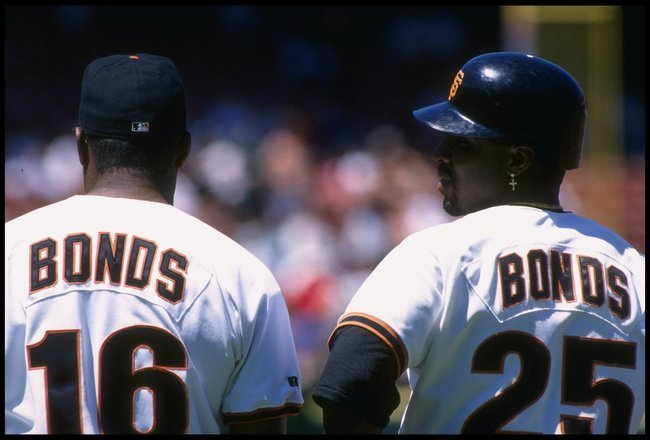
Earlier this year,* the Baseball of Fame passed an important threshold when Barry Bonds, Roger Clemens, Curt Schilling, and Sammy Sosa each failed to secure enough votes for induction on their final year of eligibility (though various mop-up committees conceivably could change that in the future). In other news, David Ortiz was the only player selected for enshrinement this year.

In the last decade or so, the online baseball social media community quickly and unequivocally came to the unwavering position that Bonds, allegations of wrongdoing cast far aside, belongs in the Hall.** Thus, any voter supporting Bonds’ candidacy is cheered as righteous, upstanding, intelligent, and correct, while any failing to do so is an unreconstructed hypocrite. These are the only choices.

As ever with these types of social movements, it isn’t enough to be “right.” One also must be right for the right reason. Naturally, herein also enters the discussion of identifying the right reason why the wrong are wrong, perhaps so as to convert them– upon receipt of the crowd’s wise and agreed critique– to being right. Among collective critics, few devices are more seductive than the critique of hypocrisy, and boy are people who think Barry Bonds should be in the baseball hall of fame enjoying lobbing that one over the barricade right now. As enunciated by ESPN baseball “insider” and live Pinocchio puppet Jeff Passan, the latest version goes like this:

The campaign against Bonds has spanned decades, involving malfunctions of fairness and logic across multiple cohorts.

It starts with Major League Baseball and the blind eye that Selig, his office and the game’s stewards turned toward PEDs. From there came the duplicity of riding the steroid wave to new stadiums and bigger TV deals and exponential revenue growth while villainaizing the very people who fueled it.

Perhaps ironically (irony being another too-seductive critique of people expressing themselves on the internet), Passan’s thesis contains some infirmities of its own. Omission of serial commas aside, this seems to ignore the fact that the Hall is a separate entity outside the control of MLB or its commissioner or club owners. Everyone associated with baseball profited from the game’s pharmacologically driven power boom in the second half of the 1990s, and MLB still recognizes all of the statistics posted and records broken during that era. Among “the game’s stewards,” only the Hall and its electors have tried to deny laudatory acknowledgement of this period of history. The facts do not support this particular smear of Bud Selig and the owners. (Readers of this site know there are plenty of other, valid reasons to engage in that exercise.)

Nor does logic support the levying of this charge. If player-driven, sport-wide profits should buoy the Hall-of-Fame credentials of the players whose playing pushed those profits, then, the theory would hold, more support is due to, for example, the non-serving players who kept the game going during World War II (vis-a-vis the likes of Hank Greenberg and Ted Williams) or the white players, simply by virtue of their skin color, during MLB racial segregation. As concerns this sort of parsing, the far-better and generally accepted view is, of course, the opposite. Passan’s contention is too reductive to be useful.

And none of this explains Ortiz’s first-ballot election. Let’s start with the case for Ortiz. He spent most of a twenty-season career with a very successful, popular, and visible Boston Red Sox team for which he was one of the most visible faces. He was a key part of three World Series championships, adding World Series and ALCS MVP honors to ten regular-season All-Star nods. Ortiz didn’t experience much of a decline as he aged, and, as a forty-year-old, he led all of baseball in slugging (.620), OPS (1.021), and doubles (48) in 2016, his final season. He finished with 2,472 hits and 541 home runs.

I don’t lose much sleep over first-ballot (or unanimous first-ballot) status; you’re either in or you’re out. That said, here, in reverse-chronological order, is the full list of players selected for enshrinement on their respective first ballot:

Continue reading

No Spin Mizer: If the glove doesn’t stick, we must acquit; or, Spin Doctors: Tracking possible reactions to MLB’s announced crackdown on pitchers using foreign substances

On June 2, 2021, MLB’s rumored crackdown on pitcher use of foreign substances took a significant step toward reality. That morning, USA Today published a story describing the enforcement of the policy as “imminent.” The same day, four minor-league pitchers who had been ejected from games during the preceding weekend for using foreign substances received ten-game suspensions.

MLB pitchers, it seemed, took note. To many, Gerrit Cole, now the top starter in the New York Yankees rotation, has become the face of elite spin rates, and he was continuing to earn that reputation in 2021. In his first start after June 2, however, his spin rate plunged.

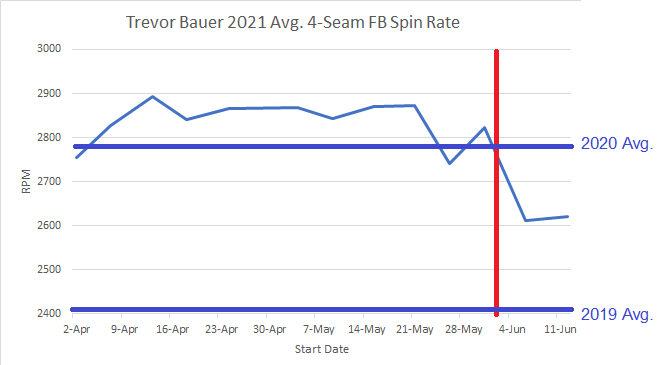
Trevor Bauer, the defending NL Cy Young winner now pitching for the Los Angeles Dodgers, forced his way into the group of spin-rate leaders last season following years of public comments criticizing pitchers who used foreign substances to increase their spin rates. Like Cole, Bauer saw his spin rate plummet after June 2.

Another leader in this category in recent seasons is Yu Darvish, now a starter for the San Diego Padres. Unlike Cole and Bauer, Darvish appeared unfazed by the June 2 announcement, at least judging by the relative consistency in his spin rates this season.

Since the June 2 announcement and enforcement of minor-league suspensions, MLB yesterday announced that it would apply the ten-game-suspension policy to major leaguers as well, with a progressive-discipline scheme for repeat offenders.

While a variety of factors can affect measured spin rates, it’s difficult to interpret the spin-rate dips from Cole and Bauer in their post-June-2 starts as anything other than an acknowledgement of the use of substances that go beyond providing the sort of control-improving grip that even batters appreciate from a safety standpoint and facilitate extreme spin rates (Spider Tack has become the brand name associated with that latter variety of substance). Cole and Bauer don’t come to this point by the same route, however. Bauer’s well-documented history of criticizing Cole and his former teammates in Houston for what Bauer strongly implied– and later seemed to demonstrate in a live-action experiment– were artificially high spin rates arguably places him in a different category than others in this conversation. On the other hand, perhaps he’s just more media-savvy. Should it make a difference if Bauer publicly changed his game to capitalize on and make a point of highlighting MLB’s underenforcement of foreign-substance rules, while Cole did, well, whatever this is?

Nor can we draw any firm conclusions from Darvish’s spin-rate graph. Not only did Darvish’s RPMs not drop after June 2, but they continued to climb. Was he undaunted by the “imminent” threat of enforcement, and, if so, why?

All of this brings us to Casey Mize’s start last night, immediately following MLB’s declaration that it would begin enforcement of its zero-tolerance policy against major-league pitchers. In his short professional career, Mize has not been a high spin guy, nor has he been publicly associated with what he calls the “sticky.” Which is why he was so upset when an umpire forced him to change gloves during the game:

Mize was walking off the mound following the first inning of his start on Tuesday in Kansas City against the Royals, when John Tumpane stopped him for what looked like a friendly conversation.

According to Mize, Tumpane said Mize’s glove was too light-colored.

Mize said the glove, which he’s worn for every one of his big-league starts, was originally charcoal-colored, but may have faded a bit in the sun.

“He said the gray color was too light,” Mize said.

Color judgement aside, Mize was most angry because Tumpane’s order came on the same day that Major League Baseball announced a widespread crackdown on the use of sticky substances that some pitchers have used to help them grip the baseball and increase the spin rate on their pitches.

“I assume everyone thinks that I was using sticky stuff now, which I was not,” Mize said. “So I just thought the timing of it was pretty (expletive), honestly. The umpires need to get on the same page, because I’ve made 12 starts (in 2021) and everybody was fine with (the glove). Or John Tumpane just needs to have some feel and just let me pitch with the glove that the other team did not complain about. (Tumpane) brought it up himself. John’s a good umpire and a very nice guy. But I mean, just have some feel for the situation because I hate that I’m in a position now where I assume everyone thinks I was using sticky when in reality, that was not the situation at all.”

First, for visual illustration, some relevant images of Mize’s mitt:

Without more information, this seems like a questionable decision by the umpire, and, whatever his motivation, the decision did drag Mize into the broader conversation about foreign substances. So what do the spin measurements say about Mize’s pitches? Most obviously, he operates in a much lower band of RPMs than the likes of Cole, Bauer, and Darvish. That alone may be more than enough for many to exonerate him. And while Mize’s average spin rates did decline between his May 28 start and his June 3 start, the magnitude of the change was negligible relative to those Cole and Bauer exhibited. If his data suggest anything, it’s that Mize is telling the truth.

However irked Mize was after being forced into a mid-game glove change, it did not appear to alter his performance. He completed 6.2 innings, threw a season-high 103 pitches, and allowed three runs on the way to a 4-3 Tigers win in Kansas City.

To this point in the season, Mize has been the best of Detroit’s young pitchers, and he trails only Spencer Turnbull in WARP. He’s following up an interesting if inconsistent debut in 2020 with across-the-board improvements in major statistical categories. While veterans attempting to be crafty and the commissioner’s office duke it out over Spider Tack, here’s hoping Mize can avoid that fray and continue to find his footing as a leading member of Detroit’s rotation.

The week in baseball: 5/29/20

From the Increasingly Nocturnal Department:

  • I haven’t found it productive to follow each new return-to-play proposal for the 2020 MLB season in any detail, but public comments this week, especially from players including Max Scherzer and Trevor Bauer, point to the very real possibility that the entire season will be lost due to the inability of the owners and players union to reach final agreement on compensation arrangements for the year in a timely fashion. Although the calendar has not yet turned to June, keep in mind that any start date will need to allow a few weeks of lead time for pitchers to stretch out, undoubtedly among other logistical considerations. The viability of opening the season on or around July 4 therefore depends on what the sides can accomplish over the next couple of days. Of all the things Rob Manfred has screwed up in his brief tenure as MLB commissioner, the complete absence of baseball in America should other professional sports leagues find a workable way to resume action would be one of the most memorable.
  • Meanwhile, the 2020 Minor League Baseball season effectively ended this week following the announcement that teams are expected to begin releasing large numbers of players shortly. Some big-league veterans, including  Shin-Soo Choo and David Price, have responded by personally paying all of the monthly stipends of all of the minor-league players in their respective teams’ farm systems.
  • The CPBL and KBO seasons are rolling on, though a recent resurgence of COVID-19 cases in South Korea has delayed the expected return of fans to KBO stadiums. ESPN is continuing live telecasts of KBO games, often with replays on ESPN2 later in the afternoon.
  • The KBO appears to have earned itself a celebrity fan in Adam Eget, trusty sidekick of Norm Macdonald and manager of the world-famous Comedy Store, who said as much on a recent episode of Joe Rogan’s podcast. He and Rogan also discussed cults and Charles Manson, so listen at your own risk.
  • Japan’s professional baseball league, NPB, announced it will begin an abridged season on June 19. The prevalent view among those who follow foreign baseball leagues is that the NPB is the league that comes closest to MLB in terms of talent and competition levels.
  • Facing the prospect of the complete absence of MLB games this year, I’ve begun posting daily baseball landmarks that occurred on that day on ALDLAND’s twitter account. Some from the past week in baseball history, courtesy of Baseball-Reference:
    • 1904 – Dan McGann steals 5 bases in a game, a feat not matched until 1974 (Davey Lopes) or bested until 1991 (Otis Nixon, 6)
    • 1922 – Supreme Court rules baseball not subject to antitrust laws, interstate commerce regulations
    • 1925 – Ty Cobb becomes 1st major leaguer with 1,000 career extra-base hits
    • 1946 – 1st night game at Yankee Stadium
    • 1951 – Willie Mays gets his first hit, a home run off Warren Spahn
    • 1952 – Hank Aaron, then of the Indianapolis Clowns, signs with the Boston Braves
    • 1959 – Harvey Haddix pitches 12 perfect innings before an error in the 13th (“there has been never been anything like it” = more from Tim Kurkjian here)
    • 1968 – NL announces expansion to Montreal, San Diego
    • 1969 – Aaron becomes the 3rd major leaguer with 500 HR + 500 2B
    • 1976 – Pitcher Joe Niekro, batting against his brother, Phil, hit his only career home run
    • 1990 – Rickey Henderson breaks Cobb’s AL stolen-base record
    • 2004 – Mariano Rivera earns his 300th save
    • 2006 – Barry Bonds hits 715th home run
    • 2008 – Pedro Martinez, making a Single-A rehab start for the St. Lucie Mets, faces off against then-recent top pick David Price, then of the Vero Beach Devil Rays. (Price and the Rays win 2-0.) Price would make his major-league debut that September and his World-Series debut the following month.
    • 2010 – Roy Halladay pitches perfect game (ESPN is airing a program on Halladay’s career and too-short life tonight at 7:00 pm)
  • Whatever happens with baseball this year, Jersey City brewery Departed Soles wants to make sure we don’t forget what happened in the recent past, and therefore has released its newest beer, Trash Can Banger, a session IPA with a can styled after the Houston Astros’ classic 1970s uniforms. For now, the beer only is available in New Jersey.
  • Did the Astros cheat? They did. Did their cheating help? Running counter both to fan intuition and the public statements on the subject by professional pitchers, the latest look at that question, like some others before it, concludes that it didn’t make much of a difference. This analysis also set out to test Commissioner Manfred’s assertion that the Astros didn’t cheat in 2019 but was unable to reach a conclusion on that question.

The week in “sports”: 5/8/20

EXOzzNaVcAEJMlI

From the Be The Ball, Danny Department:

RKB: When the joke doesn’t land where you want it to land

Following his first career walk-off hit, an eleventh-inning homer against the Toronto Blue Jays on Sunday, July 21, Detroit Tigers right fielder Nick Castellanos shared his feelings about Comerica Park, his baseball home for the entirety of his seven-year MLB career:

This park’s a joke. It’s to the point where, how are we going to be compared to the rest of the people in the league for power numbers and OPS and slugging and all this stuff, when we’ve got a yard out here that’s 420 feet straight across to center field? We get on second base, third base, and (opposing players) looking like, “how do you guys do this?” We play 81 games here, I don’t want to hear it about your two you hit that are questionable.

There’s no reason that I hit a ball 434 feet off Anibal Sanchez and it goes in the first row. That shouldn’t happen.

Let’s just say Miggy played his whole career in Yankee Stadium or Great American Ballpark or whatever – him and [Barry] Bonds are already the greatest hitters, period, there’s no discussion – but the fact that he’s played in Pro Player Stadium, the Marlins’ old park and then Comerica Park, there’s a discussion.

We do have ways of comparing player performances independent of the parks in which they performed, of course, but that’s beside the point. Castellanos wanted the Tigers to trade him prior to this season, and he probably still wanted that to happen as last month’s trade deadline approached. If I had to guess (I don’t have to, obviously), he made this statement because he’s frustrated with the lack of interest in his services from other teams and believes his fairly average batting numbers– which, he believes, would be much better if he played half his games in a smaller park– are to blame for that lack of interest. Subsequently developed information from local media sources apparently desperate to stoke fan outrage seems to confirm this:

Castellanos almost certainly would have more homers if he played in a hitter-friendlier park, but there isn’t a single MLB team or salary arbitrator (see Art. VI, Sec. E, Part 10(c) (defining admissible statistics in salary arbitrations)) evaluating him based on his raw, unadjusted hitting numbers. As long as he’s talking about those numbers, though, this may be the point to note that his career line at Comerica Park (.287/.339/.470) is better than the one he’s posted in road games (.264/.312/.454). The fact that this year’s split is running very strongly in the opposite direction likely is fueling his current frustration, however.  Continue reading

MLB’s David vs. Goliath: Will Daniel Descalso outhit Giancarlo Stanton this year? (via ESPN.com)

Here’s a hot-take kind of question: Who was the better hitter in 2018, Giancarlo Stanton or Daniel Descalso?

Stanton, the highest-profile acquisition of the previous offseason, was very good for the Yankees: 38 homers, .852 OPS and a 127 wRC+, meaning he was 27 percent better than the league’s average hitter. He was on a couple of MVP ballots. Descalso, paid $2 million after the Diamondbacks picked up his option in November, was pretty good, too: 13 homers and a .789 OPS, with a 111 wRC+.

So that was easy. Stanton hit better, assuming the point of hitting is to get on base and hit the ball far.

But, of course, it’s not. The point is to score runs, and for scoring runs, some hits are worth more than others. Descalso hit .270/.372/.541 with men on base, while Stanton hit only .236/.315/.429. Descalso drove in 17 percent of the men who were on base when he came up, while Stanton drove in only 14 percent. Of course, Stanton drove himself in 38 times, 25 more times than Descalso did — but now the question is close. By RE24, a stat that also credits a batter with the runners he advances with his hits, it’s a virtual tie. That’s assuming, at least, that the point of hitting is, rather than “get hits,” to create runs.

But it’s not. The point is to win games, and for winning games, some runs are more important than others. We call the hits that drive in those runs “clutch.” In 2018, Daniel Descalso was the fourth-clutchest hitter in the majors, according to FanGraphs’ metric. And Giancarlo Stanton was, using that same measure and that same term, the fifth least-clutch. In high-leverage situations — those situations where the game is most likely to be materially affected — Descalso was far more effective, with a .591 slugging percentage to Stanton’s .462, and a .378 OBP to Stanton’s .313. By win probability added — which measures the hitting team’s chances of winning before a player bats and after he bats, crediting the change to the batter — Descalso was one of the league’s most productive hitters last year:

  • Descalso: 3.10 wins added, 23rd in the majors
  • Stanton: 0.95 wins added, 106th in the majors

So that turns out to be not that easy of a question: Descalso, Daniel Descalso, was apparently quite a bit better than Stanton, and also better than Nolan Arenado and Manny Machado. It’s a hot take, but you can actually stand behind it. But now here’s the really hot-take question: Who will be the better hitter in 2019, Giancarlo Stanton or Daniel Descalso? … Read More

(via ESPN.com)