Upton Abbey: Episode 5 – Guess Who’s Not Coming To Dinner

upton abbey bannerDinner is a popular event at the Abbey, and after last episode’s three-course meal, it seems it’s supper time again.

This episode presents a baseball-themed inversion of a classic dinner trope, as there was no dinner guest to be found when the paternalistic Braves arrived in Queens this week to dine with the Mets:

Continue reading

Bay of Cigs: 100 days of summer run distribution

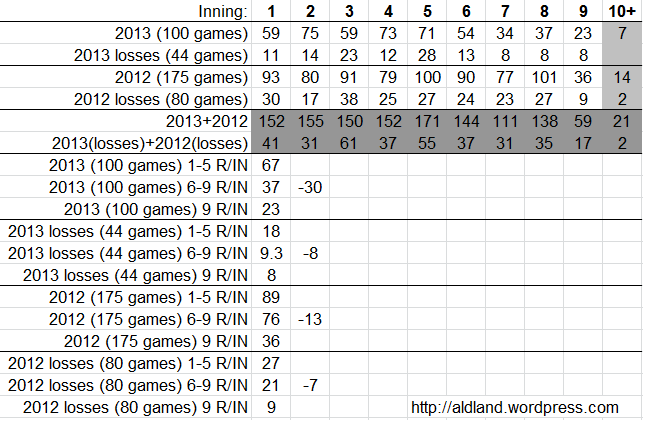
ALDLAND celebrated tax day this year by taking a dive into the numbers behind the Detroit Tigers’ offensive production. Since last season, I had developed the feeling that this should-be offensive power was having trouble scoring late in games, hamstringing their ability to mount comebacks and generally secure a win in the later innings, and I wanted to investigate to see whether that really was the case.

The evidence I gathered in April appeared to support my hypothesis. The 2013 season was just twelve games old, though, and it was difficult to ascribe too much meaning to data gathered from such a small sample set. As of today, however, Detroit has played one hundred games in the 2013 campaign, so I decided to update the numbers:

Continue reading

ALDLAND Podcast

The middle of July is one of the slowest times in sports, but the MLB came through by banning Ryan Braun for the remainder of the season for violating its drug policy and provided us with more than enough fodder for a podcast. Listen as Marcus and I discuss the Braun story and related subplots, as well as our thoughts and advice on workout gear and a recap of Lefty’s big win in Scotland.

_______________________________

Download the ALDLAND podcast at our Podcasts Page or stream it right here:

The Many (okay, two) faces of Ryan Braun

Yesterday, Ryan Braun, the Milwaukee Brewer who won the 2011 NL MVP and 2007 NL Rookie of the Year awards, agreed to a sixty-five game suspension from Major League Baseball for his violation of MLB’s drug policy and released the following statement:

As I have acknowledged in the past, I am not perfect. I realize now that I have made some mistakes. I am willing to accept the consequences of those actions. This situation has taken a toll on me and my entire family, and it has been a distraction to my teammates and the Brewers organization. I am very grateful for the support I have received from players, ownership and the fans in Milwaukee and around the country. Finally, I wish to apologize to anyone I may have disappointed — all of the baseball fans especially those in Milwaukee, the great Brewers organization and my teammates. I am glad to have this matter behind me once and for all, and I cannot wait to get back to the game I love.

Braun failed a drug test back in October 2011, but he was successful in overturning a fifty-game suspension on appeal by identifying a procedural deficiency in the testing process. During the pendency of that appeal, Braun stated:

This is all B.S. I am completely innocent.

Following its resolution in his favor in February 2012, Braun held a press conference where he issued a long statement, excerpted here:


[T]this is without a doubt the biggest challenge I’ve ever faced in my life, and it’s made it that much more challenging that I’ve had to deal with it publicly. But I truly view this challenge as an opportunity, just as I’ve viewed every other challenge in my life – as an opportunity. I’ve tried to respect this process, even though the confidentiality of the process was breached early on. I’ve tried to handle the entire situation with honor, with integrity, with class, with dignity and with professionalism because that’s who I am and that’s how I’ve always lived my life.

If I had done this intentionally or unintentionally, I’d be the first one to step up and say, “I did it.” By no means am I perfect, but if I’ve ever made any mistakes in my life I’ve taken responsibility for my actions. I truly believe in my heart, and I would bet my life, that this substance never entered my body at any point.

I’ve always stood up for what is right. Today is about everybody who’s been wrongly accused, and everybody who’s ever had to stand up for what is actually right. Today isn’t about me, it isn’t just about one player – it’s about all players. It’s about all current players, all future players and everybody who plays the game of baseball.

Ultimately, as I sit here today, the system worked because I am innocent, and I was able to prove my innocence. After today I look forward to returning my focus to the game of baseball, being able to get back with my teammates, allowing my life to return to some sense of normalcy and focusing on helping our team get back to the post-season.

Braun closed the brief question-and-answer period with this statement:

I guess the simple truth is I’m innocent. I’ve maintained my innocence from Day 1, and ultimately I was proven to be innocent.

America Has a Stadium Problem (via Pacific Standard)

Over the past 20 years, 101 new sports facilities have opened in the United States—a 90-percent replacement rate—and almost all of them have received direct public funding. The typical justification for a large public investment to build a stadium for an already-wealthy sports owner has to do with creating jobs or growing the local economy, which sound good to the median voter. “If I had to sum up the typical [public] perspective,” Neil deMause . . . told me via email, “I’d guess it’d be something along the lines of ‘I don’t want my tax money going to rich fat cats, but anything that creates jobs is good, and man that Jeffrey Loria sure is a jerk, huh?’” This confused mindset has resulted in public coffers getting raided. The question is whether taxpayers have gotten anything in return.

Economists have long known stadiums to be poor public investments. Most of the jobs created by stadium-building projects are either temporary, low-paying, or out-of-state contracting jobs—none of which contribute greatly to the local economy. (Athletes can easily circumvent most taxes in the state in which they play.) Most fans do not spend additional money as a result of a new stadium; they re-direct money they would have spent elsewhere on movies, dining, bowling, tarot-card reading, or other businesses. And for every out-of-state fan who comes into the city on game day and buys a bucket of Bud Light Platinum, another non-fan decides not to visit and purchases his latte at the coffee shop next door. All in all, building a stadium is a poor use of a few hundred million dollars.

This isn’t news, by any stretch, but it turns out we’re spending even more money on stadiums than we originally thought. In her new book Public/Private Partnerships for Major League Sports Facilities, Judith Grant Long, associate professor of Urban Planning at the Harvard University Graduate School of Design, shatters previous conceptions of just how much money the public has poured into these deals. By the late ’90s, the first wave of damning economic studies . . . came to light, but well afterwards, from 2001 to 2010, 50 new sports facilities were opened, receiving $130 million more, on average, than those opened in the preceding decade. (All figures from Long’s book adjusted for 2010 dollars.) In the 1990s, the average public cost for a new facility was estimated at $142 million, but by the end of the 2000s, that figure jumped to $241 million: an increase of 70 percent.

Economists have also been, according to Long, drastically underestimating the true cost of these projects. They fail to consider public subsidies for land and infrastructure, the ongoing costs of operations, capital improvements (weneedanewscoreboard!), municipal services (all those traffic cops), and foregone property taxes (almost every major-league franchise located in the U.S. does not pay property taxes “due to a legal loophole with questionable rationale” as the normally value-neutral Long put it). Due to these oversights, Long calculates that economists have been underestimating public subsidies for sports facilities by 25 percent, raising the figure to $259 million per facility in operation during the 2010 season. … Read More

(via Pacific Standard)

From the Vault: Phish – Joy

Before making attempts to establish my own online platforms, I took a more parasitic approach, abusing the comment sections of friends’ sites for my own purposes. With Phish returning to Atlanta for two performances this week and news of a new studio album in the works, this seemed like a good time to look back to those days and dig up my review of the band’s last studio recording.

When Phish released Joy late in the summer of 2009, it was the band’s first album in five years. Before March 2009, Phish had not appeared in concert since their two-day farewell in Coventry, Vermont in August 2004. Among other events, that five-year period saw the arrest, serious drug rehabilitation, and newfound sobriety of frontman Trey Anastasio. When Phish made its collective return to recording with Joy, longtime fan Chantyce was not impressed. I had a different reaction, though, and my responsive review from October 14, 2009 is reprinted below.

Electric Light Extended Jam

To make up for the relative dearth of Friday Jams in recent months, today’s Jam is a full BBC program on someone who is just the type of artist or athlete I like to feature in these pages and was, in part, the face of my first internet operation. Perfect for a lazy Friday afternoon at the office or elsewhere.

(HT: Shackleton)

ALDLAND Podcast

A very special edition of the ALDLAND podcast this week as blog founder AD joins us to talk NBA free agency and the MLB all-star game. Marcus and I revisit some of our MLB picks from the start of the season and AD makes his own.

_______________________________

Download the ALDLAND podcast at our Podcasts Page or stream it right here:

Pine Tar: The Untold Story (via WSJ)

On Tuesday at Yankee Stadium, George Brett will hold a news conference to talk about the most famous moment in his Hall-of-Fame career: the Pine-Tar Game.
Yet absent from that news conference will be a 47-year-old New York cop named Merritt Riley, who feels personally responsible for the pine-tar debacle.

“I really believe the Pine-Tar Game would never have happened if I hadn’t done what I did,” said Riley.

Speaking publicly for the first time ever about his role in the Pine-Tar Game—which took place 30 years ago this month—Riley said, “I remember it happening like it was yesterday.” … Read More

(via WSJ)

Sensational Sporst Synergy: Clay Travis and Fox Sports

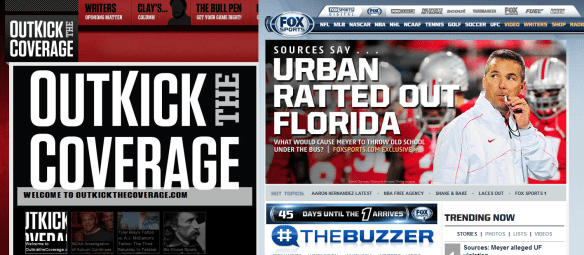
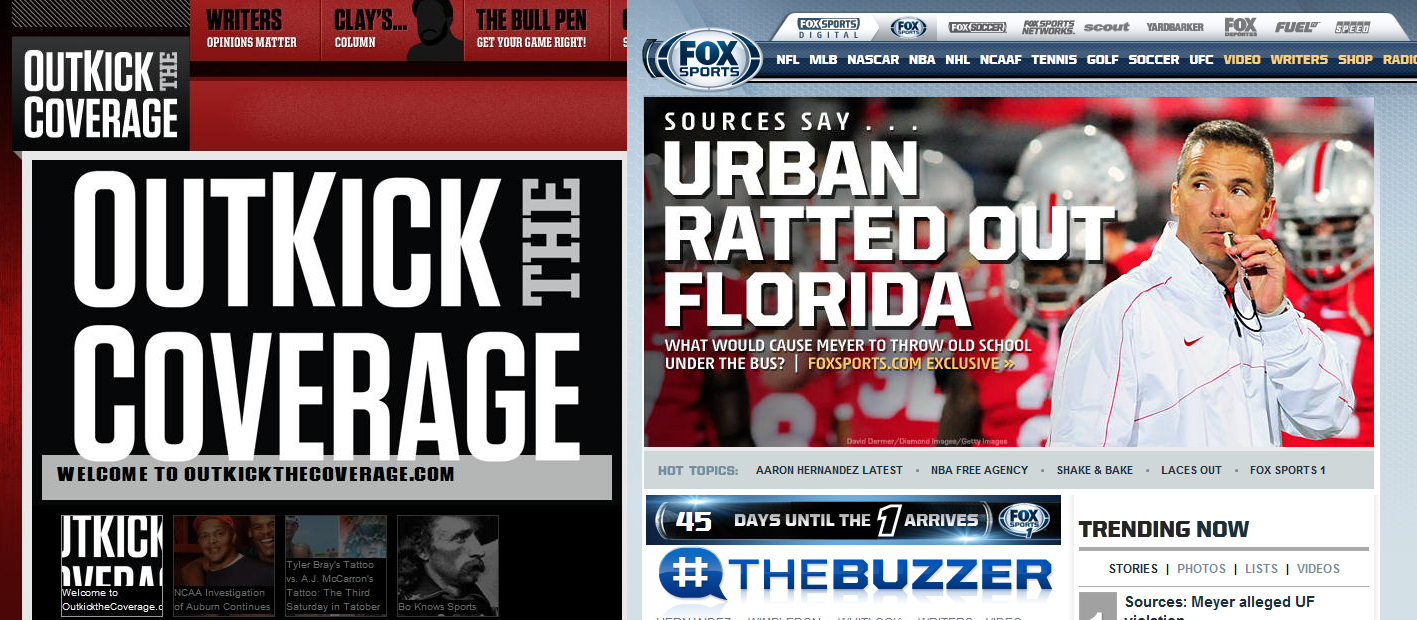
oktcfoxsportsAs of last night, Clay Travis’ Outkick the Coverage has merged with Fox Sports. The exact nature of the relationship is not clear. According to Fox Sports, “Clay Travis has officially joined FOXSports.com as a contributor.” As Clay tells it,

Outkick the Coverage and FoxSports.com have entered into a partnership agreeement. OKTC won’t change at all, we’ll just have a much broader audience. And those times when you try to hop on the site and we’re overloaded with traffic and you can’t get to our article?

Yeah, that won’t happen again.

Which is why FoxSports.com is hosting our latest story.

Did that ever happen to anyone? Anyway, Clay continued (as he always does): “After a lot of conversations FoxSports.com made the most sense and I’m excited about what’s to come.” He promises more details in the future, and for now says: “I have editorial control and Fox doesn’t want us to change at all.”

Together with MSN, Fox Sports already owns Yardbarker, which it bought in 2010, and through which it has a relationship with similar sites, such as Larry Brown Sports. Fox Sports seems to like to keep all of these formerly independent blogs underneath the umbrella of its Yardbarker Network. Major questions at this point include whether OKTC will receive the same treatment, whether OKTC itself will become a mere FoxSports.com reverse-portal, and what it means for Clay to be a FoxSports.com “contributor” (and why Clay did not reference that label on his own site).

As for clues about what Clay thinks– or thought– about Fox Sports, we can turn to the premiere source of information on all things Clay, Clay Travis, who in August 2012 responded to a question about ranking the major sports media outlets’ college football coverage by rating Fox Sports last among the given options, adding

I would rank Fox Sports last in its coverage of every sport. In its humor. In everything that it does online. I truly have no idea what this company is doing. FoxSports.com is a complete and total disaster of a site. So it’s no surprise that it’s also bad at college football. It’s also behind SBNation, Bleacher Report, and even OKTC.

Less than a month ago, he wrote that he had not visited FoxSports.com in over a year: “I barely have a conception of what [the page looks] like on direct entry.” Now that his article is plastered atop the front page of FoxSPorts.com, though, it’s probably his homepage.