This week’s issue of Sports Illustrated includes a transcript of Dan Patrick’s interview with former Kentucky Wildcat and presumptive New Orleans Hornet Anthony Davis. Included was this exchange, initiated by DP’s curiously worded question:
Patrick: Did you tell Kentucky Coach John Calipari you were going to go pro or did he tell you?
Davis: He told me. He told me to [come into his office]. When I walked in, first thing he said: “Look, Ant, you have to leave. You did too many great things this year. Won a national championship, got every award. There’s no point in you coming back.” I started laughing. But he had no smile on his face. He was dead serious.
Patrick: Did you want to stay at Kentucky?
Davis: I wanted to stay. Great team, great coach. But the way life is, you have to move on.
It’s tough to know how much to make of this out-of-context exchange. When Coach Cal called Davis into his office, was that the first time they talked about the star freshman’s departure? When Davis laughed, was it because he found the suggestion outlandish and wanted to stay, or was he just being sheepish? When Davis told DP he wanted to stay, was he being serious?
Still, there’s a persistent feeling that Cal really was kicking the kid on down the line to make room for the next crop of high-profile players. In a program operated on a one-and-done model, having a player of Davis’ talent stick around for another season could mean that UK would lose at least one of its top recruits, who commit to Kentucky because they want to shine for a single season and move along to the league where players get paid above the table.
During last weekend’s Pop Music Symposium at SUNY Clinton, I heard for the first time Carly Rae Jepsen’s “Call Me Maybe,” and late Wednesday night, reader Cactus William sent a/the music video, which will serve as this week’s Jam.
There’s a lot at play here. First, the song itself: I’ve only listened to it twice, and for different reasons, neither listen was a careful one, but it seems to be comprised of two fairly devastating pop hooks cycled as many times as three minutes and change will allow, and one less interesting bridge-ish segment with lyrics confusing in light of the purported plot. As for the singer herself, I’ve never heard of Jepsen before, and I can only assume that she comes from the Rebecca Black School of Corporate Music Manchurian Candidates, a vehicle to deliver said hooks and smile as her creators reel in the money.
Still, the financial circumstances of a song’s conception need not dictate its real value, and here I think we may have something of broader importance. I wrote earlier that Brad Paisley’s channeling of Arthur Conley with “Old Alabama” signaled country music’s arrival as America’s popular music genre, and I think something very roughly analogous is happening with “Call Me Maybe” vis-a-vis dynamics in popular gender politics. The thesis is that this song stands for a tipping point in male-female relations that sees a woman asserting herself, though just barely, as the first mover in the courtship context, contrary to traditional expectations. This thesis doesn’t ignore strong, demanding women of the past (Janis, “Tell Mama”) or even aggressive women of the present (e.g., Carrie Underwood, “Before He Cheats”), but it is operable to the extent it can bracket such apparent counterexamples as being either out of the mainstream or persistently reactionary despite their aggressiveness and focus its comparative backdrop on the likes of Taylor Swift, ALDLAND’s favorite anthro-feminine alien. On the other hand, this paragraph may have set back gender relations by a few decades or at least demonstrated my ignorance of contemporary popular music. Moving right along.
Next is the video, which stars members of the Miami Dolphins cheerleading squad. The first question here is, what motivated this? Was this just a sunny day romp around South Beach after cheer camp let out? Or, in Bring It On/Mean Girls fashion, was this a response to the leaked photo shoot of Lauren Tannehill, wife of Miami’s rookie quarterback and number eight overall draft pick Ryan Tannehill (who, if he didn’t outkick his coverage with his bride, certainly did with his draft position), in varying amounts of Dolphins-colored gear? To the extent this is knowable, determining the answer would initially involve comparing the dates of the leaking of the photos and the posting of the video, something I’m not going to do. Precision like that likely becomes less important when you’re striving for attention and HBO’s cameras are rolling.
To the extent that there’s any sports angle here, this video eventually will make you remember that, whether it’s the Hard Knocks curse, the implications of merely having cheerleaders, or the fact that Miami actually drafted Ryan Tannehill, the Dolphins are not going to be good this year, so enjoy this while you can, which is forever, because the internet is forever, unlike Dan Marino:
After some time off, ALDLAND’s podcast is back with a vengeance. Euro 2012, Liverpool’s new coach, baseball, and some big news from one of the co-hosts. It’s all here in the latest ALDLAND podcast.
_______________________________
Download the ALDLAND podcast at our Podcasts Page or stream it right here:
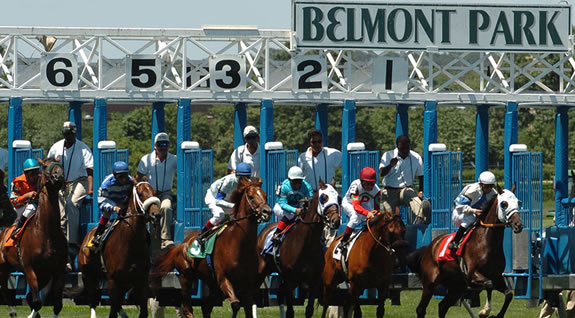
This SundaySaturday, at New York’s Belmont Park, Kentucky Derby and Preakness winner I’ll Have Another will try to become just the eleventh Triple Crown winner, and the first since Affirmed in 1978. (Interesting and surely irrelevant note: I’ll Have Another won the Derby and Preakness by the same margins that Affirmed did in ’78.) Of the twenty-one horses to win both the Derby and the Preakness, eleven have gone on to win the Belmont Stakes. After last week’s post on probability, I’m hesitant to say whether I’ll Have Another has a good shot at winning the Triple Crown after having won the first two races, but his chances have to be better for having done so. That said, I’ll Have Another hasn’t felt like a favorite in any of the two prior races, but neither does he feel like a stranger at this point. With Bodemeister’s withdrawal from the Belmont field, we won’t get to find out what would happen if these two top horses reprised their Derby and Preakness battles. The longer Belmont track would seem to have favored the late-breaking I’ll Have Another over the hard-running Bodemeister, but it could create new timing and endurance challenges for the Triple Crown contender and his young jockey. I don’t know how much Gutierrez keyed on Bodemeister in particular, but one has to expect that the pack’s overall pace will be slower around Belmont Park’s 1.5 mile track than it was in the last two, shorter races.
As with our Kentucky Derby preview (though not so much with the Preakness preview), the following is a collection of online stories and other items to help prepare your viewing experience of this weekend’s Belmont Stakes:
I’ll be on the road this weekend, so there will be no live blog of the race. You’re just going to have to watch it by yourself, without the benefit of alternatively insightful and weakly snarky running commentary.
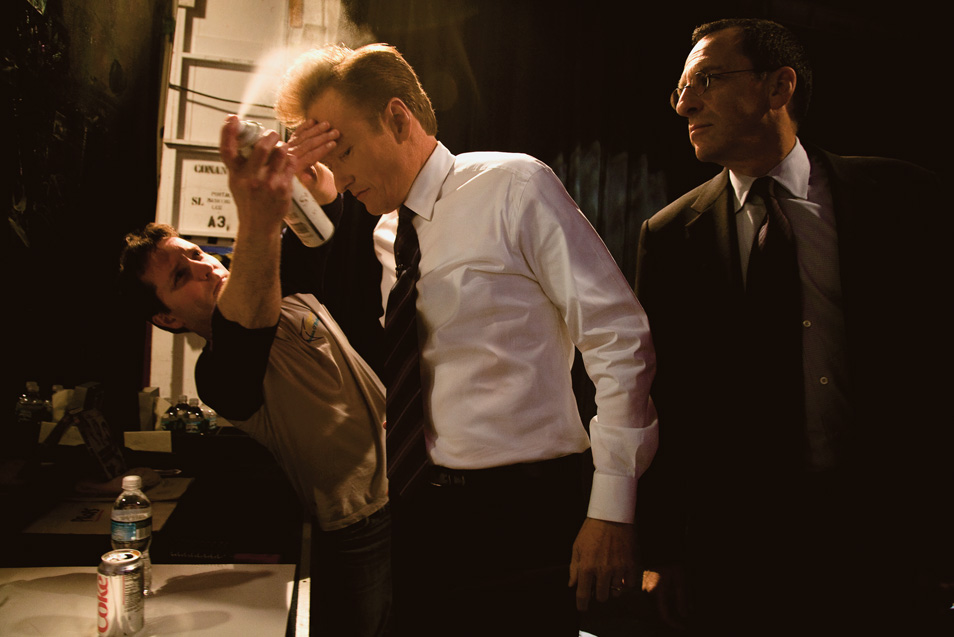
Mostly for structural technological reasons, this ALDLAND writer doesn’t watch a lot of TV. Like anyone even loosely following popular media and culture over the last few years, though, I’ve seen Conan– primarily on-demand, online, and for reasons unrelated to O’Brien himself– and have some opinion on him that I haven’t enunciated because it didn’t seem worth the effort to put into words that someone else would want to read that Conan really isn’t that funny. His move away from NBC piqued interest in the way that Charlie Sheen’s meltdown did– a spectacle was happening, and the corporate networks were openly trying to figure out how to handle it– but the only real consequence I felt was that the Mighty Max was off daily television.
But after a week watching The Great Conando pant after nobodies and ding Americans for being overweight, I’ve come to the conclusion that it’s not the lower ratings that should concern TBS. It’s the lowered expectations. By constantly moving the goalposts and pre-apologizing for Conan’s numbers, TBS only reinforces the perception that they’re less interested in the reality of Conan as a talk show than they are in the projected fantasy of it as some sort of web-friendly content farm. (Last week, Vince Vaughn “stopped by” to debut a trailer for his new movie. Yes, the star wattage was nice, but it seemed like an awfully expensive way for TBS to involve itself in something the Internet already does well enough for free, the equivalent of priority-mailing a letter to announce an e-mail you plan on sending in the morning.) Koonin’s hands-off policy and drama-free endorsements (“He’s our Mount Rushmore”) must make for a pleasant change of pace after 17 years among the backstabbing brownshirts at NBC. But it also seems to have stripped O’Brien of his most powerful weapon: his ferocious survival instinct.
Whether he was staving off cancellation rumors with coked-up werewolves or blowing off NBC’s rescheduling plans by blowing their money, O’Brien’s comedy has always worked best when he’s fighting for his life. . . . Now, tasked with little more than delivering a modest number of age-appropriate eyeballs, O’Brien seems both stunted and settled, lavishly rewarded for doing what he loves most for a company that seems to value the end product the least. It’s been well established by now that Conan O’Brien can’t stop. But it seems he’s only transcendent when someone is trying to make him.
Which is a nice way of saying what I wrote above, I think.
I also think that the reason I find myself watching him on youtube (again, for the guests) more than his competitors (that’d be Letterman, Leno, Jimmy Kimmel, and Jimmy Fallon) is because those comedians who seem to be smart (Louie, Norm, Tracy, Will) also seem to really respect Conan, and they seem to elicit honest, non-Guy Smiley reactions from Conan, and those do add to the experience of watching the guest.
It was unfair to call Lidstrom “The Perfect Human.” Nobody’s perfect, not even him. And sometimes his spotless performance and quiet personality worked against him. He was too often taken for granted because there were no downs to illustrate the ups. He was never beloved quite like his predecessor as captain, Steve Yzerman, who transformed himself from a slick scorer into a gritty leader. Who can relate to perfection? How can you celebrate a triumph over adversity when there isn’t any?
Still, Lidstrom lived up to the label somehow. If he lacked any love or attention, he never seemed to mind. He was never rude. He always had time for everyone.He was as close to perfect as a player and person could be, the definition of consistency and class, the ultimate high-performance, low-maintenance superstar. Actually, Holland called him “no-maintenance. ”
He retires as the best defenseman of his generation and one of the three best in the history of hockey. Bobby Orr won the Norris eight times. Doug Harvey won it seven times, like Lidstrom did. Though Orr could have won it more had his knees not given out, Lidstrom could have won it more, too. He was underappreciated early in his career, a three-time Norris runner-up, and the 2004-05 lockout erased a season of his prime. … Read More
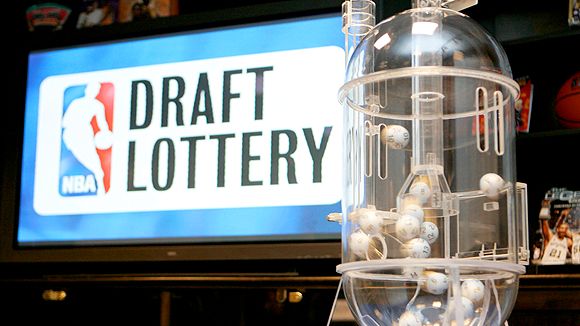
The NBA Draft Lottery is the ping-pong-ball-centered game the league plays with the four worst teams from the previous season to determine the order of selections for the next player draft. It’s basically beruit/beer pong with millions of dollars instead of Keystone Light, and, like timid lightweights, the winner doesn’t want to stay on the table for the next round.
The positions are selected in descending order, and the number of balls a team has in the hopper is inversely proportioned to how well the team finished the prior season. The ostensible idea is to give the last-place team the best shot of getting the first overall pick (i.e., the best chance at improving its lot in the future). Why not just award the worst team the first pick as a rule? I suppose the idea is to avoid the sort of tanking that allegedly is a problem in the NFL, where such a rule is in effect. Injecting an element of chance means it’s harder to game the system in a way that’s detrimental to the game– losing on purpose– although it can’t fully do away with the incentive to lose so long as it maintains its rehabilitative goal.
This year, the Charlotte Bobcats had the worst season in NBA history. The New Orleans Hornets, recently late of league ownership, merely had the fourth worst of the 2011-2012 season. This year’s draft lottery thus was arranged with the stated goal of giving the Bobcats the best shot at the first pick and the Hornets the worst.
Of course, once everyone saw that the Hornets would be in the mix for this year’s draft lottery, the conspiracy theorists, folk singers of my literary heart, rolled out their obvious prediction: the league was going to rig the lottery so that the Hornets got the top pick. Keep reading…
The Weekend Interview is back, and this time, the subject is Ricky Williams. A top pick out of the University of Texas, the running back played in the NFL for New Orleans, Miami, and Baltimore, and in the CFL for the Toronto Argonauts, before retiring in February.
Williams was one of the most curious characters: supremely talented, but with interests that strayed far from– and at times took him off of– the gridiron. At just thirty-five, Williams is a vocal person in retirement, recently confounding Dan Le Batard and Dan’s father (and anybody else watching) on the topic of head injuries and football.
Usually I have to subtly toss the “imaginary content” tag on these interviews, but not this time. Here‘s Williams and me on Monday (holiday weekend) afternoon: Keep reading…


 ALDLAND