Still processing this sad news, which broke last night. More to come, but, for now, a sampling of his music:
Still processing this sad news, which broke last night. More to come, but, for now, a sampling of his music:
It has come to my attention in the course of preparing this feature on penalties in NFL games this season that the chart I’ve been using to track penalty frequency doesn’t quite show what it purports to show. First, here’s this week’s chart:
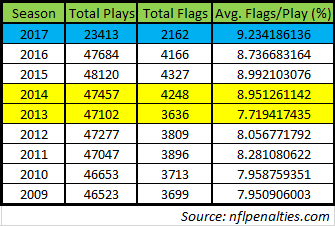
The important number is the one in the far-right column. That’s the number that represents penalty-flag frequency in a given season. The column label, “Avg. Flags/Play (%)” is a little bit misleading, though. A better label might be something like “Flags per 100 Plays.” Even better might be to rework it to be a rough estimate of flags/game based on an average plays per game number of 125 or so. For the moment, and probably for the rest of this season, though, I’m going to continue using the same chart because there’s only so much time I want to spend documenting the historic* level of monotony that is plaguing this NFL season. If you’ve been following this series of posts closely this season, you’ll notice that, as we’ve passed the halfway point, the flag rate appears to be settling into the low 9.2 range. Again, that’s down a little bit from the first few weeks, which were up around 9.6, but it’s still well above prior seasons.
Last week’s post discussed the league’s late-breaking attention to the head-injury issue, which, I suspect, is the reason for the large jump in flags from 2013 to 2014. The other aspect reflected in these data points likely is the NFL’s attempt to grow its audience by increasing excitement by increasing scoring, something it did by enforcing more defensive penalties, which, as we’ve seen, actually decreases excitement and probably should’ve raised a flag or two prior to implementation.
* The NFL Penalty Tracker has data going back to the 2009 season, but I’m pretty confident that we are witnessing the all-time high-water mark.
______________________________________________________
Previously
Waive that flag: People are noticing (NFL 2017 week eight penalty update)
Waive that flag: Is this still a thing? (NFL 2017 week seven penalty update)
Waive that flag: Alberto’s favorite things (NFL 2017 week three penalty update)
Waive that flag: NFL week two penalty update (2017)
Waive that flag: The NFL returns with zebras on parade

I used to write the sports technology roundup at TechGraphs, an internet website that died, and now I am writing the sports law roundup at ALDLAND, an internet website.
Here are the top sports-related legal stories from the past week:
Sports court is in recess.

As often happens, a topic we begin covering here turns out to be a trend that the national media eventually comes around to cover, and so it is with the NFL’s penalty epidemic, which is the subject of Drew Magary’s weekly football column today:
What has changed are the rules themselves. It was back in 2013 when the NFL decided to look like it was doing something about brain injuries, so they instituted harsher penalties for kill shots on QBs and defenseless players, and that has led to a brand of football that is ostensibly “safer” in the NFL’s mind while not being particularly enthralling to watch. In other words, this increase in penalties is something of a necessary evil, at least as far as granting you, the NFL fan, the delusion that you’re watching a kinder, gentler sport.
They’re not gonna go back to 2011 and let those shots happen all over again (unless Cam Newton happens to be playing). But what the NFL can do is find a way to compensate for those extra stoppages in other ways. They can ease up on holding penalties for defensive backs and linemen. They can ditch replay. And, most crucial, they can take the goddamn microphones from the refs.
You and I have sat through miserable games where the ref has to announce so many penalties that they become the de facto emcee of the game. I have seen Ed Hochuli during football season more than my own family. And what is really the benefit of having him out there to give a 10-minute stemwinder on some dumb replay? I know the NFL thinks that explaining a call in detail will help provide clarity to fans, but fans are drunk and miserable and will disagree with any call that goes against their team, even if it’s a proper call (I know I do). All mic’ing the ref does is draw even more attention to officials who ought to be invisible during the telecast. Need to know the exact penalty and who it’s on? The PA guy and the TV announcers can do that on the ref’s behalf. Need to justify a ticky-tack call? Let the ref do that in the postgame. Need to overturn a call? Use a hand signal. There is nothing a ref can say that’s gonna make me happy. I want him fucking GONE.
If the NFL really needs this uptick in penalties, the least they can do is minimize the attention drawn to them. It’s a cheat, but muting the refs is an easy way to make these penalties less visible. It also eliminates the danger of any ref going full GLORY BOY and becoming addicted to the power of holding the mic, like they’ve anointed themselves god of the proceedings. If I were a ref, I’d treasure my time on the mic like it was the birth of my child.
And if there’s lingering confusion from a call because the mics have been taken away, that frustration usually goes away a few plays later, when there’s something new to be angry about. I can also assure you that hearing Jeff Triplette explain himself does NOTHING to ease that confusion. Basketball and baseball do fine with officials who are hilariously inconsistent but also gratefully silent. The NFL could stand to follow suit. This is a league that abhors distractions, a league that is pathologically obsessed with getting people to focus on the game. And yet, they allow distractions to pollute these very same games with near-constant whistles and speechifying. Get Hochuli off the mic, get the focus back on the players doing cool shit, and get the fuck out of the way.
Here are the numbers from week eight:

As was the case last week, the 2017 flag rate continues to fall while still staying well ahead of any in recorded history.*
* The NFL Penalty Tracker has data going back to the 2009 season.
______________________________________________________
Previously
Waive that flag: Is this still a thing? (NFL 2017 week seven penalty update)
Waive that flag: Alberto’s favorite things (NFL 2017 week three penalty update)
Waive that flag: NFL week two penalty update (2017)
Waive that flag: The NFL returns with zebras on parade

The only thing tougher to keep up with than this penalty-induced stop-and-start NFL season appears to be this series tracking those penalties. After a couple weeks off, it’s time to find out whether (mixed metaphor warning) 2017’s historic* penalty trend is continuing or flagging.
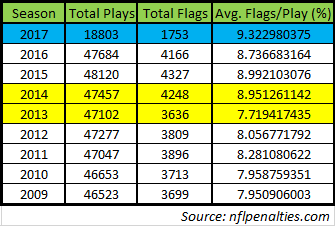 Although the flag rate this season is falling, it continues to be higher than ever. With penalties trending up and viewership ratings trending down, one continues to wonder when the NFL will get the memo and let the players play.
* The NFL Penalty Tracker has data going back to the 2009 season.
______________________________________________________
Previously
Waive that flag: Alberto’s favorite things (NFL 2017 week three penalty update)
Waive that flag: NFL week two penalty update (2017)
Waive that flag: The NFL returns with zebras on parade
I used to write the sports technology roundup at TechGraphs, an internet website that died, and now I am writing the sports law roundup at ALDLAND, an internet website.
Here are the top sports-related legal stories from the past week:
Sports court is in recess.
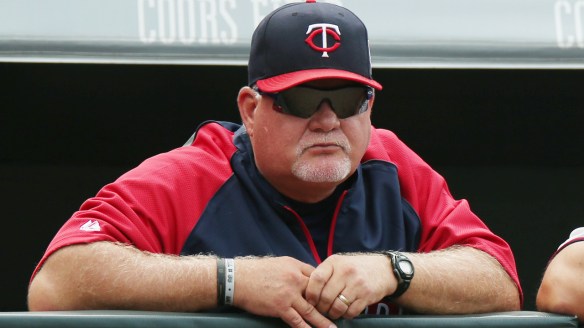
In a move sure to disappoint many, the Detroit Tigers’ managerial search reportedly is over after less than two weeks, and the team appears to be set to announce former Minnesota Twins manager Ron Gardenhire as the replacement for Brad Ausmus. From the article announcing the decision:
What separated Gardenhire from the rest of the pack?
Multiple sources told The Athletic’s Katie Strang that Tigers general manager Al Avila entered the process leaning heavily toward a candidate with previous MLB managerial experience. Gardenhire was seen as a seasoned, battle-tested option in this regard.
In his thirteen-season tenure as the Twins’ skipper, he compiled a .507 winning percentage. In twenty-seven playoff games, he posted a .222 winning percentage. All of those playoff wins came in his first three seasons (2002-2004) with the club, and Minnesota missed the playoffs entirely, and by wide margins, in his final four seasons there (2011-2014).
In my opinion, Gardenhire is the worst sort of “old-school” manager who lacks the ability to adapt to the modern game or develop young talent, two things of critical importance to this Tigers team in 2018 and beyond. He’s Jim Leyland without the edge, wit, or soul (which is to say: not Jim Leyland). He’s Dusty Baker without the success. He’s Clint Hurdle without the willingness to learn and adjust. He’s basically Bryan Price’s dad. Which is to say, not good, and vanilla at best.
To this, Tigers fans should say: “no thank you.” That a coaching search that supposedly began with fifty names ended like this reveals a front office more tone-deaf than previous personnel decisions indicated. Research indicates that managers probably have little impact on game outcomes, and if Gardenhire is coming to Detroit merely to serve as an interim stopgap during the rebuilding process, so be it. If that’s the case, though, why not bring in someone younger and cheaper who at least offers the possibility of growing with the players and the club and developing into a long-term solution? Or, why not promote from within, like the Atlanta Braves did with Brian Snitker? The team’s coaching ranks weren’t short on people “with previous MLB managerial experience,” including Lloyd McClendon and Gene Lamont.
Gardenhire’s not likely to be a detriment to the team, but his hiring feels like a missed opportunity and serves as a reminder that, after the Verlander decade, the Detroit Tigers’ rebuilding process will be a long and difficult one indeed.
https://twitter.com/Starting9/status/920356239049154560
New York Yankees starting pitcher CC Sabathia had a big night last night, giving his team a much-needed six-inning shutout start and a chance to even the series against the Houston Astros in the ALCS. With Sabathia, at age thirty-seven, in the final year of his current contract, Sabathia’s performance made some wonder about his Hall-of-Fame credentials, a subject I attempt to parse in only slightly greater detail in my latest post for Banished to the Pen.
The full post is available here.

Another empty rocking chair in the Wilbury household this week, sadly, as Charlie T. rode the late train out of town to join Lefty and Nelson at the end of the line.
Tom Petty was a hitmaker on the volume scale of Motown’s song factories, and the “was” in this sentence is doing a lot of grim work, because, in contrast to some other mourned celebrity passings, Petty, at sixty-six, remained an active and strong performer. We saw him in concert just this spring, my first time, and he was just as good and strong as I hoped. There’s a real loss here.
A 2009 Wall Street Journal article published in conjunction with the release of Petty’s career-retrospective Live Anthology memorably made the case that Petty’s slightly lower situation in the proverbial Rock Pantheon was due, in my reading, to the irony that his songs were too popular. It’s funny because it’s true, but it says more about the fans than the artist. We hold Springsteen, to borrow the foil from that WSJ piece, in higher regard because he had fewer hits? I don’t know why, or if that’s how it really works, but at some point it misses the mark to parse the greats like this.
It also misses the mark on Petty, who always seemed to belie his deep catalogue of radio-friendly tunes with his ability to wink at that great big world of entertainment with a sly smile worn by one who could take or leave the trappings of celebrity that pop stardom can offer. As he told the Journal in ’09, “We were never really Boy Scouts, you know. My vision of a rock and roll band wasn’t one that cuddled up to politicians, or went down the red carpet. That kind of thing you see so much of today. I felt like once that stuff starts happening your audience doesn’t know whether to trust you or not.” That article continues:
Mr. Petty set himself apart in other ways. While Dylan and the Stones have licensed their music to advertisers, Mr. Petty says, what for? “We don’t really need the dough that bad.” The singer has sought keep his concert tickets affordable. And unlike, say, Mr. Costello, who has collaborated with string quartets, Mr. Petty says he’s satisfied with being a workaday auteur: “To write a good song is enough. That was the loftiest ambition I had: to write a song that would endure.”
Or you could just take a look at his perfect initial interaction opposite Kevin Costner in 1997’s The Postman. Or his appearance as the Mad Hatter, forever my envisage of that character, in his own music video:
While we’re here, let’s do a few more:
The Davy Jones of Major League Baseball, John Jaso, says he plans to retire from the sport and live on his sailboat. As the Deadspin writeup notes, Jaso earned roughly $16.6 million in his nine-year career, during which he spent time with the Pirates, Rays, Mariners, and A’s. Not bad for a catcher-turned-first-baseman/corner-outfielder who amassed 6.1 career WARP.
Of course, it’s also roughly the same amount of money– $16 million– the Detroit Tigers agreed to pay Mike Pelfrey for two seasons of work. Pelfrey now has twelve MLB seasons under his belt and -2.5 career WARP to show for it. His -2.2 WARP in 2016, the first year under his contract with the Tigers, represented the worst season of his career after his rookie year. (Pelfrey rebounded to -0.1 WARP this year for the White Sox, who picked up just $540,000 of the $8 million remaining on his contract when they signed him the first week of the season.)
These are the facts, and, viewed together, they don’t reflect particularly well– though certainly in varying degrees of not-well– on anyone involved with the possible exception of the White Sox, who paid essentially the league-minimum salary for 120 innings of slightly below-replacement level starting and relief pitching. Jaso’s probably holding off on his official retirement announcement until he has an opportunity to meet with Al Avila.
__________________________________________________________
Previously
Catching Fire: Pelf on the shelf

