Sailing Away: Chris Sale and the Atlanta Braves start 2025 by charting the wrong course

At the time of drafting, the Atlanta Braves mercifully are on an off day, drudging into their home opener with an 0-7 record, a start from which no team ever has recovered to reach the postseason.

Chris Sale was supposed to be an anchor for the entire Braves team, and especially its rotation. All he did last year, his first in Atlanta, was lead the team in fWAR (6.4) by nearly two wins and receive the National League Cy Young award. As with the Braves, Sale’s 2025 season is trending in the wrong direction, however.

Sale turned thirty-six on Sunday. The next day, he pitched five innings against the Los Angeles Dodgers, allowing three runs on four hits and no walks while striking out five. Not bad against a potent Dodgers offense, but his team only scored one run, so it counted as another loss.

If I’m reading this graph I generated correctly, the real trouble looming for Sale wasn’t that he fell apart in the sixth inning after holding LA scoreless and seeing just three batters over the minimum through five innings; instead, it was that he threw the slowest fastball he’s thrown since late 2023. Visually, this illustration tracks an inverse correlation between Sale’s xFIP- (lower is better) and his fastball velocity: When he’s throwing his fastball faster, his expected results tend to be better. For example, when he was locking up the Cy Young award last year, particularly in July and August, his average fastball velocity was rising and his xFIP- was plummeting. Very good. By contrast, as his average fastball velocity is dipping to start 2025, his xFIP- is climbing. Not so good.

It’s only two games, one each against two of the best teams in the National League (he also started opening day in San Diego against the Padres). But Sale is critical to Atlanta’s hopes in 2025, moreso even than last year given Spencer Strider’s injury and the departures of Max Fried and Charlie Morton, both free agents who left Atlanta to sign with AL East teams. The team needs him to be healthy and effective in carving up opposing lineups the way he once carved up his own team’s jerseys with a hunting knife.

Sale likely will be back in action this weekend as the Braves make their 2025 home debut against the Miami Marlins.

Before you accuse me, take a look at Jake Rogers

As highlighted in our 2025 Opening Day post, PECOTA, the projection engine at Baseball Prospectus, sees the Detroit Tigers with a less than one-in-five chance of returning to the playoffs in 2025, the longest odds it projected for any team that also appeared in the 2024 postseason. That feels like a personal attack.

But how much weight should Tigers fans accord this relatively dim outlook? In a field of competing inexact-science offerings, PECOTA has earned a reputation as one of the least-inexact baseball projectors. It still makes mistakes, though. Would it be relevant to those Tigers’ fans’ answers to the immediately preceding question that PECOTA recently produced another extreme, negative projection about the team that turned out to be very wrong? If your answer to the now-immediately preceding question is “yes,” then read on.

Our preview of the Detroit Tigers’ 2024 season also included some PECOTA nuggets, one of which involved catcher Jake Rogers’ projected defensive contributions:

PECOTA sees Detroit’s likely starting backstop completely forgetting how to catch in 2024:

Rogers was a top-ten defensive catcher in 2023. (The BP website has different defensive numbers for Rogers and other catchers than those appearing in the book. I’ve inquired and it sounds like their stats team made some post-publication tweaks to their average benchmarks that may account for the variance.) Most of this projected thirteen-point drop comes in the form of a projected swing from being a top-ten framer to a bottom-thirty guy at that skill. Ironically, Rogers’ BP annual blurb mentions his “unseat[ing of] Eric Haase for the starting catching job” even as PECOTA projects him to frame as poorly as Haase did in 2023. (To fully square this circle, Haase’s 2024 framing projection is -3.2 runs.)

This is not the first time PECOTA has thought lowly of Rogers’ defense. In the 2023 BP annual, for example, it forecast him for -7 DRP, with a -6.5 on the framing component, both huge misses. Undaunted, the computer has doubled down for 2024.

Everyone in baseball will tell you that defensive metrics are especially difficult to define and measure and therefore probably should be regarded a little more cautiously than other performance metrics. That’s sensible and unobjectionable. What creates undue difficulty, in my opinion, is what seem like wild year-to-year oscillations in players’ defensive numbers. Of course players aren’t going to be exactly the same person every season, and many factors– injury, age, chance, drugs, etc.– can cause production value to vary outside a “normal” career development curve. Breakouts can happen quickly. Careers can end quickly. When we’re told a player’s defensive performance has yo-yoed erratically from season to season without ready explanation, though, it makes it very difficult to ascribe any meaning to defensive metrics, even on their own terms and within their own contexts. Maybe Rogers really is a definitively unremarkable catcher who just had his Brady Anderson framing season. Probably not, though.

Indeed not. Not only did 2024 Rogers retain his defensive prowess exhibited in 2023, he substantially improved upon it. And looking just at pitch-framing, the particular skill driving the projected drop in his overall defensive value, Rogers actually proved to be a top-three framer in all of baseball last year.

If that big whiff is enough of a reason for you to throw out the 2025 PECOTA projections in their entirety, I won’t stop you. So far as the actual team is concerned, though, there’s not going to be anything good left to project if they don’t start winning. The Tigers, still hunting their first win, are back in action tonight in Seattle after a Sunday of rest following a tough Dodgers’ sweep.

___________________________________________________________________

Previously
Is it Tiger Time? Tarik Skubal says so

Is it Tiger Time? Tarik Skubal says so

On the eve of his Opening Day start, the second of his career and just the fourth time a reigning Cy Young winner will make his season debut against the defending World Series champions, Tarik Skubal published an open letter in which he declared the beginning of “a new era of Tigers baseball.” After last year’s surprise sprint to the playoffs and win over the Houston Astros, this is exciting stuff. Skubal’s declaration addresses the current moment and looks forward, his letter also predicting this team’s “eventual greatness.”

What does the future hold for the Detroit Tigers? Skubal has more influence on that than most, so his pronouncement carries great weight. Other observers are a bit more cautious than him, though. FanGraphs (ZiPS) projects an 81-81 record and a 43.6% chance of making the playoffs. Baseball Prospectus (PECOTA) is much less optimistic, chiming in at 78.5-83.5, with just a 19.9% chance of making the playoffs.

There’s quite a bit of variance between those two systems’ projections, particularly with respect to the likelihood Detroit makes it back to the postseason again this year. Considering the path the Tigers took to get there last year, catching fire in mid-August and never looking back, it’s reasonable to wonder whether that was a fluke. With due respect to Alex Cobb, Gleyber Torres, Tommy Kahnle, Jack Flaherty (welcome back!), Bailey Horn (welcome back, sort of!), Andrew Chafin (welcome back again again!), Jose Urquidy, and Manuel Margot, you can be excused for thinking the Tigers underwhelmed in the building-on-success department. There’s also a ripe case of subtraction by addition in the outfield, which is where you’ll see Javier Baez, just coincidentally absent for Detroit’s amazing August-October run last year, returning and making his debut as a real live outfielder. (In case you were wondering, yes, Baez remains under contract through 2027.)

Last year’s team went 86-76. They were 78-84 in 2023. The combination of late overachievement; middling offseason moves plus absence of history of strong in-season moves from current ownership and management; Meadows-family injuries; emerging whispers of Riley Greene fragility; and the return of Baez have me projecting an 80-82 record.

No affiliate links here, but multiple sports books currently have Detroit’s win-total line at 83.5.

The Tigers’ season opens tonight on the road against the Los Angeles Dodgers on ESPN. After three games in LA, they head north for three games in Seattle before opening at home against the Chicago White Sox on the afternoon of Friday, April 4. If nothing else, keep an eye on Skubal: he’s increased his production value each season. Repeating that feat this season would mark a very special performance.

Tariff Jam

We don’t do political content or much policy analysis here at ALDLAND. For nearly fifteen years, we have stood as a virtual pillar of resistance against ahistorical public discourse, though, and news out of Cleveland this week prompted another opportunity for us to recommit ourselves publicly to that mission. We do so now by publishing what follows, this week’s Jam, as evidence against any persistent allegation that rank-and-file populists ever actually preferred tariffs as a means of economic protectionism.

Should you instead prefer a more-recent, more-electrified version of the aforegoing to which your poster served as an eyewitness, just head on over here.

It seems as though the Detroit Red Wings like their new coach

On Thursday, December 26, 2024, Detroit Red Wings General Manager Steve Yzerman announced that the team was firing head coach and Gru lookalike Derek Lalonde and replacing him with Todd McClellan, late of the Los Angeles Kings and San Jose Sharks and a former Red Wings assistant under Mike Babcock, effective immediately. And the effect was almost immediate.

At the time of the coaching change, the Wings were 13-17-4, having lost three games in a row and nine of the preceding twelve. McLellan’s first game behind the bench came the very next night, and it was a 5-2 home loss to Toronto.

The team has not lost since then, though. The active winning streak now stands at seven games, a stretch never matched during Lalonde’s tenure. In fact, it’s been thirteen years since Detroit last won seven consecutive times. They did it exactly that many times in January of 2012. (They actually had two winning streaks of exactly seven games that season, the earlier one spanning November and December of 2011.)

I caught a Red Wings game that season, a loss at Chicago, in which my chief complaint outside of the result appears to have been that the home fans didn’t do enough different cheers. I still haven’t been back to the United Center. I also attended the team’s preseason intrasquad scrimmage in Grand Rapids, where it seems I encountered Ken Holland in the concession line. I’ve been back to Grand Rapids since then, but I don’t have any other Ken Holland meetings to report. Detroit’s 2011-12 season ended with a first-round exit from the playoffs at the nasty hands of the Nashville Predators.

The last time Detroit won more than seven in a row, they won the Stanley Cup. They’ll have a chance to match that eight-game streak from January and February of 2008 when they lace them up against the Sharks tomorrow night.

Athletes Find New Way To Avoid Taxes (via Reason)

It felt groundbreaking when Shohei Ohtani did it with the Los Angeles Dodgers over a year ago. By the time Frank Vatrano did it with the Anaheim Ducks earlier this month, it was a certified California trend.

Athletes, like everyone else, don’t like paying taxes. California has a top marginal income tax rate of 13.3 percent, plus there’s the top federal rate of 37 percent, so high-earners like athletes are forking over a lot of hard-earned money. But if the team a player wants to sign with is in California, what can they do to avoid the state’s high taxes? As Ohtani and Vatrano have now done, they can defer the income until they likely won’t be living in the Golden State anymore.

The key to avoiding taxes on deferred payments is paying them out in equal amounts over at least a decade. “A 1996 federal law forbids states from taxing retirement income on out-of-state residents when payments are made in ‘substantially equal periodic’ amounts over at least 10 years,” The Athletic‘s Evan Drellich explained.

Those deferred payments won’t just help athletes avoid taxes—they might help ease the pain felt by franchises in high-tax states when they’re negotiating with players in free agency.

Plenty of factors go into a free agent athlete’s decision on where to sign: taxes, cost of living, and climate, not to mention team-related factors. But research has shown state income taxes really do hold back teams in high-tax states. … Read More

(via Reason)

Baseball Notes: Just a Perfect Day

This column returns on a Thursday evening with two notes as lovely as forgetting your problems and drinking sangria in the park.

Scott Harris and the Young Tigers are Going Streaking:

The Detroit Tigers are off today, and, based on their recent performance, only the MLB schedule-maker can stop them from winning. On August 10, Detroit was 55-63, and, according to FanGraphs, their odds of earning a playoff berth stood at 0.5%. Since then, they’ve been the best team in baseball, going 25-10 to push their record to 80-73. They just completed a series sweep of the Kansas City Royals and, amazingly, now sit just a half game out of the American League’s last wild card spot. Those playoff odds accordingly have skyrocketed to 42.3%.

Without a game, I spent the evening listening to an interview (video below) with second-year GM Scott Harris. It’s from June 25, when the team was 36-41. It of course is exciting to hear about all of the front office’s plans and aspirations when, almost three months later, they seemingly are coming to their near-term fruition. It is pretty illuminating to hear Harris speak with confidence about those plans at a time when, at least from the outside, things were not looking too hopeful, though. I also enjoyed this interview because hosts Dan Dickerson and Jason Benetti were able to draw Harris, a self-described introvert, out into the public light in a way in which he has not previously shown himself. The public hasn’t seen or heard very much from Harris since he arrived in Detroit, and what I had observed prior to today wasn’t particularly compelling or illuminating. This, by contrast, was both insightful and enjoyable.

The MLB playoff hunt officially is on in Detroit. The team has nine games left to play, three each against the Orioles, Rays, and White Sox.

Shohei Ohtani, and only Shohei Ohtani:

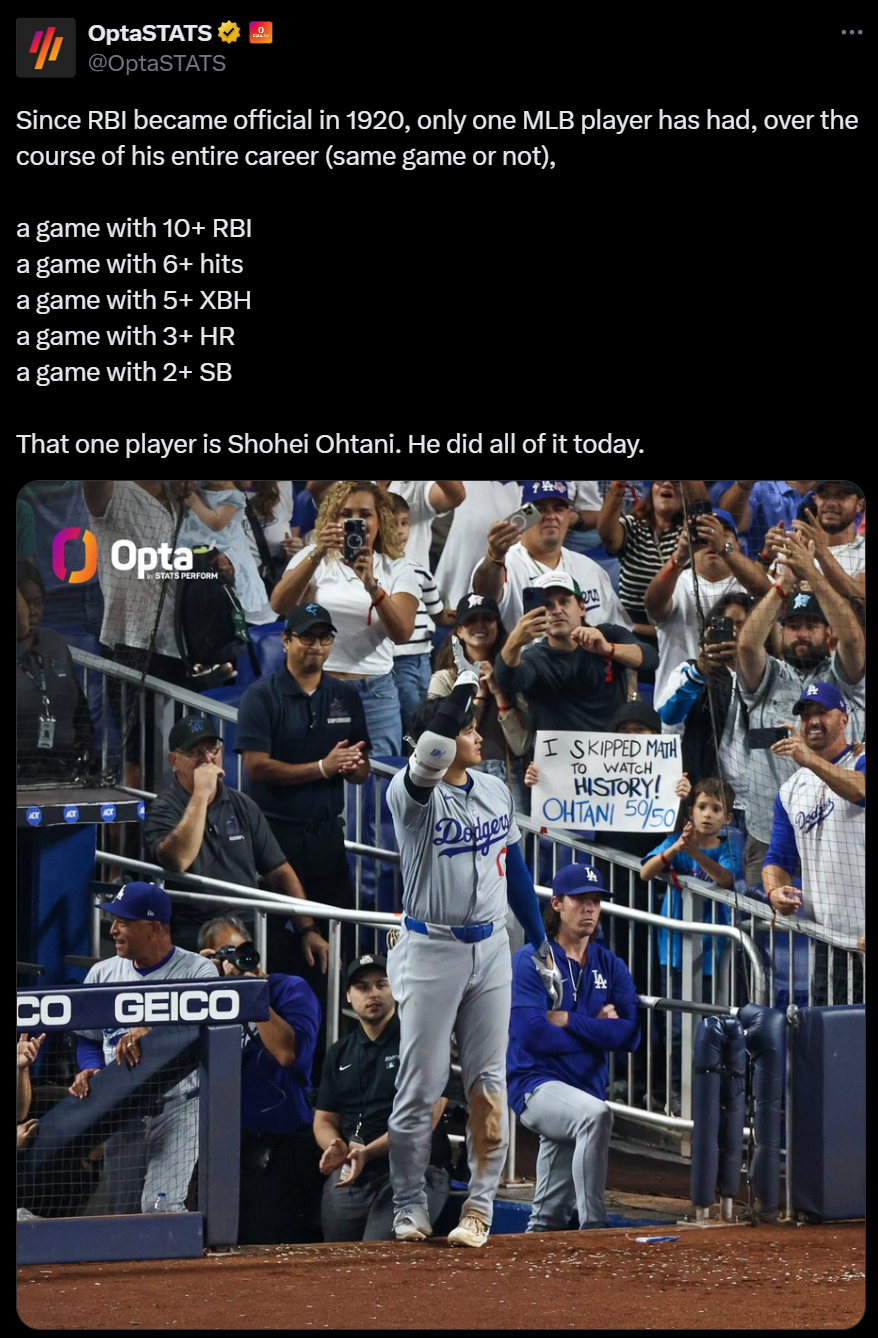
Today certainly was not an off day for the Los Angeles Dodgers. Not only did the team, in routing the Miami Marlins 20-4, clinch a playoff berth for the twelfth consecutive season, but Shohei Ohtani may have had the best single day a major-league hitter ever has had on the diamond. He went six-for-six– including three home runs and two doubles– and stole two bases.

In the process, Ohtani also became the first MLB player ever to hit fifty home runs and steal fifty bases in one season and actually stands at 51/51 with nine games remaining. We knew and hoped Ohtani would be special, but this is uncharted territory.

A perfect baseball day? I’d say so.

___________________________________________________________________

Previously
Baseball Notes: New WAR Without an Act of Congress
Baseball Notes: Offensive Discrimination
Baseball Notes: Current Issues Roundup
Baseball Notes: Baseball’s growth spurt, visualized

Baseball Notes: The WAR on Robbie Ray
Baseball Notes: Save Tonight
Baseball Notes: Current Issues Roundup
Baseball Notes: The In-Game Half Lives of Professional Pitchers
Baseball Notes: Rule Interpretation Unintentionally Shifts Power to Outfielders?
Baseball Notes: Lineup Protection
Baseball Notes: The Crux of the Statistical Biscuit

Baseball Notes: Looking Out for Number One
Baseball Notes: Preview

Related
Ronald Acuna’s 40/70 season in context

The Day Negro Leagues Statistics Met the Major League Record Books (via FanGraphs)

Wednesday was a big day in the world of baseball statistics, albeit a more complicated one than initially met the eye. Major League Baseball announced that the statistics from seven professional Negro Leagues that operated between 1920 and 1948 have been officially incorporated into its database, the culmination of a process that began in late 2020, when MLB first recognized those circuits as major leagues. As a result, several longstanding seasonal and career records have officially changed hands; most prominently, Josh Gibson is now the single-season and all-time leader in batting average, slugging percentage, and OPS, supplanting Ty Cobb and Babe Ruth in the career categories. The grassroots effort to gather and audit the Negro Leagues data that made this possible has been laudable, even heroic. But while we can never do enough to acknowledge the greatness of Gibson and his peers — along with the pain and injustice that they faced both within and outside baseball — MLB’s announcement and the dissemination of the news did strike a few sour notes, just as in 2020.

However, it is a mistake to confuse the provenance of those accomplishments as belonging to MLB, and a misrepresentation to brand them as such. As Shakeia Taylor, deputy senior content editor at the Chicago Tribune and host of the historically-focused Society for American Baseball Research podcast Ballpark Figures, succinctly put it on Twitter, “[I]t’s really as simple as referring to [Gibson] as the ‘major-league record holder’ instead of ‘MLB record holder.’ These two things are not the same.”

Again, the semantics and nuances matter. Major League Baseball (MLB) in its capitalized form refers to the corporate and legal entity created by the 2000 merger of the AL and NL, whose histories and records it subsumed, warts and all. Part of their histories is the systemic racism that excluded Black players within the aforementioned period, and so it should not simply call those records part of MLB, for however well-intentioned the gesture may be.

Within MLB’s [press] release [announcing the statistical incorporation], the supportive statements of Thorn, Lester, fellow Negro Leagues expert Phil Dixon, and Elias Sports Bureau senior historian John Labombarda are thankfully much better [than that of MLB Commissioner Rob Manfred, which elided MLB’s legacy in the creation of the Negro Leagues and the nuance of the maintenance of their statistics], with Thorn pointedly acknowledging the league’s role in creating the difficult conditions in the first place. “Shortened Negro League schedules, interspersed with revenue-raising exhibition games, were born of MLB’s exclusionary practices,” he said in the statement. “To deny the best Black players of the era their rightful place among all-time leaders would be a double penalty.”

The designation of certain bygone leagues as majors dates back to 1968, when commissioner William Eckert convened a Special Baseball Records Committee. The effort was in conjunction with publisher Macmillan’s effort to produce The Baseball Encyclopedia, which would encompass the official statistics of the major leagues. The five-man committee, which consisted of officials from the AL and NL, the commissioner’s office, the Hall of Fame, and the BBWAA — all of them white men, of course — announced in 1969 that it had determined that the AL, NL and four defunct leagues met the criteria to be considered majors[.]

The SBRC did not formally consider the Negro Leagues, with Joe Reichler, who represented the commissioner’s office, saying in 1987 that the leagues’ lack of exhaustive statistics and volume of games against local semipro teams factored into that decision. “They played against whoever they could for whatever they could get,” he told Gannett News Service. “You can’t blame them, but they never played more than 40 or 50 league games. It just wasn’t a cohesive league. There’s no way that you could say they were major league.”

The year 2020 served as a catalyst for a reconsideration of that exclusion. . . . In December of that year, MLB announced its “long overdue” decision to bestow official recognition of seven professional Negro Leagues from the 1920–1948 period as major leagues. … Read More

(via FanGraphs)

Time for Leavin’ Jam

After eighty years of ramblin, brer Dickey Betts decided it was leavin time yesterday. Firmly situated in the pantheon of American guitarists, Betts’ melodic, flowing style blended jazz, country, blues, and– self-admittedly– a pinch of Jerry Garcia to build a signature sound that would lead the musical institution known as the Allman Brothers Band for decades following the premature death of his guitar partner, Duane Allman, in its early days. Betts not only carried the guitar load on stage and in the studio, but he also was an accomplished songwriter, responsible for the band’s biggest hit and many of their most familiar songs.

Continue reading

Baseball Notes: New WAR Without an Act of Congress

During the 2018-19 MLB offseason, Baseball Prospectus revamped the offensive component of its main player-performance metric, WARP. For some people, this resulted in a significant alteration in the way they thought about the then-more-recent performances of some of the game’s top players, chiefly Miguel Cabrera and Mike Trout and the divisive MVP races of 2012-13 between those two.

Now it’s FanGraphs’ turn to update its player-performance metric, WAR (a/k/a “fWAR”). Their tweaks don’t appear to be as methodologically fundamental as what BP did to WARP, but they did result in some slight– less than a win per season at the extremes– adjustments to players’ career fWAR numbers dating back to 2016. Among those who some people now will think are better players than they thought they were a few days ago (i.e., those whose fWAR numbers increased the most) are a batch of current and (mostly) former Detroit Tigers:

  • J.D. Martinez: +2.9
  • Tucker Barnhart: +2.0
  • Gio Urshela: +1.3
  • Austin Romine: +1.1

Avisail Garcia, meanwhile, was docked 1.4 fWAR, and Leonys Martin dropped 1.1 fWAR.

The full list of players seeing a shift of at least one win in their 2016-23 fWAR totals is here.

___________________________________________________________________

Previously
Baseball Notes: Offensive Discrimination
Baseball Notes: Current Issues Roundup
Baseball Notes: Baseball’s growth spurt, visualized

Baseball Notes: The WAR on Robbie Ray
Baseball Notes: Save Tonight
Baseball Notes: Current Issues Roundup
Baseball Notes: The In-Game Half Lives of Professional Pitchers
Baseball Notes: Rule Interpretation Unintentionally Shifts Power to Outfielders?
Baseball Notes: Lineup Protection
Baseball Notes: The Crux of the Statistical Biscuit

Baseball Notes: Looking Out for Number One
Baseball Notes: Preview

Related
Miguel Cabrera continues to shine in the DRC era
Miguel Cabrera further bolstered by sabermetric update
Trout vs. Cabrera, and Aging with DRC+ (via Baseball Prospectus)
Miguel Cabrera in the bWAR era