To what we’re listening: Root Glen’s Winter EP

Whether it’s emails from East Anglia or that leftover, freezer-burned Yankee pot roast that once warmed my chilled, cabin-feverish soul and has yet to depart the refrigerator, I just can’t trust the seasons anymore. (Blame my preference for pre-Enlightenment alchemedic metallurgy over 21st century “science” or the fact that it was 40 degrees two days ago and today it was 80 and hailing with the sun out.) One thing in which I’ve learned I can trust, though, is the continued development of the band Root Glen. That trust is based on being more than seventy-five percent of the way through the New Jersey-based band’s formative year of quarterly, seasonally themed releases. In fact, that year’s almost up, as the group’s spring offering is due out shortly. I don’t even care that this review is so late, because it could snow tomorrow in Topeka, and you need to be mentally ready for that.

The sparse, dry, wintry sounds of “Throw it in the Bay” appropriately open Winter, and the tune is an excellent way to start this EP. The sound immediately transports the listener to that dark, snowbound cabin depicted in the cover art. The verse rocks out in a fashion reminiscent of the darker turn heard on the band’s Fall release with a few appropriate variations: 1) rather than straight-ahead rock, there’s a slight jam feel around the fringes creating more of a slowly looping feel, something that both reminds the listener of the band’s loose, early sound and, here, suggests a nice feeling of ongoing despair; 2) the production value continues to improve, and on this song, it serves to mute the sound– much like a heavy snow would– as much as tighten it; 3) guitarist Ross Griswold’s lead line threads a long approach through the song that both compliments the feel described as variation (1) and 4) provides some developing continuity for those appropriately frequent times when the thicker parts back out into sparseness.

The second cut, “Lost in the Night” opens like Everlast’s “What it’s Like” and features an up-front exchange between David Moroney on vocals and Eric Blank’s kit cymbals. Griswold tastefully varies the electronics on his instrument to create some subtle soundscapes underneath these two, and Andres Gonzales gets a feature toward the end after rooting this tune with his occasionally and deftly muted bass. And just as the first song gave way to a more prominent role for Moroney and Blank in the second, it’s Gonzales’ more pronounced bass that leads the way into “Removed.” The reggae feel hinted at with some of the jam sensibilities present in the first song appears in this third song, placing the listener on a calmer, higher plateau after rising through the first two pieces. Gonzales’ slightly slappy bass eventually gives way to an airy interlude that visually recalls standing on a mountain as clouds rush by in a time-lapse video.

This lilt continues into “Out of Frame,” which will be the first number likely to draw the casual listener to the EP credits to find out who’s playing that saxophone (Marty Eigen), but it’s the distant, unison vocals that especially recall Talking Heads’ Remain in Light. (While looking at the credits, the listener will discover that five additional individuals helped Root Glen on three of Winter‘s five songs in various ways, including everything from songwriting to vocals and instrumentation.) At last, “Caradhras” is a fitting tag for Winter, a seven and a half minute piece of modern progressive (post-progressive? post-post-progressive?) rock that contains a nice hook and a very slight bit of tension-and-release work while staying within the introspective confines of the EP.

With Winter, Root Glen shows listeners yet another of their faces, this one perhaps the most mature yet, reminding us very clearly of a season this year did not bring us. As before, you can stream or purchase Winter at http://rootglen.bandcamp.com/album/root-glen-winter. Catch up on the latest band news at RootGlen.com.

Might as well face it, you’re addicted to glove: Josh Hamilton’s epic night, and a lesson learned

Lately, it seems like an epic Josh Hamilton night is likely to be of the not-so-good variety, but last night was epic and historic in a very on-the-field, baseball kind of way:
https://twitter.com/#!/Espngreeny/status/200170998681710592
Hamilton hit four home runs in a game against the previously self-defying hot Orioles, which also is historic because it probably is the best night anybody’s had in Baltimore since the days when Gram and Emmylou were singing “Streets of Baltimore.”

And this time, I was the one learning a lesson after a Josh Hamilton epic night, finally getting an answer to a question I’d had since I was a kid: When you hit a home run, do you get an RBI for yourself? The answer is yes, and it came courtesy of the radio call that declared Hamilton had four two-run homers, an eight-RBI night. I can do that math.

Floyd Mayweather dodges Miguel Cotto’s fists, strip clubs to remain undefeated

After the ponies did their thing on Saturday, it was time for Cinco de Mayweather (plan B), a bout between the undefeated Floyd Mayweather and the then-twice-defeated Miguel Cotto for the latter’s 154-pound belt. The fight went the distance, and at the end of the twelfth round, the judges unanimously declared Mayweather the winner.

I can’t say I disagree with that determination, and it’s the one for which I was rooting, but I thought it was a very close fight, as my live round-by-round evaluation, reproduced below, evidences. The HBO announcers, by contrast, were confident that Mayweather was winning fairly early on and had the thing sewed up by the late rounds.

My general impression was that Cotto, the heavier puncher with the shorter reach, was able to dictate the terms of the fight: close range, with Mayweather backed into a corner or on the ropes. Even if Floyd simply was allowing this to happen, it surprised me, and I didn’t understand why he let it go on for so long. On the other hand, none of Cotto’s hits, including the one that broke Floyd’s nose, seemed to faze Mayweather, and it was Cotto who was staggering a bit in the 12th, not Mayweather. Cotto provided the toughest test for Mayweather of all the opponents I’ve seen.

Some saw it as Mayweather making like Jalen Rose and giving the people what they want, while others simply credited Mayweather’s endurance as a result of a training regimen that began when he opted for a 3:00 am six-mile run instead of a strip club visit in Orlando during the NBA’s All-Star Weekend. Whatever the reason, Mayweather heads into his eighty-seven-day jail sentence on a winning streak.

Round-by-round analysis after the jump…

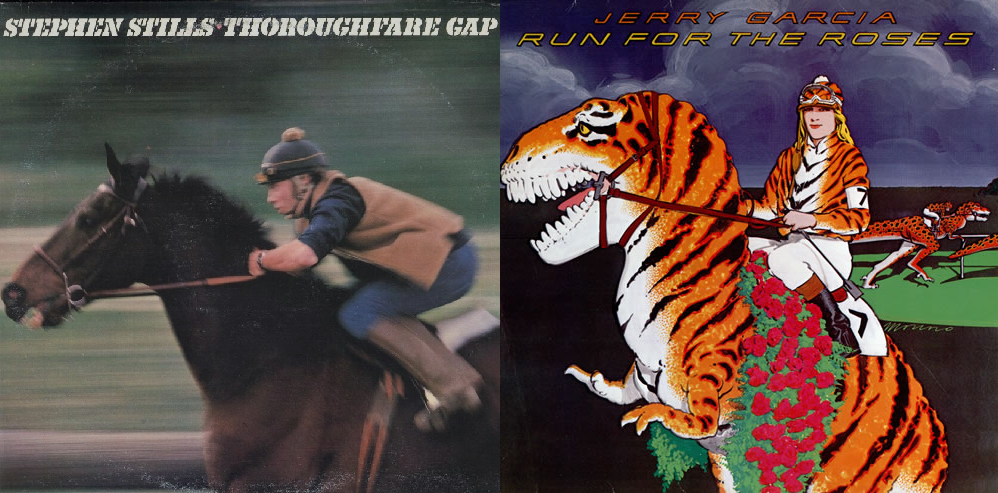
To what we’re (sort of) listening during the Derby: Stephen Stills and Jerry Garcia

Plenty of people have made good listening suggestions for Derby day (HT: @amention, who also gave us yesterday’s timely jam), but two of the musical selections I most associate with horse racing are strikingly mediocre offerings by two top-tier musicians.

First up is Stephen Stills’ Thoroughfare Gap, a 1978 release that is the lowest-rated of all Stills’ albums on AllMusic. Usually thorough (sorry), AMG’s review is a mere two sentences long: “A rather poor attempt of Stephen Stills’ to adapt to the disco/dance craze. Includes lame covers of Buddy Holly (‘Not Fade Away’) and Gregg Allman (‘Midnight Rider’) along with the semi-hit title track.” Click here for a live take of that title track in which the Texan sounds alternatively tired and British, although his acoustic guitar is expectedly dexterous.

Jerry Garcia’s 1982 Run For The Roses received a few more lines in its AllMusic review, but it really isn’t any more glowing, beginning by noting that it’s the last release for the Jerry Garcia Band and “sadly, it is also Garcia’s most lightweight effort as a bandleader,” and including adjectives like “marginal,” “impotently executed,” “underachieving,” and, with respect to the cover art (pictured above, right), “disconcerting.” Like Thoroughfare Gap, the title track is the best-regarded selection on Run For The Roses. Here‘s a lazy live version from an undated JGB performance.

What’s playing in the background of your Derby party?

Backwards down the springtime line: A reader-suggested Friday Jam

Reader, commenter, and master of the Monday Link Parade and Heli Free Sawatch domains Andy sends in this week’s Jam, and I went for it without hesitation, save the time it took to swap out the static video for this live-action version, which sacrifices nothing from the studio version, particularly as regards Charlie’s more energetic playing and Mick Taylor’s work on lead axe. Had the latter not left the Stones, one wonders who might have bourne Clapton’s nickname today.

…and down the stretch they come: ALDLAND’s 2012 Kentucky Derby Preview

Horse racing is an intriguing pairing of human and bestial talent. And money. The preparation that lasts years is tested in two minutes. Like any endeavour that involves large amounts of resources, extensive preparation, and flashpoint testing, predictability is highly prized. Here, however, it remains elusive. It is that absence of ultimate predictability, however, that keeps the sport and its accordant culture alive.

Since my only possible qualifications for writing a substantive post on horse racing at this juncture come from an evening watching harness racing at Vernon Downs five years ago and spending last week in Lexington, during which I saw plenty of horses and horse farms, but no horse racing, let me direct you to a collection of stories and other online features that will help you get ready for this year’s Kentucky Derby:

Beyond this pre-race coverage (such as it is), we will be live blogging the event beginning sometime on Saturday afternoon. Stay tuned for more details.

Finally, my win-place-show prediction, based on the same thing for which war is good, is:

  1. Union Rags
  2. Gemologist
  3. Take Charge Indy

Two other horses to watch are Daddy Long Legs and Bodemeister. Of course, you can watch all of them at once, and I’d advise that. It isn’t too difficult.

No matter what your style, be sure to check back here on Saturday afternoon for ALDLAND’s live blog of the 2012 Kentucky Derby.

Jonathan Vilma’s response to his one-year suspension

After the NFL suspended Saints linebacker Jonathan Vilma yesterday for his alleged role in New Orleans’ bounty program, Vilma issued the following statement:

I am shocked and extremely disappointed by the NFL’s decision to suspend me for the 2012 season. Commissioner Roger Goodell has refused to share any of the supposed evidence he claims supports this unprecedented punishment. The reason is clear: I never paid, or intended to pay, $10,000, or any amount of money, to any player for knocking Kurt Warner, Brett Favre or any other player out of the 2009 Divisional playoff game, 2010 NFC Championship Game or any other game.

I never set out to intentionally hurt any player and never enticed any teammate to intentionally hurt another player. I also never put any money into a bounty pool or helped to create a bounty pool intended to pay out money for injuring other players. I have always conducted myself in a professional and proud manner.

I intend to fight this injustice, to defend my reputation, to stand up for my team and my profession, and to send a clear signal to the commissioner that the process has failed, to the detriment of me, my teammates, the New Orleans Saints and the game.

_________________________________________________

Related
Scrutiny of the Bounty: An Epilogue
Scrutiny of the Bounty: Chapter 2 – The Pretension
Scrutiny of the Bounty: A prequel

The DET Offensive: Recipe for a Slumpbuster

When your baseball team is in a bad way like the Tigers have been, what can they do to get out of the collective slump? It’s a question as old as baseball, but if you’re playing in the AL Central anytime between the 1990s and the present day, the return path to winning ways runs through Kansas City. If you can get them to come over to your place, all the better. Mix in young Rick Porcello’s righting ship, add a pinch of Victor Martinez’s happy return to the clubhouse (if not the playing field), and extract Delmon Young’s unproductive toxicity. Score five runs in the first inning. Allow that to rise into a 9-0 lead. Let settle over the remaining five innings into a 9-3 victory.

Keep reading…