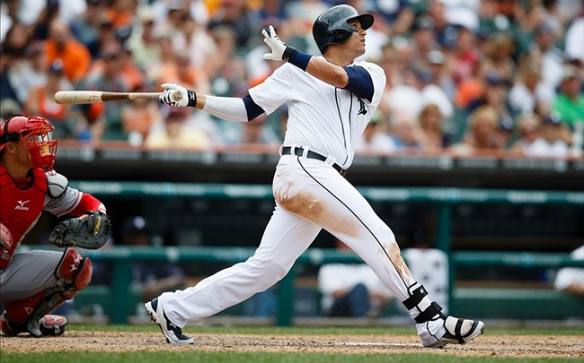
Highlights from MLB Network’s visit to Detroit Tigers spring training

avilamaddog2

As it has done in the past, MLB Network’s “30 Clubs in 30 Days” feature spends a day with each major-league team during spring training. They spent St. Patrick’s Day with the Detroit Tigers in Lakeland, Florida. Here are the highlights:   Continue reading

Window Shopping: We Got Robbed

The Detroit Tigers shot out to a hot start in 2015, but things have not been too good for Detroit since then. They’ve won just five of their last thirteen series. The team’s active six-game losing streak is its longest in four seasons.

The title of this year’s serial Tigers feature at this site, Window Shopping, comes from the common theme of Detroit season previews that, with respect to a World Series championship, the team was trying to keep open its “window of opportunity,” assuming that proverbial window had not already slammed shut under the weight of expensive long-term contracts, aging players, and perceived defensive burdens.

After the last month and a half, though, it is as if these window shoppers, gazing upon the Commissioner’s Trophy in a fancy Harrod’s storefront display (did we fight the Revolution for nothing??), reached into their back pockets in consideration of making the eventual purchase, only to find they suddenly had no money, no credit cards, no traveler’s checks, nothing. They’ve been robbed.

The Tigers are in a tailspin, and it isn’t exactly anyone else’s fault. Their recent struggles have come in games against teams largely regarded as mediocre or worse, including the Athletics, Angels, and Brewers. What’s happening?

After starting the season with an 11-2 record, the Tigers have gone 17-24, and their performance somehow has felt even worse. By my count, since April 21, the date they entered with that 11-2 mark, Detroit has a -19 run differential. Only two other American League teams– the White Sox and Red Sox– have worse run differentials during that period, and only one AL team, Toronto (187), has allowed more runs over that span than Detroit’s 185. Of course, the Blue Jays also scored 213 runs in those games, a number that dwarfs the Tigers’ 166 and is the most in the league. On the other hand, just seven AL teams have scored fewer than 166 runs since April 21, and two of them, Kansas City and Tampa Bay, still maintained positive run differentials. (Both Sox teams, along with Seattle, Baltimore, and Oakland round out this low-scoring group.) In terms of offense and defense (the fundamental terms of competitive team sports), it’s hard to be worse than Detroit right now.

Offense fueled the Tigers’ strong start, and its disappearance has triggered their decline. They averaged 5.38 runs per game through April 20. Since then, though, they’ve scored just 4.05 runs per game, a drop of more than a run and a third. Omit a blowout 13-1 win against the Twins on May 14, and that per-game scoring average falls to 3.83. No bueno.   Continue reading

Window Shopping: Shut the Door, Tip Your Cap

As I write this, his elbow likely is spontaneously combusting, but it’s beginning to look like the Detroit Tigers finally have a reliable closer. Joakim Soria has been both busy and successful this season, appearing in twenty-two of the Tigers’ forty-eight games so far, allowing just three runs and one blown save in that span. Eight of his twenty-two appearances have been on no rest, and six more were after just one day of rest. Since Joe Nathan went down with a season-ending injury, the ninth inning has belonged to Soria, and, on a couple recent occasions, part of the eighth inning as well. Soria’s success is quite welcome, and this expanded use of his closer also reflects well on manager Brad Ausmus, who was criticized for what appeared to be inartful handling of his relievers last year.

Whatever the cause of Soria’s rediscovered success this year, along with the positive contributions of his fellow relief pitchers, the Tigers suddenly find themselves with one of the best bullpens in baseball, as measured by ERA. (They were fourth-worst in 2014.) This reversal comes not a moment too soon for Detroit, where, with Victor Martinez back on the DL, the offense has evaporated like a mid-May snow melt. Thanks in no small part to Soria, though, the team was able to win two of three in Oakland while scoring just four runs in the entire series. The closer appeared on Tuesday night and Wednesday afternoon, allowing two hits, one walk, and no runs in 2.1 innings pitched to seal both victories. Below is the final pitch of yesterday’s game, which is not unpleasing to watch.

Continue reading

Window Shopping: Tigers Roaring Out of the Gate

At one month old, the MLB season now has accrued a sufficient sample size of free time to permit me to compile the opening post of this site’s regular Detroit Tigers series for 2015, Window Shopping. Last year, I came out of the gate a bit too hot, burned out, and had to take the month of June off. This year finds your resident Tiger tracker more balanced and measured in his approach. This year’s Detroit Baseball Tigers have a more balanced look too.   Continue reading

Baseball Notes: The In-Game Half Lives of Professional Pitchers

baseball notes

Early in Victor Martinez’s career-renaissance season, that being the 2014 Major League Baseball season, I expounded– in a manner so brief it likely took less time to read than the length of an average Martinez plate appearance– upon one component of the (i.e., Rod Allen’s, colloquially) notion of Martinez as a “professional hitter”: Martinez’s ability to extend his plate appearances. I contended that one of the team benefits of Martinez’s approach is that it pushes pitchers to reveal more of their arsenal earlier in the game.

In looking for general evidence of this beneficiary concept by inverting the point of focus from hitters to pitchers, I found Ben Lindbergh’s recent analysis of pitcher performance. The broad, basic point: within a game, pitchers perform worse each subsequent time they face a batter.

pitchingthroughtheorderThus, if batters benefit from increased exposure to a pitcher, it would seem to make sense that, assuming they’re paying attention in the dugout, Martinez’s teammates would benefit further from the disproportionately lengthy plate appearances Martinez induces. Lindbergh’s conclusion confirms this:

The times-facing-hitter penalty isn’t as much a fatigue effect as it is a familiarity effect that compounds as hitters have time to study their prey.

(His article goes on to discuss pitchers’ attempts to strike back against this trend.)

While many will be watching Martinez for the wrong reasons this season, keep an eye on him and his ilk to see whether they can continue to help their teammates in secondary ways, regardless of what happens to their own primary production.

___________________________________________________________________

Previously
Baseball Notes: Rule Interpretation Unintentionally Shifts Power to Outfielders?
Baseball Notes: Lineup Protection
Baseball Notes: The Crux of the Statistical Biscuit
Baseball Notes: Looking Out for Number One
Baseball Notes: Preview

Max Scherzer scouting report (backup catcher ed.)

My first post over at Banished to the Pen, a new baseball blog, takes a very serious look at a rumor of debatable seriousness: that the Texas Rangers considered adding Max Scherzer as a backup catcher before he signed as a starting pitcher for the Washington Nationals.

The full post is available here.

Flying Tigers: How the David Price trade could help the bullpen

dpvu

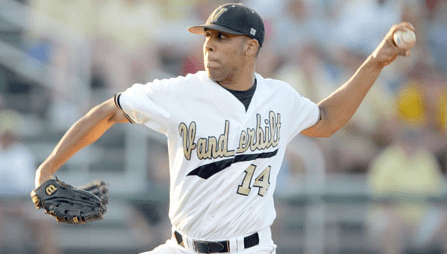
As the aftershocks of the David Price trade continue to ripple across the baseball landscape, Tigers fans still are trying to understand the meaning and implications of the move. My immediate reaction was mixed, generally because starting pitching seemed like the least of Detroit’s postseason needs, one of the most glaring of which remains a shallow, untrustworthy bullpen with nothing to speak of from the lefthanded side.

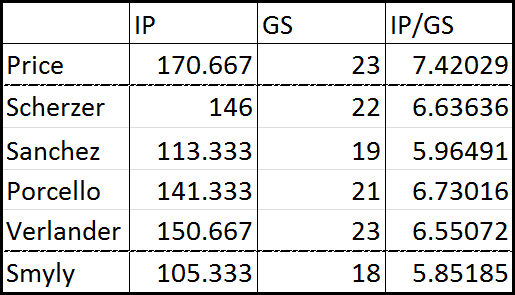
While I do think the Tigers should move Justin Verlander to the ‘pen in October, Price may be able to address the team’s relief-pitching deficiencies in his role as a starter. In 2014, Price has pitched more innings and more innings per start than any other Detroit pitcher (numbers from Baseball-Reference):

TigersPitchingDepth

Price has been going deeper into games this year than any member of the Tigers rotation. If he can continue to pitch into the seventh or eighth inning on a regular basis, that could reduce the number of relievers needed in that game and preserve bullpen options in other games.

The measure of this impact is likely to be small, but like Victor Martinez’s extended plate appearances, these could be the sorts of small advantages that, in the aggregate, push one team past another.

_____________________________________________________

Previously
Trade Deadline Explosion – 7/31
Where are the Bats?
– 7/31
Detroit finds relief, but at what price? – 7/24
Closing Time? – 6/4
Closing the Book on 2013
– 6/2
Victor Martinez, Professional Hitter
 – 5/7
Actually Mad Max
 – 4/29
Waiting for Takeoff – 4/28

Flying Tigers: Closing the Book on 2013

Rock and Roll never forgets, and neither does ALDLAND. Last season, I took a look at whether the Tigers struggled to score later in games, a trend that, if shown and in combination with the team’s bullpen woes, would make comeback wins less likely. While the preliminary numbers suggested I was onto something, the trend appeared even more pronounced with one-hundred games’ worth of data. The purpose of this post is to make good on the promise implicit in that last one by completing the full season’s worth of data.

First, an aside on data collection. I previously gathered and organized these inning-by-inning run totals by hand because I didn’t realize Baseball Reference actually tracks that information. In order to maintain the same error potential, and because B-R doesn’t separate the runs/inning between wins and losses, I’ve updated (a simplified version of) my chart as I did before.

r-in 2013

Continue reading

Flying Tigers: Victor Martinez, Professional Hitter

vmart

Tigers fans chuckle to themselves whenever they hear announcer Rod Allen proclaim with his special gravitas that Victor Martinez is a “professional hitter.” After watching Victor this season, though, I began to notice that Detroit’s DH seemed to be doing an especially good job not just of putting the ball in play, but of extending his plate appearances, forcing pitchers to display their arsenal for the benefit of Martinez and his teammates. As the chart below shows, few batters are seeing more pitches per plate appearance than Victor this season.

pitches per plate appearance

There are a few things to note about this chart. First and most importantly, because the season remains young, the rankings are subject to great fluctuation on a pitch-by-pitch basis. (Click the image to see the latest data.) A second observation is that the American League, and the AL Central in particular, and the Minnesota Twins in even more particular, find strong representation here. Or at least they did when I grabbed that screenshot. Again, probably too early to read too much into the positioning here.

Wherever he stands with respect to the rest of Major League Baseball, Victor’s seeing more pitches than his fellow Tigers. I like to think that’s a small piece of evidence showing that he’s fully embracing the role of designated hitter.

_____________________________________________________

Previously
Flying Tigers: Actually Mad Max – 4/29
Flying Tigers: Waiting for Takeoff – 4/28

Flying Tigers: Waiting for Takeoff

A month into the season, the Detroit Tigers sit atop the tightly bunched AL Central with a tenuous 12-9 record. The team, guided by first-time manager Brad Ausmus, looks and feels much different than it did over the last two years. Whether due to the change at the helm or a not-quite-coherent set of offseason moves, the 2014 Tigers appear to have traded identity for tactics and strategy. Thus begins Flying Tigers,* our third Detroit baseball series.

__________________________________________________________

When Jim Leyland announced his retirement following the end of the 2013 season, we knew Motor City baseball would be different in 2014, but we didn’t realize just how different it would be.     Continue reading