Window Shopping: Tigers Roaring Out of the Gate

At one month old, the MLB season now has accrued a sufficient sample size of free time to permit me to compile the opening post of this site’s regular Detroit Tigers series for 2015, Window Shopping. Last year, I came out of the gate a bit too hot, burned out, and had to take the month of June off. This year finds your resident Tiger tracker more balanced and measured in his approach. This year’s Detroit Baseball Tigers have a more balanced look too.   Continue reading

Snapshot: How good has the Detroit Tigers starting rotation been to date?

No, Justin Verlander hasn’t appeared in a single game this season. Yes, it’s still early in the year to be issuing deeply meaningful assessments of baseball team performances. No, I still have not pulled together a proper introductory post for this season’s Tigers series. Instead, you’ll have to get by with this extensive team season preview, which remains not wholly inaccurate, a writeup on Detroit’s bounceback from its first loss in Pittsburgh, a quick peek at changes in team base-stealing profiles, a podcast from earlier this week, and the following snapshot of the Tigers’ rotation through twenty-one games.

This morning, Baseball Prospectus released a new pitching metric, Deserved Run Average (“DRA”), which is designed as a replacement for ERA. You can read more about DRA here (and a nauseatingly detailed exposition of it here), but the one-line summary is simple: “By accounting for the context in which the pitcher is throwing, DRA allows us to determine which runs are most fairly blamed on the pitcher.” After all, that’s what we want to know when we look at a pitcher’s ERA. DRA, it would appear, allows us to know that with greater accuracy.

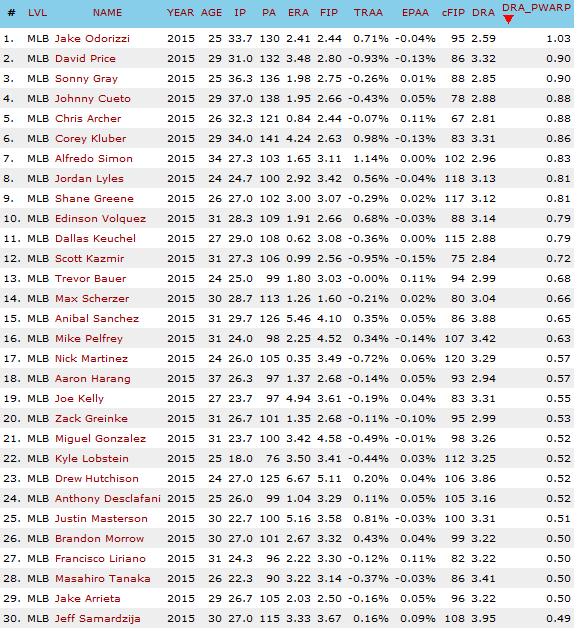
With that new tool in hand, here are 2015’s most valuable pitchers so far, factoring in their newly calculated DRA:

dra-pwarp-4-29-15Plenty of familiar names on that list, especially for Tigers fans, who will find all five of this season’s starters– David Price (#2), Alfredo Simon (#7), Shane Greene (#9), Anibal Sanchez (#15), and even Kyle Lobstein (#22)– among the thirty most valuable pitchers of this young season.

Through thick and thin offensive production thus far, plenty of credit for the team’s 14-7 record is due to the starting rotation, which, you need not be reminded, unloaded Max Scherzer, Doug Fister, and Rick Porcello in the past two offseasons. Surprisingly, so far, so good.

An audible discussion of current baseball stories

While the ALDLAND Podcast continues to take a technical hiatus, I was a guest on this week’s episode of the Banished to the Pen podcast, where we discussed current baseball stories ranging from StatCast to Chicago Cubs prospects to the Detroit Tigers and the rest of the fightin’ AL Central.

You can download or stream the entire podcast here.

Shane Greene Outduels A.J. Burnett as Tigers Hurdle Pirates to Avenge Only Loss

hurdle

After the Pittsburgh Pirates handed the Detroit Tigers their only loss of the 2015 season on Monday afternoon, Detroit sought and found revenge against Pittsburgh Tuesday night. The Tigers’ first seven games were marked by nearly unbridled offense (+32 run differential, second only to Kansas City and, excluding third-best Oakland (+28), not close to anyone else), but they looked to their defense for a bounceback win in game eight. Starting pitcher Shane Greene, making his second start for the Tigers after his acquisition from the Yankees during the offsesason, was excellent. In particular, Greene was highly efficient, averaging just over ten pitches per inning for eight innings of three-hit, no-walk, shutout baseball. Not-insubstantial credit for his performance is due to key defensive plays by Jose Iglesias, Ian Kinsler, and J.D. Martinez. (Greene, who was making his first-ever plate appearances as a major leaguer, was generally ineffective with his brand-new Louisville Sluggers, but no one should care because this from his mother was adorable.)

Pittsburgh starter A.J. Burnett also had a strong outing, but he could not keep the Tigers at bay forever. The visitors broke through with one run in the seventh and, thanks to some heads-up baserunning by Iglesias, an insurance run in the ninth. Joakim Soria retired the Pirates side in the bottom of the ninth to seal the win.

____________________________________________________

A minor subplot during this pitchers’ duel was the seemingly vertically compressed strike zone of home-plate umpire David Rackley, who had little interest in labeling anything up in the zone a strike. I was watching the Pittsburgh broadcast via MLB Network, but even I had to agree with the Pirate faithful that Rackley was robbing Burnett, who was throwing plenty down and away, when he even tried to go up in the zone. Pittsburgh manager Clint Hurdle certainly thought so, and after Rackley sided with the batter on a second or third Burnett pitch that really appeared to be in the zone, Hurdle started hollering at Rackley from the dugout, and Rackley tossed him as Jim Leyland watched from the front row.

Taking a fresh look at last night’s pitches this morning, it appears that my eyes did not deceive me, and Hurdle et al. were justified in their complaining:

burnettpitchplotI’ve circled in blue what I believe to be the Burnett pitch that immediately preceded the Hurdle ejection. Looked like a strike last night, and it looks like one today too. In Rackley’s limited defense, he wasn’t really calling any high strikes, but that defense isn’t much of a defense at all in the broader scheme of things. Consistency is important, but an umpire’s imposition of his own personal, deviant strike zone really isn’t.

_______________________________________________________________

Our 2015 Tigers series, Window Shopping, will begin in earnest very soon. Consider this post a prequel, and until I can get the engine revved up, I encourage you to enjoy this 2015 Tigers season preview to which I contributed in significant part.


Detroit Tigers 2015 Season Preview

My own Detroit Tigers series for the upcoming season– name to be revealed in due course, but let’s just say I wish Wallside Windows would sponsor it– will be underway at this site soon. In the meantime, I have collaborated with Mark Sands to produce an extensive preview of the 2015 Detroit Tigers for Banished to the Pen, which is available today.

The full post is available here.

When do baseball teams score runs?

baseballline

One of the marks of a smart baseball writer is the ability to sense a trend, research its existence and nature, place her findings in context, and present her conclusions in a way that meaningfully educates readers. Inherent in this ability is the wherewithal to know when to stop researching a trend or pressing on a concept, realizing that the fruits of the work have been or soon will be exhausted. Sometimes a person who is not a “smart baseball writer” by the foregoing definition will noodle about on an idea for so long, he’ll end up with a small pile of research that no longer has any bearing on any meaningful conclusions.

Two years ago, I decided to investigate a hunch that the Detroit Tigers were having trouble scoring runs late in games. My initial research mostly seemed to support my hypothesis, and a follow-up look appeared to confirm it more strongly. More than merely interesting (and fleetingly self-satisfying), it also was informatively concerning, because it placed the team’s well-known bullpen problems in a more nuanced light: relief-pitching woes alone weren’t the problem, because the lack of late-game scoring was compounding the problem of surrendering leads during the final frames. As strange as it seemed, the Tigers had interrelated shortcomings on both sides of the plate.

One comment I received in the course of sharing those findings stuck with me: I needed to place this information in context. After all, there are plausible reasons to believe that all teams might, perhaps to varying extents, experience decreased run production in the late innings.

And so it was that, two years later, I finally discovered Retrosheet, a site that compiles inning-by-inning scoring data to a more useful degree than the resources I’d utilized back in 2013. What follows are two graphs of the inning-by-inning scoring of sixteen teams for the 2014 season. Continue reading

Max Scherzer scouting report (backup catcher ed.)

My first post over at Banished to the Pen, a new baseball blog, takes a very serious look at a rumor of debatable seriousness: that the Texas Rangers considered adding Max Scherzer as a backup catcher before he signed as a starting pitcher for the Washington Nationals.

The full post is available here.

Mr. Scherzer goes to Washington


Overnight, the long-anticipated news of this baseball offseason finally broke: The Washington Nationals won the Max Scherzer sweepstakes by signing the former Detroit Tiger to a seven-year, $210 million contract.

Scherzer made news last March when, heading into his final season before becoming a free agent, he turned down the Tigers’ six-year, $144 million offer to stay with the team. That failed (from the team’s perspective) dance fouled up a variety of personnel matters for Detroit. They had already traded Prince Fielder and much, but not all, of his contract to Texas and starter Doug Fister to Washington for figuratively literally nothing all probably in an attempt to clear the books for Scherzer’s new contract. When Scherzer balked at the offer, the team responded by giving Miguel Cabrera all the money. Last season got off to a rough start, and, at least from a business perspective, Scherzer was at the center of it.

Max probably was my favorite amongst a very likable group of guys playing for the Tigers over this last stretch of seasons. His relief appearance against Oakland in the 2013 playoffs always will be among my most favorite half-innings of baseball.   Continue reading

Flying Tigers: The State of Baseball in Detroit

The Detroit Tigers, once unequivocal favorites to run away with the AL Central, today find themselves clinging to a wild-card spot. And today is a good day. A if-the-season-ended-today-the-Tigers-would-make-the-playoffsish day. Not all days are those days these days.

Even with a 7-3 record over the last ten games (you’re glad I didn’t write this post ten games ago), Detroit has a losing record so far in the second half of the season (23-24, -4 run differential). While the offense, unaddressed before the trade deadlines, continues to be a problem, injuries to Anibal Sanchez, Justin Verlander, and Joakim Soria effectively negated any defensive gains resulting from the team’s only two late-season trades.

The group of “rational Tigers fans” beat back even the slightest hint of worry with blanket appeals to the greatness of the historically great members of this Tigers team. “Don’t read too deeply into the struggles you’re seeing because this team has MIGUEL CABRERA, who can’t possibly lose” or whatever. It’s important to vent, though. And to be honest (and, you know, rational). Cabrera can barely walk right now. Yes, he’s leading the sport in doubles this season, but that’s because his power has evaporated (i.e., he’ll probably finish the year with half as many homers as he hit last year and, at very best, the third-worst HR season of his career). His injuries mean that Victor Martinez has to spend more time playing first base. At age thirty five, Victor’s having a breakout power year, but he has no knees, which makes it tough for him to defend first. J.D. Martinez and Ian Kinsler’s bats have cooled off after hot starts. None of the various replacement-level players filling time at short can hit, and there’s a noticeable problem with catching the ball to tag out base stealers.

How do things look with a month, twenty-four games, to go? Continue reading